
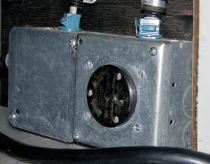
Prewired For A Generator?
Dear RV Doctor:
We are considering adding a generator to our coach. We have heard our model is prewired for one, but we are not sure. How do we tell, and what type should we get?
Steven Christian, Berwick, Pennsylvania
To determine whether your motorhome is prewired for a generator, look inside the generator compartment. It should be equipped with a louvered door to allow for the ventilation requirements. There will be an electrical box mounted somewhere inside that compartment. Called the generator “makeup” box or “J” box, it will contain conductors that run from the generator compartment to the panelboard distribution box (breaker box) somewhere inside the RV. Or, it may be routed to a 30-amp (presumably) receptacle located near the shoreline cord entrance, such as shown in the photo. At the main breaker panel, you also may find a separate breaker labeled for the generator, or at least space for one. Some motorhomes also come from the factory with an automatic transfer switch installed. This device automatically switches the source of AC voltage from the shoreline cord to the generator after it starts. If there is no automatic transfer switch on board and there is a 30-amp receptacle at or near the shoreline cord, then you must plug the shoreline cord into the generator receptacle in order to power the coach.
You can always contact the coach manufacturer, assuming it is still in business. If you provide the manufacturer with your motorhomes’s model and vehicle identification number (VIN), the company should be able to tell you how that particular coach was outfitted as it left the factory.
As far as generator brands go, quite a few nice models currently are available. I’d suggest seeking out information about suppliers that have a proven RV track record, such as Onan and Generac, for starters, but I certainly wouldn’t rule out any of the newcomers to the RV market. I’d probably start from scratch and collect information from any companies that currently offer RV generators, making sure the unit is indeed approved for RV use. There are quite a few options today. Do your homework and compare sizes, output ratings, costs, fuel efficiency, etc., prior to making the decision.
Don’t forget; before selecting a generator, you’ll have to first mathematically “size” the RV’s electrical needs to determine how much power you’ll require from the generator. In other words, based on the 120-volt-AC devices in your RV, how much wattage will you actually require? The answer to this question will determine what kilowatt-size generator you should consider. Once you’ve done the math, add another 20 to 30 percent for a safety buffer; keep in mind that you’ll also be plugging in devices such as coffeemakers, curling irons, etc., in addition to the built-in or “hard-wired” AC loads associated with your particular motorhome. The bottom line is to always have more output capacity available than you’ll typically need at any given time. Keep in mind that generators converted to propane or those used in areas of high altitude will be less efficient than their stated ratings.
Lack Of Voltage
Dear RV Doctor:
I recently purchased a 2008 Forest River Lexington motorhome. I started the generator and after a few moments I turned on the air conditioner. While adjusting the thermostat on the air conditioner, I accidentally turned off the unit. I turned the air conditioner back on and it immediately lost electrical power. Not only did I lose power to the air conditioner, but also to the other 120-volt-AC circuits (TV, microwave oven, etc.) in the motorhome. I went to the bathroom and tried to reset the ground fault circuit interrupter (GFCI). It would not reset. We went to an RV park a half-hour later, and I thought plugging in to shore power would do the trick. However, I found that I could not get 120-volt-AC power when the generator is running or when the coach is operating on shore power. I did not trip a breaker on my panel box; however, I reset all those as well. Where else might a breaker be? Help!
Charlie Bye, Hampton, Virginia
Your Lexington incorporates an automatic transfer switch to facilitate the automatic switching between the voltage from the generator and shore power. I realize you’ve reset the circuit breakers on the main panelboard, but also make sure the circuit breaker on the generator itself is not tripped. If that breaker is tripped and at the same time the transfer switch relay is stuck on the generator output, you will not have any voltage from the shore power. However, it sounds as though the power surge caused by the accidental short cycling of the air-conditioner compressor probably blew the fuse inside the transfer switch or possibly damaged the relays inside. It’s apparent that you are not receiving voltage from either source now, as evidenced by the nonfunctioning GFCI. The coach GFCI will “test” only when voltage is applied to that circuit. You’ll need to find the auto transfer switch box.
The transfer switch is a large box that usually is relatively easy to find, since the shore power cord feeds directly into it. Trace the shore power cord as it enters the motorhome and you should find it. It may be behind the convertor. It most likely will have two other power cables leading to it from the generator and the convertor. Once you locate the transfer switch, make sure the shore power cable is unplugged and the generator is not running. Open the transfer switch cover and check the fuse(s). If a fuse is blown, replace it. If not, there could be internal damage to the switch controls and/or the associated relay, and you will need to have your system diagnosed professionally. You should have no trouble replacing the fuse, but only a certified RV technician should attempt further internal diagnostics.
Which Is Which?
Dear RV Doctor:
I have a 1982 Pace Arrow. I need to know which fuel tank is the main tank; the front or the rear?
John Rockert, Placerville, California
The main fuel container on that vintage Fleetwood motorhome probably would be the one located between the main frame rails. The Pace Arrow typically had one tank between the rails and one tank located outboard of the main frame on one side or the other. The floor plan dictates the tank locations, however, and if your motorhome has both tanks between the frame rails, look for the tank with the rounded edges, probably the one mounted closest to the rear of the motorhome. The auxiliary tank generally had square corners while the main container had rounded corners and edges. The other way to determine which is the main fuel tank is to locate the electric switchover solenoid valve (usually inside the front right frame rail), and follow the fuel lines back toward the tanks. The inlet port on that switchover valve that is “in line” with the outlet port is the one fed from the main tank. That said, all the above information should help you unless someone has modified the original installation.
Wiring Diagram Question
Dear RV Doctor:
I’m replacing the two 12-volt house batteries in my Winnebago Adventurer, so I referred to the wiring diagram in the July 2009 “House Calls” column (page 22) in FMC. The technical service representatives at the battery manufacturer, Interstate Batteries, told me that the positive cable should connect to battery number 1 and the ground cable should connect to battery number 2. Both sides should have jumpers as shown in your diagram, but their placement of the ground connection was different than what was shown in the diagram. Also, I had Camping World install new batteries about three years ago and they wired them like the diagram. Last summer I had my motorhome in for service and the repair technician told me the wiring was wrong, so he changed the ground to battery number 2. Can you please clarify?
John Ruiz, F357920, Whittier, California
The information you received from both of the technicians you spoke with was correct. The wiring diagrams in the July 2009 “House Calls” column will work as illustrated, but for optimum health of all the batteries in the bank, it is best to have the positive conductor on the first battery in line and the negative conductor (ground) on the last battery in the bank. The only downside to having both leads on the same battery is that it’s possible for the last battery in line to acquire more sulfation than the others. In a two-battery bank, this problem is almost negligible, but on battery banks that include three or more batteries, it is more pronounced.
Thank you for your diligence. It is readers like you who keep us on our toes for the benefit of everyone.
{loadpositionEndBlurbHouseCalls)