
By Darrell Gilliland, F153488
October 2011
“Birds do it, bees do it, even educated fleas do it” . . . and Red River Rovers members who attended the chapter’s 10th anniversary rally, June 9 to 12, 2011, in Hugo, Oklahoma, can also tell you how Asian elephants do it. One of the highlights of the anniversary rally was an afternoon tour of the Endangered Ark Foundation, located northeast of Hugo. Attendees enjoyed exploring this site and many others during the event.
The host committee for the Red River Rovers’ anniversary rally took advantage of a guided tour service offered by the Hugo Chamber of Commerce. Our tour guide was Walter White, a retired businessman who was a constant resource for our rally needs and arranged to keep our group very busy on both Friday and Saturday. Now in his 80s, Walter has lived in Hugo most of his life. The Endangered Ark Foundation was one of our many stops.
Established in 1993 to help preserve these endangered mammals, the Endangered Ark Foundation is home to the second-largest herd of Asian elephants in America. Besides elephant breeding, two other major goals of the foundation are to offer educational programs to the public and to acquire and save threatened endangered animals.
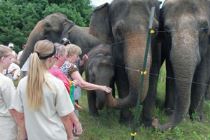
On this particular afternoon, more than 40 chapter members joined with an equal number of small children from a nearby church camp to tour the facilities, which include secure cages and exercise runs for many of the breeding stock. The children dueled it out with the “seniors,” asking questions about the elephants, their habits, care, training, and work. Many of the elephants were in strong pens built of steel. Others had free roam in a large pasture nearby, where both “juniors” and “seniors” had an opportunity to view and touch them. We enjoyed feeding them and scratching their trunks.
We had 45 chapter members present in Hugo for this special anniversary rally, including two couples who joined the chapter. We were honored that Fred Kennedy, outgoing national vice president, South Central Area, and his wife, Lou, were in attendance. Fred presented Red River Rovers president Jim Guess with a certificate recognizing the chapter’s 10th anniversary. It also was a pleasure to have three teenage grandchildren present.
Many of our members arrived in Hugo several days before the rally to explore the area on their own. Some found themselves more than once in Hugo’s Choctaw Casino, one of seven casinos of the Choctaw tribe in southern Oklahoma.
On Friday morning, Walter took us through the Frisco Depot Museum. The museum is filled with items dating back many years and includes circus memorabilia and a wealth of information about early Choctaw County history. Upstairs are Harvey House Restaurant boarding rooms, where “Harvey House” waitresses once roomed while working at the restaurant. Most of our group had lunch in the restored restaurant downstairs before lining up in our cars to travel 17 miles east to Doaksville and Fort Towson.
Walter had made arrangements for John Davis, historic properties manager with the Oklahoma Historical Society, to give us a personal tour of Doaksville and nearby Fort Towson. An archaeological site today, Doaksville was once the largest town in the Choctaw Nation. The settlement began in the early 1820s when Josiah S. Doaks and his brother established a trading post.
Some of our group walked, while others rode on wagons pulled by a tractor on dirt paths among large trees to observe many excavated and preserved building foundations and water wells that have been discovered in the ruins of this early-day community.
At nearby Fort Towson, Walter and John took the group to a shaded pavilion where we learned more about the history of Doaksville and the fort. The latter was built in 1824 to try to prevent conflicts between American Indians, settlers, and other factions, and it also served to guard the Spanish border just south at the Red River.
At the conclusion of the tour, we received a lesson on preparing a Civil War cannon for use, and Fred Kennedy was given an opportunity to fire it. We covered our ears before he pulled the long string that provided spark for the powder charge in the cannon.
In addition to its circus heritage, Hugo is also home to many champion rodeo performers and distinguished musicians and singers. On Saturday morning, Judy Wilson, executive director of the Hugo Area Chamber of Commerce, and our guide, Walter, made arrangements for some local talent to perform for our group. First was Stacy Pace, who presented a Patsy Cline show. For one number, Stacy selected six Red River Rovers to “audition” for her band. Divided in two teams of three, they were asked to play pretend instruments as she sang a Patsy Cline favorite.
Our second entertainer was Hugo’s own Bill Grant, recognized by three Oklahoma governors as “Ambassador of Bluegrass Music.” Jeff Jones, a singing newcomer in Hugo, concluded the two-hour show by performing several original songs.
Hugo is proud to be referred to as “Circus City USA.” More than 20 circuses have made this southern Oklahoma town their winter home. Today it is the winter quarters for three traveling circuses.
To highlight this circus heritage, Saturday afternoon’s tour included a visit to Hugo’s Mt. Olivet Cemetery, which is internationally famous for “Showman’s Rest,” a section reserved for people who have been associated with the circus. Likenesses of tents, clowns, trapeze performers, and animals are used as grave markers in a nod to circus members who spent their lives entertaining American families.
The cemetery also serves as the resting place of three rodeo legends. The first is bull rider Freckles Brown, who in 1966 rode “Tornado,” a previously unridden bull, in the National Finals Rodeo in Oklahoma City. Second is Lane Frost, a young PRCA champion bull rider on whom the film 8 Seconds was based. Frost died after being gored by a bull during a rodeo performance; his wishes were to be buried next to Freckles Brown. The third interred here is Todd Watley, world-champion steer rider, bull rider, and all-around cowboy.
The Frisco Depot RV Park, where we stayed, is a short distance across the street from the Frisco Depot Museum and the Harvey House Restaurant. It has 48 full hookups, 30- and 50-amp breakers, full shower and bathroom facilities, and an adjacent 3,000-square-foot building with cooking appliances and a meeting area. The building is a metal structure uniquely divided into three sections by the outer walls of circus tents. Other FMCA chapters would find Hugo a great place to hold a rally.