
Burner Orifice Redux
Dear RV Doctor:
I enjoyed your “RV Water Heater Maintenance” article in the May 2012 issue of FMC magazine (page 40) very much. I do have one question. When I remove the water heater main burner orifice to clean it, should I use any pipe thread compound, sealant, etc. when screwing it back in?
Paul Lewis, F404823, Sierra Vista, Arizona
Typically, there is no need to apply sealant to the orifice fitting, because it threads into the main burner fitting on the control valve of an Atwood heater. The brass fitting that attaches directly to the control valve does require sealant. However, that fitting does not need to be removed when cleaning the orifice. At the point in the system where gas exits the orifice, the propane is not being contained in a sealed environment; it’s simply passing through the valve on its way to being consumed in the fire at the burner. It must, however, be tightened securely so it won’t back out from road vibrations, etc. Just tighten it enough to stay put.
On a Suburban water heater, the main burner orifice is built into the air/gas mixing tube.
With both brands, be sure to soak the main burner orifice long enough to dissolve any blockages, and allow it to air dry. Don’t stick anything through the hole as it may (will) distort the opening enough to cause erratic flame operation.
Alternative X
Dear RV Doctor:
I have lived out in the country for most of my life and always had a septic system. We have used Rid-X as an additive to promote enzyme growth in the tank. My question is, why can’t or why don’t people use this in the motorhome black water holding tank? I would think if it works in a septic tank, why not a holding tank? Thanks for all you do to help the RV travelers of the world.
Chuck Wyskochil, Beaver Dam, Wisconsin
This is a great question. Since Rid-X uses live bacteria, the preferred type of additive, it would indeed work inside a motorhome holding tank as well as the residential septic systems for which it was designed. The problem is that you’d have to leave it in the tank quite awhile to be effective. Septic tanks should be treated monthly and Rid-X, to my knowledge, uses a time-release formula that works well in septic tanks, but only over a period of time. Motorhome owners, on the other hand, are motivated to evacuate their holding tanks when they become three-fourths full. Often, that doesn’t take very long. Further, formulas designed for RV holding tanks are far more concentrated so as to work quickly, taking less time. If you use Rid-X, you’d be dumping your holding tanks long before the beneficial action of the bacteria begins to work. Plus, you probably would use much less additive if you stick with an RV blend of bacteria and enzymes. One product I like is Pure Power Blue (PPB) by OP Products, because of its strong concentration. Not only does it eliminate odors, it also dissolves solids quite quickly.
So, while Rid-X would work in theory, in a real-world RV application it would be futile. And don’t forget, odors can also propagate in the gray tank just as easily as in the solid waste holding tank.
Leaky Toilet
Dear RV Doctor:
We saw you at FMCA’s 86th Family Reunion and Motorhome Showcase in Madison, Wisconsin, and enjoyed your seminars. I have a SeaLand toilet, and the seal has started to let the water drain out of the bowl. If I order a repair kit, is it a hard job to install?
Larry Scott, F411891, Clintonville, Wisconsin
All toilet manufacturers assemble various repair packages that contain everything you’d need, including the requisite seals. But before undertaking the job, I’d suggest you first try tightening the band that holds the inner assembly together. You’ll have to remove the entire garnish to gain access to the subassembly. There’s a good article about repairing a SeaLand toilet online at www.ehow.com/how_4692928_repair-sealand-marine-rv-toilet.html. You may find the information helpful, as it shows a photo of the band in Step 9.
RV toilet repair is not difficult for the average handyperson; it’s just not a delightful way to spend an afternoon. If you undertake this task, wear disposable gloves and be sure to disinfect all your tools afterward. Just focus on the fact you’ll be saving some cash and keeping your holding tank from filling prematurely! That might make it a bit more bearable.
Terminal Clarification
Dear RV Doctor:
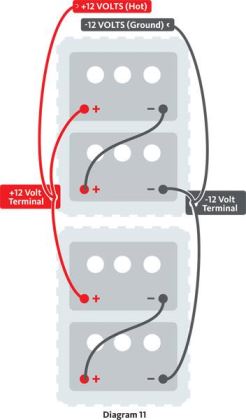
Referring to your article titled “The Balance of Power” on page 46 of the January 2012 issue of Family Motor Coaching, what type of terminal should be used in diagrams 5 and 11? Where can I get such a connection? Also, where will you be speaking next?
Gil Bourdon, F409591, Henderson, Nevada
External mounting terminal lugs/studs are available at any electrical warehouse or online from a number of suppliers. The terminals are available as surface-mounted studs or as pass-though bulkhead studs. No matter which type you choose, they must be sized and rated for the total ampacity of the battery bank. You certainly don’t want these external connections to be the weakest link in the chain. They’ll need to carry the largest expected load/charge (amperage rating) your battery bank can handle.
By the time you’ll read this, my next seminars will be presented at FMCA’s 87th Family Reunion and Motorhome Showcase, which will be held at the Indiana State Fairgrounds in Indianapolis, from August 27 to 30. I look forward to seeing you there; stop by and say hello!
{loadpositionEndBlurbHouseCalls}