
By Ken Reid, F417908
October 2012
Early in the morning of April 22, 2012, a meteorite estimated to be the size of a minivan streaked through Earth’s atmosphere. The sonic boom and huge fireball that it created attracted plenty of attention over large parts of Nevada and California.
Using weather radar and other means, scientists predicted that the remnants of the meteorite likely had fallen near Coloma, California. Within days, small pieces were found near Sutter’s Mill. Since then, it has been referred to as the Sutter’s Mill Meteorite.
While gold was trading at around $53 per gram at the time, it was reported that collectors were willing to pay up to $1,000 per gram for pieces of this meteorite! Word spread rapidly, mostly through extensive news coverage.
People came from near and far, once again seeking prosperity in that part of the Golden State. Remember that on January 26, 1848, gold was first discovered in California near Sutter’s Mill.
My wife, Gayle, and I just happened to be staying in our motorhome at the Ponderosa RV Resort, located approximately 1 mile north of Coloma on Highway 49, the week after pieces of the meteorite were first found. The discovery area was within walking distance of the RV park, so we had to try our luck searching for meteorite fragments, too.
On Saturday, April 28, we attended a presentation by NASA officials at the Grange building in the historic town of Coloma. We learned that this particular meteorite is called a CM chondrite, a rare class that could contain material from 4.5 billion years ago — including water and carbon compounds similar to those responsible for producing life on Earth.
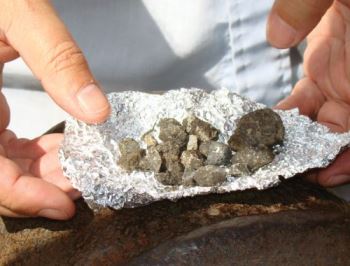
Confirmed pieces that had already been found were shown to those in attendance. The exterior had a relatively smooth black coating similar to charcoal, which was caused by the searing heat as the meteorite surged through the atmosphere. Small white flecks could be seen in those that broke apart. NASA scientists hoped to enlist the help of volunteers to find pieces and then surrender them for scientific examination. Apparently, the fragments contain material from which scientists can extract important information about the early solar system, the formation of planets, and possibly even the origins of molecules necessary for life.
One of the NASA officials we learned a great deal from was Scott Sandford, Ph.D. He is a research astrophysicist for the Space Sciences Division, working out of the Ames Research Center at Moffett Field near Sacramento. We also saw him examining several small objects that looked like what had been described. But, like us, most people were finding “meteorwrongs” instead of meteorites. The situation was similar to the way prospectors in the old days discovered “fool’s gold” instead of the real stuff.
But some people did find the real deal! Excitement was obvious everywhere. We saw mothers pushing strollers while searching along pathways and roadsides. Entire families scoured the Coloma park and nearby Henningsen Lotus Park. We recognized several RVers we’d seen at the Ponderosa RV Resort. The more serious prospectors, some from as far away as Arkansas and Alabama, risked molting rattlesnakes and abundant poison oak to search through the tall grass and brush on hillsides with eastern-facing exposures (the meteorite came in from an easterly direction).
It occurred to us that RVers are ideally suited to take advantage of this once-in-a-lifetime situation. For example, many are full-timers and able to set up pretty much wherever and whenever they want. Many part-timers can do so, too. There are nice RV parks in the area, and the entire family can participate in this new type of prospecting.
Equipment needed is inexpensive and easy to obtain. Plus, searching for meteorite pieces isn’t nearly as physically demanding as panning for gold. For those who get bored easily, plenty of other fun activities are available within walking distance — or a short drive — of Coloma.
One important piece of equipment you’ll need to begin your search is a “meteorite stick” of some sort. We saw some made of golf clubs with the head chopped off and a magnet attached in its place. We also noted many people with magnets attached to sticks, dowels, and other easy-to-acquire pieces of wood. I saw one man with a contraption that looked similar to a push broom — with a head about 1 foot wide — and magnets attached all the way across. We learned that material in the meteorite pieces would adhere to the magnets — one really good way to eliminate meteorwrongs. However, scientists discourage searching for meteorite pieces using magnets, since this can destroy any natural magnetism in the rock.
NASA scientists are hoping searchers will carry a GPS device and camera to record the exact conditions and location where the pieces are found. In some cases, a cell phone will serve both purposes. Satellite service is spotty in the area, but Verizon seems to work in most places.
The scientists also request that finders handle the item as little as possible and place it in aluminum foil to keep it clean. Note the conditions around where it was found, and if you don’t have a GPS, take photos of the horizon in two directions.
Other items that might be useful during the search include plenty of water, a snakebite kit, and a small pack.
Several sources pointed out that although pieces may be found on public lands — such as the Marshall Gold Discovery State Historic Park in Coloma, Henningsen Lotus Park, Bureau of Land Management property, and the like — don’t forget to ask permission before searching on private property.
My wife and I found excellent photos of meteorite pieces, along with advice about hunting for them, at www.meteoriteusa.com/how-to-find-meteorites.htm. We also received a flier requesting that anyone finding meteorite pieces notify Peter Jenniskens at petrus.m.jenniskens@nasa.gov.
Indications are that there are not only lots of small pieces waiting to be found but that there may well be chunks as large as a basketball, too. Representatives from NASA and the Search For Extraterrestrial Intelligence (SETI) Institute chartered a zeppelin at least twice during the early part of May 2012 to look down from above for burn marks and craters where large pieces struck. Scientists believe pieces may be strewn for more than 100 miles, possibly as far away as Folsom Lake to the west.
My wife and I love the area, and we spend a lot of time at the Ponderosa RV Resort. There are other camping options in the area, but none we like nearly as much. The Ponderosa can handle any size RV. In fact, we have met many other FMCA members there. You can find all the details about the Ponderosa at www.rvonthego.com/ponderosa-campground-profile.html.
I’m sure we will be doing more walking in the Coloma area than we normally do, looking down at the ground instead of just checking out what is up ahead. I bet we run into many other FMCA members doing the same.