
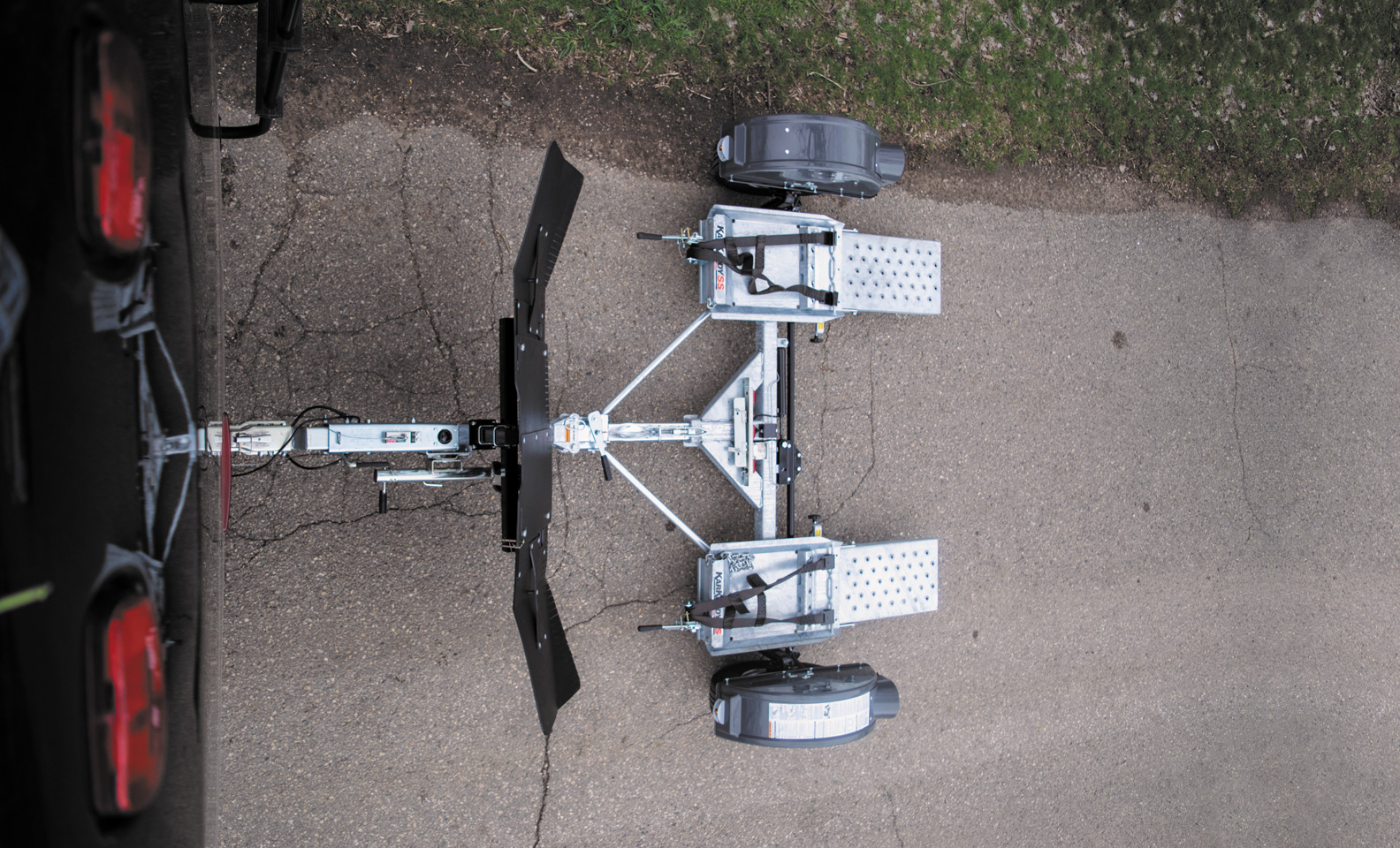
Towed-vehicle equipment choices consist of a trailer, a tow dolly, or a four-wheels-down setup with a tow bar and baseplate.
By Mark Quasius, F333630
October 2018
Motorhomes are a great way to travel, but the size of larger models often precludes using them to run errands, go shopping, or visit nearby attractions. Therefore, many motorhome owners opt for the convenience of a towed vehicle, often called a dinghy.
A popular method of towing a vehicle behind a motorhome is four wheels down, or flat towing, but tow dollies and trailers are also common. Each method has its pros and cons. The method you choose will depend on a number of factors.
Safety is paramount when towing, so it’s important to stay within a motorhome’s specifications for hitch capacity, gross combination weight rating (GCWR), and tongue weight. The ratings determine the towed vehicle’s maximum weight.
Not every car, truck, or SUV can be flat towed. Check the owners manual and FMCA’s annual towing guide, published in each January issue and available online, for information about vehicles that auto manufacturers have approved for flat towing. Some vehicles are limited by their driveline, although it’s sometimes possible to overcome those limitations by adding a driveshaft disconnect or transmission lube pump. If a vehicle absolutely cannot be flat towed, you might consider using a tow dolly or a trailer. The other option is to trade in the vehicle for one that can be flat towed.
Trailers
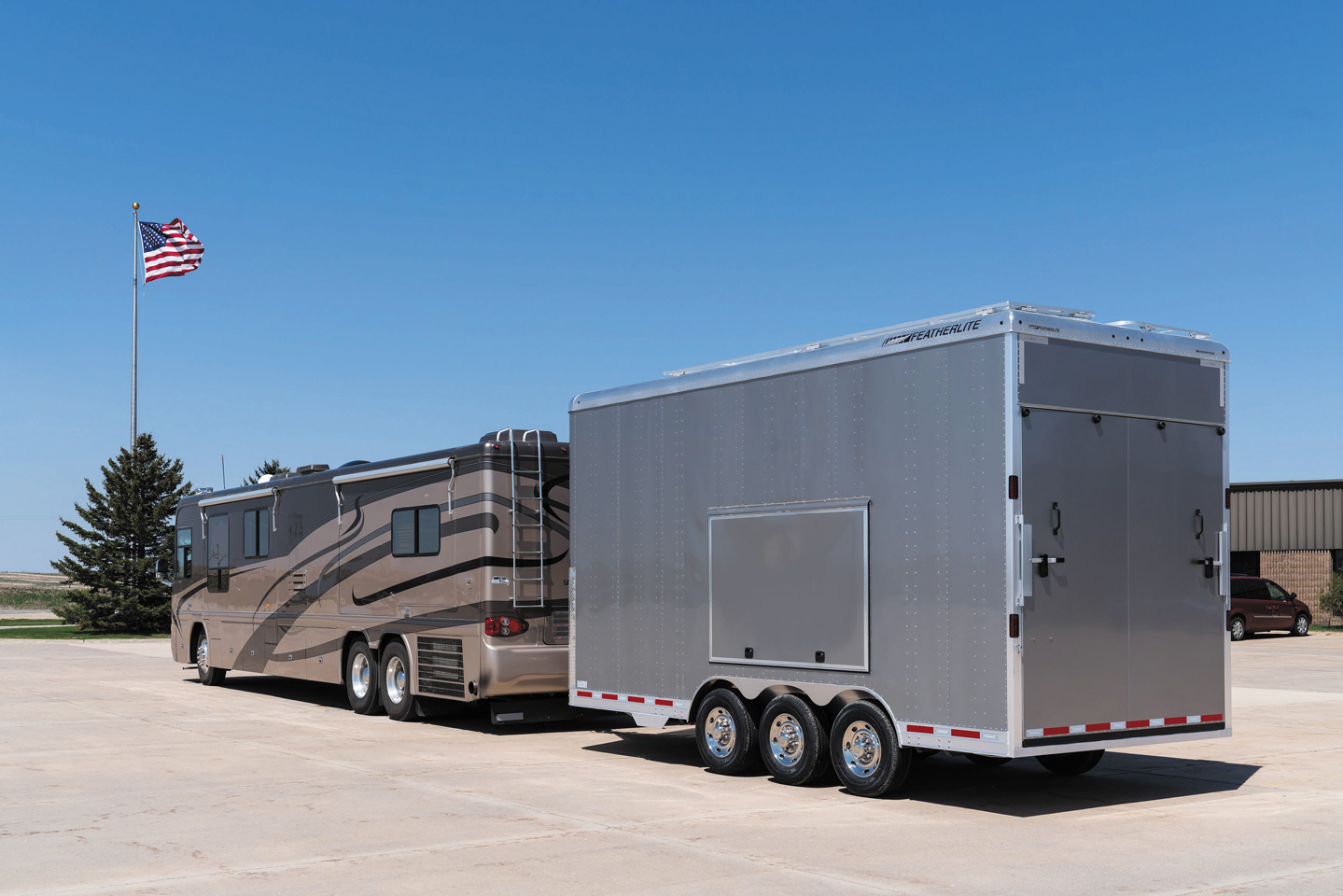
Enclosed trailers, such as Featherlite Trailers’ Model 4926, pictured here, do a good job of protecting vehicles from the elements.
Trailers can be open-bed or enclosed. Open trailers are less expensive and are popular with the off-roading community. Enclosed trailers are large but protect an expensive or collectible vehicle from the elements. They also make a great rolling storage barn for motorcycles, ATVs, or other toys. Trailers are equipped with brakes, which can be hydraulic surge brakes, electric trailer brakes, or hybrid electric-over-hydraulic systems.
Surge brakes are the simplest. A sliding hitch, called a surge brake actuator, operates the hydraulic brake master cylinder. As the RV begins to brake, the inertia of the trailer collapses part of the master cylinder in the trailer’s hitch, applying brake fluid to the trailer brakes. Surge brakes are not as accurate or proportional as a true brake controller, but they allow the trailer to connect to a tow vehicle without an electrical trailer brake connection. And, you must get out and flip the trailer hitch’s lockout latch in order to back up without locking up the brakes.
Electric trailer brakes activate by an electronic brake controller mounted in the motorhome’s cockpit. The controller is connected to the RV’s brake system and automatically applies the trailer brakes by varying the voltage sent to them. Most motorhomes are equipped with the 7-pin RV-style trailer lighting connector as well as a wire that runs to the motorhome’s dash area. Generally, you can find this wire by looking beneath the dash, but you may have to check with your RV dealer for its exact description and location. Then, connect the wire to your trailer brake controller.
In some cases, hydraulic disc brakes are used on larger trailers and are activated by an electronic controller. This hybrid electric-over-hydraulic system offers the superior stopping power of hydraulic disc brakes while still allowing an electrical interface to the RV to control them.
If you pull a trailer behind a large Type A diesel pusher, you may be limited in where you can park for the night. Not every campground has a long enough pull-through site capable of accommodating the combination. In such cases, they may allow you to unload your vehicle from the trailer and park the trailer in an area designated by campground management, and then drive the motorhome to your site. So, there are a few caveats to towing with a large trailer, which is why many motorhome owners choose to flat tow.
Tow Bars And Flat Towing
Most modern tow bars simplify the process of connecting a towed vehicle to a motorhome. Most tow bars are inserted into the motorhome’s trailer hitch and can remain there. They have collapsible arms that extend for easy alignment and connection to the towed vehicle, and they extend and lock up when the towed vehicle is backed up or the motorhome is driven forward a bit. Once disconnected, the arms collapse to a shorter length and the tow bar folds up and is stored on the motorhome. Tow bars don’t require storage room at your campsite.
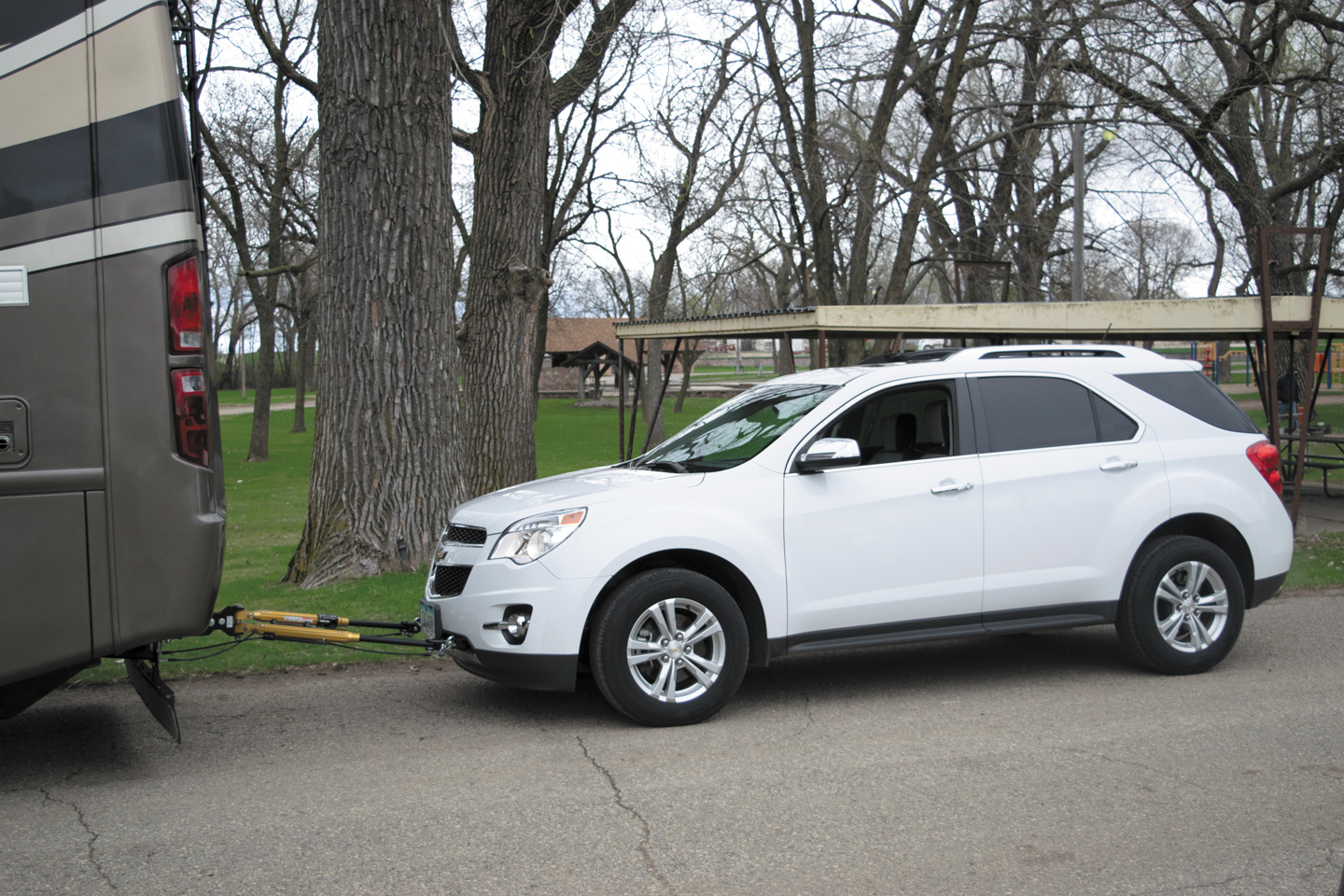
This towed vehicle is ready to be flat towed after being equipped with the Dominator, a lightweight steel and aluminum tow bar from Demco. It is rated at 7,500 pounds.
But not every vehicle can be flat towed. First, you must be able to mount a baseplate onto the vehicle so that the tow bar can connect to it. Some vehicles may lack a suitable forward frame structure for that. Another consideration is the vehicle’s driveline. Most four-wheel-drive vehicles equipped with a transfer case that can be shifted into neutral are great candidates for flat towing, which is one reason Jeep Wranglers are so prevalent at campgrounds. Shifting the transfer case into neutral prevents the spinning driveshaft from damaging the transmission while towing.
Other vehicles may or may not be rated for flat towing, so be sure to verify before buying. In some cases, damage to the transmission can be prevented by installing a lube pump, made by Remco Manufacturing. The electrically operated pumps circulate the automatic transmission fluid in the transmission while towing to prevent damage to the transmission. Another option is the Superior Driveline Drive Shaft Coupling, which prevents the driveshaft from turning at the transmission end on many rear-wheel-drive and four-wheel-drive vehicles equipped with automatic or manual transmissions. Again, it’s important to verify whether a vehicle can be flat towed, whether limitations have been placed on the vehicle, and whether additional equipment is needed. FMCA’s towing guide is a great resource.
After confirming that your vehicle can be flat towed, you must work out the details. Tow bars must be reasonably level when in use. A towed vehicle with tow bar mounting plates that are higher than the motorhome’s trailer hitch can vault over the hitch and damage the rear of the RV during a sudden stop. A towed vehicle with tow bar mounting plates that are lower than the hitch could dive under the motorhome, which would lift weight off the RV’s rear axle, reducing braking power at the coach’s rear wheels. In most cases, the tow bar should be kept level or within three inches above or below the motorhome’s hitch receiver. When towing a higher vehicle, such as a lifted Jeep, a dropped hitch adapter can be added to achieve the correct alignment.
Each RV has a gross combination weight rating (GCWR), which is the allowable combined weight of the RV and towed vehicle or trailer. Manufacturers base the GCWR on the assumption that the towed vehicle has a supplemental braking system, so it’s imperative that all towed vehicles have one. An overview of such systems appears in the October 2017 issue of Family Motor Coaching. It’s also important to verify that the towed vehicle does not exceed the hitch’s weight rating.
Once you’ve established that your motorhome and towed vehicle are a good match, install a lighting system for the towed vehicle to signal other drivers of your intentions. Such systems were covered in the September 2018 issue of Family RVing.
Tow Dollies
If your vehicle can’t be flat towed and you don’t want to bother with a trailer, you might consider a tow dolly, which is basically an axle with a tongue that connects to the trailer hitch. You drive your vehicle’s front axle onto the dolly, strap it down, and drive away. Most front-wheel-drive vehicles work well with a tow dolly, because the front drivetrain doesn’t turn while towing and thus cannot be damaged. The rear axles just roll along. A dolly, therefore, essentially is a half trailer that removes the driveline limitations from the towed vehicle.
A benefit of a tow dolly is that the towed vehicle does not need a baseplate or supplemental braking system, because the tow dolly should be equipped with hydraulic surge brakes. Dollies are equipped with lights, but the vehicle in tow may also be required to have working lights, so check your state or provincial laws. Even if such lights are not required, you may want to add a portable light bar if your towed vehicle hides the fender-mounted lights on the dolly.
Like other towing methods, tow dollies have limitations, including a maximum weight capacity and both a minimum and maximum track width of the front wheels. Tow dollies are not suitable for full-time four-wheel-drive vehicles, because the rear driveline needs to turn while the front driveline cannot.
Compared to flat-towing, the typical setup time for a dolly is greater. Before loading or unloading a vehicle, you first must hook up the dolly to the RV. Then you drop the dolly’s ramps and carefully drive the vehicle onto the dolly. Once the vehicle is centered on the dolly, strap down the front wheels using the attached ratchet straps and hook up the safety chains between the dolly and the towed vehicle’s front suspension or frame.
Another concern: You may need a campsite that is a bit longer to accommodate a dolly. Tow dollies that come with a folding tongue are more space efficient.
And, just as with a tow bar, you can’t back up with a tow dolly without jackknifing.
Summary
Your choice of towing method will depend on your motorhome, the vehicle you wish to tow, and your personal preferences. Flat towing is convenient but has initial setup costs. An enclosed trailer offers protection for your vehicle but may limit your campsite options. A tow dolly can be affordable but requires extra time to load and unload. The important thing is to tow safely, stay within the recommended specifications of all of the manufacturers involved, and enjoy your RV travels.
Following is a sampling of products available from some manufacturers. Note: Prices were correct as of August 31, 2018.
ACME Tow Dolly Company
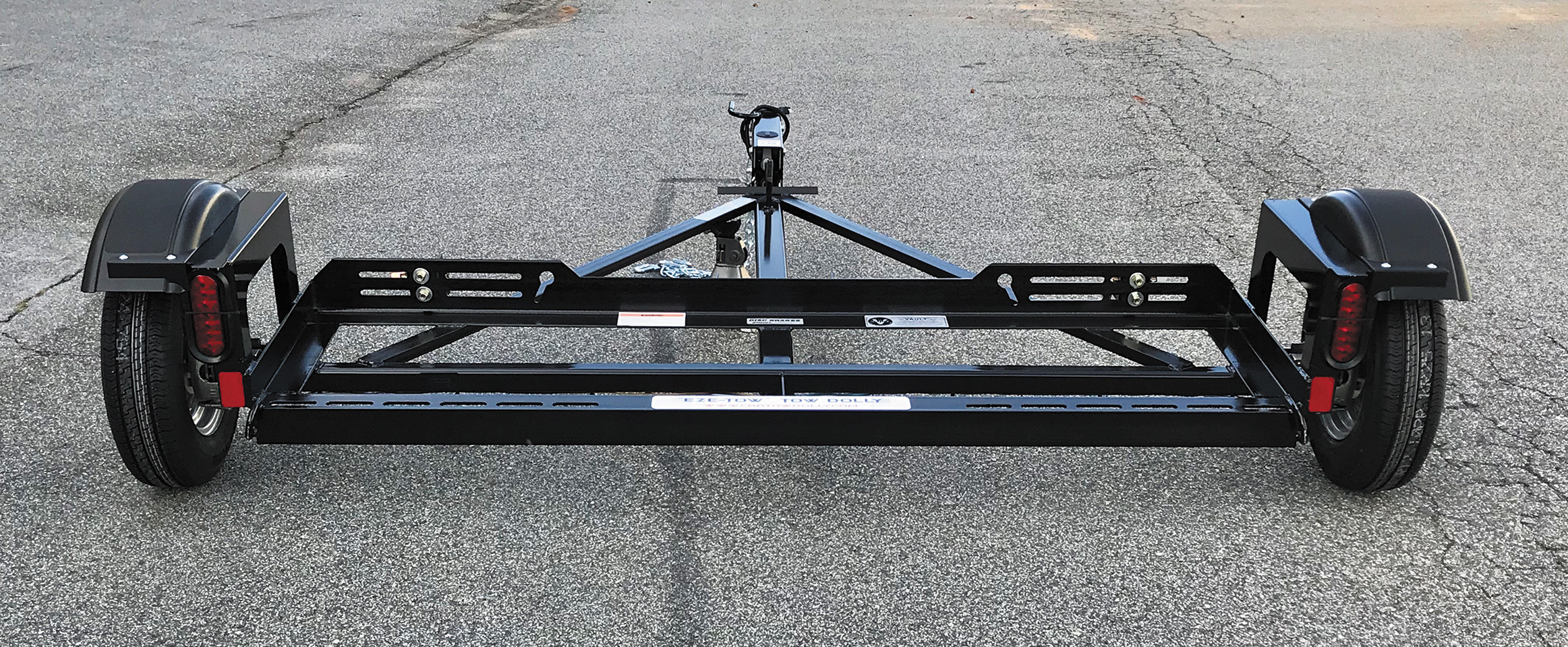
Acme Hydraulic Disc Brake Car Tow Dolly
Acme, a manufacturer that sells directly to the public, claims to have the lightest tow dolly on the market. Two models of its Eze-Tow dolly are available, and both can accommodate a vehicle with a curb weight less than 5,000 pounds. The Idler Tow Dolly ($1,699.99) weighs 330 pounds. It has no brakes. The Hydraulic Disc Brake Car Tow Dolly ($2,399.99) weighs 380 pounds and features a disc brake surge system.
(336) 996-4396; https://cartowdolly.com.
Blue Ox*
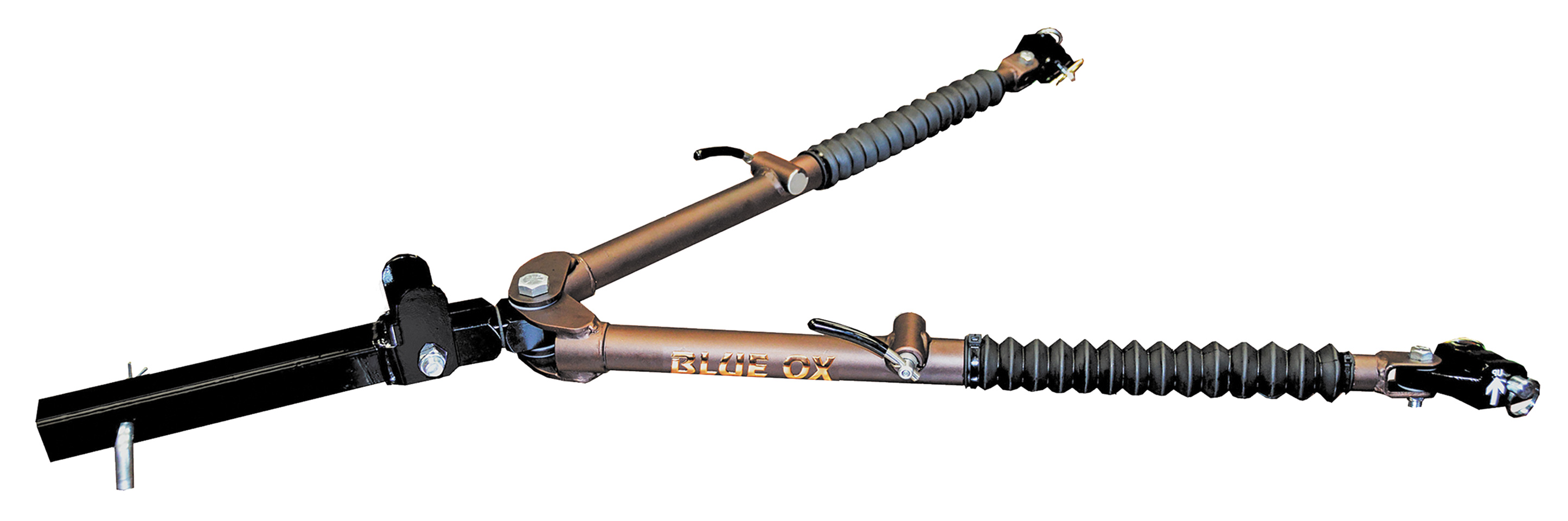
Blue Ox Avail
Blue Ox makes tow bars, baseplates, supplemental braking systems, and accessories. Recent offerings include the Avail and Ascent tow bars. The Avail ($1,025), a steel model rated at 10,000 pounds, incorporates longer arms for an improved turning radius. A new locking mechanism features nonbinding latches that release easily. The Ascent ($1,132), an aluminum model that weighs 31 pounds, is rated at 7,500 pounds and features the same nonbinding latches and longer arms as the Avail, as well as metallic powder coating. All Blue Ox tow bars have steel inner rod arms with rubber dust boots to help keep them clean. (800) 228-9289; www.blueox.com.
Demco*
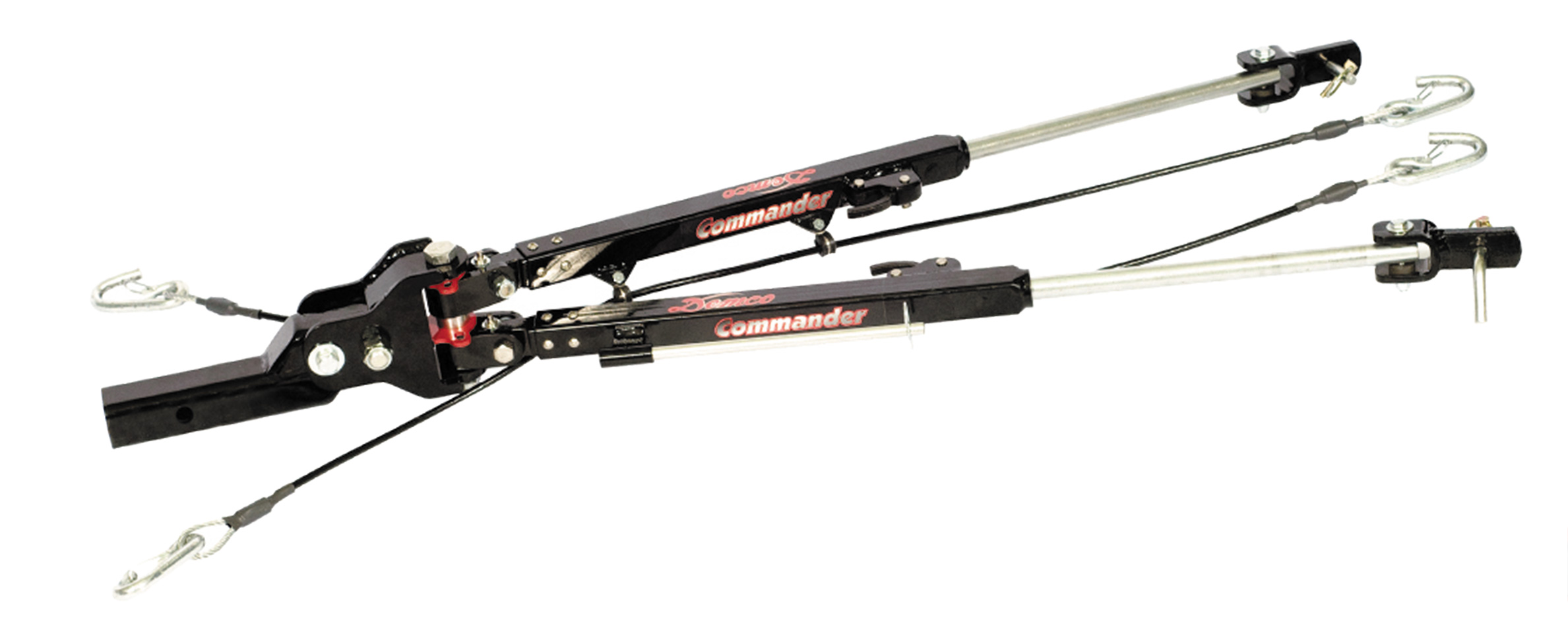
Demco Commander
Demco makes tow bars, tow dollies, and supplemental braking systems. The tow bar selection consists of the Commander ($743), a 6,000-pound-capacity bar; the Dominator ($1,230), a lightweight steel and aluminum bar rated at 7,500 pounds; and the Excali-Bar II ($917), rated at 10,500 pounds. The Excali-Bar II, which features modular steel construction, has an offset hitch shank that can raise or lower the tow bar by 1 inch to accommodate raised vehicles or vehicles with low baseplate connections.
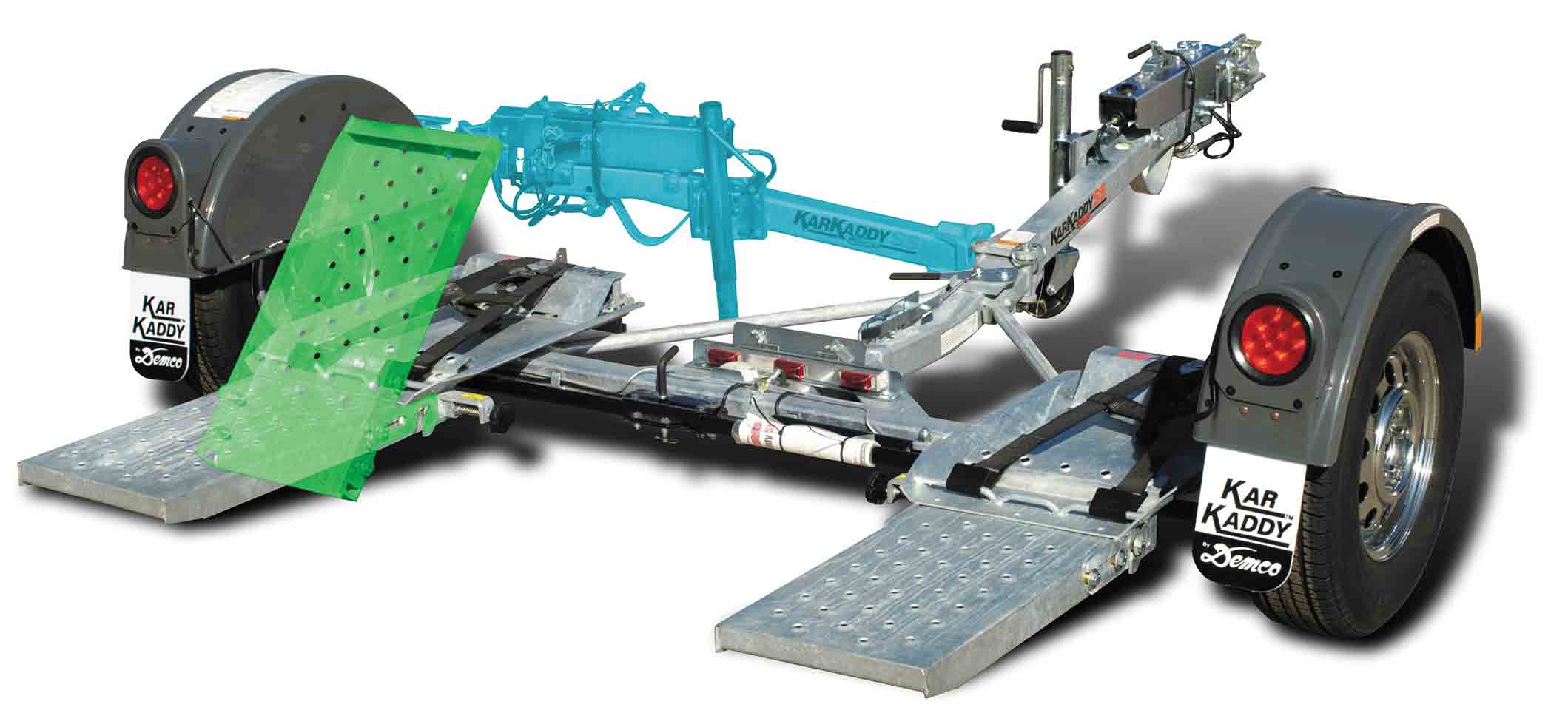
Demco Kar Kaddy SS
Demco’s Kar Kaddy series of tow dollies includes the Kar Kaddy SS ($4,674), which has hydraulic disc surge brakes and a galvanized finish. The dolly is 133 inches when fully extended, but it folds to a length of 67 inches. It is rated for a maximum vehicle weight of 4,700 pounds, with a maximum front axle weight of 3,500 pounds. (800) 543-3626; www.demco-products.com.
Featherlite Trailers
This brand includes all-aluminum open and enclosed car trailers. Its most popular enclosed car hauler is Model 4926, which is available in base lengths from 16 feet to 32 feet; the manufacturer’s suggested retail price ranges from $19,885 to t$27,115. Standard width is 8 feet 6 inches. The standard height is 6 feet 6 inches, but it can be increased to the buyer’s needs. The trailer includes a standard aluminum floor and rear ramp with cable assist. Options include graphics or paint, cabinets, additional lighting and electrical upgrades, a lined interior, ramp extensions, and more. (800) 800-1230; www.fthr.com.
Master Tow*
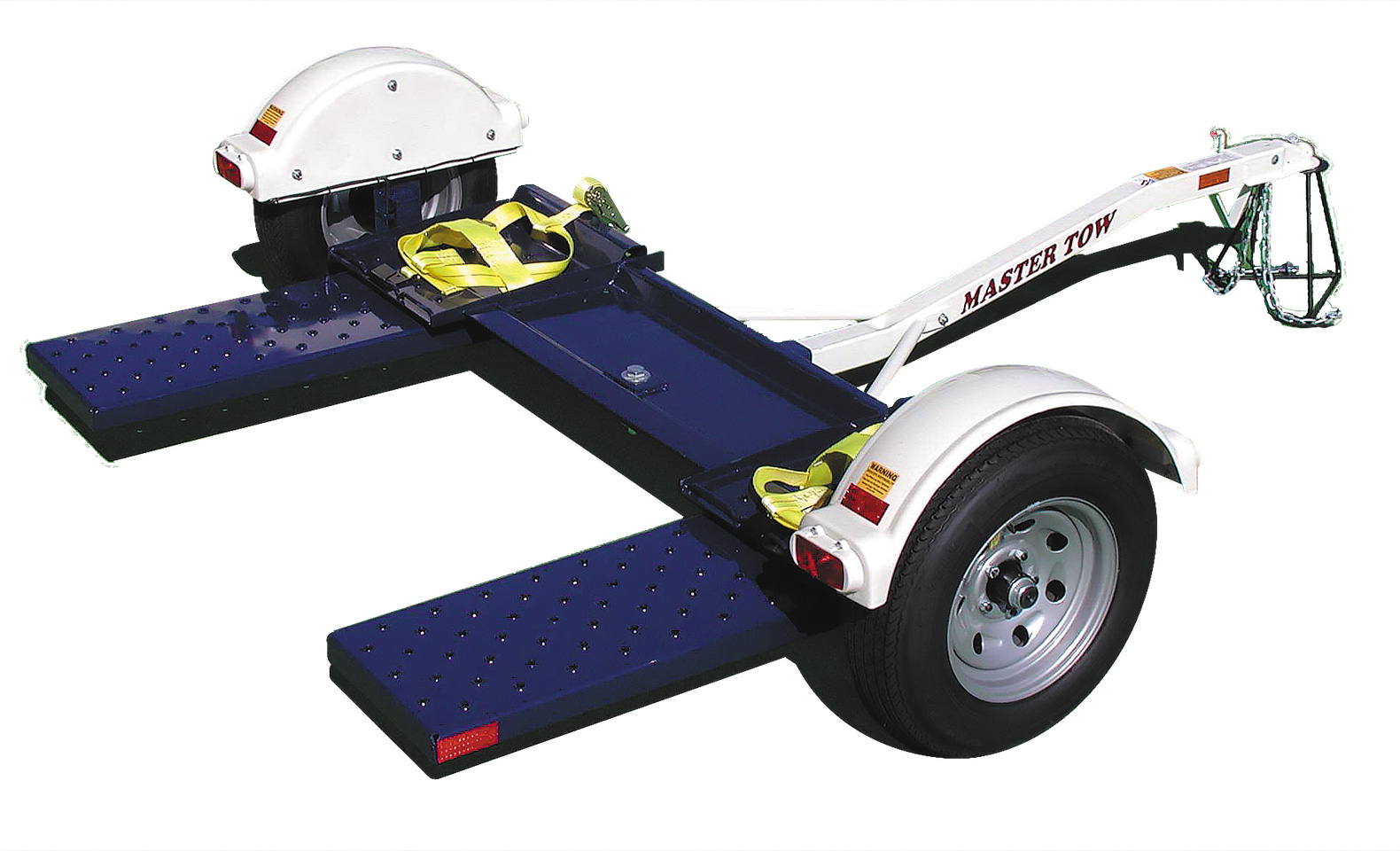
Master Tow Model 80THD
Master Tow manufactures two models of tow dollies as well as open trailers for car hauling. Tow dolly Model 77T (starting at $1,100), which weighs 500 pounds, is rated to tow vehicles with a gross weight up to 4,500 pounds and an overall body width up to 75 inches. Tow dolly Model 80THD (starting at $1,300), which weighs 550 pounds, is rated to tow vehicles with a gross weight up to 4,900 pounds and an overall body width up to 78 inches. The dollies feature tilt-bed loading, swivel-platform steering, polyethylene fenders with LED lighting, and computer-balanced 14-inch radial tires. Options include electric brakes and hydraulic surge brakes.
Trailers are available in 6-foot-4-inch and 6-foot-10-inch widths, and bed lengths that range from 16 feet to 24 feet. Trailers feature slide-out ramp loading and a steel tread plate floor. An open center is optional. (800) 522-2190; www.mastertow.com.
Remco Industries*
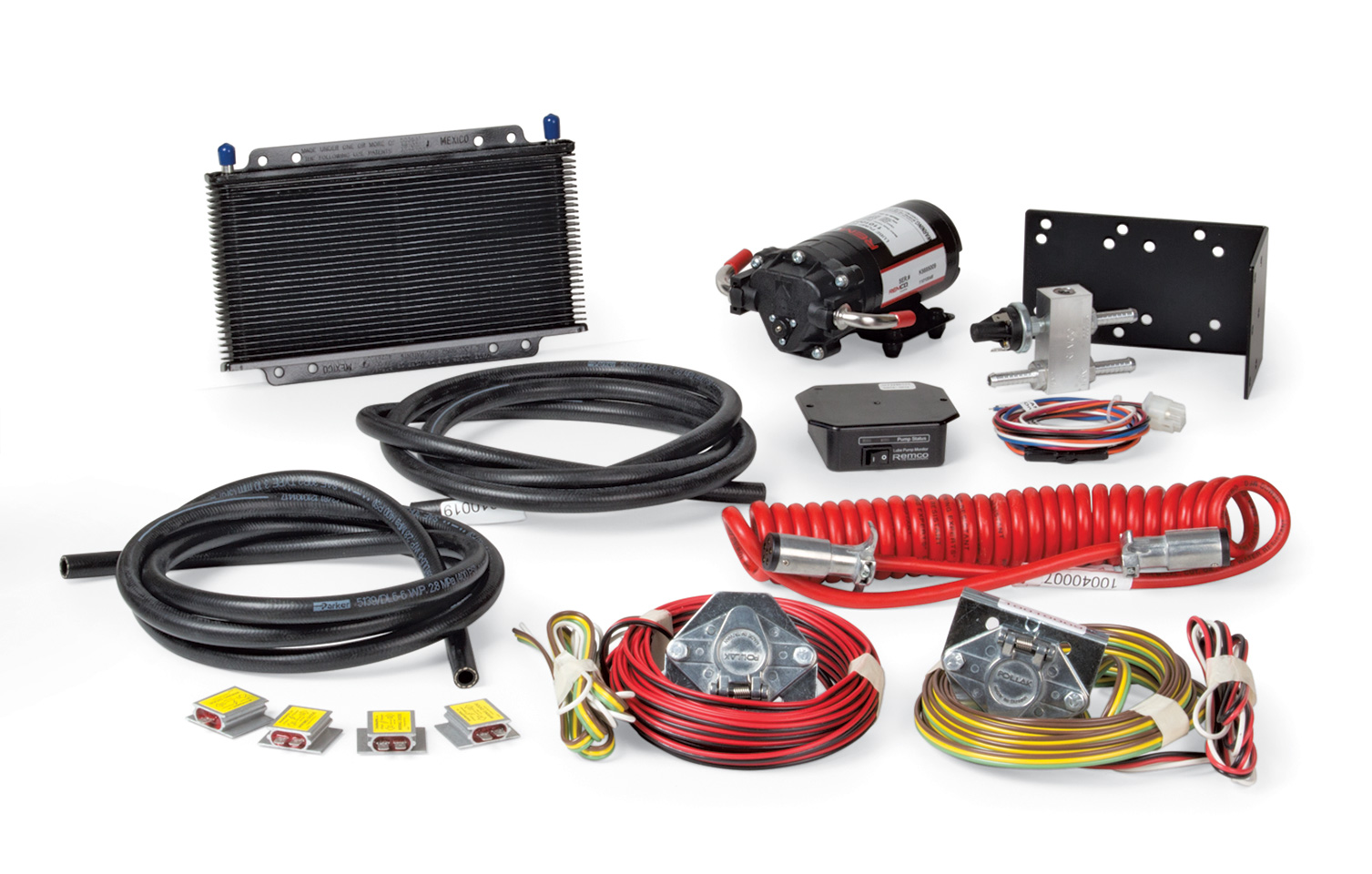
Remco Power RV Lube Pump Towing Kit
Some vehicles not approved by their manufacturers for flat towing can be modified to allow four-wheels-down towing. The Remco Power RV Lube Pump Towing Kit can be installed on front-wheel-drive vehicles to provide a reliable lubrication system for the automatic transmission while the vehicle is being towed. An electronic monitor/control panel monitors the system while towing and alerts you if a problem arises. The lube pump is powered by the motorhome’s electrical system, so you need not worry about a dead battery in the towed vehicle. The price of a Remco Power RV Lube Pump ranges from $1,175 to $1,895. (800) 228-2481; www.remcoindustries.com/towing/.
Roadmaster*
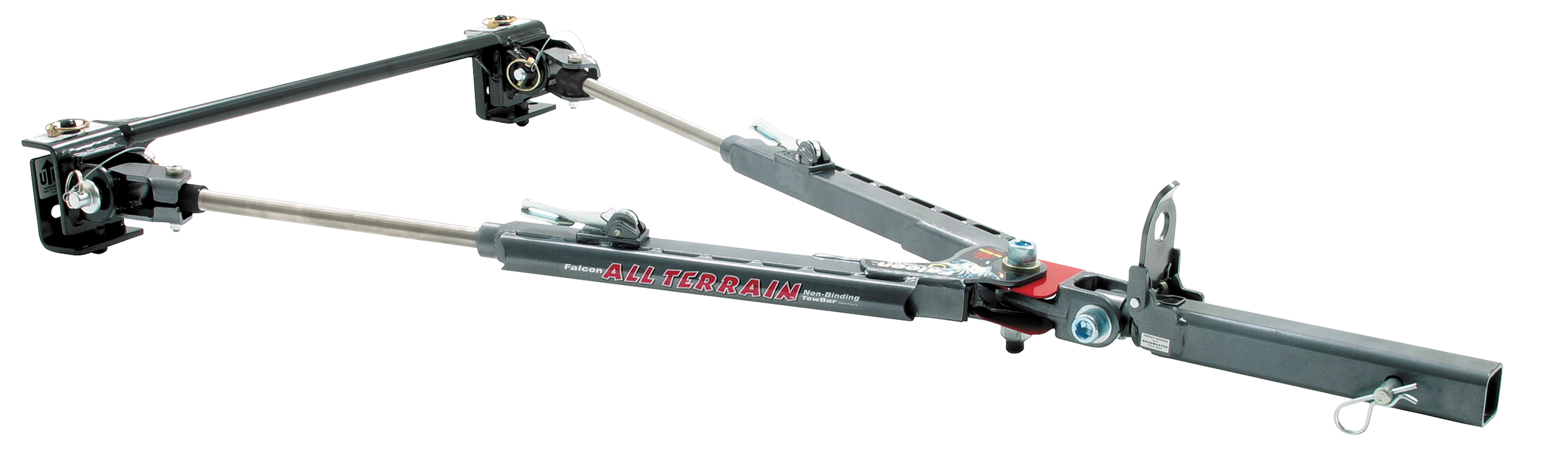
Roadmaster Falcon All-Terrain
Roadmaster’s extensive selection of towing products includes tow bars, baseplates, supplemental braking systems, lighting kits, and other accessories. The nonbinding line of tow bars includes the Falcon All-Terrain ($873), a steel bar rated at 6,000 pounds; the Blackhawk 2 All-Terrain ($1,020), a steel bar rated at 10,000 pounds; and the Sterling All-Terrain ($1,112), a lightweight bar made with military-grade aluminum outer arms, rated at 8,000 pounds. All Roadmaster tow bars use stainless-steel inner arms and Nylatron bushings. Roadmaster’s latest entry is the Nighthawk ($1,250), rated for 8,000 pounds. Its powder-coated aluminum outer arms are the longest ever produced. The Nighthawk features LED lighting that taps into the taillight circuit that passes through the tow bar. (800) 669-9690; www.roadmasterinc.com.
Superior Driveline*
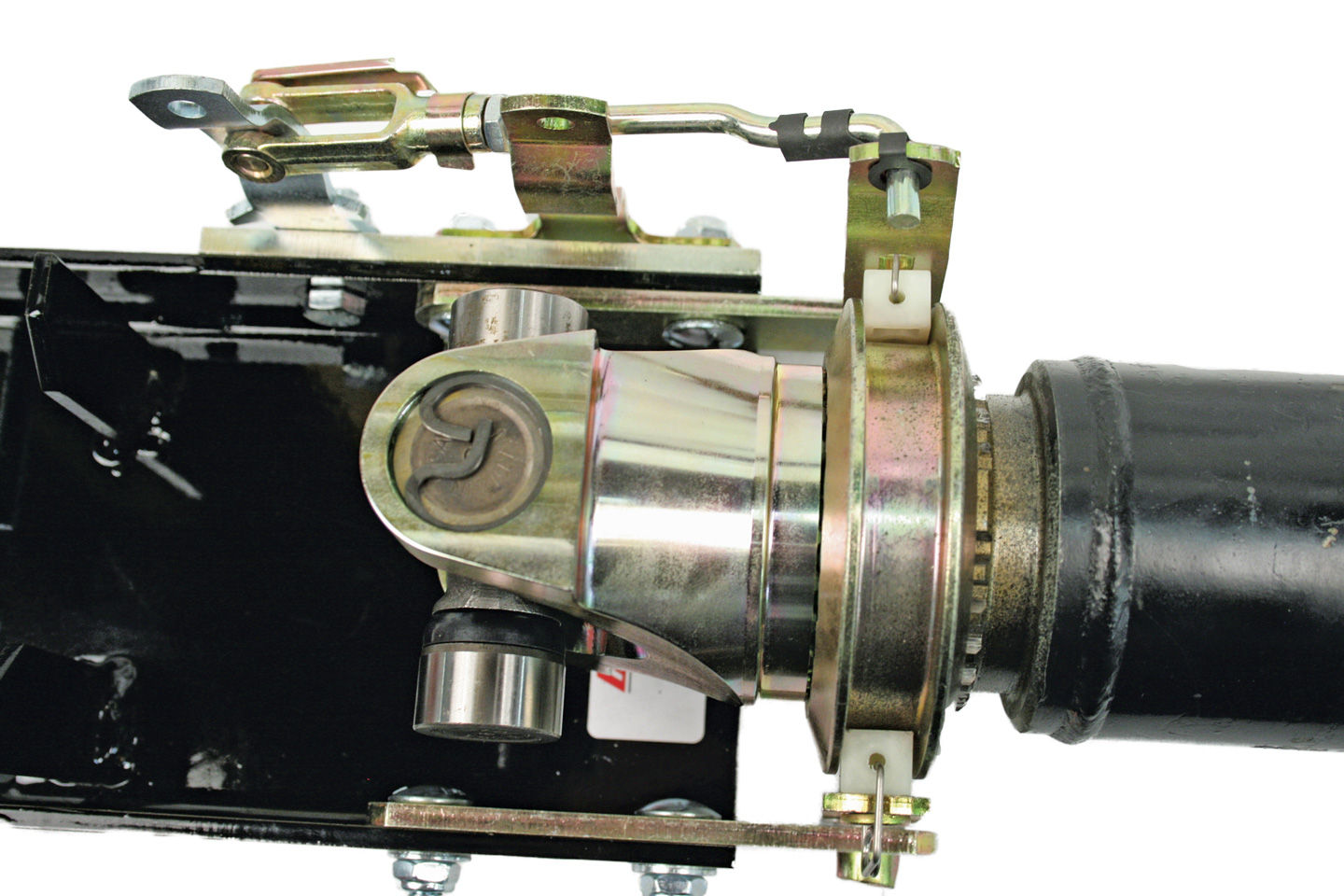
Superior Driveline Drive Shaft Coupling
When rear-wheel-drive and four-wheel-drive vehicles with automatic or manual transmissions are not approved by their manufacturers for flat towing, the Superior Driveline Drive Shaft Coupling may be a solution. The system disconnects the driveshaft at the rear U-joint and is controlled by a heavy-duty cable from the driver’s seat, so it’s not necessary to get under the vehicle. Simply pull the cable handle — much like the old choke cables — and disengage the steering wheel lock, and you’re ready to tow. To re-engage the driveshaft, push in the cable handle using a designated procedure, and you’re ready to drive. The cost of a Superior Driveline Drive Shaft Coupling ranges from $765 to $1,600, depending on the vehicle. Installation charges are extra. (855) 447-3626; www.superiordriveline.com.
Tommys Trailers*
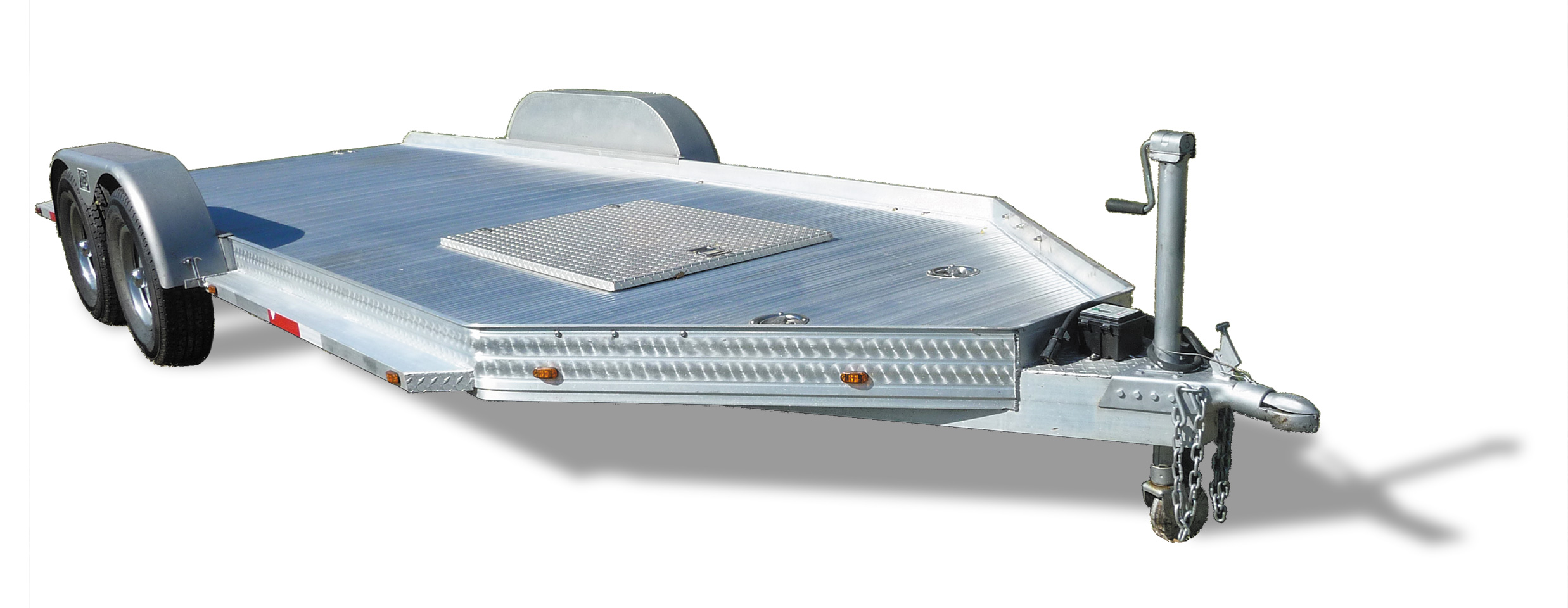
Tommys Trailers Deluxe All-Aluminum Car Trailer
Tommy’s manufactures open and closed trailers. Open trailers include the Production Class Aluminum Trailer, which is 8 feet 6 inches wide (with 80 inches of floor width between the side rails) and is available in lengths of 20 feet, 22 feet, and 24 feet. The 20-foot model weighs 1,300 pounds. Features include two 3,500-pound-rated rubber torsion E-Z Lube axles; four-wheel electric brakes; aluminum tongue-and-groove board flooring; 6-foot aluminum ramps in lockable rear compartments; and removable fenders. The price of the 20-foot model is $5,995; the 22-foot model costs $6,795; and the 26-foot model is $7,295.
The Deluxe All-Aluminum Car Trailer is an open trailer that includes extras such as four running-board step plates; a recessed spare tire compartment; a spare tire and wheel; and a machined swirl design. Prices range from $7,895 to $8,895. Tommy’s Trailers also sells an optional removable canvas enclosure. (800) 889-7785; www.tommystrailers.com.
* FMCA commercial member