
Nature
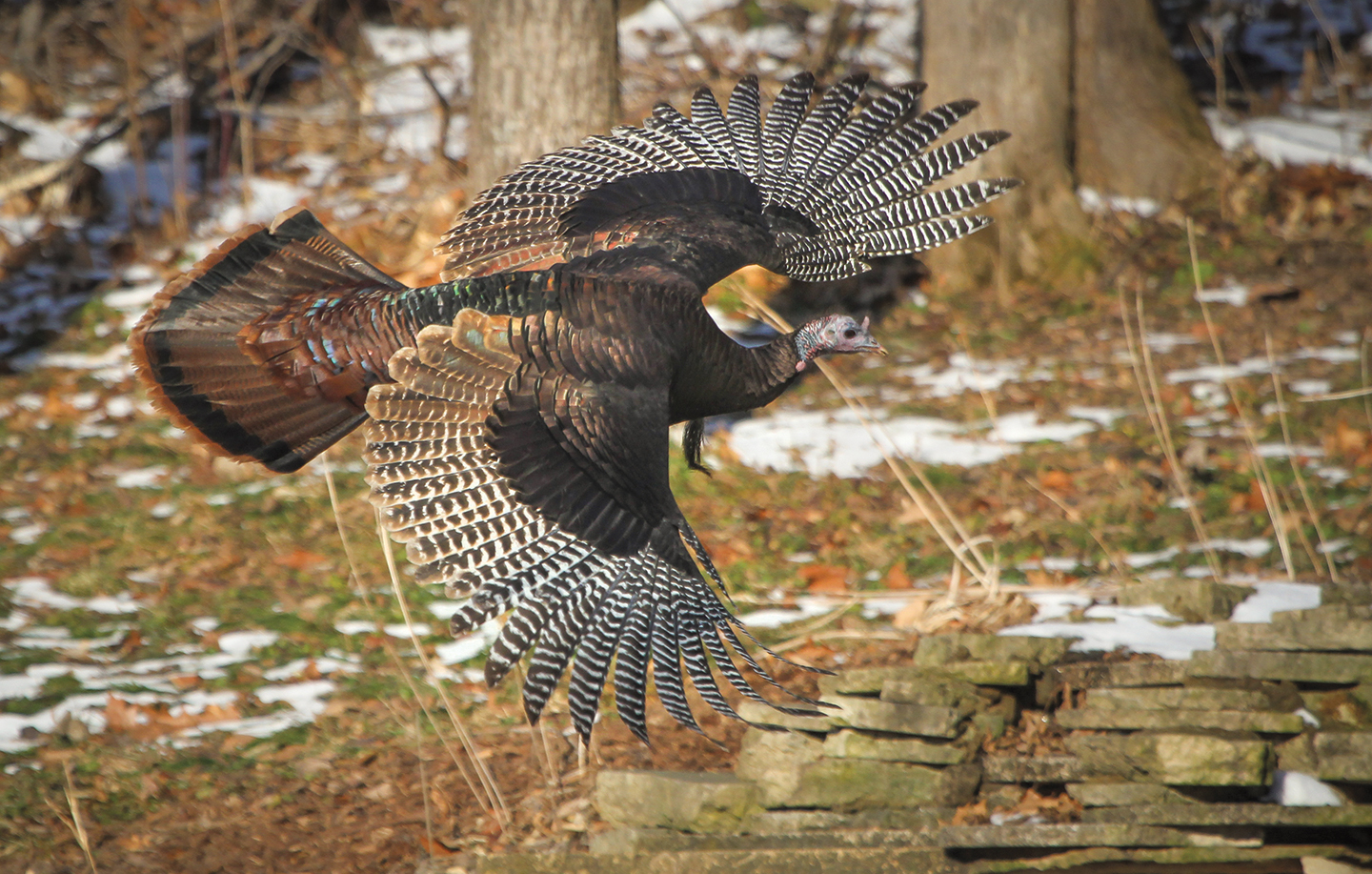
These Turkeys Can Fly!
“As God as my witness, I thought turkeys could fly!”
—Arthur Carlson, WKRP general manager, “WKRP in Cincinnati”
Those big-chested Thanksgiving turkeys specially bred for our tables cannot soar through the sky on their own. That was the lesson learned by a fictional radio exec in a 1978 episode of “WKRP in Cincinnati.”
But Mr. Carlson was not entirely mistaken. Wild turkeys can and do fly every day. These native birds can be found in Mexico and Canada, with the majority living in the United States — an estimated 6 million of them, in fact.
So, while you enjoy the nonflying type of turkey this Thanksgiving, here are some facts about their airborne cousins:
*Benjamin Franklin didn’t suggest making the wild turkey the national bird. He simply compared it to the bald eagle, and wrote that the turkey was “a much more respectable bird . . . a bird of courage.”
*These birds can fly at speeds of up to 60 miles per hour, and can see three times more clearly than 20/20. And in color!
*They sleep in trees at night, and eat fruit, acorns, insects, nuts, grasses, and even reptiles.
*Of the six different subspecies of wild turkeys in North America, the most common is the Eastern wild turkey, found in 38 states and several Canadian provinces.
*By autumn, wild turkeys have separated into two kinds of flocks — all males, also called gobblers, or all hens and juveniles. Family groups and gobbler groups will meet again in the spring.
*Their meat is darker than farm-raised turkey, but that doesn’t affect the taste; it’s still delicious when prepared correctly.
*Hunting them is legal in 49 states. Wisconsin, Missouri, South Dakota, Wisconsin, Florida, and Tennessee are just a few popular spots.
Considering those last two facts, the wild turkey is probably really glad it can fly!
App File
Campgrounds
Need help finding the perfect camping site? Check these out.
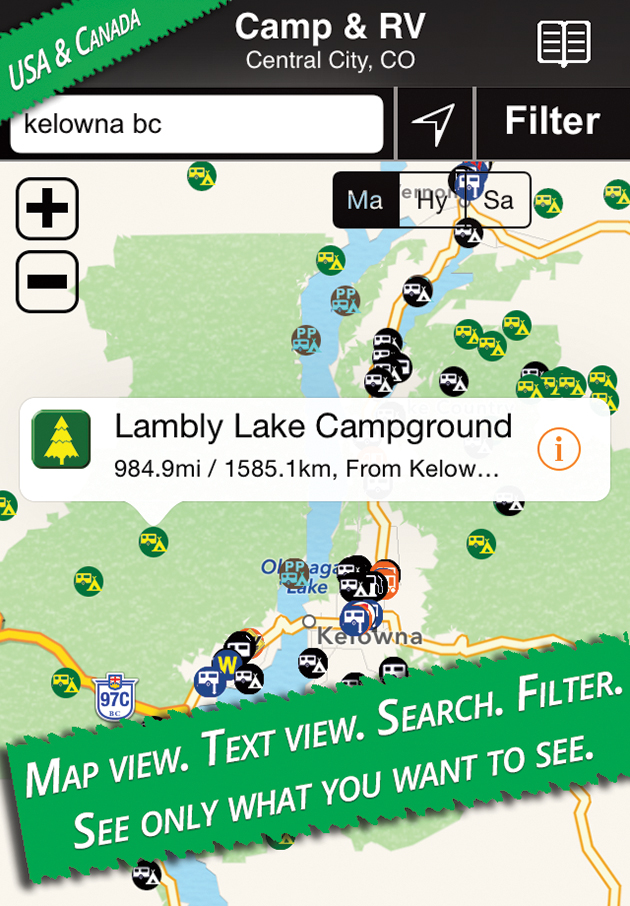
The AllStays Camp and RV app.
AllStays Camp and RV: The app lists more than 30,000 public and private campgrounds in the United States and Canada, and includes details about hookups, amps, dump stations, laundry facilities, pets, internet access, and much more. Filters allow you to add or remove amenity info from the map view. The app stores data on your phone, so some information is available even without internet. Available for iOS only. $9.99. www.allstays.com/apps/camprv.htm.
FMCA Mobile: Members can search by city, state, and province for campgrounds that are FMCA commercial members. Each campground’s contact information and location on a map are displayed. Members also can use the app to search for repair shops; to search for and request information about FMCA chapters; to obtain quotes on tires; to contact FMCA; and to display the member’s digital membership card. Free (with FMCA membership) for iOS and Android.
RV Parky: Built by a full-time RVer, the app includes listings for commercial and public campgrounds, as well as rest areas and stores such as Walmart, Cracker Barrel, and Cabela’s. The app is said to have 25,000 listings in all. Filters allow users to select the campground amenities they prefer. Free for iOS and Android. www.rvparky.com.
Ultimate Campgrounds: The Ultimate Campground Project, with FMCA members at the helm, includes a website, apps, and point-of-interest lists of more than 38,000 publicly owned camping locations (municipal, state, and national parks; Bureau of Land Management; U.S. Forest Service, etc.). No private/commercial sites are listed. Filters allow the user to refine the search, and filters are remembered for subsequent searches. Favorites can be marked and saved. Info is updated monthly. Available for iOS: $3.99 (U.S. data); $1.99 (Canada data). Mac computers: $3.99 (U.S. data). Android: $3.99 (U.S. and Canada data).
www.ultimatecampgrounds.com.
Campground Spotlight
Antique Capital RV Park, Gladewater, Texas
Imagine hooking up your RV at a site located on Patsy Cline Boulevard or Buddy Holly Avenue. Or maybe an RV park street named after James Brown, Jerry Lee Lewis, Roy Orbison, or Elvis Presley. They’re all part of the nostalgia at Antique Capital RV Park in Gladewater, Texas.
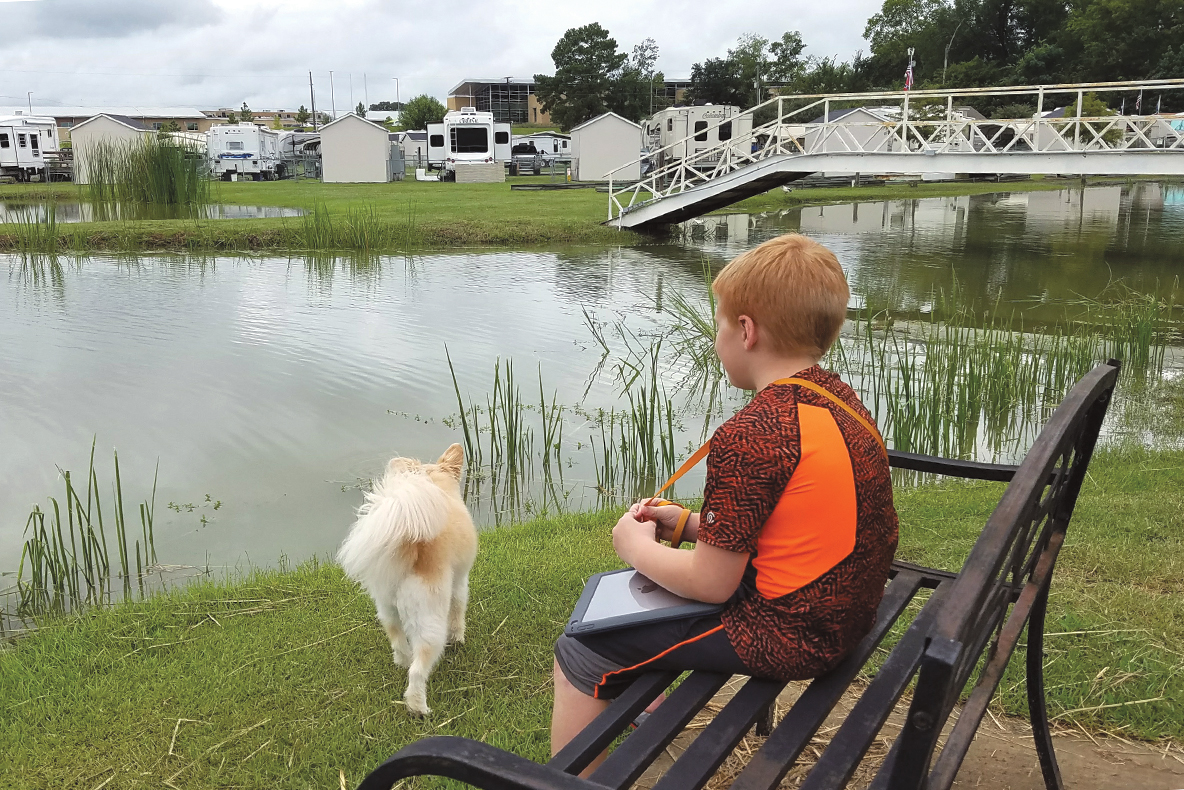
Campground amenities at the Antique Capital RV Park in Gladewater, Texas, include an on-site store, activity center, and catch-and-release fishing pond.
The reason the private streets give homage to musical greatness is the park’s creator and original owner “was very music oriented and he loves to do music,” according to park office manager Charlene Mills. This successful campground turned 10 in October 2018, and the original owner sold it just last year. New owners Jamie and Heidi Stevens kept the street names just as they are, even though, as Charlene jokingly said, “They’re not registered with the post office!”
The Antique Capital of East Texas is the nickname for Gladewater, which, like other East Texas towns, took part in the oil boom of the 1930s. Following that prosperous period, several empty buildings could be found on Main Street. One of them was turned into an antique mall and opened in 1986. Soon more antiques dealers arrived. Today the local chamber of commerce claims hundreds of dealers are represented in town amid antique malls and individual shops.
The future King of Rock ’n’ Roll was around 20 years old when he spent many days and nights in East Texas at the start of his musical career. Elvis Presley, along with two other musicians who made up his band, played at schools and clubs in the area back in the mid-1950s. Gladewater locals old enough to recall the days are happy to tell you about them, and at the Gladewater Museum, artifacts and memorabilia contribute to the story. It helps to make all those street names at Antique Capital RV Park even more appropriate!
The 143-site RV park is a popular host for FMCA chapter rallies. Most sites are occupied by long-term campers, but the park keeps at least 30 spaces open for short-term use. Amenities include a large, well-equipped activity center; pull-through sites; Wi-Fi; a fishing pond; an on-site store; an exercise room; and two laundry areas.
Further Information
Antique Capital RV Park, C11751
500 South Loop 485
Gladewater, TX 75647
(903) 845-7378
www.acrvpark.com
Giving
The Gifts Of Time And Talent
The upcoming holiday season focuses on items you can wrap or send in the mail. But no gift is as valuable as your abilities and time.
Volunteermatch.org connects volunteers with causes and organizations that welcome their “gifts.” It lists thousands of projects available in locations throughout the United States, with some in Canada and Mexico as well.
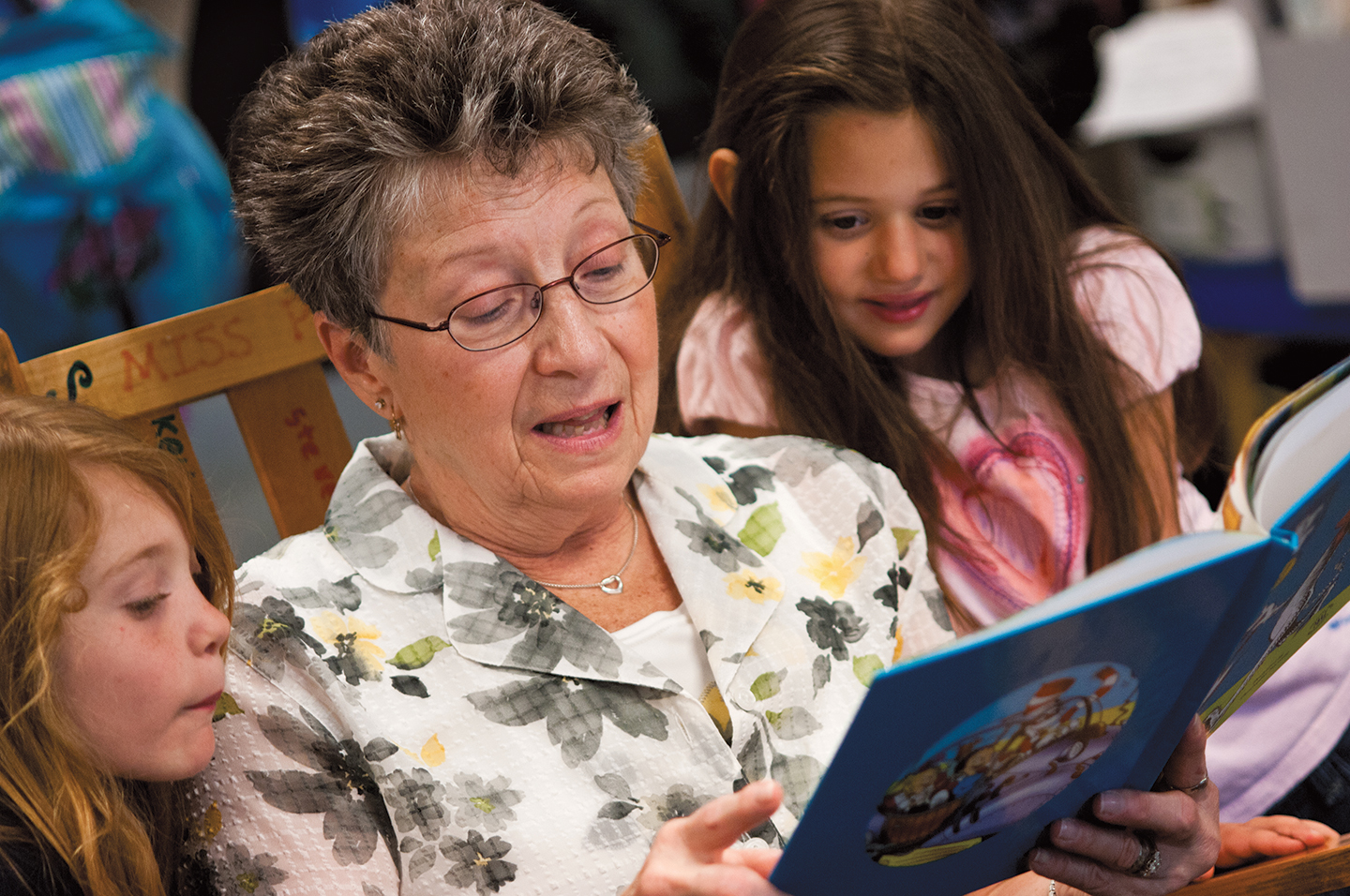
A foster grandparent volunteer reads to girls at school.
This matching service is not limited by your physical location. Choose “virtual” instead of “local” to search for projects you can join online. It’s charity work that takes place at home, even if your home is at the beach!
At the site, you can set up a profile that indicates your skills and interests, and choose from among many different kinds of causes. Retired medical or dental professionals may want to put that expertise to work at a health center. Or, maybe you’d like to help animals. Or, how about coaching kids at a community center? The possibilities seem endless.
To help you choose a particular cause, read reviews on the site written by previous or current volunteers. They can provide invaluable insight into what the job would entail.
According to VolunteerMatch, the site has generated $10 billion in social value since its founding in 1998. It is a partner with nonprofits such as the American Red Cross, Easter Seals, Girl Scouts, National MS Society, and many more national and local organizations.
To get started, visit voluntermatch.org.
Hobby
Be A Traveling Sketchbook Journalist
Gain inspiration from this art-class-in-a-book.
RVers attuned to the beauty or whimsy of their surroundings might try recording those sights by pen or pencil rather than snapping smartphone photos. Artist-author-teacher Steven B. Reddy suggests how in his book Everyday Sketching & Drawing: Five Steps To A Unique And Personal Sketchbook Habit (The Monacelli Press, $24).
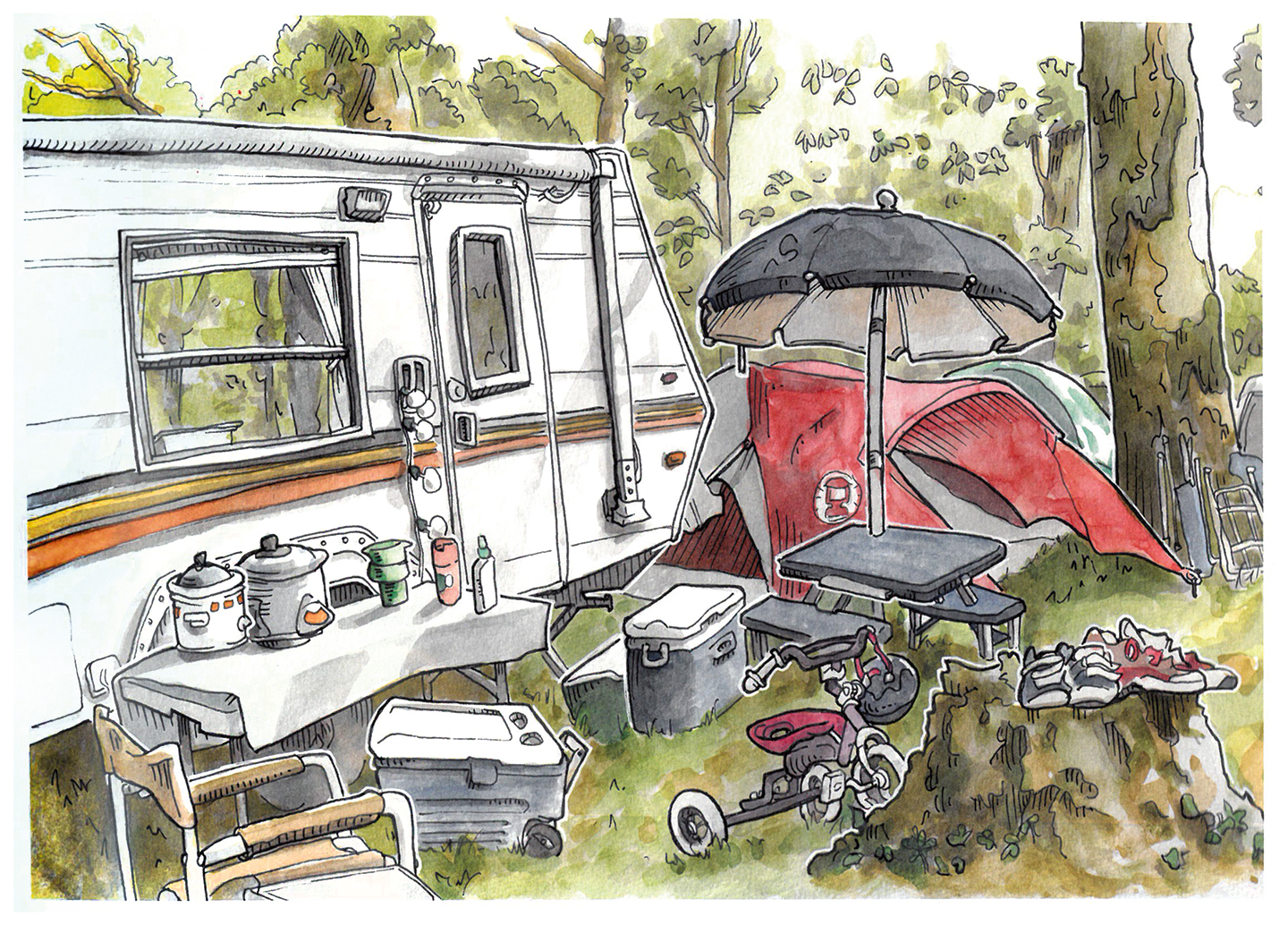
An original sketch from Steven B. Reddy’s book Everyday Sketching & Drawing.
Mr. Reddy, who admits to having a “daily sketchbook habit,” assures readers that drawing is for everyone, even those who believe they have no artistic talent. The mistakes a person might see in his or her own drawings are the very features that make them unique, he adds.
He outlines a five-step drawing strategy based on the techniques of the 1700s Old World masters. Stage one is a “quick pencil plan” — drawing the main objects in a scene. Next he describes how to add contours; gray tones for depth, mood, and visual balance; stages of color; and “hatch lines” for texture and detail.
Mr. Reddy’s illustrations appear on practically every page. He explains how to sketch still lifes, interiors, exteriors, and even clutter-filled spaces such as desks. (He calls the latter “embracing complexity.”)
RVers may be interested in a chapter on “travel sketching,” or sketching in public, in which he shares experiences from his own forays to Southeast Asia and Mexico. In the “Travel Journaling” chapter, he suggests that although it’s tempting to look for that perfect scene, you should draw what’s in front of you instead. You’ll take more interest in your surroundings and more accurately record the experience.
Perhaps the best advice Mr. Reddy offers is this: “Draw often, make it a habit, and you can’t help but discover techniques and attitudes that help your drawings express how you see the world.”