
By Gary Bunzer, Technical Editor
December 2018
Satellite Antenna System
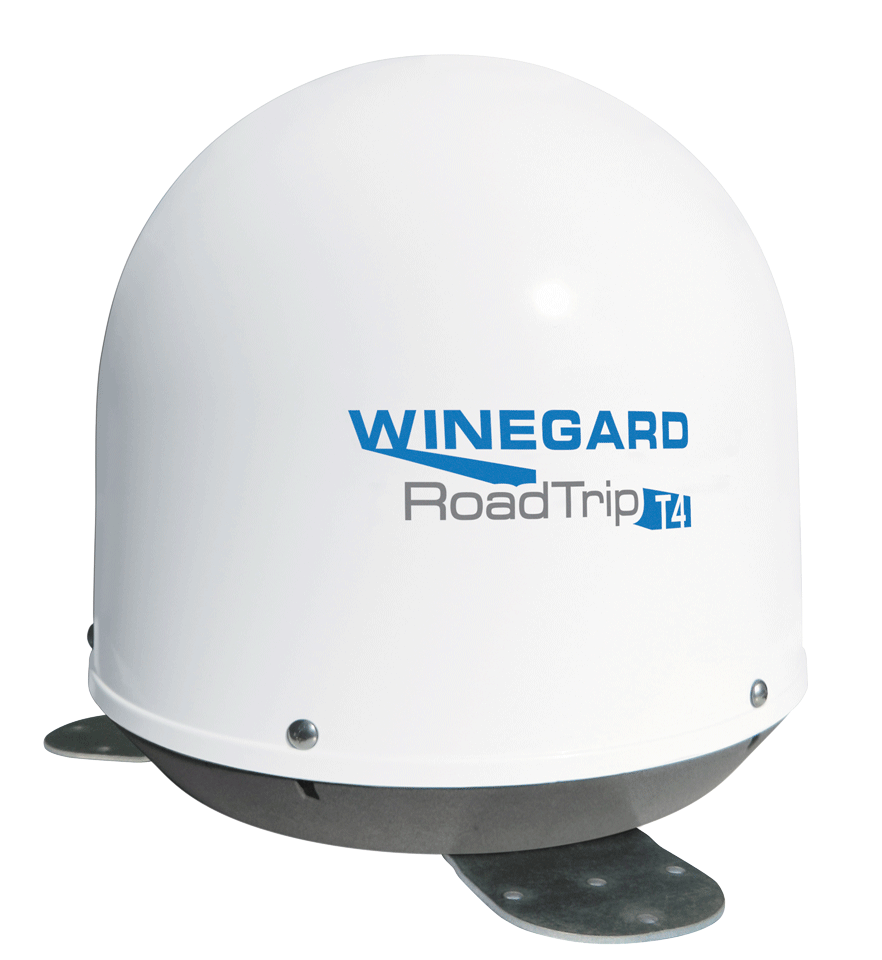
I have a Foretravel RV. I am considering installing Winegard’s roof-mounted RoadTrip T4 satellite antenna so passengers can watch TV as I drive. Is this antenna compatible with the Foretravel? I have DirectTV at my home. What other equipment do I need inside the RV besides the antenna on the roof?
— Larry Broussard, F446152 ● Lafayette, Louisiana
A satellite antenna is a great add-on product that can be installed on virtually any motorhome.
And typically with such a system, a receiver is required along with a wall-mounted kit for the incoming power connections. The entire kit often is included in the box with the antenna.
Depending on which service you subscribe to, the provider may lease the receiver to you. This would be the case were you to stick with DirectTV. The T4 can support two separate receivers in case you have one TV inside the motorhome and another outside or in a different area of the coach.
I have not tested or evaluated any of the currently available satellite antennas. I suggest you visit the FMCA Forums (https://community.fmca.com) to seek feedback from members who have experience in this area.
Camera Crash
I have a Thor A.C.E. motorhome. The camera monitor failed in 2016. I notified Jensen and they replaced it, but it failed again in 2018. They replaced it again, but on the receipt it said “no replacements.” It did not work properly when I installed it. The image on the screen is so dark that it can’t be made out. After a few minutes it goes blank. Also, camera three says “no input.” The unit is a radio and camera monitor mounted in the dash. I don’t know what to do to replace the unit. Any ideas?
— Daniel Rottenberk, F468914 ● Aston, Pennsylvania
Based on what I’ve read, Jensen has had some issues with the robustness of some of their radio and monitor systems in the past. I’m of the opinion that the constant jostling and vibration of a motorhome loosen connections or component contacts inside the device. Some people also blame the power source switching. I do not have a recommendation regarding a replacement unit, but I did find an interesting thread on the Thor Forums, www.goo.gl/2J6naV. Take a look and see whether the recommendations spark any interest for you.
Propane System Problems
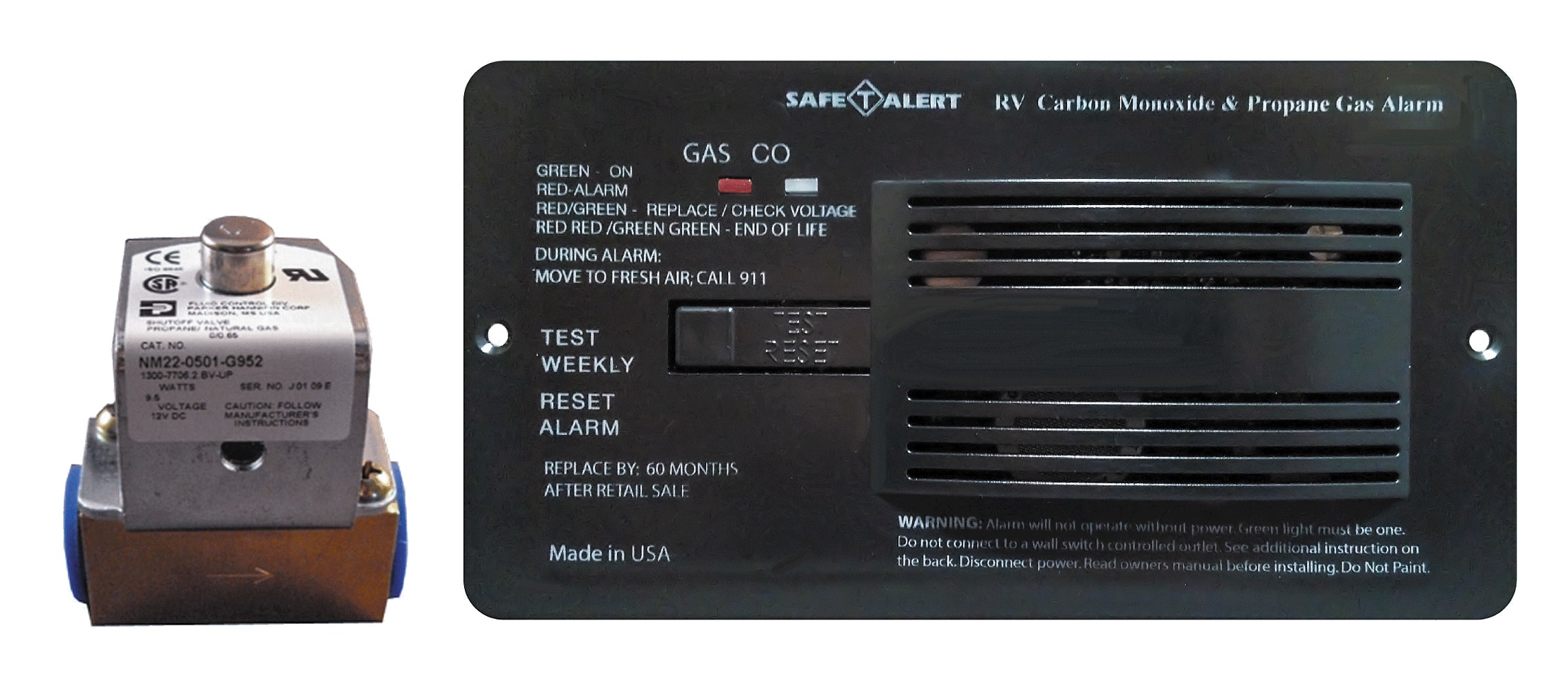
A typical carbon monoxide/propane alarm with a solenoid valve.
We have a 36-foot Forest River Georgetown motorhome. The propane system is not functioning. We have checked the solenoid valve and it is working properly, but not when it is hooked into the system. We also have replaced the 5-amp fuse, but that made no difference. The carbon monoxide/propane alarm was replaced last year. When we took the motorhome out for the first time this year, none of the propane appliances would work. Do you have any idea what the problem may be?
— Dan Gall, F314647 ● Baltimore, Ohio
I hate to ask this, but must: Have you checked to be sure you have propane in the container? Now that that’s out of the way, on to some other, more logical possibilities.
Remember, it is important that the pressure regulator be set properly to deliver 11.0 inches of water column vapor pressure. It takes special equipment to properly set the pressure, so this is best left to a certified service tech.
Once the pressure is correct, verify that the solenoid valve is opening and closing properly. Just because it makes a noise when power is applied does not mean the valve is actually closing. To quickly eliminate the valve (or the detector) as the problem, completely remove the solenoid valve, hook the connection from the regulator directly to the piping system that extends to the rest of the coach, and see whether propane flows without the solenoid valve installed. If the appliances operate normally, then you’ll know the problem is with the detector, the solenoid valve, or the wiring from point A to point B.
Another option is to bench-test the solenoid while it’s out of the system by blowing air through the valve as you energize it with a 12-volt source. The valve should close, thereby prohibiting further flow of vapor. There’s always the possibility that it works on the bench, but not on the motorhome. If you indeed have positive voltage to the solenoid when on the coach, also verify that you have a good, solid ground connection.
Also remember that if the detector was replaced, in most cases the solenoid valve will have to be replaced with the same brand. A new sensor/detector may not be compatible with the older solenoid valve.
If the solenoid is operating properly (remaining open when not energized), and there is proper pressure and zero leaks, and you still have no gas flow, look for a kink in the tubing or flexible connector somewhere in the system downstream of the regulator. This may require a little more inspection and troubleshooting, so verify all of the above first.
I’m guessing it’s a matter of the older solenoid and the newer detector not being compatible, or perhaps a faulty ground connection, but it may require a deeper level of troubleshooting to eliminate all the possibilities.
Mismatched Shore Cable
My nephew recently purchased a 32-foot travel trailer. During the walk-through, a question arose regarding the 120-volt-AC electrical shoreline service. The salesman declared it was a 30-amp RV and pointed to the power connection on the side of the trailer; he indicated three prongs equates to 30 amps. On my nephew’s first outing, he secured a site with 30-amp and 20-amp service. He connected the three-prong power cord to the side of the camper. When he tried to plug the other end of the cord into the 30-amp power pedestal, he discovered it had four prongs, which relates to a 50-amp receptacle. We scrambled to locate a 50-to-30-amp reducing adapter. Luckily, I had the needed reducing pigtail. Is this unusual — having a 30-foot power cord that has a 30-amp connection on one end and a 50-amp connection on the other end?
My nephew wants to add a plug-in surge protector as well. In his current configuration, he would need a 50-amp surge protector or a 30-amp protector with a 50-to-30-amp pigtail. I cannot see spending money for 50-amp surge protection when you are protecting only 30 amps at the trailer. I recommended that he contact the salesman and request a 30-to-30-amp power cord.
— John Schoepf, F232737 ● Moneta, Virginia
That does appear odd that your nephew has two different amperage plugs on his shore cord. I’m assuming this is a used RV and that the prior owner replaced one end and attached it to a longer cable. Definitely do not use that cord until a competent electrician has checked that the 30-amp end is connected to only one leg of the 50-amp end — not across both legs. Obviously, the coach is wired for 30-amp power, so I would suggest obtaining a new, detachable cord of that amperage.
You are correct in stating that because of the overload protection (circuit breakers), the limitation is 30 amps maximum. However, I would check to be sure that the main breaker on the RV is still a 30-amp breaker and that the former owner did not modify the internal wiring configuration of the RV or within the shore cord itself. Without a closer inspection, we can only hope he did not. I also believe the 30-amp surge protection is less expensive than the 50-amp version, so he’ll save a little money there.
I would indeed go back to the dealer and request they provide the correct shore cord. But I would not settle for a simple 30-amp male plug cap that can replace the male 50-amp plug. For code compliancy, both ends must include molded ends. I would demand a new power cord with correctly molded plugs at both ends.