
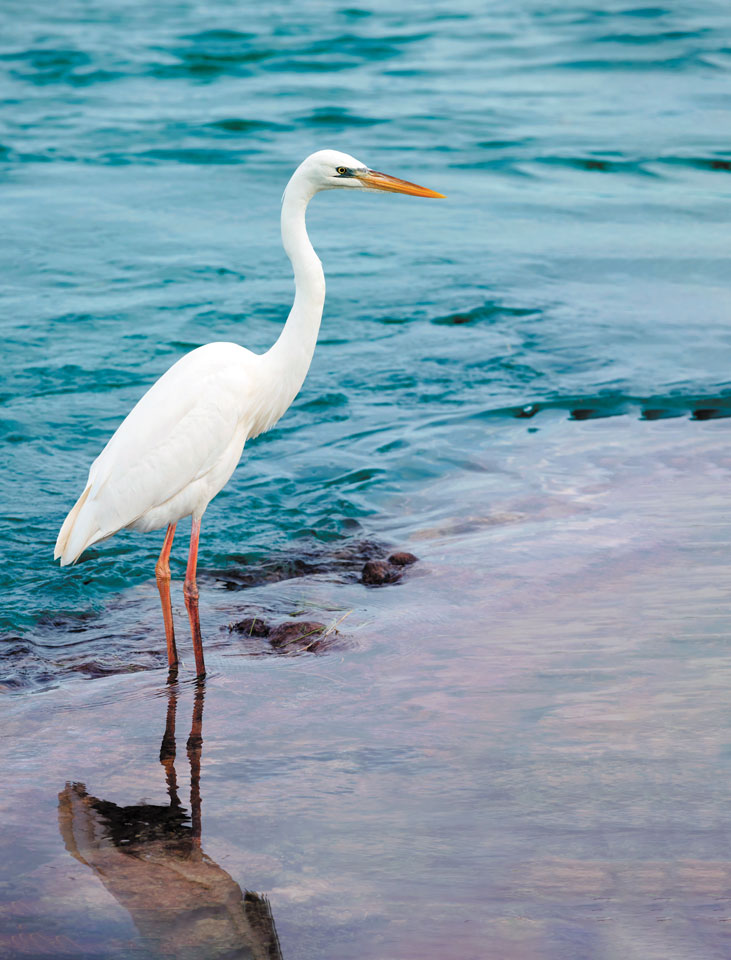
A film photographer recalls one lucky morning along Florida Bay.
By Bob Grytten
April 2019
Florida Bay, the shallow water between the Florida peninsula and the Keys, is home to about 850 breeding pairs of great white herons — the majority of the world’s population. Scientists are still not sure whether these birds are simply a white version of the more common great blue heron (Ardeaherodias occidentalis); or a subspecies; or maybe a separate species. They are sure that these are the biggest herons in North America.
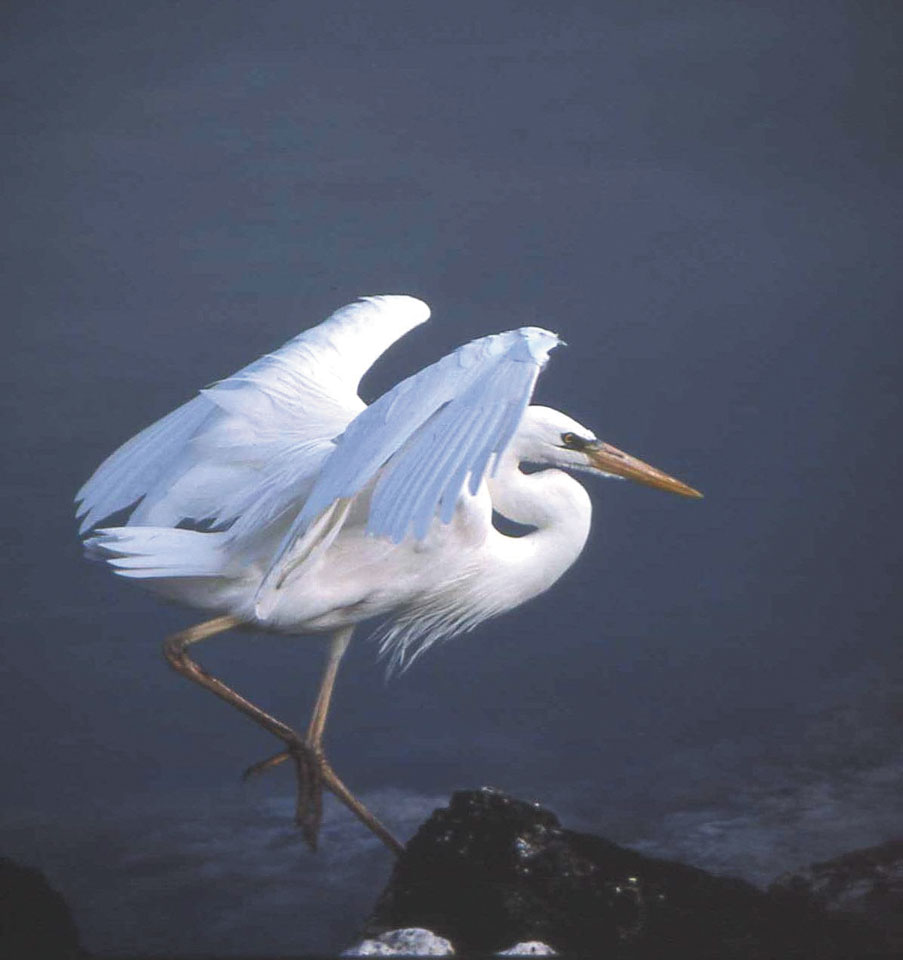
Patience was one of the keys to capturing the great white heron on film.
About 20 years ago, before digital photography was prevalent, I was in the area. My five-day stay didn’t allow much time, but I decided the Lower Keys, including the Great White Heron National Wildlife Refuge, would be the center of my photographic activities. If I was lucky, I’d be able to get close enough to photograph a great white heron.
An article I read spoke of the birds’ nesting habitat on nearby red mangrove islands along with a wide variety of other bird life: pelicans, egrets, and other herons. These colonies can be heard from some distance, especially in the mornings as they carry on their greeting and courtship rituals.
The winds had been blowing at about 20 mph. That is not unusual for February, but it ruled out getting to islands in the refuge by boat. I had heard of recent heron activity near Cudjoe Key, about 25 miles east of Key West along the Overseas Highway, so I went there.
Early morning light provides warm, rich colors, but the colors turn flat a few hours after sunrise, so the window is narrow. While many birds are busy concentrating on feeding and usually ignore a photographer, one has to be careful not to harass them, so it’s often slow going. That, coupled with limited “good” light, could only increase my challenge.
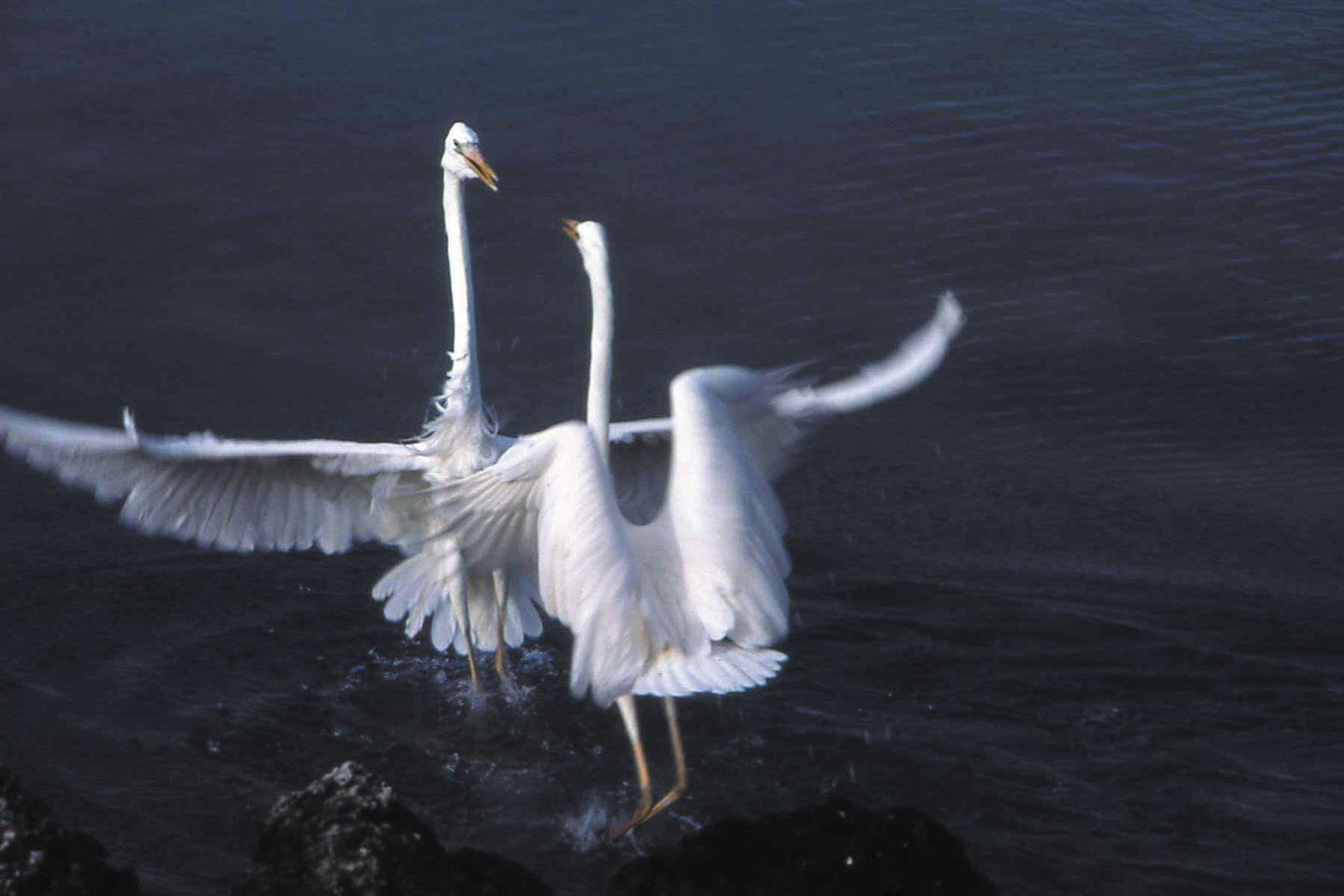
The author photographed two herons performing what appeared to be a courtship ritual.
The first two mornings I was able to get some good shots of a little blue heron and a snowy egret, but the great white heron was farther away than I wanted.
On the third day, I spotted another great white, but it was well camouflaged, and couldn’t be coaxed out for a clear picture. Great white herons have a knack for avoiding notice. If near cover, they will crouch with only their heads peering above the leaves. The shadows of the leaves break up the bird’s outline, making it almost invisible. Film can’t record contrasts in color and shades as vividly as our eye sees them, so a photo of the great white in the bushes was not going to work.
The fourth day, it rained.
My last day. One more try.
The wind speed was about 10 miles per hour. I drove toward Cudjoe Key on the Overseas Highway once again, hoping to see a bird while driving. The sun just breaking over the horizon cast a warm glow. Beautiful. As I crossed more bridges, the road bank dropped sharply to the blue-green water.
Then, just to my left, I saw a flash of something white in the rearview mirror. I swung the car around and approached slowly along the shoulder. The vehicle shook as other travelers whooshed by. I edged closer. There it was. At first I thought it was an egret, but no! Its bill was much thicker, and its yellow legs confirmed it. A great white heron!
I noted a second one by a bridge about 100 feet away. What could they be doing? Herons generally stalk their prey at night; they like herring, sardines, and mullet. They rest on mangrove islands during the day.
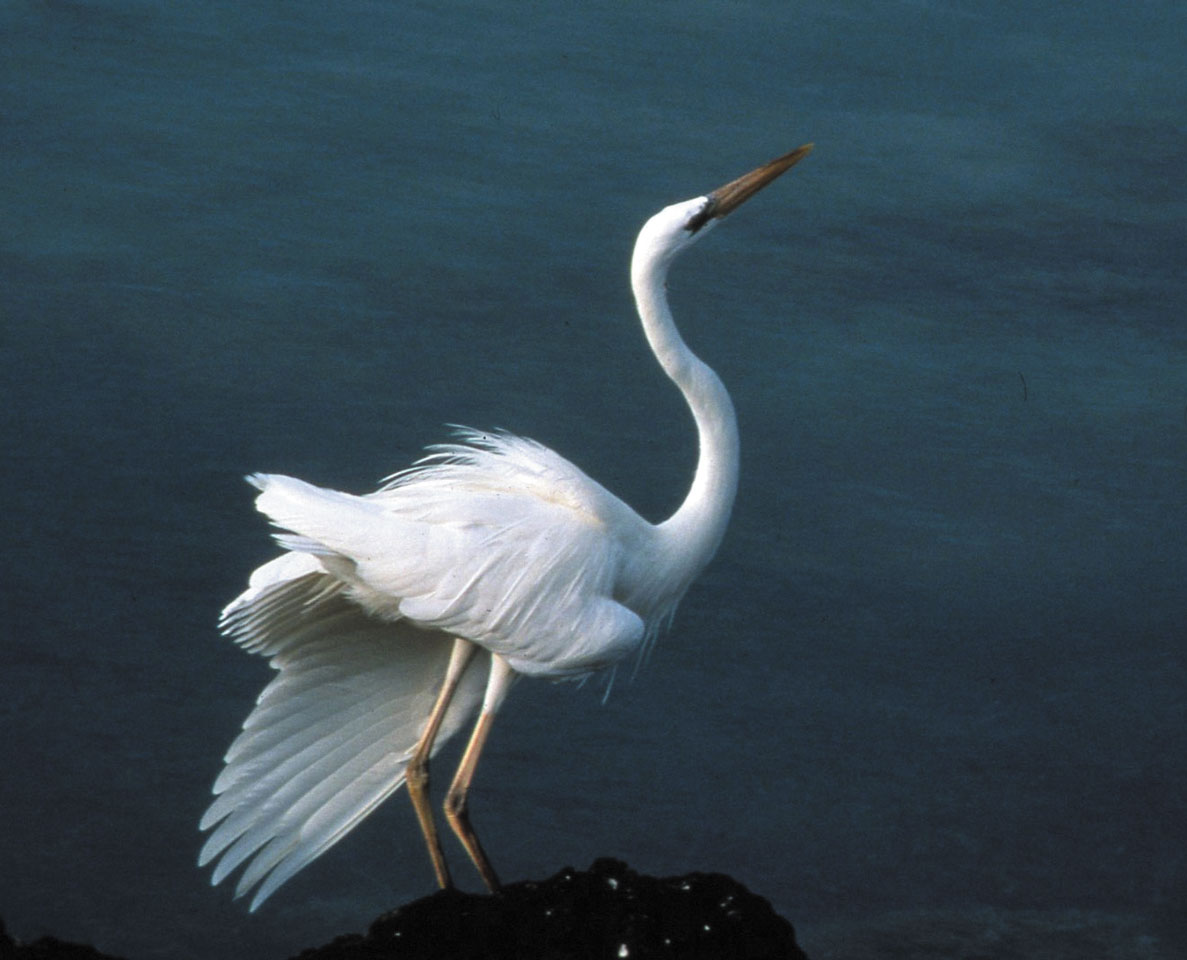
During a courtship ritual, a bird held a wing at its side, as though it were broken.
It’s best to stay in the car in areas where birds are used to traffic. I attached a Nikon 300 mm lens to the camera and aimed out the open passenger window. I adjusted focus and took my first grab shot. Would either one take flight? Or both? My heart pounded.
They ignored me.
I slowly moved the car about 10 feet closer. They seemed preoccupied. I concentrated on the heron closest to me and made full-frame shots. Then one of them began walking around nervously, amid the rough, rocklike coral shore. Out of the corner of my eye, the other one was moving my way, his neck stretched, head high.
It had to be some kind of courtship ritual. Without warning, the larger bird took flight, landing a few yards away, right wing down at its side as though it were broken. Its feathers were ruffled out now, head still high in a curved position. The other bird approached, wading closer to shore. Now they were both in the water. They came closer together, looking at each other.
Suddenly, they both leapt into the air, face to face, wings flapping, bills parted. They leapt again and again, water splashing, necks and bodies stretched high. I lost track of the frame I was on and only hoped I wouldn’t run out of film.
They stopped just as quickly, as though nothing had happened. One was in a crouched position, neck and head pulled in. The other floated on the water like a swan, wings stretched out, head high. They were unbelievably beautiful, and I was there, lost in the moment.
I quickly reloaded my camera. Dare I risk getting out of the car to move closer? Just then I spotted a hitchhiker approaching, thumb out. The closer he came, the less time I had to make any more shots before they flew away. I opened the door and slid out. There was no time left to stalk carefully. I quietly approached, managing only six more shots before the birds took flight.
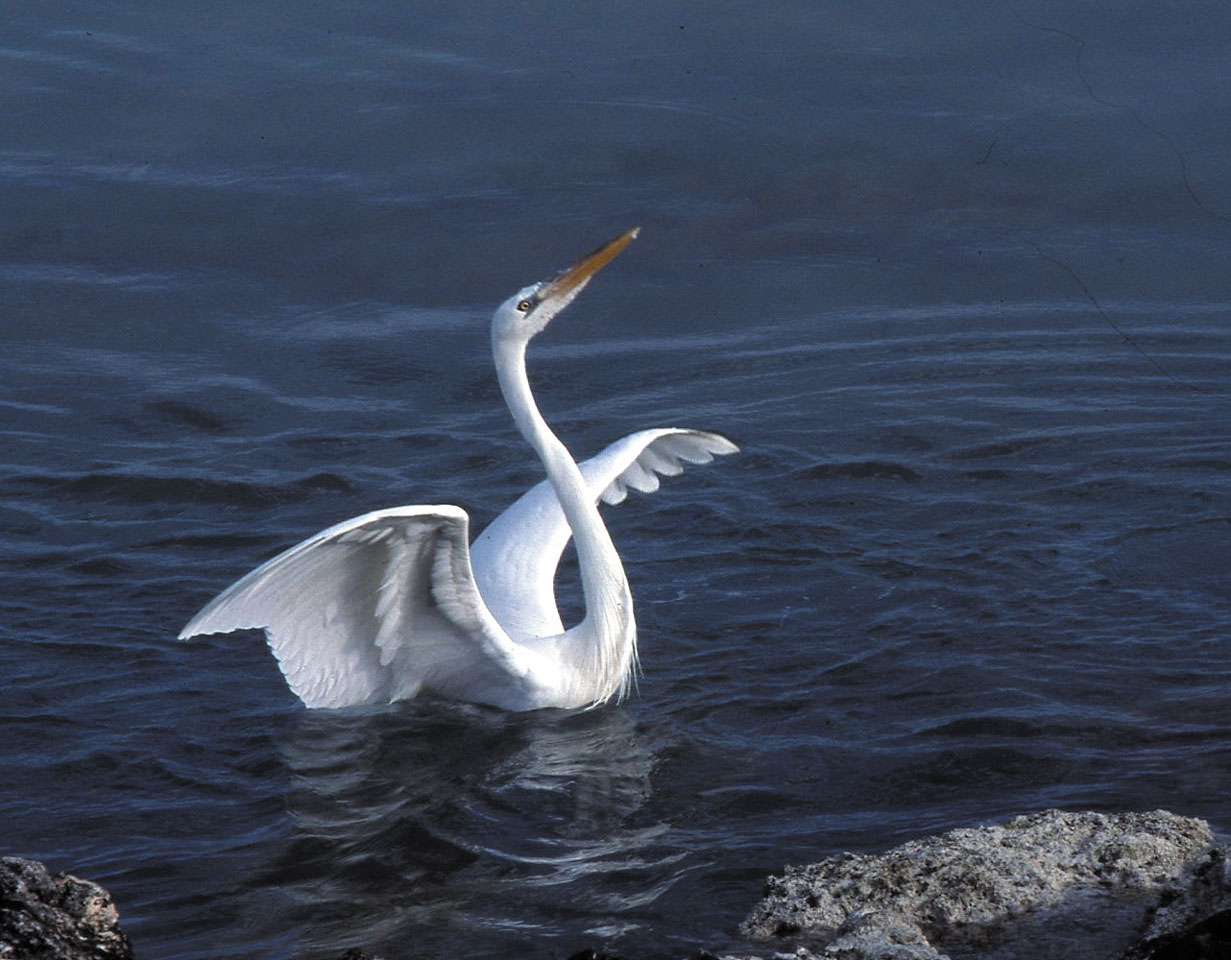
The author captured the moment a great white heron regally floated across the water.
The golden morning light was still on the entire scene. A broad smile crept over my face. Not only had I photographed this marvelous thing I had actually come for, but I had also witnessed some kind of activity beyond my wildest imagination.
The Great White Heron National Wildlife Refuge
This area was set aside in 1938 as a haven for great white herons, migratory birds, and other wildlife. It encompasses almost 200,000 acres of open water and islands, and is known locally as the “backcountry.” The refuge provides critical nesting, feeding, and resting areas for hundreds of species of birds and sea turtles.
Visiting today. Wildlife-dependent activities are allowed; these include saltwater fishing, boating (with restrictions), snorkeling and scuba diving, wildlife observation and photography, interpretation, and environmental education. If you don’t travel with your own kayak or boat, consider a wildlife tour through a local company such as Dream Catcher Charters: (888) 362-3474.
The visitors center for the refuge is on Big Pine Key at the National Key Deer Refuge. For more information, contact: (305) 872-0774; www.fws.gov/refuge/Great_White_Heron/.