
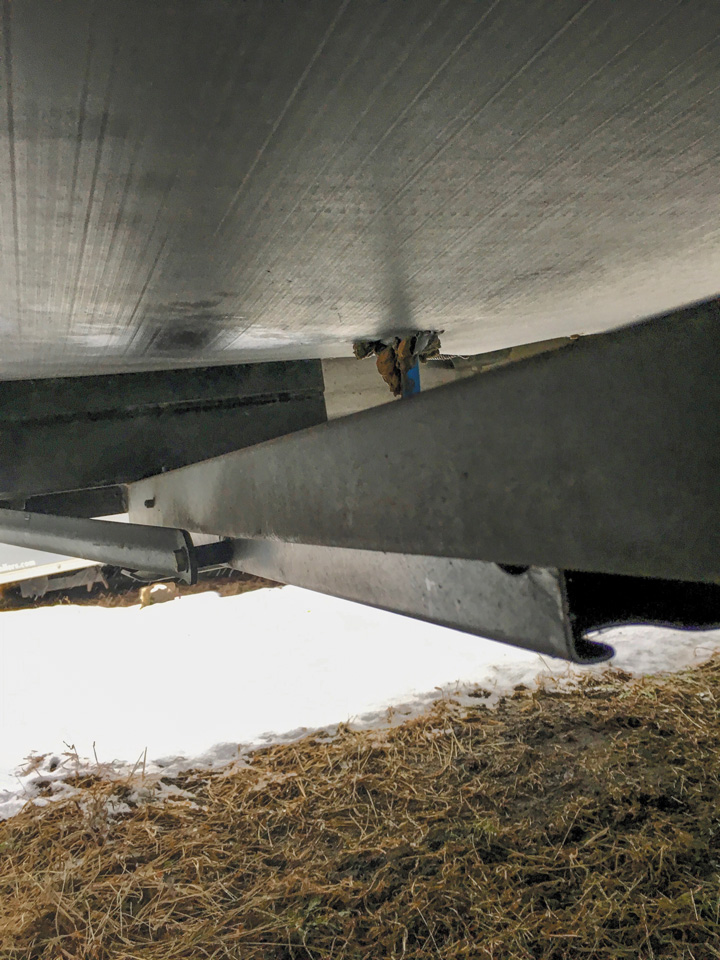
Stuck Stabilizer
I just purchased a preowned Cougar travel trailer from a dealer. While the RV was at the dealership, the front switch was used to activate the rear electric stabilizer unit, but I failed to have them extend the legs all the way to the floor. When I parked the RV for winter storage, I tried to extend the legs. I hear the motor running, but the legs do not come all the way down. The motor stops when extending and when retracting after about 30 seconds or so of activation. It does not trip or burn fuses. The motor just stops as though it reaches a limit. Am I missing a manual latch or other manual component that I should turn or unlatch, or could the screw have run out of the threads?
John Sadler
Via email

Boeshield T-9 spray lubricant may help with stuck stabilizers.
Unless someone manually overextended the drive screw, the stabilizers should come all the way down. I can’t see any drastic issues in your photo. See whether you can lower them farther with the manual override, but be careful. It is possible to strip the gear if too much force is used in either direction.
Your stabilizer appears to be the Ultra Lite version from Lippert Components. The Ultra Lites came equipped with a spacer that is not replaceable, unfortunately. If the spacer is damaged, the assembly must be replaced. But, it could simply be a matter of rust, salt, or debris in the screw gear.
Even though the stabilizers do not require lubrication, it might be necessary to spray them with a lubricant such as Boeshield T-9 to get past that one stopping point, but try lowering them manually first. Unless the prior owner added something, there should be no other latching mechanism to worry about.
Tow Or No Tow

Ford F-150
I have a 2017 Ford F-150 Limited 4×4 pickup truck, SuperCrew cab, with a 145-inch wheelbase, 3.5-liter V-6 EcoBoost engine, and a 10-speed automatic transmission. It is equipped with 22-inch wheels, a 3.31 rear axle ratio, and a trailer tow package with a brake controller, a dynamic hitch, and backup assist. I am considering a Grand Design Reflection 315RLTS travel trailer. These are the specifications:
unloaded vehicle weight: 8,994 pounds
hitch weight: 1,065 pounds
gross vehicle weight rating: 10,995 pounds
length: 37 feet 11 inches
height: 11 feet 5 inches
wheel size: 16 inches
Can my F-150 safely tow this trailer?
Barb Echols, F452310
San Antonio, Texas
Your truck, properly equipped, is rated to tow a maximum 11,100-pound travel trailer, according to Ford. Another number to consider is the gross combination weight rating (GCWR), which would include the full weight of the trailer, as loaded for travel, as well as the weight of the truck and all its occupants and stored cargo. Your F-150 has a GCWR of 16,700 pounds. The unloaded vehicle weight of the Reflection, according to your numbers, is about 9,000 pounds, but its gross vehicle weight rating (the maximum allowable weight of the fully loaded vehicle) is almost 11,000 pounds. Doing the math, I would not feel safe with your truck towing that trailer, since it’s likely you’ll exceed the maximum tow rating of 11,100 pounds easily. It’s just too close for comfort, unfortunately.
Timed Battery Charging
I keep my diesel pusher motorhome hooked to 120-volt-AC power all winter long. I also have a trickle charger hooked to my chassis batteries through the 120-volt receptacle in the engine compartment. This setup allows everything to be routed through my surge protector. I have just purchased a weekly timer that would allow my hookup to the motorhome to be powered just eight hours, two days a week. Is this a good idea? Will turning it on and off twice a week for eight hours each time cause electrical problems?
Rick Estes, F463382
Nampa, Idaho
I’m not usually a fan of leaving the coach plugged into shore power when not utilizing the RV. However, in your instance, I can see validation. With lead-acid batteries in particular, it’s quite possible to overcharge the batteries when no one is around to check the electrolyte level on a regular basis. But in your case, at only twice a week, I see no problem. Just be sure to check the level at least periodically. Your motorhome likely has a sophisticated, three-stage charger for the house batteries, but limiting the time under a charge for all the batteries will do well for keeping both banks charged, while allowing adequate time for rest and dissipating the surface charge. Keeping an eye on the hydration level is important, so don’t forget to check it periodically. I see no harm in your setup as long as you remain diligent.