
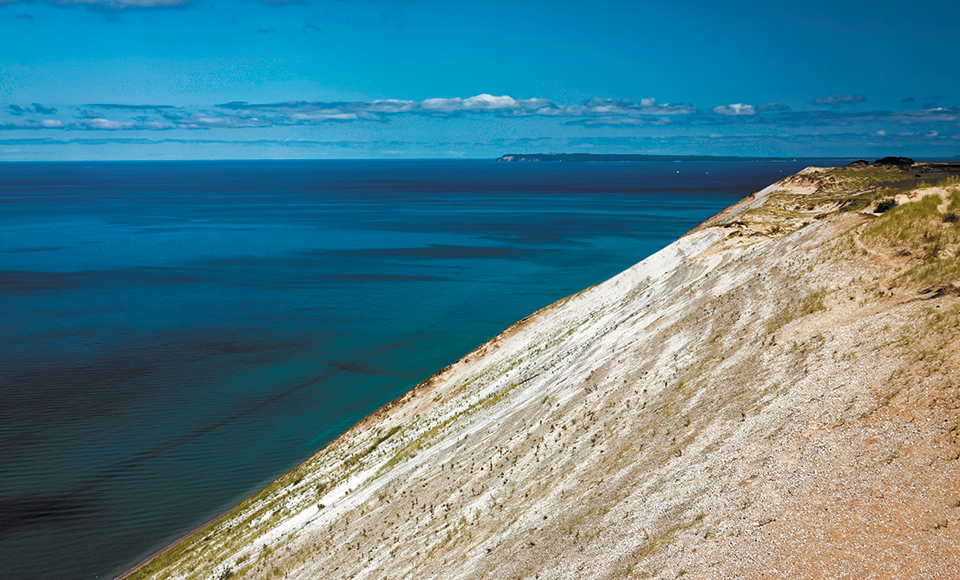
Autumn color enhances the amazing beauty of this park located along Lake Michigan.
By Sally Weigand
October 2019
Sleeping Bear Dunes is a whimsical name for a superb vacation spot. It’s a national park with 71,000 acres of land, 65 miles of shoreline, and two offshore islands. Blue water meets sandy shore placidly in some places, and with ocean-like waves in others. Tan sand dunes rise high into the sky, sculpted by wind, water, and winter’s ice.
RVers will want to know that green forests shelter the camping spaces, as well as the hiking and biking paths. A black nighttime sky highlights sparkling stars. To this multicolored landscape add historical interests, outdoor activities, multiple smaller lakes, and nearby villages — all elements are present to keep the entire family enthused.
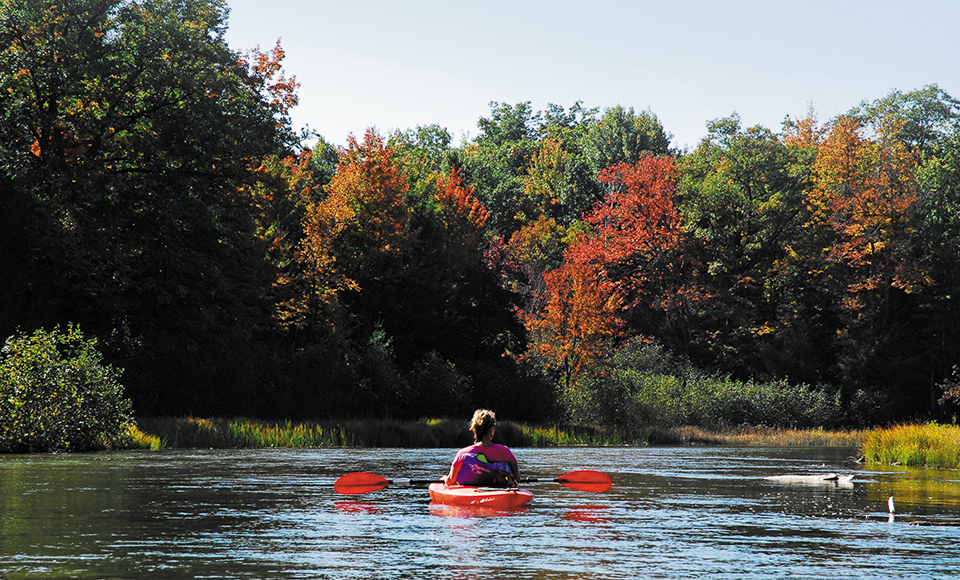
Visitors can kayak on the preserve’s lakes and rivers.
Before the land became a national park, a local lumberman named Pierce Stocking built a scenic route through the Sleeping Bear Dune plateau. The winding road, Pierce Stocking Scenic Drive, still leads through forest and climbs past viewpoints atop the surrounding landscape, overlooking high dunes, to a trailhead and an observation deck 450 feet above Lake Michigan. With the park’s visitor guide in hand, you can learn something at each of the stops. The road is 7.4 miles and open May through mid-October.
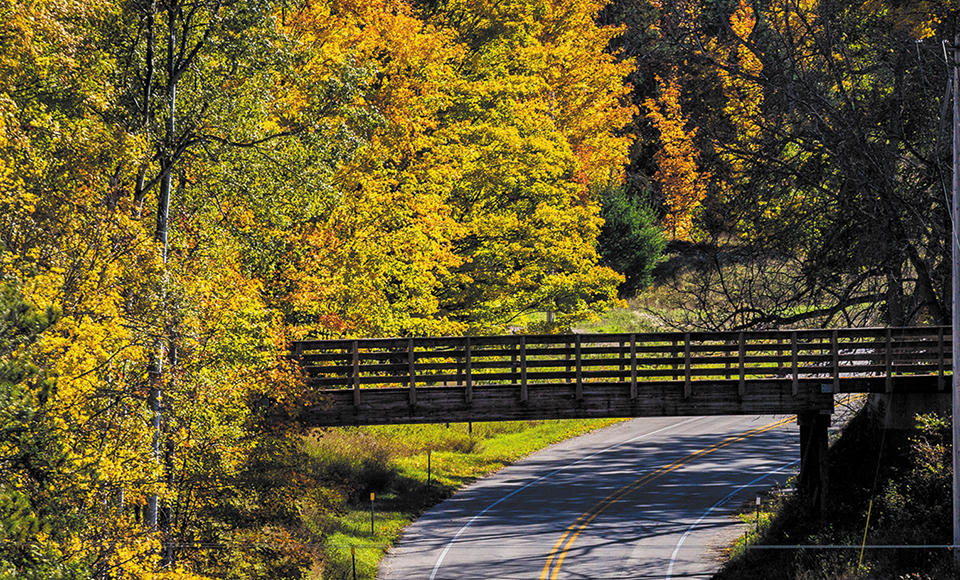
Fall colors enhance tours along scenic roads in Sleeping Bear Dunes National Lakeshore.
The road has steep hills and tight curves. RVs are permitted, but parking is limited at the overlooks; the most popular overlook has only two RV spots. In addition, no tow combinations are allowed. So, if you are towing a trailer or towing a vehicle behind a motorhome, you must unhitch and drive only one vehicle. A parking area has been set aside for unhitched trailers. A covered bridge at the onset of the route has a clearance of 13 feet 6 inches and so should accommodate most RVs; just know your height limit. And check with rangers before you embark.
Nearby, the Dune Climb beckons the more athletic to ascend the 110-foot-high shifting surface of sand for the view from the top. Some climbers resort to rolling back down. Many rest with a snack at the picnic tables on the grassy base afterward. If this isn’t challenging enough for you, trek up and down more dunes on the Dunes Trail until you reach Lake Michigan, an arduous round-trip hike of 3.5 miles. It’s best to stay on the marked trails and take sufficient water for hydration. The dunes are open year-round.
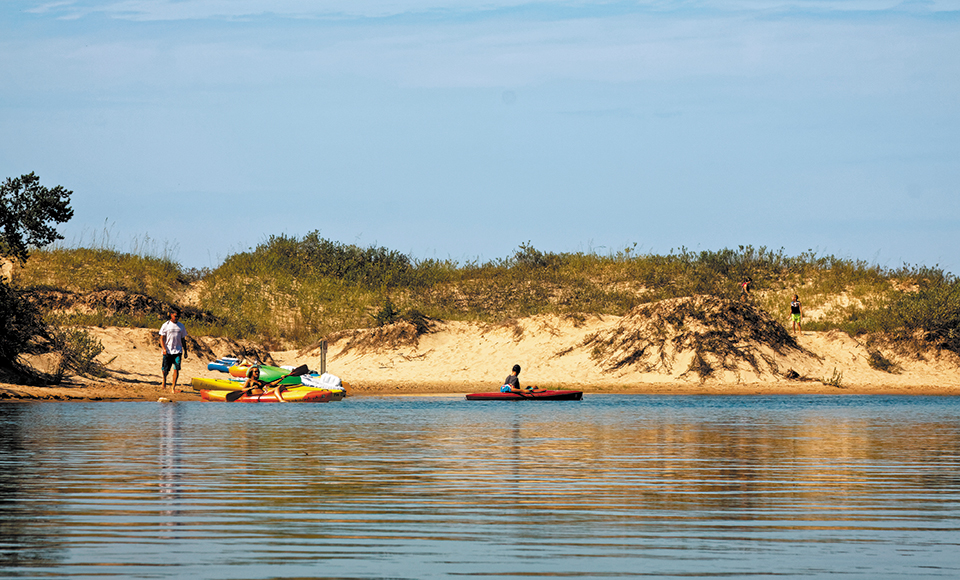
Many visitors bring their rafts, kayaks, canoes, and other personal watercraft to the park.
Summer’s warmth lures visitors to the pleasant beaches for relaxing or cooling off in the clear and cool water. Since water takes longer to cool than air, autumn is a great time to enjoy a dip as well. Be mindful of currents in Lake Michigan and know that no lifeguards are there to watch swimmers. Platte River Point, where the Platte empties into the lake, provides a protected area that children can play in safely, so it’s a very popular summertime spot. Seven additional sand beaches are scattered throughout the park and offer more seclusion.
Leisurely wending their way down the Platte River and Crystal River, kayakers and tubers laugh and call to each other from their colorful crafts. Fall is a great time to do this. Within the park boundaries, 21 lakes of varied sizes beckon fishermen, swimmers, kayakers, and canoeists to savor the water. Motorized boats are not permitted on most of them.
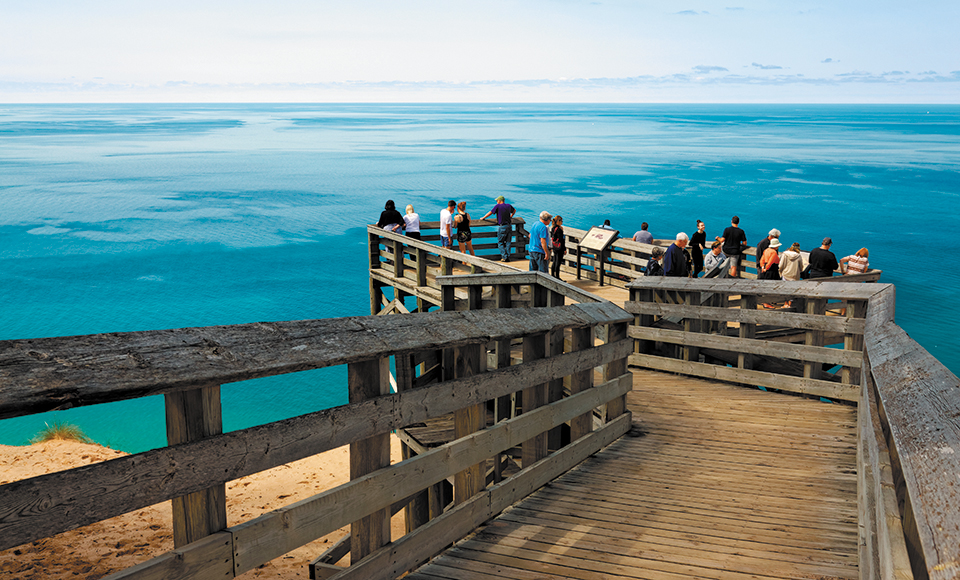
This overlook high above Lake Michigan is located along Pierce Stocking Scenic Drive.
Through the woods or fields, on sand or to broad vistas along 100 miles of trails, each hiker or walker in your crew will be satisfied. Bicyclists and walkers appreciate the Sleeping Bear Heritage Trail, a predominantly hard-surface pathway that meanders for 22-plus miles from the little town of Empire to Bass Lake. Most of it is comfortable to tour, as hills generally have less than a 5 percent grade. Users of wheelchairs and strollers find the less hilly sections very pleasant. If you own bikes, this is the trail for you.
Take a break in the small town of Glen Arbor to visit restaurants and attractive shops. Even if you aren’t using this trail, take a drive to Glen Arbor to sample the small town or to boat on Glen Lake or Crystal River.
Two historic districts reveal diverse aspects of former ways of life. Both are a part of the park itself. The first is the village of Glen Haven (not to be confused with Glen Arbor). Glen Haven is typical of the small settlements that served the steamers along the Great Lakes. Close to the water is the large Cannery Boathouse, formerly used as a cherry cannery and now housing an impressive collection of restored Great Lakes watercraft. The D.H. Day Store appears as it did in the 1920s and offers merchandise you would expect to find in such a place. Watch a blacksmith at work forming useful items from iron.
The general store, boat museum, and blacksmith shop officially close after Labor Day, but visitors are welcomed to enjoy meandering around the village. Rest rooms will still be open, and on some weekends, you may still find the blacksmith working.
Continuing a short distance along Sleeping Bear Dunes Road takes you to the Maritime Museum, which also closes after Labor Day, but, again, visitors can enjoy exploring the grounds. During the summer season, this museum tells the story of shipping on the Great Lakes and of the U.S. Life-Saving Service, which became the U.S. Coast Guard. From the boathouse here on Sleeping Bear Point, men rolled lifeboats on tracks to the water to help passengers on floundering ships. Stand and imagine the number of men and the work it would take. At the daily summer program “Heroes of the Storm,” rangers demonstrate, with help from kids, how the Life-Saving Service rescued shipwreck victims. Using the Lyle gun, they fired a heavy line from shore to a distressed ship to retrieve its stranded crew. Furnishings and exhibits in the main building give visitors a feel for what it was like to work here in 1931.
Fall travelers will revel in a colorful driving tour in the huge Port Oneida Rural Historic District, 3 miles north of Glen Arbor in the northern reaches of the parkland. According to public information officer Merrith Baughman, this 18-homestead area is the largest historical farm district owned and protected by the United States government. Quiet, peaceful, and blissfully stuck in the past, it reveals turn-of-the-20th-century farming methods, plus land and buildings handed down through families. Visitors are free to stop, walk around, and peer into windows and admire the hard work that built these properties.
From the town of Leland north of the national lakeshore, passenger ferries make the trip to and from South Manitou and North Manitou islands. Separating these islands from the mainland is Manitou Passage, infamous for the numerous boats it has claimed.
The only lighthouse in the park is situated on South Manitou. On a visit, you can walk to sand dunes, some remains of a village settled in the 1830s, or the sand beach around the island. In summer, tractors pull wagons taking tourists on two different tours of parts of South Manitou.
Day-trippers travel to South Manitou; visitors to North Manitou must camp overnight (tents only). The ferry runs a few weeks after Labor Day to both islands, but on a very limited basis.
Even if you are not exploring the islands, the small town of Leland makes an entertaining visit. Old wooden shanties and docks line the harbor in the historic area known as Fishtown. Although commercial fishing operations once housed there are gone, galleries and shops have replaced them. You can catch dinner from a charter fishing boat; relax on sand beaches on Lake Leelanau or Lake Michigan; and treat your palate to a variety of wines at tasting rooms, both in town and farther inland in Lake Leelanau. For spirits, visit a distillery tasting room.
Scuba divers delight in exploring numerous shipwrecks in the Manitou Passage. Some wrecks are not far from the shore; others are around the Manitou islands. This area, known as the Manitou Passage Underwater Preserve, provides diving depths of from 5 feet to 165 feet for all abilities.
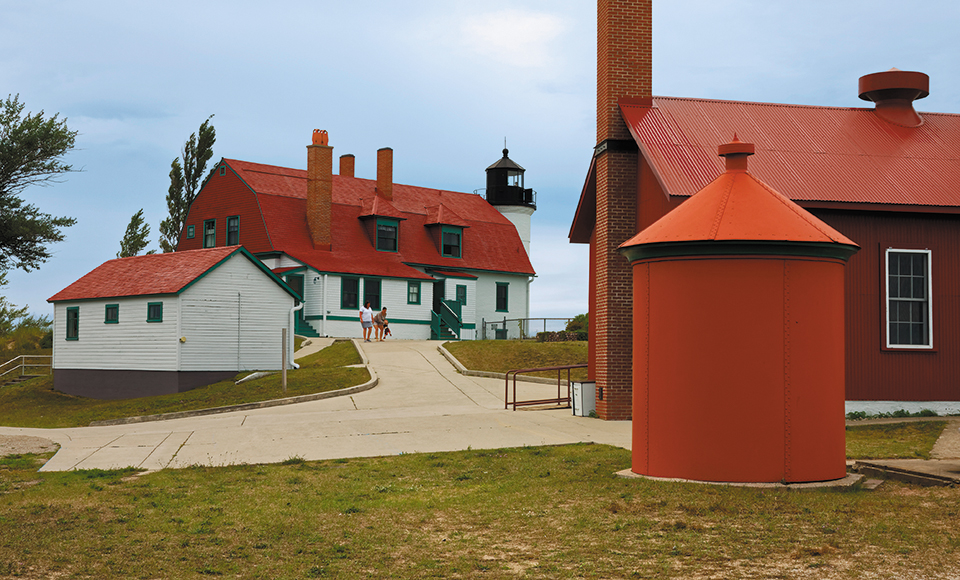
Portions of the Point Betsie Lighthouse complex are open to visitors, including the 1858 keeper’s residence and the light itself, which has 34 steps to the top.
Outside the southern border of Sleeping Bear Dunes stands the Point Betsie Lighthouse, constructed in 1858. Although no longer in service by the Coast Guard, it has been restored and is maintained by a volunteer group. The lighthouse is open to tours for a small fee Thursdays through Mondays until October 27 this year.
On October 16, 1880, a violent Great Lakes storm sank 90 boats; 118 people lost their lives. Among the damaged vessels was the schooner J. Hazard Hartzell, with a crew of seven men and a female cook. Don’t miss learning the story of this rescue, which involves the saved crewmen abandoning the woman on the ship.
RV travelers will be glad to know that two campgrounds are open within the park. Platte River Campground offers modern facilities, while D.H. Day Campground is rustic. Platte River is open year-round, and D.H. Day closes the last Sunday in November. Both are in wooded areas. In addition to these, the region is home to about a dozen more RV campgrounds with hookups.
Although the landform that prompted the American Indian legend for which the lakeshore is named has eroded, Sleeping Bear Dunes is a vacation spot to remember. Western Michigan has the largest freshwater sand dune complex in the world. Experience it for yourself.
Further Info
Sleeping Bear Dunes National Lakeshore
(231) 326-4700, ext. 5010 (visitor center)
www.nps.gov/slbe/
The park is open year-round, as is the park’s Philip A. Hart Visitors Center in the town of Empire. National Parks passes are honored for entry. Those without a pass pay $25 per vehicle for a visit up to seven days, or $45 for up to a year.
Reservations are needed at Platte River Campground through October 15. For campground reservations, call (877) 444-6777 or visit www.recreation.gov. For campground information, call (231) 326-4700, ext. 5019, or the main park phone number — (231) 326-5134.
For details about privately owned commercial campgrounds in this area, check the RV Marketplace listings on FMCA.com (and in the January issue of Family RVing) and also those listed through the local travel info source below:
Sleeping Bear Dunes Visitors Bureau
(231) 334-2000
info@sleepingbeardunes.com
www.sleepingbeardunes.com