
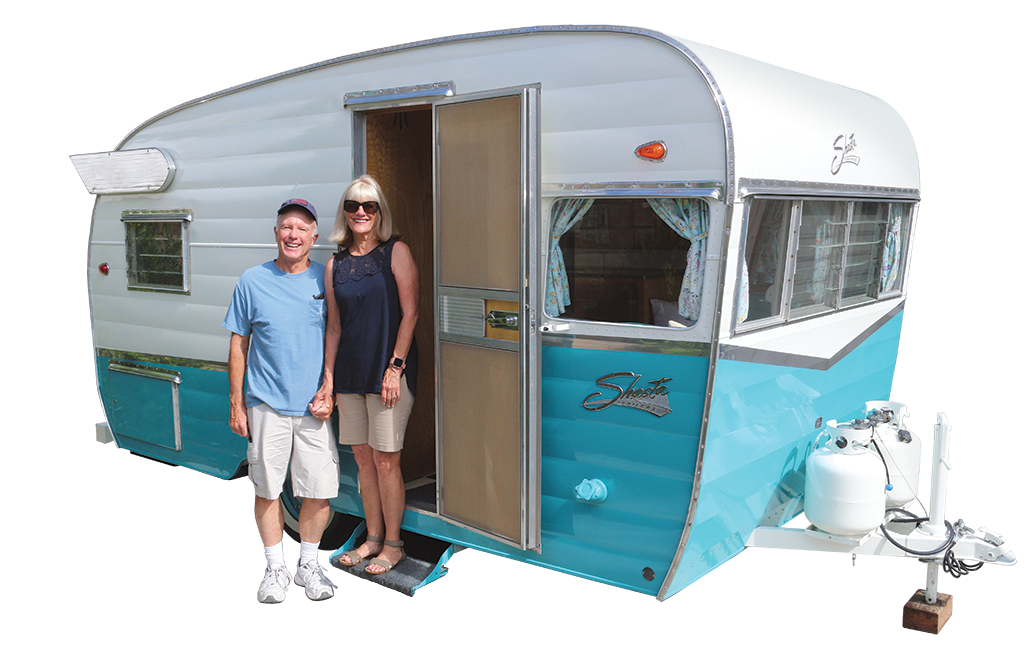
A 1963 Shasta receives new life after a retired airline pilot purchases it and embarks on a mission to return the unit to its former glory.
By Lazelle Jones
December 2019
Every now and then, we hear of hidden treasures being revealed. One example is a Caravaggio painting found in the attic of a home in Toulouse, France, several years ago that was valued at up to $170 million. Another is the 1963 Shasta 16 SC (16-foot, self-contained) travel trailer Pete Cooper stumbled upon in Barstow, California.
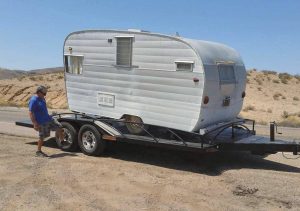
This 16-foot Shasta travel trailer sat unused in Barstow, California, from 1970 to 2017 before the Coopers purchased it.
Pete is a retired American Airlines pilot, and someone whose passion is to take things apart and put them back together so they are “as good as new” — or, in some cases, better. On a whim more than anything, he and his wife, Maggie, went to Barstow in the summer of 2017 to look at a Shasta travel trailer that had been parked alongside a house there since last being used in 1970. The folks in Barstow were the second owners. They purchased the RV from the original owner in 1968 and had used it only three times.
The high-desert environment in which the vintage RV had been parked preserved it somewhat during the 45-plus years the vehicle sat idle. The all-white factory paint that had adorned it back in November 1962 no longer existed, though, having been sandblasted in essence, leaving just the bare aluminum skin. However, get this: Pete discovered that the propane refrigerator still worked, as did the propane oven and the three-burner cooktop. With so little use over the years, even the original screen door was in good condition, free of rips or tears.
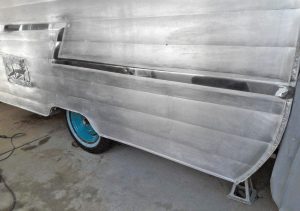
One of Pete’s jobs was to restore the decorative “Z”-shaped aluminum strip on the exterior.
The second owners of the unit handed Pete the 1963 bill of sale from the original owner. They also had up-to-date DMV paperwork, including the registration, and the vehicle had a current license tag.
Just in case he decided to buy the vintage RV, Pete had brought along an assortment of items and tools to help get the unit home, including an air compressor. And, guess what? The tires held air. He called his friend, Chuck Sacks, who had a pickup truck and a flatbed trailer. Chuck hauled the Shasta 120 miles to his shop (California Skier in Lake Elsinore), where Pete had him install new tires, inspect the brakes, and replace the wheel bearings. Finally, Chuck towed the Shasta over Ortega Highway (California State Route 74) to Pete’s place, where the real work would take place.
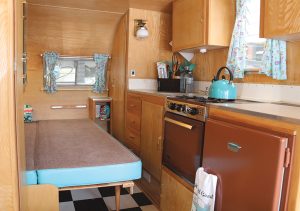
The Shasta contains original working appliances.
Pete decided to restore the interior first. The wood panel walls inside had obvious water damage below the windows. He removed the damaged wood and replaced studs where needed. He also added block-foam insulation in these areas. He replaced the interior walls with new wood panels that matched the original.
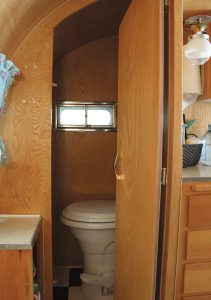
The private bath features a hinged door.
Only a few modifications had been made to the Shasta over the years, among them adding a couple of mirrors and a second propane tank. Pete removed the mirrors, but he kept the second propane tank. The refrigerator, cooktop, and oven were serviced, and a single sheet of black-and-white checkerboard vinyl replaced the interior floor surface. The original porcelain toilet was swapped out with a new one. The front dinette was updated with new upholstered cushions, as was the rear sofa bed.
The residential systems found on this 1963 Shasta travel trailer were quite different from those of today’s RVs. The Shasta had no 12-volt-DC electrical system. For primitive camping, the light source was a Veritas propane-fueled lamp that is anchored to the wall, where it illuminates the galley and the rear bedroom area. This fixture also heats the interior, for there was, and still is, no heating and cooling system in the original Shasta SC. The propane light operates like a conventional lantern, with a mantle inside. A window needs to be cracked to ventilate the interior when this device is in service.
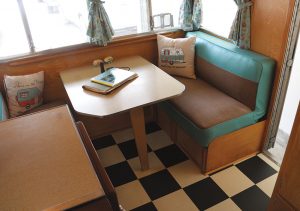
The front dinette was updated with new upholstered cushions, as was the rear sofa bed.
Pete added a 12-volt-DC system to support modern power supply needs, along with a 12-volt no-maintenance absorbed-glass-mat house battery to power it. To charge the battery, he installed a controller/converter. The original configuration consisted of a 15-amp 110-volt-AC connection for use where shore power was available, with a circuit breaker located behind a cabinet door. The original Shasta featured a 110-volt light in the ceiling above the dinette, which Pete retained but updated. He also added a smoke detector and a carbon monoxide alarm/propane detector.
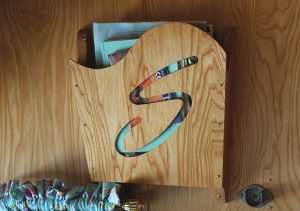
A magazine rack adds flair.
Pete also added an electric water pump, as the original unit had none. With no 12-volt DC power on board the original unit and no water pump, how was water delivered from the fresh-water tank to the galley faucet and to the marine-style toilet for flushing? It turns out that Shasta engineers implemented a very interesting design to keep the fresh-water system pressurized. The 20-gallon galvanized-metal fresh-water tank is mounted underneath the front dinette. The fill point is on the bottom of the tank, which has an attachment for a garden hose. When the garden hose spigot is turned on, water flows from the garden hose under pressure, and as the bottom of the tank fills, a blanket of pressurized air is created across the top of the water in the tank. When the garden hose is removed and the entry point is capped, this pressure blanket above the water inside the tank provides the push to deliver the fresh water through the system to the galley and to the toilet in the rear bathroom. Ingenious!
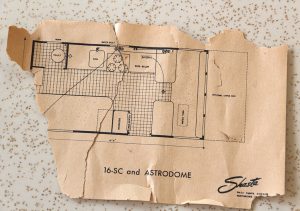
The Shasta’s original floor plan.
But that was only half of Shasta’s pressurized fresh-water system design. If you happened to be primitive camping, or otherwise did not have access to a garden hose with fresh water, another fill point was available to add water to the tank. On the patio side of the unit, just forward of the entry door, is a large metal cap that looks like a gas cap. With this cap removed, a fill spout becomes available, and water can be poured via a gooseneck into the fresh-water tank. To solve the issue of how to pressurize the system, Shasta engineers installed a valve akin to the ones used to add compressed air to a tire, allowing a bicycle pump to be attached and the system pressurized. Sweet!
The Shasta 16 SC has a waste tank that holds slightly more than 20 gallons (it has no separate gray-water tank); so, when the fresh-water tank is filled, it’s wise to empty the waste holding tank. The waste holding tank services both the galley sink and toilet. The Shasta does not have a shower, nor does it have a water heater.
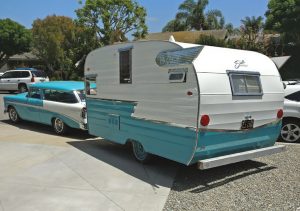
The trailer, now teal and aqua, is towed by a matching 1956 Chevy Nomad station wagon.
A sofa sits at the rear of the trailer against the curbside wall, across from the room that houses the toilet. The sofa converts into a double bed by sliding a sheet of finished plywood (part of the platform the sofa rests on) toward the bathroom and then spreading out the foam sofa cushions to create a sleeping area. When the double bed is made up, the bathroom door cannot swing open fully, which would make it impossible to use the toilet. Shasta designers thought through this issue as well: They hinged the door in the middle (top to bottom) so it can be folded in half, allowing it to be opened all the way.
When Pete moved outside the Shasta to begin the restoration process, work involved prepping the exterior and then applying primer and full-body paint. The original exterior color scheme on this Shasta was white over white, with a highly polished strip of aluminum skin (in a Z shape) separating the upper half from the lower half. The Z runs down both sides of the unit.
After sanding and prepping the roof and walls, Pete tackled the Z-shape strip. When he finished polishing the 2-inch-wide strip of aluminum that runs fore and aft down each side of the Shasta, it looked like the finest-quality chrome steel. Pete devoted hours of sanding, buffing, and polishing the strip to achieve this look. The Coopers’ Shasta 16 SC also has the “wings” that gave these vehicles their distinctive shape in the 1950s and ’60s.

Pete and Maggie are the third owners of their Shasta 16 SC travel trailer (right), which was built in Northridge, California, in 1962.
Pete wanted to paint the exterior himself, and to accomplish this, he erected a fabric paint booth that engulfed the Shasta, sealing it inside. He chose a white over aqua, or turquoise, paint scheme, which matches the restored 1956 Chevy Nomad station wagon that he uses to tow the trailer. Pete worked with The Paint Store in Laguna Niguel, California. They helped him choose the paint and acted as advisers, giving him detailed instructions on exactly what needed to be done and how to do it.
However, Pete made one mistake that he can laugh about now, because it’s history and a valuable lesson learned. He had not read the fine print on the primer container. After spraying the primer on the entire outside of the Shasta, he glanced one last time at the directions, and in the fine print it read, “Paint needs to be applied immediately after applying the primer.” Well, since he had not yet chosen the exact paint shade, he had not purchased the paint for the top coat. Then it dawned on him, “Now I’ve got to sand off all the primer and start over.” He now chalks it up to the fact that “stuff happens.”
Pete spent nine months restoring the Shasta to look and function as it had in November 1962 when it was new and sold at Trailer Center, an RV dealer operating in El Cajon, California, in the early 1960s. The Coopers’ RV was built by Shasta in Northridge, California. Today, more than a half century later, Shasta is still making RVs. The company now operates in Middlebury, Indiana, and is a division of Forest River Inc.