
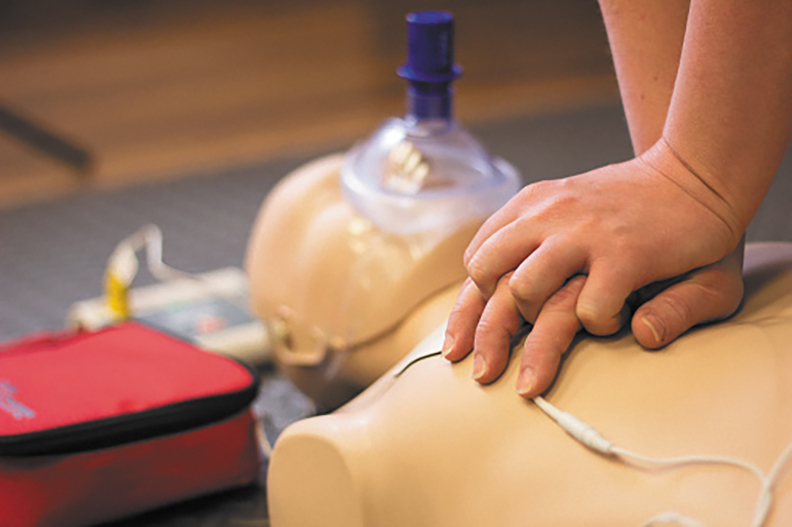
Hands Only CPR involves doing chest compressions, but not breathing for the victim. By learning to do CPR, you’ll gain confidence that you can care for loved ones in their time of need.
Keep calm and follow the basics before emergency medical personnel arrive.
By Randy Davis, F471978
February 2020
RV travel allows us to escape the hustle and bustle of urban and even suburban life. But getting away from it all often means we’re also far away from fast response by emergency medical services (EMS).
We need to be ready to handle medical emergencies until EMS personnel can arrive. A delay in care can mean the difference between life and death. You may be the only one immediately available to provide first aid. Brain cells begin to die four to six minutes after cardiac arrest, and bleeding from a major artery can result in death in even less time.
First aid may be needed to address minor illness or injury, or in more extreme circumstances, to keep someone alive until help arrives. To keep a victim alive, the simple goal is to make sure that oxygen molecules can get to the lungs (clear airway), attach to red blood cells (breathing), circulate around the body (heartbeat), and not squirt out (bleeding). Along the way, we can ensure that the body is not too cold or not too hot, and we can help to lessen the effects of shock.
Look For The Signs
To begin, you must determine whether a problem exists, and if it does, be sure that the area is safe for you and the victim. The first rule of rescue is protect yourself. You can’t help if you’re hurt.
Recognition of a problem is actually easy. Remember when your child declared that he or she was not feeling well and shouldn’t go to school? You probably looked at the youngster and said, “You’re okay,” or “Oh . . . you look sick!”
Similarly, you can use the mnemonic SAW to determine whether someone is critically ill or injured. It is what you SAW when you first looked at the patient.
S is for SKIN. Is it normal (pink, warm, and dry)? For persons of color, are the fingernails and palms pink? Is the skin blue, cold, pale, sweaty, red, hot, bleeding, swelling, etc.? The latter indicate problems.
A is for APPEARANCE. Does the victim appear “normal”? That is, are they awake? Are they speaking normally, or are they silent, slurring words, or speaking strangely? Are they alert (aware of you, their location, the date, etc.)? Can they walk normally? Is something sticking out of the body or in the body that shouldn’t be? Is the person calm? Anxiety and restlessness are clear signs of issues.
W is for WORK OF BREATHING. Normally, a person’s breathing is easy, regular, and quiet. If you see someone working hard to breathe, or they are not breathing at all or are only gasping, they need help. An example of abnormal breathing is a person who leans forward with hands on knees, using accessory muscles like those on the sides of the neck to help lift the chest. Or you may see the skin “suck in” between their ribs. You may hear wheezing, which indicates a lower airway issue such as asthma. You also may hear stridor — a high-pitched whistling sound — that can indicate a partial obstruction or swelling of the upper airway. You may note that they are breathing very fast or very slowly.
If you SAW that the victim has any abnormal signs, then you know they have a problem.
What To Do Next?
Once you determine the person needs your help, remember these fast first aid tips:
*If the face is pale, raise the tail (legs, that is; lay the victim down).
*If the face is red, raise the head.
*If the face is blue, needs O2 (oxygen).
*If blood squirts out, plug it up (use a dressing; apply pressure).
*If the victim is too cold, warm ’em up.
*If the victim is too hot, cool ’em down.
It’s really all common sense.
And, of course, call for help. Know where you are at all times so that you can tell responders an accurate location. My fellow paramedics and EMTs can’t help you if they can’t find you!
CPR
Lastly, if a victim is unresponsive and not breathing, or only gasping, you should call for help first. Then, bare the patient’s chest, place your hands on the lower half of the breastbone, and push fast up and down deeply (at least 2 inches on an adult and one-third the depth of the chest on a child). Don’t worry about breathing for the victim, and don’t worry about hurting the victim. This is called hands only CPR. If you know complete CPR, which includes breathing for the victim, by all means, do it. If you don’t know CPR, learn it!
If the victim is unconscious and breathing, simply turn them on their side (if no spinal injury is suspected), which will protect their airway.
Learning CPR and first aid should be high on your list of training classes you can take to make your RV experience safer and more enjoyable. What better reward could you receive than simply knowing you can take care of a loved one or fellow traveler in their time of greatest need?
Have a safe day.
Randall J. (Randy) Davis is a nationally registered paramedic licensed in Missouri and Kentucky. His EMS career has spanned more than 40 years, first as an EMT in 1979, then as a paramedic beginning in 1981. He has presented numerous life-support classes for the American Heart Association, the American Academy of Pediatrics, and other nationally accredited education programs.