
By Gary Bunzer
March 2020
Cylinder Changeover
I have a fifth-wheel with two propane cylinders. They are equipped with an automatic changeover lever. When the main tank goes empty, the valve does not switch. I have manually rotated the valve to the other tank, but still no go. Is the problem the regulator for that tank or the changeover valve?
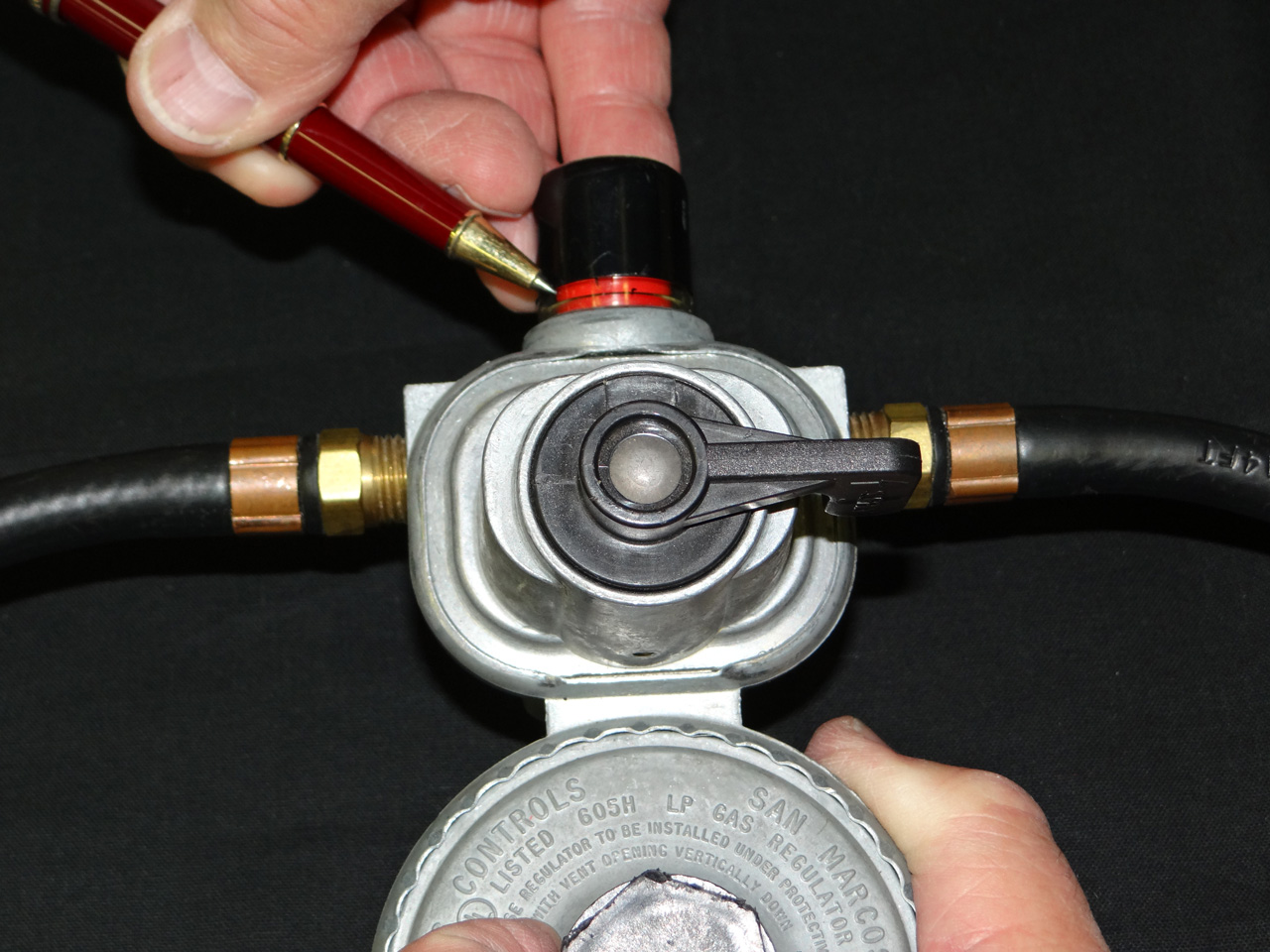
A typical propane twin-cylinder automatic changeover mechanism.
Mike Pardina, F487057
Oakdale, California
That changeover mechanism is the first stage of the required two-stage regulator. Besides directing the flow of vapor, the first stage reduces the container pressure (which fluctuates) to approximately 10 psi. As a separate component, the mechanism can be replaced independently, but it is considered a portion of the main propane regulator for both containers on your fifth-wheel.
In normal operation, the red sight indicator is visible when the lever is pointing to an empty cylinder (see photo). The appliances should automatically begin drawing from the filled container, although the lever itself will not rotate automatically. The user rotates it to the filled container when the red indicator appears. That way, the empty cylinder can be removed for refilling while the RV is still drawing from the new primary container. Once the lever is rotated to the full cylinder, the sight indicator turns green. If you are absolutely sure that appliances are not drawing consecutively from both cylinders, make sure both are filled and perform the following test procedure:
- With all hoses connected and leak-free, rotate the cylinder selector lever fully toward one of the cylinders. This will now be the primary cylinder; we’ll call it cylinder A. The other cylinder will function as the reserve cylinder, or cylinder B.
- Open both cylinder service valves fully and wait until the sight indicator on top turns green.
- Ignite two or three cooktop burners to create a demand or a load on the pressure regulator. Look at the flame structure and note its appearance. Leave the burners lit for the duration of the test.
Note: Do not use the water heater or the furnace to create this demand on the regulator. They may satisfy their individual thermostats before the conclusion of the test.
- Simulate running out of propane by turning off cylinder A (close the service valve fully). The sight indicator should turn red.
- Once the sight indicator turns red, inspect the ignited cooktop burners. They should remain lit, and the flame structure should look exactly as before.
- Rotate the cylinder selector lever fully toward the reserve cylinder, cylinder B. The sight indicator should immediately turn green.
- Once the indicator turns green, disconnect the pigtail hose from the service valve on cylinder A. No fuel should emit from this disconnected hose.
- If no gas flows out of the disconnected pigtail hose, reconnect it to cylinder A and again open its service valve fully.
- Repeat steps 1 through 8, beginning with cylinder B this time.
- If both cylinders perform as indicated above, the automatic changeover regulator system is working properly. If propane vapor emits from the pigtail hose when it is disconnected, or if the burner flames are extinguished at any time during this test, further troubleshooting is in order. Chances are the switchover mechanism has failed or a blockage may exist somewhere, perhaps at the connection of that far cylinder. Contact a certified or master certified RV service technician. Overfilling or physical trauma are the only two ways the mechanism can become damaged that I’m aware of.
If you have a separate high-pressure regulator mounted between one cylinder on the far side of the RV and the changeover mechanism on the other side, that regulator could be faulty. To determine whether the fault lies within the high-pressure regulator, the technician can temporarily remove it from the system (an appropriate fitting to connect the two flexible hoses is required). If the switchover mechanism passes the test again, the tech should replace the nonadjustable high-pressure regulator.
While any of the hoses are disconnected, see whether you can spot evidence of an oily liquid inside any hose. The presence of a gummy, oily, liquified substance inside a hose or inside the regulator body indicates a possible overfilled situation or a deteriorated plasticized hose that has leached. It may be necessary to have a professional certified or master certified tech take a look if you do not feel comfortable doing this on your own. If liquid propane entered the hoses, the high-pressure regulator, or the auto switchover mechanism, parts definitely will need to be replaced.
Holy Roof!
A tree branch broke and stuck in the roof of my Type C motorhome. Should I patch the hole or fill it in with lap sealant? The hole is thumb-size and about an inch deep.
John Brodie
Via email
I don’t think it’s wise to squeeze lap sealant into the hole, because it will likely self-level inside the roof/ceiling void. If you are sure the branch penetrated only the roof surface, I suggest another route.
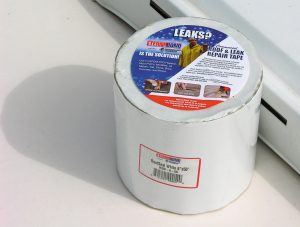
EternaBond can be used to seal cracks and holes in RV roofing surfaces and sealants.
First, be sure no wires or other internal roofing components were damaged. Then, carefully insert the nozzle of a can of expanding foam into the void. Slowly and carefully build it up until it just starts to ooze out of the opening. Once it cures, carefully trim away excess that protrudes above the roof. Obtain a roll of EternaBond tape, clean the roof surface, and apply a 3-inch-square piece of EternaBond directly over the hole and the surrounding couple of inches. Be sure to follow the EternaBond directions. For it to stick properly, pressure has to be exerted over the entire section of tape. EternaBond sticks to any RV roofing surface as long as it’s prepped and cleaned properly beforehand. With a hole that small, I wouldn’t have much concern once you seal it with the EternaBond.
RV Antifreeze Types
We want to winterize our new travel trailer. A few websites recommend using only RV antifreeze based on propylene glycol. They say that those based on ethanol alcohol can dry out the seals and can leave an aftertaste. We have been to three RV stores in our area. They carry only the ethanol-based antifreezes. What is your opinion on ethanol-based antifreeze?
Riley & Marla
Via email
In this instance, the websites you’ve visited are correct. I recommend only propylene glycol types of RV antifreeze. I can only surmise that some RV accessory stores carry only the ethanol alcohol type because of the price. Propylene glycol RV antifreeze is more expensive in most locations. I’ve also seen a combination of ethanol and propylene blends available. I would recommend avoiding these as well, although they are approved for RV use.
Ethanol alcohol definitely can dry out seals. Propylene glycol RV antifreeze, on the other hand, has a lubricating quality that helps keep the seals in the toilets and valves moist throughout the winterizing period. Though it may be more expensive, propylene glycol RV antifreeze can be captured and used more than once. Keep the empty jugs, and come spring, drain the antifreeze back into them from the low-point drain valves. You can reuse it next winter. I’ve even heard reports of people using the same antifreeze three years in a row. Over two or three years, the extra cost of the propylene glycol RV antifreeze is quickly forgotten, and you have the comfort of knowing you’re doing the best for your plumbing system.