
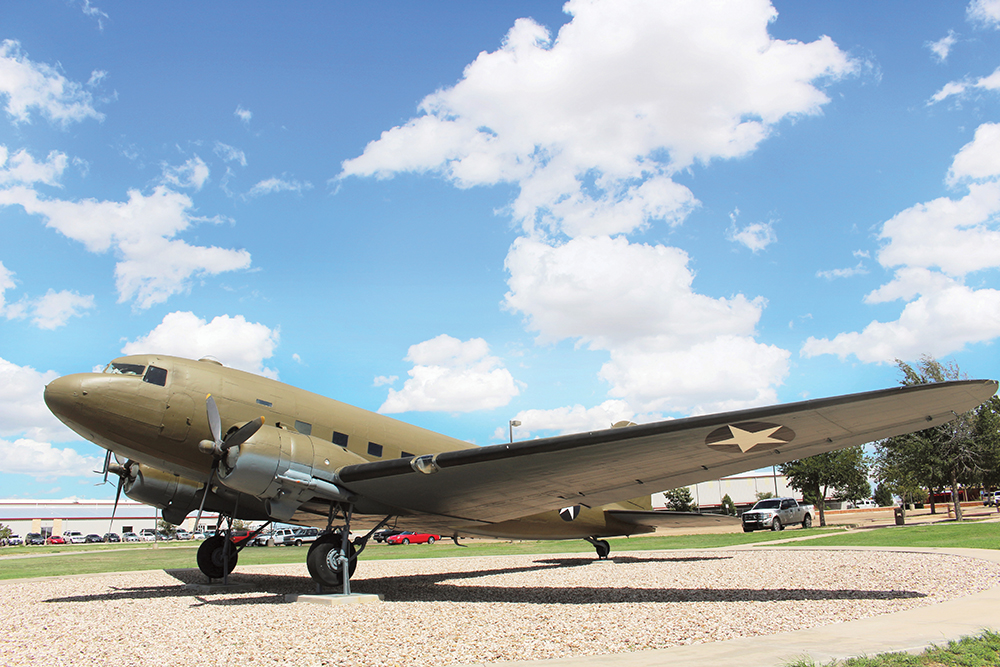
And once you get there, the home of Texas Tech University will impress you with many cool and unusual sights.
By Lazelle Jones
May 2020
Just south of the Texas Panhandle is a college town with approximately a quarter-million residents. It reflects America’s ranching past and is part of the story of the American West. It’s Lubbock, worthy of that two-hour drive south from Amarillo, Texas, via Interstate 27.
“Hub City,” as Lubbock is called, is the home of Texas Tech University, where students pursue undergraduate and graduate studies, and attend law school and medical school. Founded in the early 1920s, Texas Tech cultivates the pride of what it means to be from West Texas.
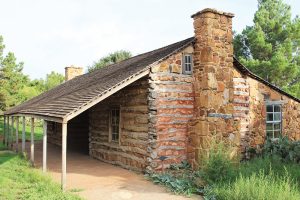
The National Ranching Heritage Center encompasses 27 acres and includes this 1855 home.
The university hosts two free museums, and free parking is available at a guest lot with ample room for RVs. The entrance is via Fourth Street.
The first museum is the National Ranching Heritage Center. This large, beautifully groomed complex is very well put together. Here, you can become engulfed by the legacy of ranching in Texas and the history of ranching across the entire western United States. Nearly 50 authentic ranch structures are here, transported from Nebraska, Montana, Wyoming, and elsewhere. Houses, granaries, and stables are among these restored buildings. A few date back to the 1700s when Texas was part of the world called New Spain.
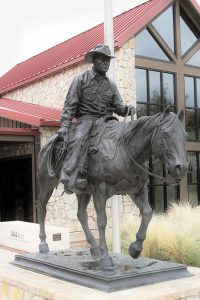
The National Ranching Heritage Center recalls the lifestyle.Walking paths lead to each building on the 27-acre grounds. An easily readable, detailed history at each stop explains the building’s purpose, origin, and years of use. Photographs show what the structure looked like when it was discovered, before being relocated here.
There’s no hurry here, either. Take in the sights at your leisure. Benches are placed so that you can stop, rest, and breathe in the beauty of the native plants that lace the grounds.
The ranch center also boasts the DeVitt Mallet Museum, whose exhibits pull you in with compelling stories. When I visited, one included the story of the Comanche nation. More recently, museum displays have focused on cowboy boots, saddle makers, Western artists, and art depicting legendary Texas rancher Charles Goodnight. For more details about the National Ranching Heritage Center, visit www.depts.ttu.edu/nrhc or call (806) 742-0498.
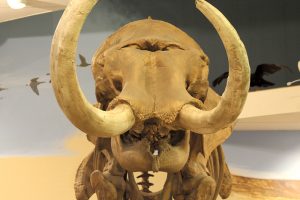
The immense collection at the Museum of Texas Tech University includes fossils from the Ice Age.
After spending an hour to two at the ranching center, head over to an equally fascinating place: Museum of Texas Tech University. Its displays center on Texas, the Southwest, and beyond.
Permanent exhibits feature native and Meso-American pottery, with examples from pueblos across the Southwest. Another long-term exhibit is “Ice Age on the Southern Plains,” with examples of prehistoric mammoths, camels, bears, and other mammals from the Pleistocene Period. New temporary displays in 2020 include one that focuses on the “staked plains” — the Llano Estacado, and another titled “Medieval to Metal: The Art & Evolution of the Guitar.”

The Museum of Texas Tech University displays Pueblo Indian pottery.
For more information about the Museum of Texas Tech University, see www.depts.ttu.edu/museumttu or call (806) 742-2490.
There’s more to see off campus. For example, would you believe that little Lubbock has a vital connection to World War II events such as D-Day in France, the invasion of Sicily, and the building of the Burma Road between India and China?
Back in the days before helicopters, combat troops, equipment, and armaments were snuck behind enemy lines using glider planes. During the early and middle years of World War II, 80 percent of all U.S. glider pilots were trained in Lubbock. Today the Silent Wings Museum honors and pays tribute to their bravery and intrepid actions.
Gliders were towed into the sky by bigger aircraft. Besides learning how to fly, a glider pilot had to master properly loading his craft with heavy equipment, troops, and supplies; controlling it after the tow cable was
loosened; and choosing a spot to land where no landing strips existed. Many times, a successful landing
was pure luck. After landing and unloading the gear, the glider pilot would serve as an infantry soldier for the duration of the mission.
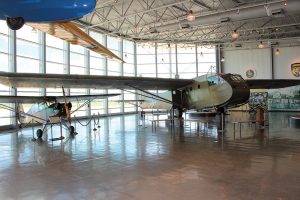
Gliders are on display now in the former Lubbock airport terminal. They are among the items at the Silent Wings Museum, which focuses on military glider aviation.
Exhibits at the Silent Wings Museum are legion, with a focus on military aviation up to, during, and after the war. For example, it’s amazing to learn that jet aircraft were tested back in the mid-1930s, and the first helicopter was flown in the ’30s as well.
The museum is housed in the former Lubbock airport terminal. Admission ranges from $5 for children ages 7 to 17 to $8 for non-senior adults. Visit https://ci.lubbock.tx.us/departments/silent-wings-museum or call (806) 775-3049 for more information.
Our next stop, the American Windmill Museum, is also an unusual and educational spot. The role the windmill played in the settling of America, and especially the West, is often overlooked — but not here. You’ll learn that windmills have been found dating back to about 900 B.C.
The invention of the wind-powered water pump in the mid-1800s by a fellow named Daniel Halladay made it possible for areas far from running water, rivers, creeks, and lakes to become farmable. Halladay’s windmill pumped water from underground lakes called aquifers, which can lie from a few feet to hundreds of feet below ground. An example is the Ogallala Aquifer, which sprawls from current-day South Dakota to West Texas. It’s huge! By 1930, more than a half-million windmills were pumping water from below the ground across America. As you travel today, you can still see some being used to fill livestock water tanks.
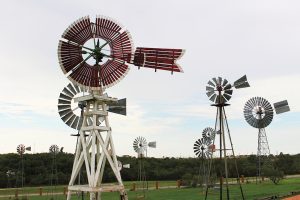
The American Windmill Museum demonstrates how wind power enabled the settlement of the Plains. Its collection includes hundreds of indoor exhibits as well.
The more than 70 windmills at the Windmill Museum include power mills, grist mills, saw mills, wind pumps, and more. The collection’s pride and joy is called a post-mill, which was inspired by a 1621 English windmill that was brought originally to colonial Virginia. Built in 1978 to commemorate and replicate that Virginia windmill, it is one of the few working post-mills in the Western Hemisphere.
Plenty of parking is available for RVs here as well. The museum is open Tuesday through Saturday (Sunday hours are added in summer). Admission ranges from $5 for children to $7.50 for non- senior adults; active military are admitted free with I.D. For more info, see www.windmill.com or call (806) 747-8734.
These are only a few reasons to saddle up your RV and spend some time in Lubbock. While in town, you may want to tour these sites also:
Buddy Holly Center:
https://ci.lubbock.tx.us/departments/buddy-holly-center
Prairie Dog Town:
https://ci.lubbock.tx.us/departments/parks-recreation/parks/prairie-dog-town
Bayer Museum of Agriculture:
www.agriculturehistory.org
MORE INFO
Visit Lubbock
(800) 692-4035
(806) 747-5232
www.visitlubbock.org