
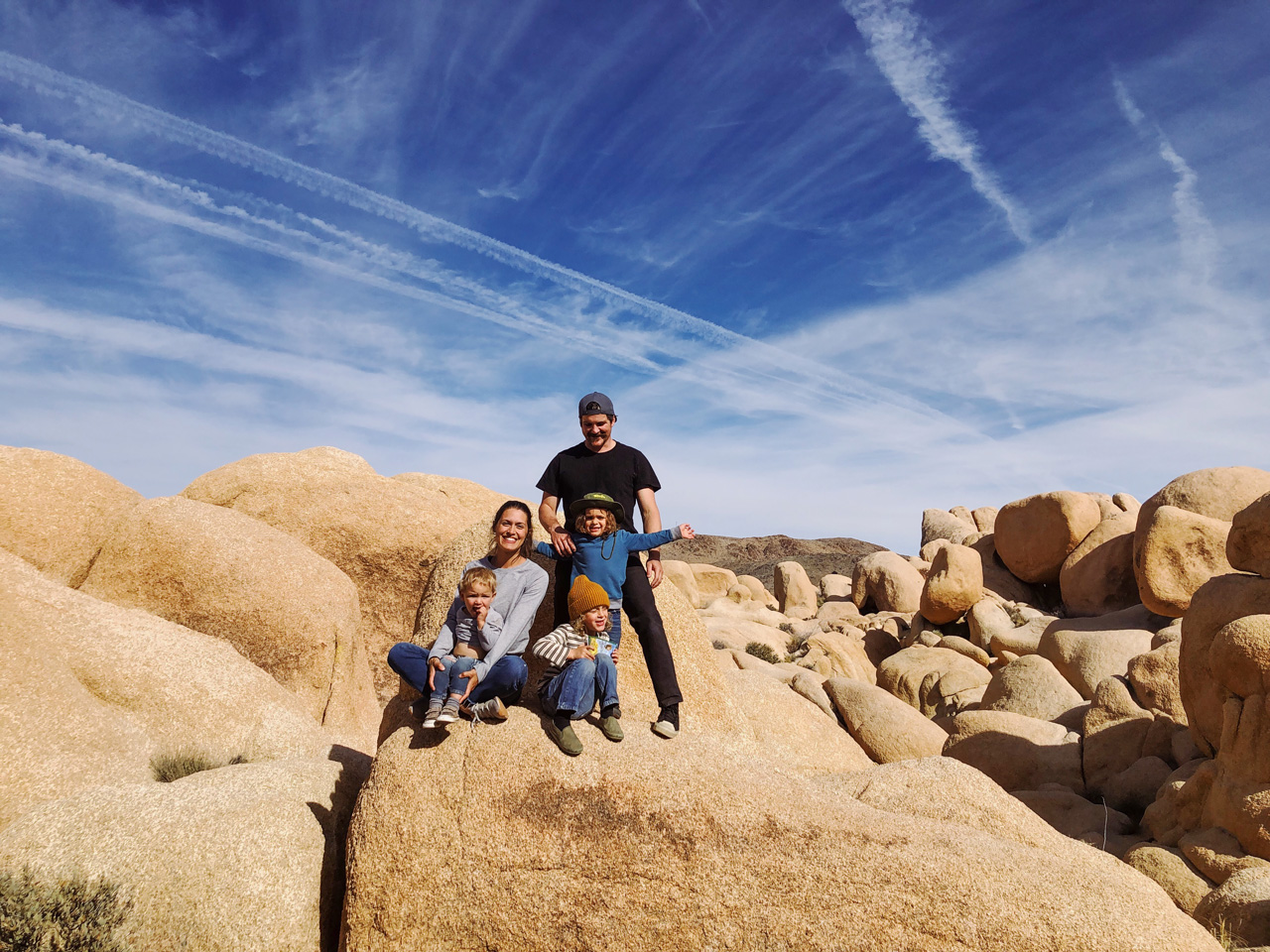
A parent’s observations after RVing 8,000 miles with three small children.
By Maja Scheler
July 2020
As I write this, we are at the threshold of summer, and uncertainty has scaled back life as we’ve known it. A hunger for normalcyand connectedness has awakened things we take for granted: places to go, spaces to roam, and people to share life with. Sounds like the lament of a cooped-up traveler, but nothing quite embodies “Life’s a journey” like a road trip.
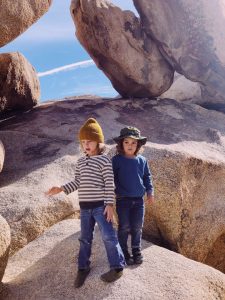
Arch Rock dwarfs sons Milo and Soren.
As a child, I lived for road trips. Although I can’t recall each excursion in detail, I can see now how they’ve shaped me, as I watch my own children experience life on the road. Our most recent trip was at the beginning of this year. We traveled more than 8,000 miles in a Phoenix Cruiser motorhome with our three boys, ages 4, 2, and 1. The idea of being in a vehicle with kids for an extended amount of time may sound worse than quarantine, but now that I have experienced both, I can honestly say it is not. Indeed, packing up your family and hitting the road can feel intimidating, but the benefits, arguably, outlast any bumps along the way.
Here’s what my family and I have observed from our time on the road:
Curiosity is one of life’s most important gifts. And it doesn’t take much to spark it. On our recent trip, my three sons were on a scavenger hunt at White Tank Campground in Joshua Tree National Park — a first-come, first-served, bare-bones facility for RVs 25 feet or shorter burrowed among impressive granite boulders. They received a Junior Ranger booklet from a park ranger, which included a list of native wildlife to find. The boys set out like Indiana Jones seeking the Holy Grail. They found a desert lizard under a juniper tree. They followed the call of a desert wren till they noticed her on top of a boulder. They recognized the scat of a chipmunk and caught a glimpse of one scurrying behind beaver cacti up into the rocks.
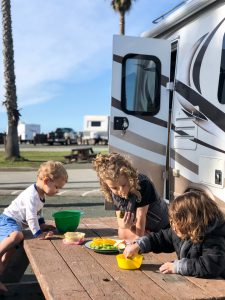
Snack time at Morro Dunes RV Park.
Life on the road is a lot of things, but one thing it is not is boring. There is much to observe; thus, observation excites curiosity, excites exploration, excites imagination. Research shows that exploring exercises the brain’s limbic system, which develops our play-and-seek process, helping us with spatial awareness, creativity, and problem solving. It’s the very thing that made us notice the sand dollars half hidden along the shores of California’s Morro Bay, and the sea urchins buried within the rocks at low tide, as well as the contrast between the sunny spot where my son stood and the storm clouds he watched roll in from afar.
Nature is a schoolhouse, and therapy at its finest. To keep the stream of curiosity flowing on longer days of travel, we like to find a park or a creek in the middle of the day so we can all stretch and explore — keeping us active.
Movement stimulates creativity, and creativity helps us to adapt to different environments. I laugh at the thought of trying to get my boys to sit still for a change. I’ve learned to accept that stillness is for when they sleep, and I recognize the importance of staying active. Nowadays, children average six hours of screen time each day — staring at a computer screen, a smartphone, a TV, etc.; adults may average up to 11 hours a day.
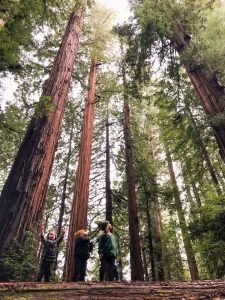
Standing tall in Jedediah Smith Redwoods State Park.
Fixation on artificial light and a tendency to be more sedentary than in motion are two problems that plague us unconsciously. Although road trips require sitting for the driving portion, it makes the outdoor portion that much more intentional. Nature walks, running along the beach, biking through towns, climbing rocks, swimming in hot springs, collecting wood, building a fire . . . the list goes on. Whether you’re beneath Sonoran skies; marveling at the saguaros; or walking among “ambassadors from another time” in a redwood forest (as John Steinbeck described them), diverse natural settings challenge us to embrace new experiences, rhythms, and perspectives.
One of the beautiful elements of traveling with your family is seeing how each person experiences something new. It’s been said that children’s brains are like sponges. The ability to expand their comfort zones and accept new roles likely comes more easily for them than for us adults. Nonetheless, road life fosters these skills.
This leads me to my favorite reason for road tripping with the family, which can be applied to any sort of traveling experience:
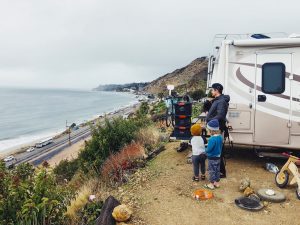
Wes Scheler and sons take in the ocean from Malibu Beach RV Park.
There is no substitute for time spent together. I’ve been told, “Wait to travel with your kids until they are old enough to remember the adventures.” This advice is commonly given to families with young children. As the world seeks to emerge from uncertain times, another piece of advice counters the prior: Seize the day; we aren’t guaranteed tomorrow.
Toward the end of our 8,000-mile-plus road trip, we were parked in a pothole-filled lot near the California coast, with a view of Half Moon Bay just across the street. Next to us stood a large recreational half-pipe skate ramp. The boys filed out with their skateboards in hand, following their dad to the ramp as I prepared a skillet breakfast. Not even five minutes later, my eldest son came tromping back to the motorhome. “I just want to play inside,” he said.
I blocked the door, meeting him at the step. “Buddy, you just got outside. How cool is that ramp?”
He glanced at it. “Yeah, but I’m not good.”
“You just need to practice. Come on, bud, Big Life Kid style.” That’s a phrase I say often, referring to a podcast he loves that shares real-life stories of kids who persevere despite the obstacles they face.
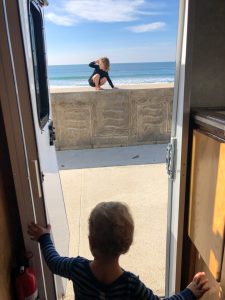
A surf check and play stop at Tamarack State Beach.
“But the podcast is going to want to talk about me if I don’t do it right the first time,” he said. As my son’s shoulders slumped, his personality opened up to me. I could see exactly what goes through his mind in these kinds of situations. That revelation was all I needed to understand how to motivate him, and what eventually made him get back on his board. For another couple of hours, we and the boys ate, played, and soaked in our morning view from our home on wheels.
Research tells us that two-thirds of conversation time between parent and child is about daily routine. Life shows us that by the time children are 6 years old, a third of their childhood has already been spent. If I could share only one life lesson from my family travel experiences, it would be what I’ve already mentioned: There is no substitute for time spent together. Perhaps that is exactly what all of life’s uncertainties remind us of, too.
Road trips have a way of detoxing us from society’s hustle. The countless miles can culminate in a single moment that changes us — giving us quality for the quantity of our time together. No hard night’s sleep or lack of personal space (yes, social distancing with children is impossible) can combat what’s being deposited at the core of who we are, and who our children are becoming. With high hopes for the adventures that await us, my boys, now 5, 3, and 2, huddle around a map, and with wide eyes ask, “Where to next?”