
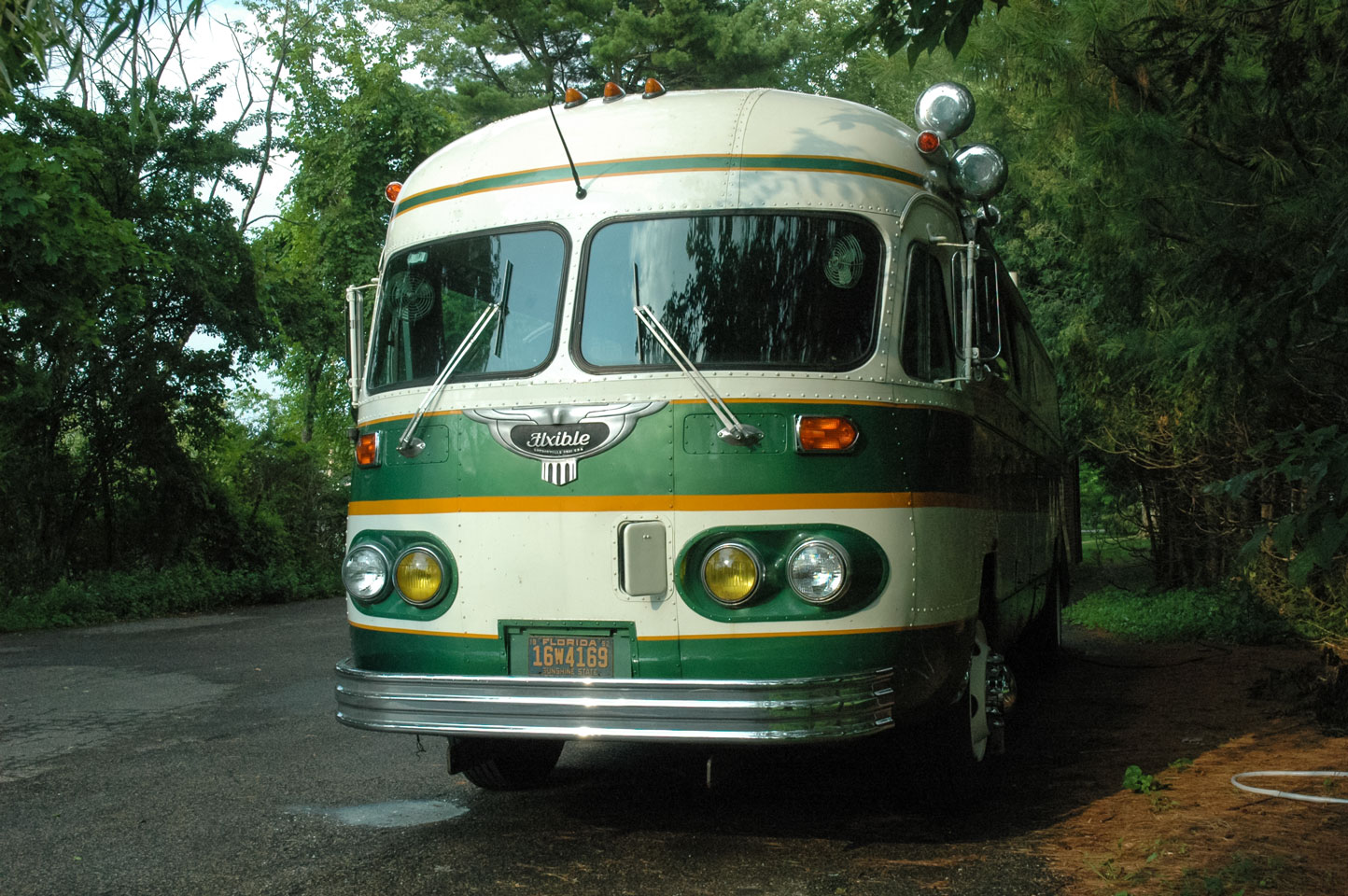
The kindness of others allowed an FMCA member to become reacquainted with the Flxible Visicoach he painstakingly converted decades ago.
By Steven Arnold, F444094
December 2020
I have always been interested in how things are designed and assembled. I was the kid who took things apart when they were broken to see what made them tick. In my teenage years, I loved anything with a motor in it, and as I reached driving age, I bought and improved muscle cars and 4×4 trucks. Collector cars continue to be a hobby of mine.
This passion attracted me to motorhoming. I enjoy fixing and improving and just plain tinkering with our coach. One of the first clubs my wife, Laurie, and I joined was Bussin’ Buddies, a New England chapter of FMCA. At club events, it was interesting to meet and talk with bus conversion folks, and one of them was Stanley Phillips, F10990, who lives in Worcester, Massachusetts. Stanley had sold his bus many years ago, but I enjoyed hearing about the conversion process, because it involved a 1952 Flxible Visicoach, one of the most attractive buses in many people’s eyes.
The bus is similar to the red and white model in the 2006 movie RV, starring Robin Williams, the difference being that Stanley’s bus was a raised-roof model that provides more headroom and eliminates the step down to the aisleway. Flxible made such raised-roof buses for use as bookmobiles, X-ray labs, and mobile showrooms, as well as Custom Coach Corporation’s Land Cruiser motorhomes.
What also impressed me about Stanley’s bus was the apparent scope and detail of his build. At each rally we attended, I tried to get some time with him, and the more I heard, the more I appreciated what he had done. I have completed quite a few full car restorations, and to do it right requires an enormous amount of time, so I certainly respect the serious commitment needed to do a high-quality, full bus conversion. Countless hours are required for planning, designing the many systems, locating components, and construction. Stanley did all of that pretty much single-handedly while running a business and being a family man.
At a summer 2019 rally, Stanley mentioned that one of his sons, Steven, had tried to get in touch with the current owners of the old bus in hopes they could see it again when the owners attended a festival in Connecticut. But it didn’t work out, and Stanley clearly was disappointed. That’s when I began my efforts to reunite Stanley with the bus.
Steven had not made direct contact with the owners, but he thought the bus might be in Florida or New Jersey. I tried to find information about the bus or its owners by posting on a couple of RV forums, without success. Then I found the Flxible Owners International website (www.flxibleowners.org), which led me to John Maryo, F412782, a club officer who knew of the bus and its current owners. More than a month after I began the search, I was in touch with brothers Ken and Ned Brown, the owners of Stanley’s old bus.
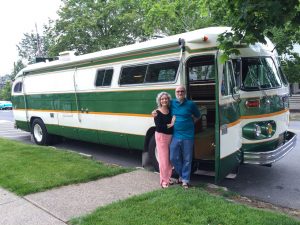
Ned and his wife, Karen, with the bus at a local “cruise night” in Hopewell, New Jersey.
They are great guys and were excited about the possibility of connecting with the person who first converted it. In fact, they had been trying to locate that person since purchasing the bus five years earlier. They had a wealth of information about it.
I call it “The Stanleys’ Bus,” to recognize its connection to more than one Stanley. First, factory records show that the bus originally was built for The Stanley Works Company, a tool and hardware manufacturer in New Britain, Connecticut, as one of its two 100th anniversary tour buses. It was outfitted with displays of Stanley hardware and traveled around the United States.
The other connection, of course, is to Stanley Phillips, who performed the extensive conversion. After Stanley Works sold the bus, it was converted into a mobile chest X-ray unit to diagnose tuberculosis. By the time Stanley Phillips purchased it in the 1970s, the bus was in rough shape, but the painted markings signifying it as an X-ray bus still were visible.
My intention was to depart from my Connecticut home, pick up Stanley in Massachusetts, drive with him to Ned’s home in New Jersey, and then return, all in one late-December day in 2019. But I couldn’t fit it in, because I had plans to head south for the winter in a few days. I told the Browns I would contact them again in the spring to arrange a meeting. A day or two later, Ned surprised me by saying that Ken, a pilot, could fly Stanley and me to New Jersey in a private plane before New Year’s Day. The time savings made it workable. I was so appreciative of their gesture.
After landing in New Jersey, we walked around the terminal and were pleasantly surprised to see “The Stanleys’ Bus.” It was beautiful. Stanley was speechless.
We stepped inside, and the interior condition was as nice as the exterior. It was like going back in time. Ken sat in the driver’s seat, donned a period-correct bus driver cap, brought the engine to life, and we headed to Ned’s house. I noticed how quiet and well-mannered the coach felt. It seemed to accelerate effortlessly. To be honest, the ride was much better than I expected.
Ken behind the wheel.
The Browns found the bus behind a repair facility five years ago. It was in a state of disrepair and neglect, a victim of many subpar repairs. Since purchasing the coach, they have spent countless hours searching for period-correct parts, fabrics, and new-old-stock components. They also have devoted many hours to repairing and updating all the bus’s systems, including electrical management components, charging and inverting, plumbing, and power generation. Ned took the lead on the systems; Ken and his wife focused on the carpeting and upholstery.
The more they dug into the coach, the more they gained respect for whoever had done the conversion. The attention to detail was obvious. As Ned made updates and improvements, he was careful to hide modern components whenever possible. When selecting new carpeting and fabrics, Ken chose patterns and styles similar to the original.
It was interesting to watch the Browns and Stanley discuss details of the bus. For example, Ned asked Stanley what company made the ceiling. It shows quality workmanship and is made of white padded material that closely mimics the material and style of modern high-end coaches. Stanley said he did it himself, and he explained how it was fabricated and installed. We were all in awe. Stanley seemed to enjoy looking back on his accomplishments.
The Browns also asked about the wall material, which is in excellent condition despite being installed more than 40 years ago. It was fabricated from a tooled-look synthetic leather with nail-head finishing accents. The workmanship and detail are stunning around difficult areas such as the trapezoid-shaped windows. Stanley told us he had done that work also, and that he had learned how by taking a night class.
As we continued our interior tour, other areas showed evidence of Stanley’s ingenuity and craftsmanship. He had devised a simple but functional storage system for a matching pair of tables. The easily assembled tables can be used individually between the sofas or can be combined to create one long table, with the grain of the solid-wood tops matching exactly. Other features include a curbside sofa with a portion that rotates to become the copilot’s seat; a fiberglass-surround shower; and a rear stateroom with twin beds that easily convert to a king-size bed. The galley includes cabinetry and Formica countertops that Stanley built by hand. A newly added microwave oven is one of the few visible upgrades.
After a light breakfast prepared by Ned and his wife, we toured the bus exterior. The overall look is quite amazing, especially considering that it is still adorned by the green and white Imron paint and yellow accent stripe that were applied during Stanley’s conversion. The paint job is one task that Stanley asked a capable friend to undertake on his behalf. The paint is in fantastic condition, with only a few minor areas that the Browns plan to address. Stanley also added pinstriping that nicely accents specific areas.
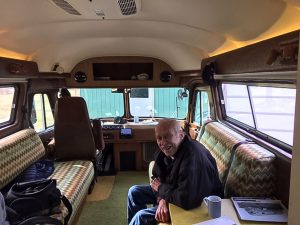
Stanley during his reunion with the vintage Flxible.
Ned has repainted the steel wheels and has replaced the stainless-steel wheel centers and lug nuts, in addition to replating many items, including the headlight surrounds, the bumpers, and the air horns. The Browns couldn’t find a quality Flxible nameplate to replace the broken one on the rear of the bus, so Ned machined a replacement from copper and had it chrome-plated.
As we walked to the rear of the bus, it was worth taking a moment to admire the shape and lines of the back of it. An air scoop on the roof draws air into a plenum where the radiator and cooling fan are located, which optimizes the air movement and cooling. The entire rear of the bus appears aerodynamic, complemented by unique glass lens stop/turn signals. Ned was able to locate a pair of perfect stoplight assemblies.
Under the hood is a pretty special power plant. When Stanley was doing the build, he spoke with others who had completed Flxible conversions, and they recommended he replace the tired and underpowered straight-eight-cylinder Buick engine with an Oldsmobile 455. After one season with the new motor, Stanley was hungry for more power, so he purchased an Oldsmobile Rocket 455. To further increase its output, he completed a performance rebuild and installed the engine during the off-season.
A few years later, Stanley took another stab at the power issue while also converting to an automatic transmission. At the time, the International DT-466 was a diesel engine highly desired for its modern design, power, and reliability. Stanley secured one for the bus. For a transmission, he chose the reliable four-speed Allison.
The last major component he needed was the differential axle. After making calculations based on the final transmission gear ratio, the optimal engine rpm at highway speed, and the tire diameter, he knew the differential ratio he needed. Then he searched over-the-road truck junkyards until he found his prize under a 10-wheel dump truck. An added benefit of the massive differential unit is a pair of the largest brake actuator cylinders I have ever seen. Combined with larger brakes, they increase braking capacity dramatically over the original units.
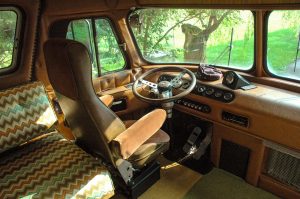
The Browns restored the bus interior with equipment and furnishings that recall its early look.
Once all the components were in hand, the transplant work began. The frame and mounting areas were reinforced significantly to handle the extra weight and power of the new setup. A close look at the engine bay reveals a professional and detailed installation. With the exception of the visible frame reinforcements, the whole assembly looks like a factory installation. It has been extremely reliable.
A walk around the bus reveals the utilitarian components within the storage bays. On the curbside are three bays with drop-down doors. The first two are for user storage. The third bay offers access to the 100-pound propane cylinder and propane connections. In between the third bay and the rear wheel is one of two black-water tanks.
On the street side, the rearmost compartment houses the refurbished electrical compartment. It extends higher than the floor level and fills the space under one of the rear beds. The compartment houses a 3.5-kilowatt portable multifuel generator, a 3-kilowatt Xantrex inverter, two 300 amp-hour AGM batteries, and a Progressive Industries shore power manager and surge protector. In front of the left rear wheels is the second black-water tank; in front of it is another drop-down door that houses the two 8D chassis batteries. Two 40-gallon fuel tanks are located forward of this bay, and they are interconnected to alleviate the need for a switching device.
Ned suggested that I take a look at the fuel tanks, as they are another item that he considers to be a work of art. Closer inspection revealed two fiberglass-wrapped welded steel tanks with many obscure angles that allowed for optimizing the size of the tanks within fractions of an inch of the chassis and body shapes and various components. Designing and fabricating the tanks to fit in the area they occupy was quite a feat.
After completing our tour, we had a few minutes to see Ned’s amazing woodworking and metalworking shops. At one time he owned a custom cabinetry and furniture manufacturing facility. Coincidentally, Stanley also had a metalworking business that involved fabricating components for customers. Why mention this? Because it demonstrates the level of skill both gentlemen possess. It is likely that the bus would not have survived were it not for Stanley and the Browns.
Returning to the airport in the bus was another fun ride. People and cars stopped in their tracks when “The Stanleys’ Bus” rolled by. We saw nods and thumbs up everywhere.
I am so thankful I could reunite Stanley with his old bus, meet its current owners, and be a part of a very special day. Ned and Ken are special gentlemen. I feel fortunate to be able to call them friends. Meeting Stanley was special for them, too, as it ended a long search.