
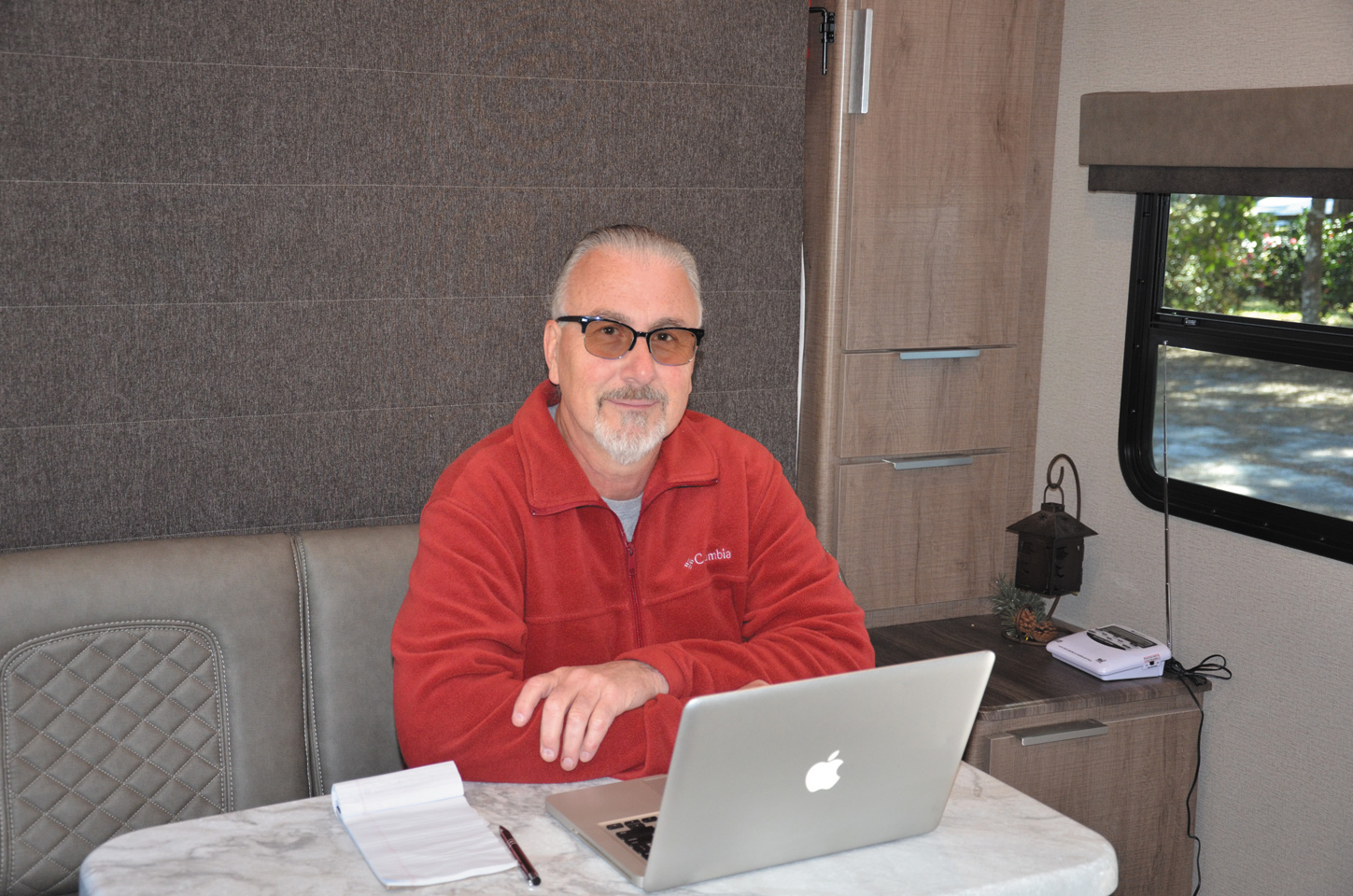
When working from home goes mobile.
By Jeff Crider
April 2021
Lisa Johnson, supervisor at a Florida credit union, received a directive on March 19, 2020: All of the 97 employees she managed would need to start working from home because of the COVID-19 pandemic.
“We had to get all of our workforce home for safety reasons,” she said.

Brent and Lisa Johnson enjoy the work-RVing blend; Lisa said it feels like a vacation.
But with today’s internet and call-routing technology, Lisa and her employees quickly found they could do their jobs just as easily from home. “We’ve been so successful with it,” she said, “that we are all now permanent remote workers.”
In other words, Lisa and her employees still have their jobs, but they’ll be doing them from home from now on ˛ that is, if they choose to stay home.
Less than three months after she received the work-from-home order, Lisa and her husband, Brent, started shopping for an RV. By July 4, they had purchased a 2020 Keystone Montana fifth-wheel. They have since given up their apartment in Tampa and now enjoy the freedom to travel that comes with their 38-foot unit.
“For the cost of an apartment, the RV seemed like a much better idea,” Lisa said. “We can basically be anywhere we want if I have a good internet connection. It gives you that sense that you’re on vacation even when you’re not on vacation.”
Lisa knows about the benefits of RVing. The daughter of a coal miner, she grew up in western Pennsylvania and took RV trips with her parents. Today, however, she sees RVing not only as a fun way to travel and build wonderful memories but as a way to save money, too.
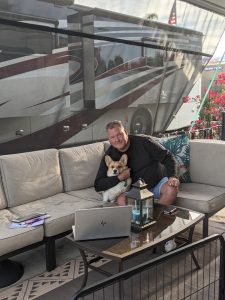
The Johnsons’ dog, Winston, travels with them.
Indeed, living and working remotely from an RV has provided Lisa with several benefits, including the elimination of the daily commute, as well as a major reduction in dry-cleaning and makeup costs, since she no longer has to dress up for work every day.
“The overall savings (from full-time RVing) may allow me to retire sooner,” she said. Brent had already retired but found part-time work in the security department of a nearby hospital network.
When I caught up with the Johnsons, they were spending the winter at Upriver RV Resort in North Fort Myers, Florida, where they enjoy kayaking in the Caloosahatchee River. “My (previous) commute time has now been taken up with a new hobby,” Lisa said “Brent and I bought each other kayaks for Christmas. I just love being on the water.”
Across the country, Mike Clark of Oakland, California, also was ordered to work from home during the first surge of the COVID-19 pandemic last year. It didn’t take long, however, for him to realize he didn’t necessarily have to stay in his Oakland apartment to continue doing his job for a Silicon Valley technology company. So long as he had access to a strong Wi-Fi connection, he could do his job from anywhere.

Californian Mike Clark took his technology job on the road after adding connectivity solutions to his RV.
As work-from-home orders have continued, many Silicon Valley technology workers have taken advantage of the pandemic to escape the Bay Area’s sky-high real estate market and have purchased homes and condos in more affordable markets, according to published reports. Mike is part of a smaller but growing subset of those workers who have purchased RVs so they can live and work remotely wherever they want to be. He purchased a 37-foot Thor Outlaw toy-hauler motorhome, which he uses to transport his two mountain bikes. One is an e-bike he uses on steep trails.
When we spoke this past winter, Mike had traded the cold and rainy Bay Area for the warmth of the southern Arizona sun, using Sonoran Desert RV Park in Gila Bend as his winter base camp.
“I can mountain bike to where the petroglyphs are,” he said, noting that Painted Rock has thousands of prehistoric American Indian drawings. These and other nearby historical spots, such as the Oatman Massacre site and the Butterfield Overland Stage Route, are highlighted in an ATV trail guidebook produced by Ted Werner, one of Sonoran Desert RV Park’s winter visitors.
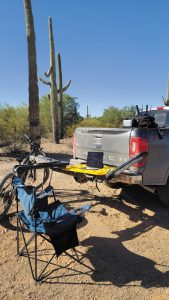
In southern Arizona, Mike Clark enjoyed mountain biking when not working.
Mike sees a curious analogy between the early American pioneers searching for water and today’s full-time RVers who work from the road. Instead of seeking water, the RVers need good bandwidth. He said he overcomes Wi-Fi worries by traveling with three different technology solutions. That way, he doesn’t have to rely on the Wi-Fi system at campgrounds and RV parks, the quality of which varies greatly ― particularly in remote areas where fiber-optic lines are not available.
Mike uses a router and high-speed cellular internet service through www.unlimitedville.com. “It’s unlimited with no caps,” he explained. “I chose the option which uses T-Mobile. My phone is AT&T. I have a Verizon MiFi ‘pay as you go’ router as a backup only. Some parks have good bandwidth. But I try not to hog it.” (Editor’s note: FMCA’s Tech Connect+ program provides discounted rates on unlimited mobile hot spot data and other technology offers.)
Of course, while the pandemic has prompted many people to work remotely from their RV in recent months, some have been living and working from their RV for years. They include 75-year-old Art Rivera, who has been full-time RVing for the past eight years as a self-employed private investigator.
“I had one of the largest PI companies in Southern California until about 20 years ago. I used to have a staff of 18 in the office,” he said.
But after going through a divorce nine years ago, Art said he decided to become a full-time RVer, partly because it would give him the freedom to visit his daughter and son, who live in Bellingham, Washington, as well as another son and grandchildren, who live in Ventura, California. He likes to spend the summers in Washington, where the weather is pleasant, and the winters in Southern California.
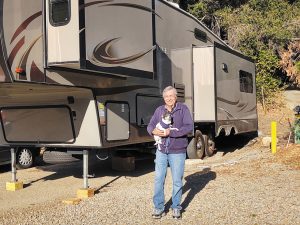
Private investigator Art Rivera, with his dog, Buddy, likes the flexibility of running his business from an RV.
Art also has found that he can easily do his investigative work from the comfort of his RV, a 37-foot Heartland Sundance fifth-wheel. “I do a lot of background investigations, financial investigations, and (investigations) for family law,” he said.
Art said that becoming a full-time RVer was “weird‚” in the beginning. “I had always lived in big homes. But you get used to it. There is a sense of freedom.”
Sixty-three-year-old Chris Eggleston of Binghamton, New York, also decided to become a full-time RVer after going through a divorce. He initially spent a year traveling around the country and staying in Airbnbs before purchasing a 29.5-foot Grand Design toy hauler, which he uses to transport his motorcycle.
Chris said he was introduced to the RV lifestyle by his ex-wife’s parents, who were avid RVers. “We used to join them on some of their trips. It’s a great way to travel and see the country,” he noted.
Eventually, he attended the Recreational Vehicle Service Academy in Palmetto, Florida. Now he uses his newly developed skills as an RV service technician to “pay it forward,” helping other RVers with repairs as he travels. In the future, he plans to assist people who may not be able to afford certain repairs.
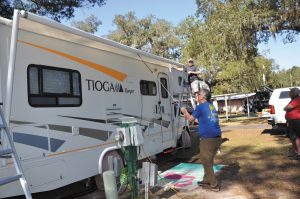
Chris Eggleston took RV service technician training and now assists fellow RVers who need repairs.
At the time of this writing, Chris was spending the winter at Florilow Oaks RV Park in Bushnell, Florida, before heading north to spend the summer months.
Asked how long they expect to continue living and working from their RVs, Lisa Johnson and Mike Clark said they aren’t sure.
Lisa initially thought she and her husband could live and work in their RV until they found a place where they wanted to settle. “Now we can take the time to really investigate other areas for a home. But I’m not even sure if we will do that again. I’m kind of digging this,” she said.
Mike said his future is up in the air until his Silicon Valley employers decide whether they want everyone to return to the home office as the pandemic subsides, or will continue to let employees telecommute from wherever they happen to be.
Art, the private investigator, already has eight years of working and full-time RVing under his belt. “I don’t have any plans of stopping,” he said.
Need A Job?
RVers who are seeking employment as they travel can check a variety of sources, including the following:
Amazon Camperforce
www.amazondelivers.jobs/about/camperforce
Workamper News
www.workamper.com
WorkampingJobs.com
www.workampingjobs.com
Workers On Wheels
www.work-for-rvers-and-campers.com