
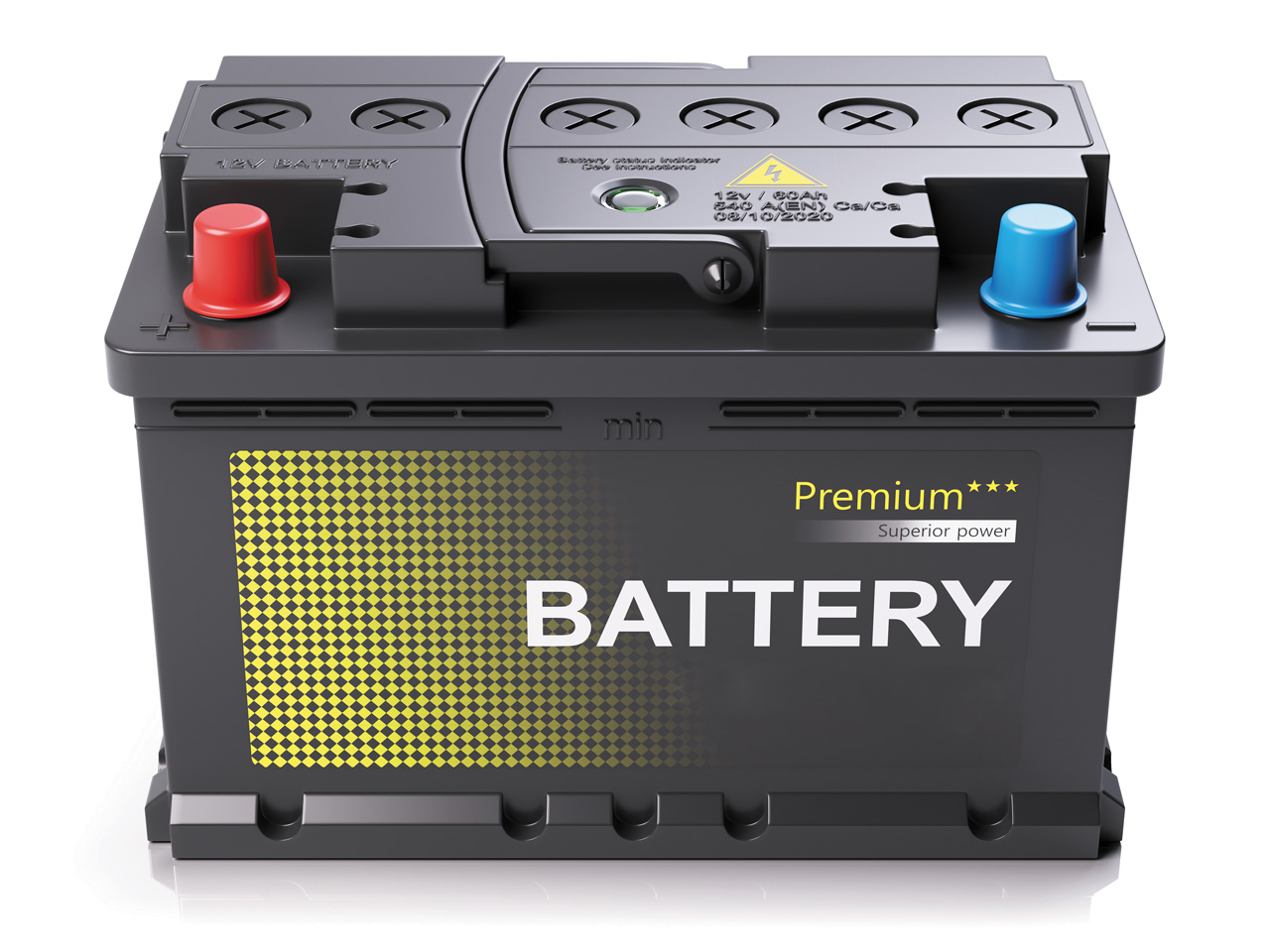
RV battery issues can be draining. The solutions may be easy or could require professional help, but fixing the problem is always empowering.
By Steve Froese, F276276
April 2021
It’s time to answer emails from Tech Talk readers. My responses assume some basic knowledge of electrical measurement on the part of the reader, and rate a 2½ out of 5 on my technical difficulty scale.
“My engine batteries are not being charged while on shore power. Why?”
– John (2006 Fleetwood Bounder 38N)
John, battery interconnectivity issues can certainly cause frustration. In your case, I suspect a problem with your battery isolator circuit, which may be under the hood or in your outside power bay. You are looking for a cylindrical device about 1 inch in diameter by 2 inches high. It has two large battery posts on the sides, and one or two smaller posts on the front. It likely is wired to a control module with a black housing. Somewhere near the module should be a fuse for the isolator. That should be checked first.
Since you didn’t ask about it, I assume your house batteries are charging from shore power. If this is the case, we can rule out a problem with the charge module itself. Other culprits could be loose wiring, a loose fuse, or a faulty solenoid or control module. I assume you own a multimeter and know how to take voltage measurements. If not, seek assistance, or take your coach to an RV service center.
With the coach plugged into shore power, measure the voltage of each battery bank separately (house and chassis). Set your voltmeter to a DC range of at least 15 volts. Note the voltage at each battery bank (measure between the positive post of the first battery and the negative post of the last one in the chain). Both banks should show the same voltage equal to the charging voltage (greater than roughly 13 volts). This means the solenoid is functioning properly and is closed, allowing both batteries to charge. If the measurements at both banks yield different results, the solenoid is open, indicating an issue with the system. In your situation, I suspect the latter to be the case.
Note that if the batteries happen to be at the same idle voltage, this test will be inconclusive. If so, carefully remove the positive battery lead from the engine battery bank. (Be sure not to touch the wrench to a ground point, short the battery terminals together, or let the positive cable touch a ground. And always wear gloves and eye protection when working with batteries.) Perform the same test, measuring the voltage between ground and the disconnected battery lead. If the solenoid is open, it will measure no voltage. If it is closed, it will show the same voltage as the other battery bank.
Based on your symptoms above, I’m guessing the solenoid is not closing when the coach is plugged in. Measure the voltage across the small terminal(s) on the front of the solenoid. If there are two small terminals, just measure between them, with either probe on either post (as long as you have a digital meter). If there is just one terminal, put the positive probe on the terminal and the negative probe on the solenoid case or another ground point. If it measures at least 4 volts DC across the terminals, and the battery banks measure different voltages, the solenoid is defective and should be replaced.
You should read at least 4 volts DC across the small solenoid terminals when the engine is running, or while connected to shore power. There should be no voltage across the small terminals with the ignition off.
If there is no voltage across the small terminals when there should be, an issue exists with the control module, wiring, or fuse. If your house batteries are charging when the engine is running, but your engine batteries are not charging when connected to shore power, the control module attached to the solenoid may be bad.
If you don’t have at least 4 volts DC across the small solenoid terminals while connected to shore power, locate the black control module. Measure the voltage between the “Coach Bat” and “Ground” terminals. If it measures at least 13 volts DC there, but nothing between the “Solenoid” and “Ground” terminals, you should replace the control module. If it measures less than 13 volts DC at the “Coach Bat” terminal, the solenoid should remain open as designed. In this case, measure the coach battery voltage again to verify whether it is being charged. The voltage measured at the coach battery and the “Coach Bat” terminal of the module should be the same. The solenoid will only be commanded to close if this is deemed to be a charging voltage of at least 13 volts DC.
If your battery voltage is in this range, but the voltage at the module terminal is less (likely zero), there is a wiring issue that may require professional repair.
“I cannot locate the relay that the Aux Start Switch activates so the coach batteries will replace the chassis batteries if the chassis batteries are low. I had someone work the switch on the dash while I listened everywhere for the click and I never could hear it. I realize that could mean that the relay coil itself is bad and so would not click, so I thought I would ask the expert where it is.
If I measure the starting voltage at the power point on the dash and then push the button, it makes no difference. Thanks for any help you can give me in locating this part.”
– Gene (2003 42-Foot American Eagle)
If the terminals do not show exactly the same voltage, the solenoid is faulty.
I can’t say exactly where the solenoid is, but it may be on the firewall or in the power compartment. I can’t find any schematics for your coach, but you can go to www.americancoach.com/owners/support/technical-assistance to email for help.
Once you find it, you should verify whether the solenoid is getting power from the switch. The dash emergency start switch utilizes the same battery isolation solenoid discussed in the first question. The difference is that the dash switch sends 12 volts directly to the small solenoid terminals, which closes the solenoid, allowing the house batteries to supply the starter motor with voltage. Therefore, if your charging system is functioning (house batteries charge from the alternator and chassis batteries charge from shore power), the solenoid is good and the issue is with the fuse, switch, or wiring.
Once you locate the solenoid, have someone hold the switch while you check for voltage across the small wires on the solenoid. It should be at least 12 volts. I should note, if your house batteries are also dead, the solenoid will not close.
If you measure voltage across the two small terminals, then measure the voltage across each large battery terminal with the dash switch closed. If the terminals do not show exactly the same voltage, the solenoid is faulty. In this case, we will assume the battery bank voltages are not the same at idle, since one would only press the switch in the case of a dead chassis battery bank.
If you don’t have voltage across the small terminals, that indicates a blown fuse, which should be located near the isolator; a wiring issue; dead house batteries; or a failed switch. To rule out the switch, measure between a ground point and each wire on the switch. One side of the switch should have 12 volts going into it, and the other side should have 12 volts when the switch is active.
It is not uncommon for these solenoids to fail over time, but they are easy to troubleshoot as indicated above. It is also possible that the solenoid is good but there is no power going to it.
I hope this month’s column helps if you have a battery connectivity issue.
Send Your Troubleshooting Questions to Steve Froese at techtalk@fmca.com. The volume of correspondence may preclude personal replies. Not all responses will apply in every instance. Some situations may require a visual inspection and hands-on testing. If you choose to follow any procedures outlined in this column, first satisfy yourself that neither personal nor product safety will be jeopardized. If you feel uncomfortable about a procedure, stop and make an appointment with an RV service facility.