
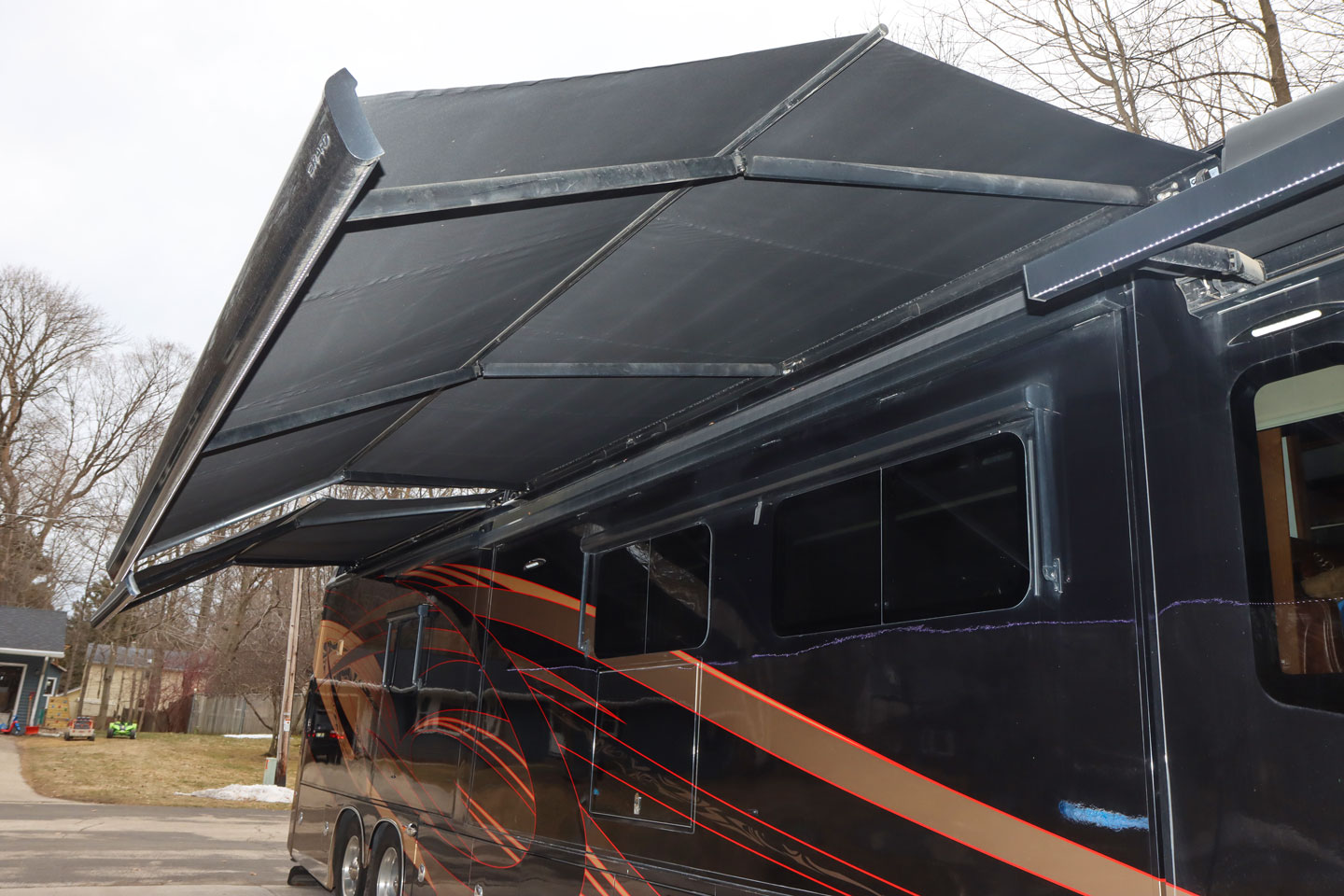
Awnings provide protection from sunlight, rain, and debris, and with regular cleaning and a little maintenance, they can prove to be a cool part of any RV.
By Mark Quasius, F333630
July 2021
Awnings are a popular RV accessory. In fact, if you look around, it may be difficult to find an RV that is not equipped with an awning. Awnings come in many forms and sizes and are installed in a variety of locations. Patio awnings, entry door awnings, window awnings, and slide toppers all have one thing in common — fabric that unfurls and retracts.
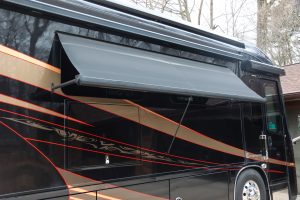
A large window awning.
Awnings bring a number of benefits to any RV. Patio awnings provide shade, which creates a comfortable spot next to the RV and helps cool the side of the vehicle. That, in turn, keeps the RV interior cooler. Window awnings help block sunlight from entering the RV, where it increases the temperature and fades fabrics, carpet, and wood trim. Entry door awnings do the same, but they also provide a small safe haven when it’s raining and you are unlocking and/or opening the door. Slideout topper awnings help keep the top of slideouts free of puddles and prevent twigs, leaves, and other debris from entering the RV when the slideouts are retracted.
Awnings have changed over time, along with developments in technology. Initially, patio awnings were mounted to the side of the RV and were equipped with hinged vertical arms that swung out to support the awning as it unrolled. In most cases, these arms could be removed from the side of the RV and staked to the ground for greater stability. The mechanism that allowed the awning to extend or retract was a long awning rod, which made it possible for the operator to reach the awning without a ladder. This type of manually operated awning is still in use today.
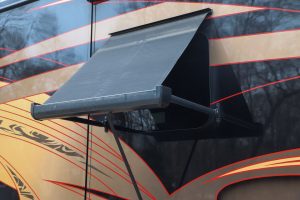
A bedroom window awning.
However, power awnings are becoming increasingly popular. Simply push a button and the awning extends or retracts. Some power awnings still utilize vertical arms as supports, but more and more awnings now are built with lateral arms, which provide a much cleaner appearance on the side of the RV. Some of the latest high-end awnings, such as the Girard Nova II series, utilize a lateral arm cam system that creates a gullwing when fully extended. The awning begins to extend straight out so that it clears any slideouts and gives the maximum height. Then, at a certain point, the outer half of the awning dips down on an angle to afford greater shading, while the upper portion remains horizontal. The lateral arm design also is used for power entry door awnings to provide a clean appearance, with no arms to get in the way.
Awnings traditionally have been mounted to RV sidewalls, and many still are today. However, some RVs are now being fitted with rooftop awnings. These awnings blend in with the front and rear caps to provide a streamlined appearance. This design also frees up some of the clutter from the sides of the RV and helps to hide rooftop components such as air conditioners, vent hoods, and satellite dishes. This type of awning provides a bit more height to help clear slideouts when extended as well.
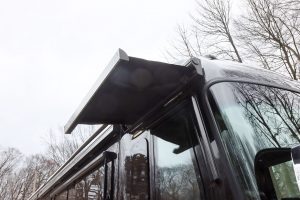
An entry door awning provides cover while unlocking or opening an RV door.
Window awnings usually are manually operated and consist of a spring-loaded roller and tie-down strap. An awning rod is used to extend or retract them. Some high-end RVs offer optional power window awnings, which are the ultimate in convenience. They can be deployed simply by pressing a switch inside the coach. In addition to keeping out sunlight, window awnings also make it possible to leave windows open during a light rain.
Slideout toppers shield the top of the slideout from the sun, but their main purpose is to keep the slideouts free of water and debris. Anyone who has ever retracted a slideout without a topper after it has rained has undoubtedly gotten a bit of a shower. These topper awnings also prevent leaves, twigs, and other debris from jamming the slideout as it is retracted.
Awnings are not maintenance free. Any item with moving parts that sits outside in the elements needs lubrication from time to time to prevent rust from forming on the mechanism. This is even more pronounced on awnings that are rarely used, so moving them in and out every now and then is essential. The fabric itself also can become dirty and moldy, so cleaning it should be a regular ritual.
Cleaning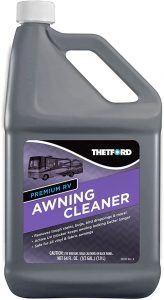
Awning fabric can be either acrylic or vinyl. Acrylic awnings have a woven fabric, and the weaves tend to load up with dirt and tree sap. They are treated with a water repellent to prevent leakage through the fabric. When cleaning acrylic awnings, it’s important to wipe the fabric rather than scrub it with a hard brush so as not to remove the water-repellent coating. An even better choice is to replenish the water-repellent coating after cleaning. Various sprays are available, such as 3M’s Scotchgard Auto Fabric and Carpet Water Shield, which I personally use.
Vinyl is easier to clean, because it isn’t porous like a woven acrylic fabric. Vinyl awnings do not mildew, but dirt does collect on them, so they need to be cleaned regularly. Vinyl awnings don’t have to be sealed, but applying a good UV protectant is a wise choice.
 Cleaning an awning isn’t all that difficult, but it does take a bit of time. A good, clean spray bottle is required, along with a sturdy stepladder. Any number of cleaners can be used. It’s generally best to check with the awning manufacturer to see what is recommended. Some owners choose dish soap, since it won’t harm the RV’s paint. A number of commercial products designed for cleaning awnings are also available. Simple Green is very popular, as are automotive cleaners designed for convertible tops or Jeep soft tops. Mildew stain removers also can be used. Bleach is not recommended except for extremely tough spots, because it can be hard on the awning’s fabric, reducing its life expectancy.
Dilute the cleaner with water and pour the mixture into a spray bottle. The exact ratio depends on the product and how dirty the awning is, but typical ratios run between three to six parts water to one part cleaner. Check the product directions for the proper amount.
To begin, extend the awning. Then spray the entire underside of the awning, ensuring plenty of coverage. Once the underside is totally soaked, roll up the awning so the cleaner contacts the top of the fabric as well. Leave the awning rolled up for at least an hour, and then unfurl it and use a garden hose to rinse off the cleaner. Be sure to rinse off both the top and the underside of the awning, being generous with the water to remove all of the cleaner. Once the awning is rinsed, leave it extended to dry. Don’t rush this. If it’s not totally dry, mildew can form. It’s best to pick a nice sunny day for cleaning your awning and to start early enough to give yourself adequate time.
If your awning includes heavy concentrations of tree sap, you may need to do a bit of spot cleaning or pretreating. RV owners have gotten good results with isopropyl alcohol, Formula 409, or Clorox spray.
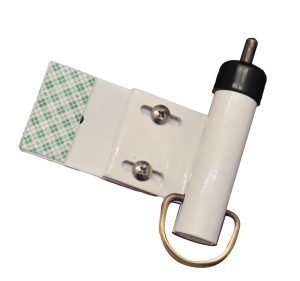
The RV Awning Travel Lock prevents an awning from unfurling in transit.
Other Concerns
Manual awnings contain a ratchet mechanism that utilizes a locking pawl to prevent the awning from unrolling when stored. This pawl engages the toothed roller that holds the awning material. However, the pawl can become worn and is subject to failure from bouncing during travel. Having the pawl fail can allow the awning to unfurl while the RV is in motion and act as a sail. This generally results in the awning being ripped off of the RV, with significant damage to the vehicle and the potential to cause accidents. Strapping the awning arms to the sidewall won’t help. You need to prevent the roller from rotating should the ratchet pawl fail. Fortunately, vendors offer awning travel locks. These locks can be easy to use and securely hold the awning roller to prevent it from rotating when driving.
Wind also can wreak havoc on an awning, and the higher-end power awnings with lateral arms are most susceptible. Manufacturers have designed safety features into the awnings to help, such as sensors that detect movement and automatically retract the awning. Others utilize wind sensors that detect wind speed. These methods help, but they are not foolproof, so the best practice is to keep an eye on wind conditions and don’t leave the awning out when you are away from the RV.
Awning Manufacturers
Awnings By Zip Dee, C716 *
(800) 338-2378
www.awningsbyzipdee.com
Awnings By Zip Dee is a full-line awning supplier. The line includes both manual and power patio awnings, window awnings, door awnings, and slideout toppers.
Carefree of Colorado, C444 *
(303) 469-3324
www.carefreeofcolorado.com
One of the largest awning manufacturers, with patio awnings bearing various brand names, including Paramount and Mirage, as well as window awnings, entry door awnings, slideout topper awnings, and screened sunrooms.
Dometic
(800) 366-3842
www.dometic.com
Dometic makes a wide variety of awnings for RV use. Its manual 8500 and powered WeatherPro series are popular patio awnings, while door awnings, window awnings, and screen rooms are also available.
Girard, C6970 *
(800) 382-8442
www.girardgroupcompanies.com
Girard is known for high-end motorized awnings, such as its dual-pitch Nova II patio awning, G-1500 entry door awning, slideout awnings, and both manual and power window awnings.
Lippert Components
(547) 537-8900
https://store.lci1.com
Lippert Components offers its line of Solera awnings, as well as accessories that work with them and with certain awning models manufactured by Carefree of Colorado and Dometic.
Awning-Related Products
RV Awning Travel Lock
(319) 395-7405
www.awninglock.com
The RV Awning Travel Lock is an easy-to-install device that prevents awnings from unfurling when the RV is in motion by not allowing the awning roller to rotate.
Shade Pro Inc., C117768 *
(800) 328-5100
www.shadepro.net
Shade Pro offers acrylic and vinyl replacement fabric for RV awnings and slideout toppers and also sells RV patio awnings, window awnings, and slideout toppers from various manufacturers.
Star brite
(800) 327-8563
www.starbrite.com
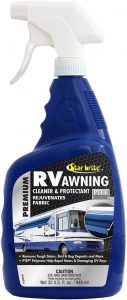
Star brite’s full line of products includes an awning cleaner and protectant with PTEF polymers that create a durable barrier against UV rays.
Stone Vos, C13091 *
(352) 942-0224
www.stonevos.com
Stone Vos provides acrylic and vinyl replacement fabric for RV awnings and slide toppers, as well as solar screens.
Thetford, C109 *
(800) 543-1219
www.thetford.com/product/premium-rv-awning-cleaner/
Thetford’s Premium RV Awning Cleaner is biodegradable, with UV blockers.
* FMCA Commercial Member.
For additional FMCA commercial member companies offering awning-related products and services, visit FMCA.com/rvmarketplace.