
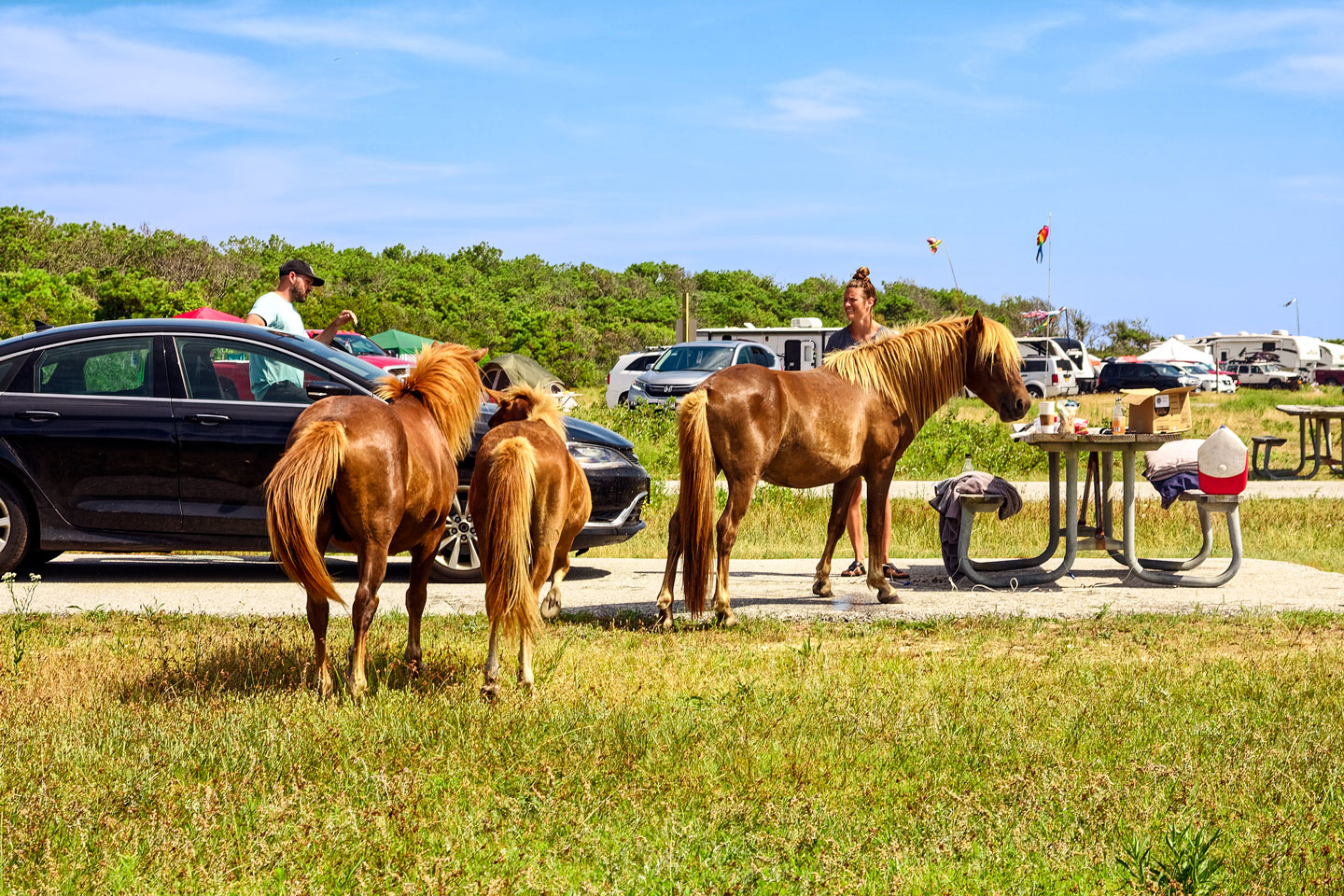
The fabled equines that reside on Assateague Island are among many highlights along the eastern shore of Maryland and Virginia.
By Sally B. Weigand, F498134
July 2021
Quick. Put the food away. Here they come!”
“They” are the wild horses of Assateague Island, known for their routine of wandering through Assateague State Park and elsewhere on the barrier island along the coasts of Maryland and Virginia. Visitors’ meals at campsite picnic tables sometimes are interrupted as people scurry to gather up everything and stow it away. Horses have the run of the park, and we must stay out of their path — as with other wild animals, no feeding or touching. It’s a unique experience.
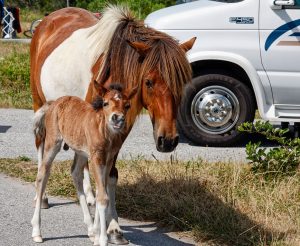
A mare and her foal come calling.
Be forewarned that these equines may pull items off tables and step on anything lying on the ground, such as bicycles. Although some call them ponies, genetically they are horses. Because of the inferior quality of the diet on which they graze, which consists of marsh and dune grasses, they do not grow to the size of other horses. Their abdomens frequently appear bloated, because of the high salt content of their food, which causes them to drink more water.
The horses typically separate themselves into bands of two to 10; each band favors a home turf. On our recent visit, a group of the same five, including a mare and her newborn foal, came through our campsite area to graze several times each day. Watch where you walk, as they leave behind evidence of their trek, which park staff cleans up routinely.
How did these animals get to Assateague Island? The National Park Service says they likely are descendants of horses that were brought to barrier islands such as Assateague in the late 17th century by mainland owners seeking to avoid fencing laws and taxation of livestock. However, in 1997, wreckage of a Spanish galleon found off the coast of the island gave plausibility to another theory: The horses may be descendants of equine cargo from a ship that sank, forcing them to swim to shore.
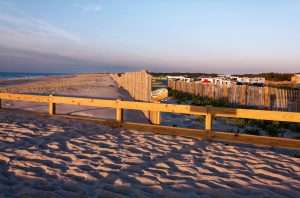
Morning breaks near Assateague State Park Campground.
This 37-mile-long island in the Atlantic Ocean is split between Maryland and Virginia, with a fence separating them at the state line. The horse herds in each state are treated differently. The Maryland herd is managed by the National Park Service, while the Chincoteague Volunteer Fire Company owns the Virginia herd. The latter horses are permitted to graze in Chincoteague National Wildlife Refuge, on Assateague Island, thanks to a permit issued by the U.S. Fish and Wildlife Service. Marguerite Henry’s famous book Misty Of Chincoteague is set on this island during the annual Pony Penning, which still takes place. The Virginia horses are rounded up and swim to nearby Chincoteague Island to be auctioned off, with proceeds supporting the fire company. This controls the size of the herd, which remains at approximately 150. While the event may sound exciting, those in the know suggest that folks be prepared to wait for long hours with a crowd in the hot sun.
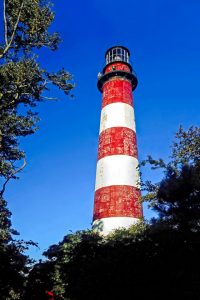
Assateague Lighthouse.
Assateague State Park in Maryland adjoins Assateague Island National Seashore, which is located in both states. Chincoteague National Wildlife Refuge is primarily in the Virginia half of Assateague Island but has parcels in nearby locations. (It’s a bit confusing.) Pets are prohibited in all these areas except the Maryland part of Assateague Island National Seashore.
Blue water capped with white laps the seemingly endless stretches of fine-sand beach. The ocean scene along Assateague Island shows visitors relaxing, playing, surf fishing, walking, swimming in the refreshing salt water, and reading books on the beach — the quintessential warm-weather seashore vacation. Biting insects can be a plague when an inland breeze is wafting, so insect repellent is advisable, along with sunscreen. In those areas where driving is restricted, except with an over-sand vehicle (OSV) permit, modes of transportation include walking, horseback riding, driving off-road vehicles (ORV), and kayaking.
As part of the Atlantic Flyway, Assateague Island is prime bird-watching habitat: 320 species visit or live there. Fishing, kayaking, paddleboarding, and swimming in the calm bay water lure visitors inland a bit, as do the ranger-led programs along the national seashore. Exhibits and films at the visitors center are worth seeing.
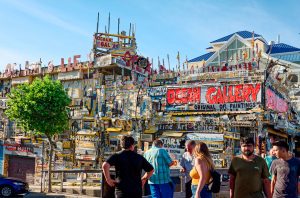
The Ocean City, Maryland, boardwalk.
Campsites without hookups on the Bayside and Oceanside campgrounds on the Maryland side of Assateague Island National Seashore are $30 per night. Some of the Bayside sites have shade trees. Three hundred additional campsites — some with electric hookups — are available at Assateague State Park a little farther north on the island and range from $27.50 to $38.50 per night; these have no shade. A short walk from these campsites through the dunes takes you to the beach and the Atlantic Ocean, where you also may encounter the horses. Seeing their silhouettes against the rising sun is an image to cherish.
Chincoteague National Wildlife Refuge, one of the most visited refuges in the nation, offers paved trails for biking and hiking. Vehicles are permitted on the Wildlife Loop after 3:00 p.m. Refuge wetlands and salt marshes are rich with nature, providing vital habitat for critters. Maritime forests, primarily loblolly pine, shelter nonmarine wildlife.
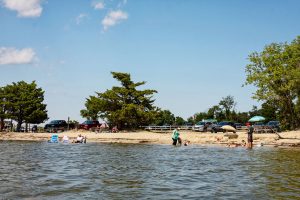
Sinepuxent Bay borders Assateague Island on the west.
Sending a beacon out to mariners at sea is the iconic, historic, red-and-white-striped lighthouse, also located within the refuge. The land south of the lighthouse attests to the constant change of barrier islands; it has grown two miles since the lighthouse was constructed in 1867 (an earlier, much smaller lighthouse was built on the site in 1833). Ascend to the top of the 142-foot-tall structure from June to September to view the watery landscape and to observe up close twin rotating lights that still cast their unusual double flash.
For restaurants, attractions, and more, Assateague Island is served by Ocean City, Maryland, in the north and Chincoteague, Virginia, in the south. Other nearby sites and towns offer interesting explorations as well.
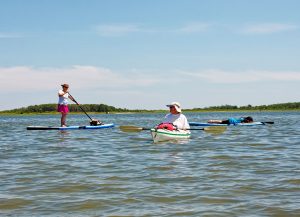
Enjoying the waters of Sinepuxent Bay.
Ocean City, a popular seaside town, swells with residents in the summer months. Its wide sand beach, accompanied by the soothing sound of the surf, contrasts with the adjacent clamorous boardwalk filled with eateries, gaming establishments, hotels, and shops. Fishing boats carry anglers offshore in search of a catch, while sightseeing boats motor into local waters for diverse views and marine life spotting. If you can handle a boat, rent one for a self-guided expedition. Watching marine traffic from a restaurant on the bay creates a pleasant dining experience.
Anchoring the boardwalk’s southern tip is the Ocean City Life Saving Station Museum. During the summer, be outside the museum at 10:00 a.m. every day except Sunday to join a free program covering varied topics, from history to knot tying.
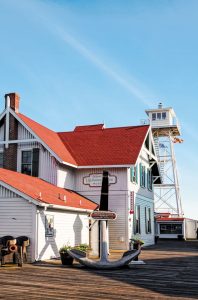
The Ocean City Life Saving Station Museum.
On seven-mile-long Chincoteague Island, home of the town of Chincoteague, a culinary treat awaits: fresh-from-the-sea clams and oysters. This island lacks the busy atmosphere of Ocean City, offering instead a simpler, more unspoiled vacation experience. From here, several boat cruises take visitors on bird-watching, nature, and sunset wildlife expeditions. Sometimes an inquisitive dolphin will accompany the boat for a few minutes. During the popular Waterfowl Week in November, visitors observe and learn about wintering waterfowl. Campers can choose from several private facilities on the island.
Located five miles west of Chincoteague Island is NASA’s Wallops Flight Facility Visitors Center. It is the place to see exhibits of scientific balloons, aeronautics, current missions, and rockets; a viewing site for launches is provided. Free educational programs enliven the calendar.
In Snow Hill, a small town on Maryland’s Eastern Shore, visitors experience a previous time at Furnace Town Historic Site. Numerous buildings were constructed around the hot-blast Nassawango Iron Furnace to supply necessities to workers. Today, they give visitors a peek into 19th-century life. Artisans demonstrate crafts of the day and sell their wares, as well as other historic-style gifts.
Furnace Town sits along the boundary of Nassawango Creek Preserve, which is home to one of the most northern stands of bald cypress trees. Paddling through this primeval forest or walking the trails are perfect ways to unwind and commune with nature.
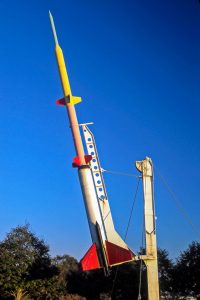
An outdoor rocket display at NASA’s Wallops Flight Facility Visitors Center.
Pocomoke City, Maryland, bills itself as “the friendliest town on the Eastern Shore.” Founded in the early 1700s as New Town, it later was given its current name, an American Indian term meaning “black water,” because of the cypress-lined river that flows through it. Boating, fishing, and wildlife viewing remain popular activities. Beginning from the city dock at Cypress Park, a 1.5-mile nature trail traverses varied sites, including a gazebo, a long fishing pier, boardwalks, a pedestrian bridge, and exercise stations. Three times in the town’s history, fires destroyed many buildings, but thanks to the resiliency of residents, it was rebuilt after each conflagration.
From Shad Landing in Pocomoke River State Park, a wooded canoe trail treats paddlers to a peaceful excursion. The park provides lovely campsites, a swimming pool, and a vast trail system that winds through Pocomoke State Forest.
If you are willing to drive an hour to Crisfield, the southernmost town in Maryland, you can board a boat to Smith Island or Tangier Island in Chesapeake Bay. Join the 200 residents of Smith Island, Maryland, for a taste of the simplified life of watermen and listen to their unusual British Colonial dialect. After renting a golf cart or bicycles, make the Smith Island Cultural Center & Museum your first stop for a film, displays, and a map before leisurely touring the island. Be sure to have fresh crabs in some form; crown your meal with a slice of Smith Island cake, which boasts eight or more thin layers of sweetness interspersed with minimal frosting.
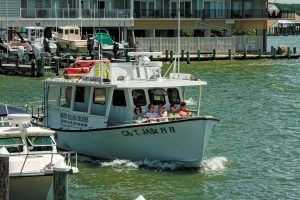
Boats transport passengers to Smith and Tangier islands.
Fewer than 700 residents call the 1.2-square-mile Tangier Island home, and they speak a distinct dialect of their own creation. Many are crabbers. Settlers from Cornwall, England, arrived in 1620, and this Virginia island now is on the National Register of Historic Places. Prior to the English, Pocomoke Indians occupied the island, as evidenced by the huge number of arrowheads that continually are uncovered. Exploring larger Tangier Island is similar to Smith Island. Experts say Tangier is sinking into the sea, so make your visit sooner rather than later! Seagulls hover, and you inhale the tangy salt air if you join other passengers on a charter fishing boat, hoping to take home samples of the Chesapeake Bay’s bounty while touring the Crisfield area.
An easier alternative to returning to Assateague is to camp at Janes Island State Park, just outside of Crisfield; more than 100 campsites are available, 49 with electric hookups.
Assateague is a unique experience. Roaming wherever they choose, whenever they want, the horse herd delights visitors. It is their turf, and we humans are their guests. The wild horses are the main attraction, but numerous other activities and additional venues in the region make for a memorable vacation. Because of summer heat and humidity, spring and fall are the optimal times to visit. Most places and programs have been in flux because of the pandemic, so check their status before venturing out. Whenever you go, however, you will be rewarded in countless ways.
Info
Assateague Island National Seashore
www.nps.gov/asis/planyourvisit/index.htm
Assateague State Park
www.dnr.maryland.gov/publiclands/pages/eastern/assateague.aspx
Maryland Eastern Shore
www.visitmaryland.org/regions-cities/eastern-shore
Eastern Shore Of Virginia
www.visitesva.com