
By Susie Wall
September 2021
There are those American cities that grow through time. They start out small, but then the people come, homes and businesses are built, and the city evolves into a thriving metropolis. Butte, Montana, is not one of those cities. In fact, it is just the opposite. With the success of copper mining operations in the late 1800s and early 1900s, Butte ballooned seemingly overnight into one of the largest cities west of the Mississippi River, boasting a population reported to be more than 100,000 strong. It is said that crowds of people six deep would line the sidewalks of uptown on any given day. But as with most regions dependent on a natural resource, Butte’s success was precarious. Copper prices dropped, spurring the closing of the mines in the 1970s. Butte shrank as a result. Today the population hovers around 35,000.
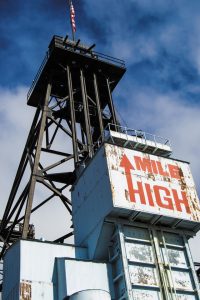
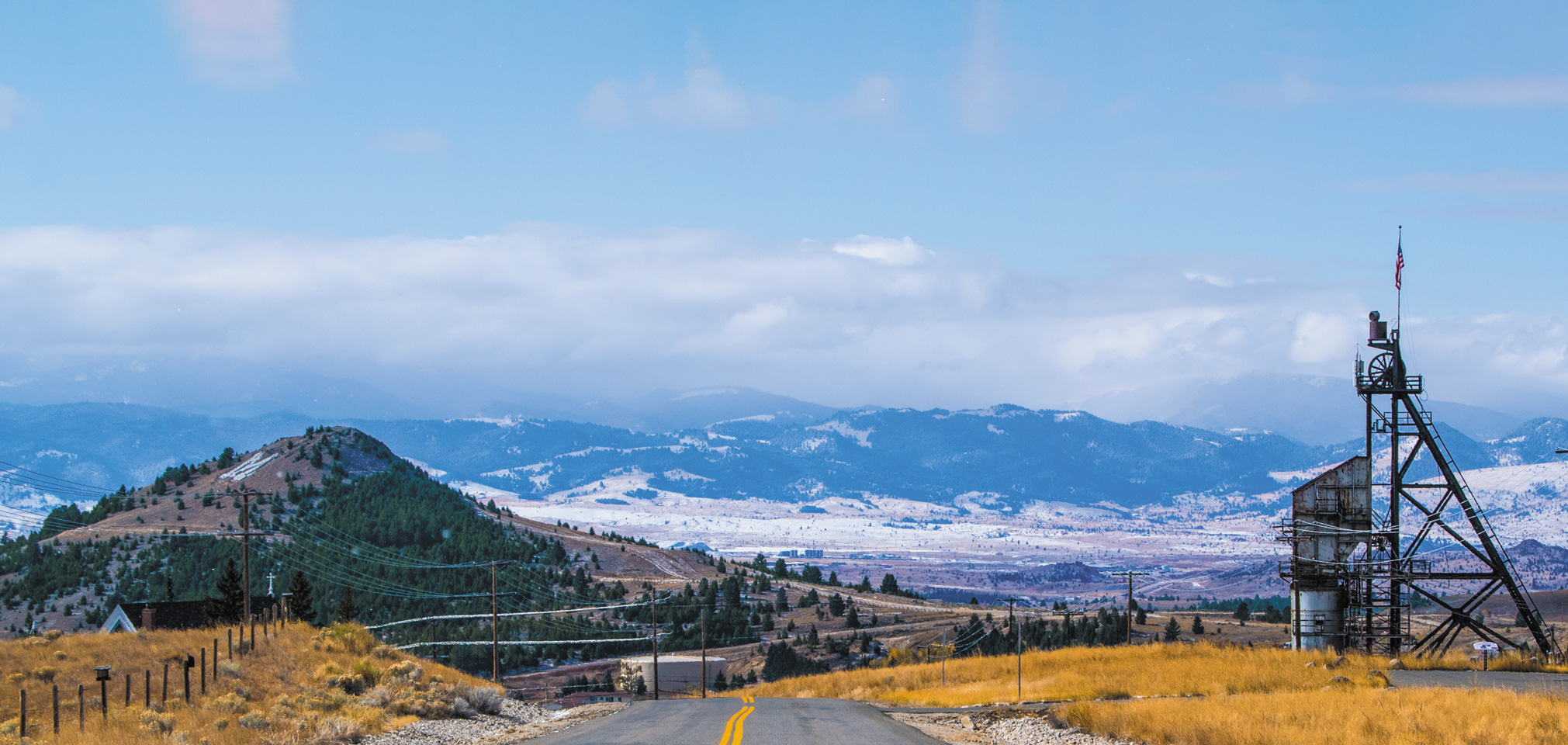
Headframes mark the area’s mines.
Although 21st-century travelers to Butte experience a much different vibe than travelers a century before did, what they discover is a quaint city overrun with historical attractions, stunning architecture, and welcoming locals with fierce civic pride, all cradled within the heart of Montana’s stunning Rocky Mountains.
Richest Hill
As you drive into Butte along Interstate 90, the first things that catch your eye are the headframes that loom over town, dotting the northern hills. Headframes are structures erected over an underground mine shaft. Their main function was to house the cable system used to lower miners into the depths of the earth. In its heyday, Butte had more than 100 operating mines, produced more than half of the United States’ copper, and earned the nickname “The Richest Hill on Earth.” Fourteen of these steel ghosts still stand today as monuments to Butte’s mining history.
To get up close and personal with a headframe and to develop a feel for daily life during the mining boom, start your visit to Butte at the World Museum of Mining. This sprawling 22-acre outdoor museum features many exhibits, including the replica town of Hell Roarin’ Gulch. Stroll along boardwalks lining the streets to get a glimpse inside businesses, medical offices, and schools as they existed at the turn of the century. Life-size dioramas depict the workings of the town, from Edgar Guay’s tack shop to Hans and Louise Peterson’s sauerkraut factory to the horrific but essential Dr. Ironside’s dentist office.
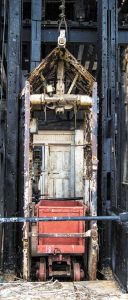
Butte’s mining history includes the rusty remains of steel headframes that lowered miners deep into the ground.
The Orphan Girl Mine, with its towering headframe, makes up the other section of the museum. If you dare, don a hard hat and headlamp and venture 100 feet down the actual mine shaft for a taste of what the brave men of Butte experienced on a regular day at work.
The daily risks the miners took to support themselves and their families were very real. Many places around Butte pay homage to this dedication but none so much as the Granite Mountain Memorial. Overlooking the Continental Divide and Butte’s colorful mined hills, this memorial commemorates the tragic Speculator Fire, in which 168 men died on June 8, 1917. Beautifully carved plaques depicting scenes from that day line the memorial, and recordings tell the stories of those who perished. It is a place for both remembrance and quiet reflection.
The majority of Butte’s population during the mining boom were men and women toiling just to carve out a life for themselves and their families. On the other side of the economic spectrum, you find the copper kings. Men such as William A. Clark and Marcus Daly made their fortunes in Butte during the copper boom, and they are memorialized in town through their stately homes.
To best experience what life was like for these copper barons, make a stop at the Copper King Mansion. Built in 1888, this 34-room red-brick palace was the residence of William A. Clark. Today, it operates as a bed-and-breakfast and offers daily tours for a view into the luxurious lives of Clark and his family.
During your time in Butte, drive or walk around the west side of town, north of I-90, to gawk at all the historic homes. The dedicated local government has enacted preservation programs to ensure these lovely Victorian and Queen Anne-style houses forever remain a part of the city.
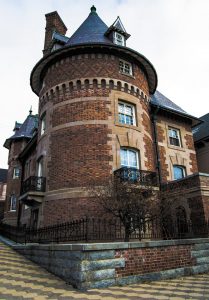
“Copper King” William A. Clark built the Clark Chateau for his son Charles in 1899.
Travel Back In Time
History buffs, prepare to geek out in Butte. The Butte-Anaconda Historic District is one of the largest National Historic Landmark Districts in the United States in terms of the number of contributing properties, with close to 6,000 buildings registered. The district includes the communities of Butte; Walkerville, just north of uptown Butte; and Anaconda, a 24-mile drive west on I-90. You can explore Butte’s history in many ways, but two of the best are by taking a self-guided walking tour and signing up for a guided tour.
For the self-guided walking tour, make a stop at the Butte Convention and Visitors Bureau to pick up a “Walk to Remember” guide. This printout takes you on a 1.5-mile walking tour of Butte’s historic uptown. And up you will go. Calf-busting steep streets rise above town. With names such as Mercury, Silver, and Aluminum, they take you past some of Butte’s most historic and significant buildings.
Dive deeper into Butte’s raucous past on a tour with Old Butte Historical Adventures. A knowledgeable and passionate guide takes you around uptown, unlocking doors to secret passages. The now-quiet Rookwood Speakeasy features a beautifully carved bar and a two-way mirror used for vetting potential patrons.
The folks of Butte are famous around Montana for working hard and playing hard, and their predecessors were no different. The tour guide also takes you below City Hall to see jail cells that were used until the 1970s. Graffiti line the walls of the windowless, hot cells. You could easily spend all day reading the scrawls of both men and women who found themselves on the wrong side of the law. Look closely and you’ll see Butte’s most famous hometown son listed on the jail roster: Evel Knievel. Some sources say the motorcycle daredevil was arrested for — what else? — reckless driving.
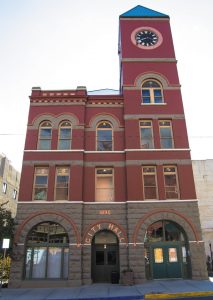
Butte’s iconic City Hall.
If you prefer to take a break from walking, sign up for a trolley tour. Catch the trolley at the visitors bureau and then settle in for two hours as a guide transports you to Butte’s historic neighborhoods and famous sites such as the Dumas Brothel Museum. The trolley’s hours correspond with the bureau’s hours, so it’s best to call ahead for the schedule.
Higher Learning
One of Butte’s most venerable institutions is Montana Technical University, known around the state as simply “Tech.” Tech was established in 1900 as Montana State School of Mines. Since then, it has grown into one of the nation’s premier technical universities, offering degrees in scientific-based fields such as geological, metallurgical, and petroleum engineering. Along the lines of work hard, play hard, they also have one heck of a football team.
Visitors to Butte enjoy strolling around the grounds of the historic and intimate campus, taking in the architecture and views of the surrounding mountains. While you’re there, be sure to check out the Mineral Museum. If you dare to pass the imposing cave bear fossil greeting you at the door, proceed to check out the many cases full of shining polished minerals found around Butte and around the world, such as quartz, malachite, and fluorite. Other exhibits focus on meteorites, gold, copper, and earthquakes. Stop in the gift shop to purchase minerals to take home, or splurge on a set of tools to take to the field for your own mineral hunting adventure.
Diverse Butte
The promise of good wages for men who lacked much education brought families from all over the world to Butte during the height of the mining boom. Folks of Irish, Chinese, Italian, Mexican, and German descent, to name a few, flooded the town, creating a melting pot in the mountains of Montana. At one time, you could hear more than 20 languages spoken as you walked the streets of uptown.
Once the mines started closing, many ethnic groups had to leave to seek better opportunities. Despite the exodus, several cultures are still celebrated today by Butte’s citizens in museums and at historical sites and annual festivals. If you’re in town in mid-August, make time for the An Ri Ra Irish festival. For three days, Irish food, dance, music, and history fill the town, attracting visitors from around the world.
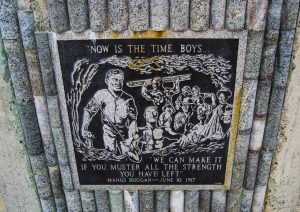
The 168 miners who died in the Speculator Fire in 1917 are remembered at the Granite Mountain Memorial.
Asians represented one of the largest populations in Butte at the turn of the century, despite being barred from working in the mines. At one time, the Asian population numbered more than 6,000, with eight blocks of uptown considered Chinatown. Although unable to take part in mining, Chinese people carved out their own niche by operating stores, laundries, and noodle parlors.
A wonderful example of the noodle parlors is found in the Mai Wah Museum, housed in the adjoined Wah Chong Tai and Mai Wah buildings on West Mercury Street. Take a tour through the Butte Chinese Experience Exhibit to view period clothing, household goods, and other artifacts showcasing what life was like for these immigrants seeking a better existence thousands of miles away from home. Move next door to marvel at the glass cabinets full of teas, medicines, and dried food once sold in the Wah Chong Tai Mercantile. Upstairs are remnants of the noodle parlors. Massive woks sit empty on a heavy brick stove. The floor in front of the stove is worn down, immortalizing the spot where cooks served up the endless strings of noodles made on-site.
Eat, Drink, And Be Merry
When you’re ready to take a break from your educational tour of Butte, plenty of fun activities await.
Montana is well known for its craft breweries and distilleries, and Butte is no exception. Butte Brewing Company, Quarry Brewing, and Headframe Spirits are at the ready with glasses of liquid gold that both quench your thirst and continue to celebrate Butte’s past. Headframe’s Orphan Girl Bourbon Cream Liqueur is perfect for sipping on a hot day. Toast the Irish with a pint of Butte Brewing’s Butte Irish Red. History and beer really come together at Quarry Brewing, located in the Grand Hotel, built in 1916.
Take the steps down to the basement of the Miner’s Hotel to imbibe in a modern-day speak-easy at 51 Below. At first, you find yourself cornered at the base of the stairs, but see that phone on the wall? Dial “5” and a door slides open, revealing a lively bar. The cocktail selection continues the theme with drinks such as an old-fashioned, a gimlet, and a pink mink.
Butte may have an industrial past, but as in all of Montana, outdoor adventures are abundant. A system of walking and biking trails snakes around town, leading through historic neighborhoods and natural areas. Pick up a map of the trails at the visitors bureau.
Stodden Park is a great place for family fun and includes attractions for everyone, such as the Ridge Waters waterpark, which boasts water slides and a lazy river. One of Stodden Park’s newest additions, the mining-themed Destination Playground allows kids to slide, climb, and zip their way to fun. Take a spin on the Spirit of Columbia Gardens carousel, with its hand-carved horses, or play a round at one of the park’s two nine-hole courses at Highland View Golf Course.
Beyond Butte
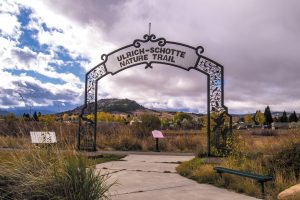
Walking trails offer a close-up connection to Butte’s natural areas.
If your spirit of exploration continues to burn bright, many adventures within a short drive of Butte are worth checking out.
Fifteen miles west of town, Fairmont Hot Springs Resort checks off several boxes for the RVing crowd. A stay in the associated Fairmont RV Resort grants you free admission to the resort’s steaming pools. Adults will appreciate a soak in the calming waters of the two mineral hot springs, while the kids will have hours of fun in the two swimming pools, complete with a giant water slide. If you feel you need to earn that relaxing soak, spend the morning at the golf course or on a guided fishing trip offered through the resort.
The 45 minutes it takes to drive from Butte to Lewis and Clark Caverns State Park is well worth it. This is your chance to tour one of the largest limestone caves in the Northwest. Follow a guide deep into the earth to learn about stalactites, stalagmites, and soda straws, as well as the history of the exploration of the caverns. Tours are offered May through September. Hiking trails and a campground are also found at the park.
On your return to Butte, take a detour off I-90 to visit another unique geologic feature: Ringing Rocks. As the name suggests, the rocks in this pile of boulders give off a melodious sound when hit. Bring a hammer and scramble among the rocks to create your own stone symphony. The road is gravel, and based on its current condition, a short walk or a high-clearance vehicle may be required to reach the rocks.
Whether you concentrate your explorations in Butte or venture beyond, it’s quite likely you’ll become absorbed in the history, culture, and scenic beauty of the area.
Further Information
Butte-Silver Bow Convention & Visitors Bureau
www.visitbutte.com
(800) 735-6814
Camping
2 Bar Lazy H RV Park
122015 W. Browns Gulch Road
Rocker, MT 59701
(406) 782-5464
www.2barlazyhrv.com
Butte KOA Journey
1601 Kaw Ave.
Butte, MT 59701
(406) 782-8080
www.koa.com/campgrounds/butte
Fairmont RV Resort
1700 Fairmont Road
Anaconda, MT 59711
(406) 797-3505
www.fairmontrvresort.com
Lewis and Clark Caverns State Park
P.O. Box 489
Whitehall, MT 59759
(855) 922-6768
fwp.mt.gov/stateparks/lewis-and-clark-caverns/