
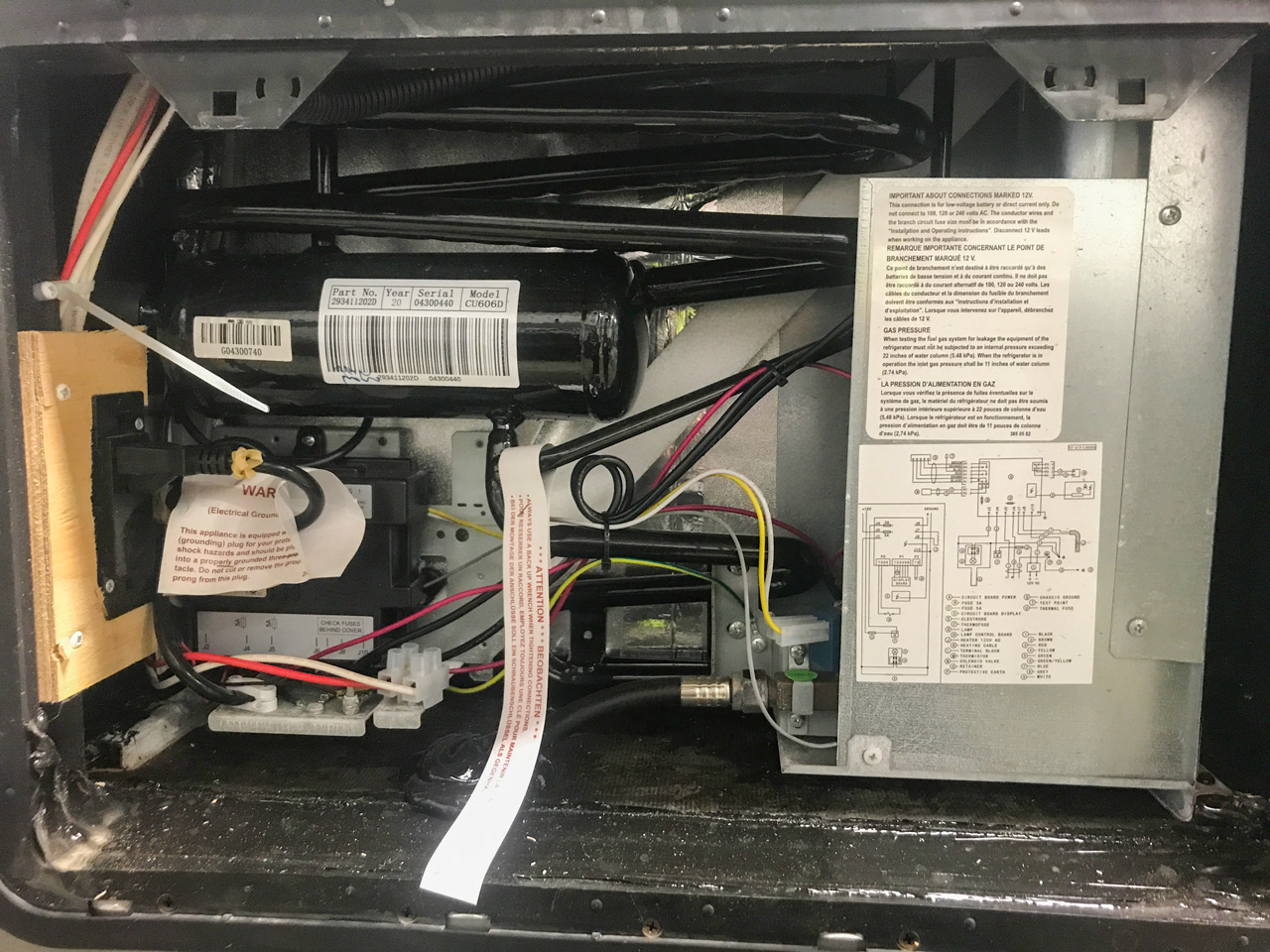
Troubleshooting refrigerator fans, which help to create the airflow needed to keep an RV refrigerator operating properly.
By Steve Froese, F276276
October 2021
We received the following email from a member:
“Our fridge works well when plugged into shore power but not on propane. We hear a fan when on shore power but not when on gas. Is there a way to make the fan work on gas? If not, what do you recommend for a fan when on gas?”
Let’s start with the cooling fans. Many refrigerators, especially four-door units and larger double-door models, have one or more cooling fans in the back. These fans are installed vertically and assist with air movement from the bottom sidewall vent to the top sidewall vent or roof vent. Cooling fans are particularly useful on RVs where the refrigerator is installed in a slideout, which utilizes an upper sidewall vent instead of a roof vent.
Think of the air space behind the refrigerator as a chimney. Air can move much more efficiently if it enters the lower sidewall vent and flows straight up and out the roof vent, as opposed to having to change directions and exit an upper sidewall vent. This is why RV refrigerator manufacturers have very strict installation guidelines for the space behind and beside the fridge. In the case of upper sidewall vents, this includes an angled baffle starting directly at the top of the cooling unit and ending just above the sidewall vent. This baffle must be tightly sealed to prevent any hot air from getting trapped behind the baffle, or above or beside the refrigerator.
The cooling fans greatly assist with the airflow. The fans are connected to the same electrical power wiring as the refrigerator and are wired through a thermal switch connected to the cooling unit tubing. When the cooling unit reaches a certain temperature, the thermal switch closes, causing the fans to turn on. Once the unit cools back down, the thermal switch opens, and the fans turn off. Depending on the ambient temperature around the RV, the fans may run constantly, frequently, or rarely.
The fact that the fans are not working while the refrigerator is running on propane is, in my opinion, not an issue in that it is not actually a failure. The energy source used to power the refrigerator has no bearing on functionality of the fans. In other words, regardless of whether the fridge is running on propane or electricity, the fans toggle on and off as the cooling unit temperature changes. Since you noted that the fans function when the refrigerator is on electricity, I believe the fans are not faulty and are doing exactly what they are supposed to.
I believe what is happening is that the refrigerator is not operating on propane. When the refrigerator is operating on electricity, the cooling unit is heating up, and the cooling fans are functioning as needed. When the change is made to operating with propane, something must be preventing the refrigerator from functioning, so the cooling unit is not heating up and, therefore, the fans are not turning on. I believe when the issue preventing the fridge from functioning on propane is resolved, the fans will start working in that mode as well.
I reached out to the author in search of more information. He reported that the refrigerator works fine on all three energy sources when the temperature is below about 80 degrees, but it does not work on propane when it is over 80 degrees and they are driving. This could be a huge clue. I reached out again to ask whether they are running the refrigerator on propane because they are driving, or whether the fridge does not work on propane only when they are driving. As of this writing, I have not heard back on this, so I will examine both cases.
Knowing that the fridge works when the temperature is below 80 degrees, this means nothing is fundamentally wrong with the system. If the refrigerator works on all three energy sources except when they are driving, the issue likely is that the propane flame is being blown out by the wind as the RV rolls down the road. This problem is rare, because the flame is protected by the sheet metal covering the burner, as well as the lower refrigerator vent cover. It is possible that the sheet-metal flame cover was removed or altered at some point. I also have seen RVs completely missing the outside lower vent cover. Assuming the latter is not the case, the author should check the sheet metal covering the burner to make sure it is intact and not altered in any way. Sometimes one of the metal flanges gets bent outward so the flame can be properly observed and then doesn’t get bent back inward again. If everything is as it should be, the author may need to fabricate additional baffling to protect the flame from the wind. Great care must be taken not to impede the cooling airflow, however.
If the issue is simply that the refrigerator does not cool in the propane mode when the temperature is above 80 degrees, this likely is related to insufficient airflow across the cooling unit. Earlier the importance of this area being tightly sealed was mentioned. Unfortunately, sometimes manufacturers fail to take the time to properly construct the baffle in the air space. They often are misaligned, incorrectly fabricated, or missing entirely. Sometimes the gaps are not sealed sufficiently. These issues create poor airflow, resulting in hot air accumulating above and around the refrigerator instead of exiting out the vent.
In a perfect world, the cooling unit would heat up, the fans would come on, and the cooling unit temperature would decrease to a functioning level. However, in the case where the air can’t flow properly, the cooling fans may move the hot air around in a turbulent fashion rather than venting it outside. If the cooling air is turbulent enough, it could result in airflow and temperature variation such that the thermal switch for the fans may not activate. This is a definite stretch, but it is possible.
What it boils down to is that the airflow may be the culprit, and the author should remove the upper vent and thoroughly inspect the area to make sure it matches the installation specifications outlined in the refrigerator’s users manual. These manuals are readily available from the manufacturer or online.
As is always the case with my technical responses, without actually inspecting the issue in person, I can’t guarantee I properly understand the symptoms or identify correct cause and correction. If my suggestions fail to identify the issue, or if you are not comfortable performing the steps I present, I recommend seeking professional RV service assistance.
If you have technical questions or comments related to your RV or RVing in general, don’t hesitate to send an email to techtalk@fmca.com. Also, FMCA maintains extensive user forums covering many RV-related topics. It is worth searching these forums — https://community.fmca.com — to see whether your issue has been discussed. If not, feel free to post your issue and one of our readers may assist.
SEND YOUR TROUBLESHOOTING QUESTIONS to Steve Froese at techtalk@fmca.com. The volume of correspondence may preclude personal replies. Not all responses will apply in every instance. Some situations may require a visual inspection and hands-on testing. If you choose to follow any procedures outlined in this column, first satisfy yourself that neither personal nor product safety will be jeopardized. If you feel uncomfortable about a procedure, stop and make an appointment with an RV service facility.