
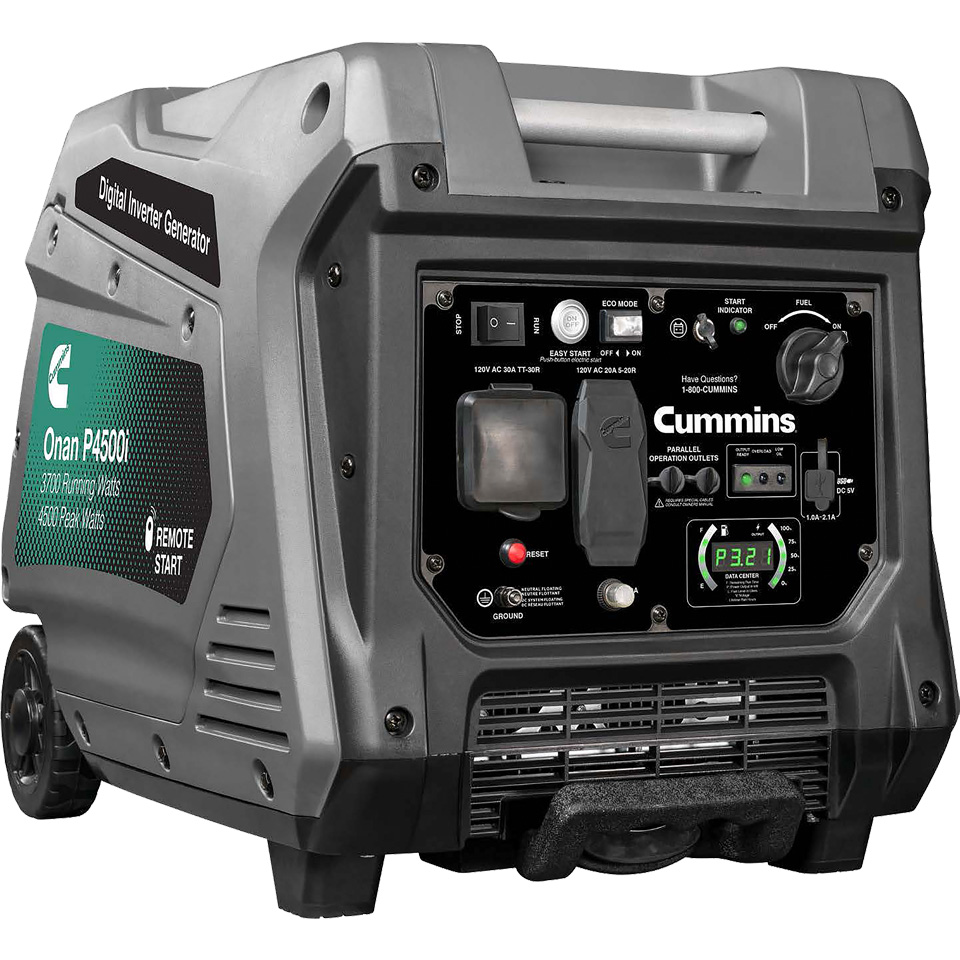
Inverter generators supply a more stable and steady AC power source, which has many benefits, especially with today’s sensitive electronic devices. But do you really need one?
By Steve Froese, F276276
January 2022
Generators have been around a very long time; in fact, they were already being produced by the early 1900s. But generator technology has remained relatively unchanged, as the concept of converting chemical energy into electrical energy is fundamental. However, the advent of inverter generator technology about 10 years ago has had a dramatic impact on the generator world, allowing for much more stable electrical output, which has numerous benefits when it comes to providing power to an RV.
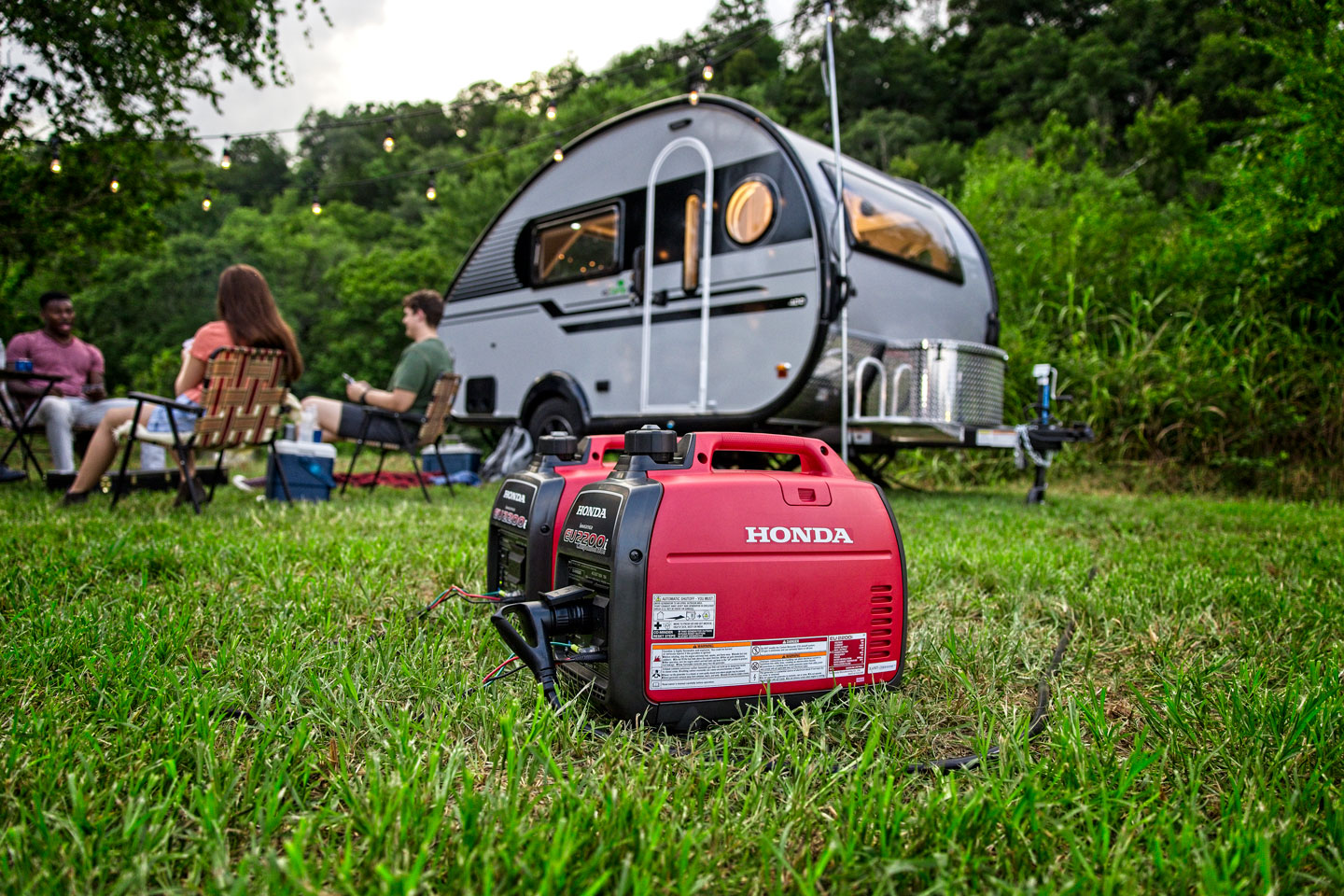
The Honda EU2200i is an example of an inverter generator that lends itself to RV use.
In general, generators are relatively simple machines. While they consist of many components, they have three primary parts: engine (prime mover), alternator, and control system. In the case of RV generators, the prime mover is simply a gas, diesel, or propane internal combustion engine.
As many of us are aware, an internal combustion engine functions by converting chemical energy into mechanical energy (the fuel is potential chemical energy; the combustion is thermal energy; and the resulting shaft rotation is mechanical energy). In simple terms, when the piston reaches top dead center inside the cylinder (the piston is at the top of the stroke), the air inside the cylinder is at high pressure, since it has been compressed by the piston. A small amount of fuel is injected into the cylinder and ignited by the spark plug or injector. This fulfills the requirements for combustion (fuel, air, and heat) and results in a small explosion, forcing the cylinder down, causing rotational motion of the crankshaft.
In a vehicle, the engine output shaft is attached to the transmission, drive shaft, differential, and wheels. On a generator, the engine output shaft is connected to the rotor of the alternator. The rotation of the rotor causes an electrical field to be generated in the windings of the generator housing (stator) through the process of electromagnetism. This, in turn, converts mechanical energy into electrical energy.
Appliances and devices that depend on energy supplied from this alternating current (AC) generally are sensitive to changes in both frequency and voltage. Low-voltage, high-voltage and frequency conditions can result in everything from annoying behavior to damaging devices. Power grids usually deliver stable AC voltage to your sticks-and-bricks home, although many readers have probably experienced high-voltage power surges or low-voltage brownouts from unstable power delivery. A generator must precisely control both voltage and frequency so the loads can run properly, reliably, and without incurred damage.
Frequency is defined as the number of times an event occurs per unit of time. In North America, the nominal AC frequency is 60 hertz, which means the current completes 60 cycles each second. The standard voltage for single phase is 115 volts AC (VAC). In generators, the output frequency is a function of the rotational speed of the rotor. Simply put, generator frequency (f) is a function of engine speed in revolutions per minute (rpm) and the number of magnetic poles on the alternator rotor (P) divided by 120. RV generators have either two or four poles on the rotor.
Let’s calculate the required rotational speed for a four-pole alternator. First, we will rearrange the equation for rpm = 120*f/P = 1,800. So, for a four-pole alternator, the required engine speed is 1,800 rpm (simple math reveals that the required speed is 3,600 rpm for a two-pole generator).
Generator voltage is also a function of rotational speed, but since the frequency is directly related to rpm, the ability to alter the speed of the engine to adjust output voltage is limited, unless both frequency and voltage are equally out of spec. Older generators utilized a mechanical linkage called a governor to automatically adjust generator speed to keep the frequency in specification. Modern generators generally use an automatic voltage regulator (AVR), a solid-state device that automatically regulates the output voltage to maintain nominal 115 VAC.
Any fluctuation of the engine rpm or failure of the AVR leads to unstable generator output voltage and/or frequency. Perhaps more important, because of how generators create electricity, they produce power that is not “clean,” which results in a higher total harmonic distortion (THD) than that provided by the power utility. THD is largely a measure of how clean AC power is. Many of today’s sensitive devices can be damaged by a high THD. Similar to the importance of a pure sine wave inverter is the requirement for low THD generator power.
Enter the inverter generator, which was introduced by Honda about 10 years ago. Inverter generators provide a much cleaner power output than standard generators. As a reference, many standard generators produce a THD as high as 25 percent, while an inverter generator can be as low as 1 percent.
An inverter generator works by first rectifying the AC output of the alternator to direct current (DC). A microprocessor then inverts this DC voltage back into AC. Because the AC voltage is created and controlled by a computer circuit, the voltage and frequency can be precisely regulated. It also results in pure sine wave output instead of the square wave created by a traditional generator. This results in safe operation of sensitive electronics such as computers, phone chargers, and televisions.
The other advantage of inverter generators is that the engine speed varies according to electrical load, unlike a traditional generator, which has a constant rpm. As the electrical demand increases, the microprocessor simply increases the engine speed to create more current. This saves fuel and creates less noise.
Inverter generators have many other benefits as well, although they also have some drawbacks compared to traditional generators. Here are some pros and cons:
If you run your generator frequently and at full load, a traditional generator may better serve your purpose, since an inverter generator is more expensive and will be consuming comparable fuel to a traditional generator. If you run your generator infrequently and/or to power light loads, an inverter generator is probably for you. However, note that inverter generators can only generate up to approximately 4,000 watts (4 kw) of power, which is about 33 amps. This is enough to power a 30-amp RV but not sufficient for a 50-amp unit. Some inverter generators can be connected to other units in parallel to create more output power, but this is an expensive option, and not all generators are capable of this.
Your RV already may be equip-ped with a generator, and if it is a traditional type, it probably doesn’t make sense to replace it with an inverter type, if it’s even feasible. However, if you are in the market for a portable generator, you might want to consider an inverter generator. Be sure to consider the pros and cons listed above.
I hope this article has provided you with some insight into how generators work, their limitations, and how inverter generators alleviate these concerns.
Inverter Generator Pros
Smaller and lighter than traditional
Quieter than traditional
More fuel-efficient than traditional
Produces cleaner power for sensitive devices
Inverter Generator Cons
Smaller capacity than traditional
More expensive than traditional
Send your troubleshooting questions to Steve Froese at techtalk@fmca.com. The volume of correspondence may preclude personal replies. Not all responses will apply in every instance. Some situations may require a visual inspection and hands-on testing. If you choose to follow any procedures outlined in this column, first satisfy yourself that neither personal nor product safety will be jeopardized. If you feel uncomfortable about a procedure, stop and make an appointment with an RV service facility.
You may also want to consult the FMCA Forums (https://community.fmca.com) to see whether your question has already been addressed or, if not, to post it.