
Cashless tolling is a trend. What does it mean for RV owners?
By Roger Marble, F399427
March 2022
With more than 300 toll roads, bridges, and tunnels in the United States, it’s common for drivers to have to stop and dig out some cash before they can proceed. However, an increasing number of toll facilities allow fees to be paid by electronic toll collection (ETC), which can save drivers time and, possibly, money. Does it make sense to sign up for an account? The answer depends on where you travel and how much importance you place on convenience.
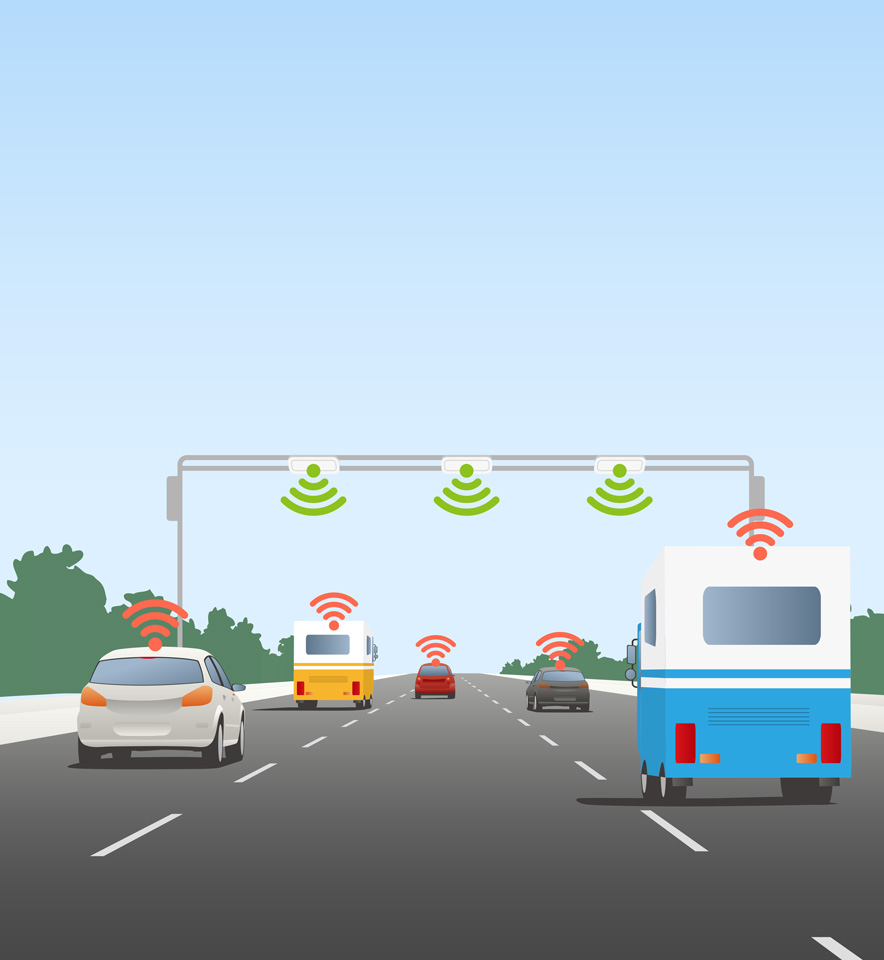
Here’s how an ETC system works. After you establish a prepaid account with a participating tolling agency, you receive a small electronic transponder or an adhesive tag that attaches to the inside of your vehicle’s windshield. As you approach a collection point, you drive under a gantry, an antenna reads your transponder or tag, and the appropriate charge is deducted from your account. Once the balance in your account reaches a predetermined threshold, the account is replenished by charging against a credit card. If you do not have a transponder or tag, a camera photographs your license plate, and you receive an invoice in the mail.
Most toll facilities charge rates based on the type or classification of vehicle, so when opening an ETC account, you are asked to provide vehicle information such as weight, number of axles, and height. For example, Ohio has seven vehicle classes. Class 1 includes low two-axle vehicles and motorcycles. (“Low” vehicles are under 7 feet 6 inches in height as measured over the first two axles.) Class 2 consists of high two-axle vehicles and low three-axle vehicles. Class 3 includes high three-axle vehicles and low four-axle vehicles. Class 4 encompasses high four-axle vehicles and low five-axle vehicles; and so on.
If you tow a vehicle behind a motor-home, the towed vehicle’s license plate number should be added to your account. Some agencies require drivers to obtain a second transponder for the towed vehicle. For details, and to ensure such transponders are programmed correctly, contact the ETC system’s customer service center in the state where you open an ETC account.
You do not have to live in the state where you get the transponder. Some states charge a monthly fee for its use, while others offer one for free. So, it pays to shop around online to find the best deal for you and your vehicles.
ETC Benefits
A big advantage of electronic toll collection is that many locations have special ETC-designated lanes, and vehicles sometimes can pass through such lanes at normal or close-to-normal highway speeds, saving drivers time. Also, having an ETC account means that you can use any lane; it eliminates that last-second maneuvering to get your RV into a cash-only lane. In addition, there’s no need to fumble around for money on those occasions when you encounter tollbooths that accept ETC or cash only.
It’s also worth noting that many ETC systems offer discounts off the cash toll rates. Additional discounts may be available for commuters, residents of a particular state, and people who make a certain number of monthly trips on a particular tolled road. However, it’s difficult to say how much money RVers might save, because so many factors are involved, such as the toll agency, location, miles driven, and type of vehicle. Still, electronic tolling almost always offers a lower price when compared to paying cash.
Depending on the ETC system, you may be able to open an account online, by mail, by phone, or by walking into a customer service center. Regardless, it’s best to have your transponder activated and ready to go before beginning a trip. If you apply by mail, it may take a couple weeks to get squared away. Even if you walk into a customer service center, the transponder may not be activated for a day or two. Also note that customer service centers may not be accepting walk-ins because of COVID-19.
E-ZPass
The E-ZPass Group is billed as the world’s largest toll collection program. It consists of toll agencies in 19 states: Delaware, Florida, Georgia (due to start accepting in spring 2022), Illinois, Indiana, Kentucky, Maine, Maryland, Massachusetts, Minnesota, New Hampshire, New Jersey, New York, North Carolina, Ohio, Pennsylvania, Rhode Island, Virginia, and West Virginia. The states jointly use the cashless E-ZPass technology so that drivers do not have to stop, present a toll ticket, and pay. A map of the participating states, as well as information about E-ZPass toll facilities in each state, can be found at bit.ly/3nVNBip.
E-Z Pass variations. Even within the E-ZPass Group, a wide range of variations exist. For example, Illinois is connected to E-ZPass, but the system in use on the Illinois Tollway is called I-Pass. In 2016, a section of Illinois Route 390 became the first all-electronic cashless tolling roadway on the Illinois Tollway; that section has no coin baskets or tollbooths. Drivers without an I-Pass must pay the toll online or by mail. Other states likely have implemented such systems, which lessen the cost of toll collecting.
In New York, a special motorhome discount called the Thruway Motor Home Discount Plan is based on the number of axles on the motorhome. The plan provides for a lower passenger-vehicle rate for motorhomes. Proof of motorhome registration is required. The Thruway Special Discount Towing Plan offers a special rate for pickup trucks towing a fifth-wheel trailer. Although no discount is available, those towing a conventional travel trailer or a boat can obtain a special tag programmed for the combination to allow them to use a dedicated E-ZPass lane. The special tags are intended to be used only with the towing combination.
In Massachusetts, all the state’s toll roads, bridges, and tunnels have transitioned to electronic toll collection. The program is called EZDriveMA. Equipment to read E-ZPass transponders, as well as cameras that can capture images of license plates, are mounted over the roadway. If you don’t have an E-ZPass or a registered pay-by-plate account, you receive a bill in the mail. Another example is Rhode Island, which also transitioned to all-electronic tolling in October 2021.
In North Carolina, the ETC system is called NC Quick Pass. North Carolina toll roads accept not only E-ZPass but also SunPass (a Florida ETC program) and Peach Pass (a Georgia ETC program). Therefore, by buying an NC Quick Pass in North Carolina, you gain access to electronic toll collection in 19 states. Florida’s new SunPass Pro program also works in Georgia and everywhere E-ZPass is accepted.
Using E-ZPass. In summer 2021, I drove my Type C motorhome from northeast Ohio to Gillette, Wyoming, for FMCA’s international convention. I traveled through Ohio, Indiana, and Illinois, which are all part of the E-ZPass system. Without E-ZPass, my tolls would have been $41.10 for my motorhome or $29.40 for a passenger car. Using E-ZPass, tolls were $33.33 for my motorhome and would have been $23.83 for a car. I did not have to stop at any tollbooths, but I did have to slow to 10 mph twice in Ohio and twice in Indiana, and I slowed to 55 mph once in Illinois.
For a list of E-ZPass fees and discounts by state, visit this Wikipedia page: https://en.wikipedia.org/wiki/E-ZPass.
Other ETC Systems
In Florida, SunPass works on 30 toll roads and bridges within the state. SunPass also can be used on North Carolina toll roads that accept NC Quick Pass and on Georgia toll roads that accept Peach Pass. Likewise, Peach Pass works on Florida and North Carolina toll roads. Be sure to register your license plate on your ETC account to ensure compatibility.
Also, the ETC systems in Kansas (K-Tag), Oklahoma (Pikepass), and Texas (TxTag) are compatible with each other.
While you’ll find more states that share coverage with facilities in other states, note that some ETC systems work only in a particular state.
Because every RVer’s situation is different, some research will be required for you to determine whether an ETC system — one that covers multiple states, or a single state — might be beneficial. Some agencies charge a sign-up fee; others don’t. Some require just a deposit for the transponder (in some cases refundable), while others charge a monthly or annual fee. Required minimum account balances also vary. With many states and agencies involved, the rules, fees, and other costs are subject to change.
For many RVers, the primary reason for enrolling in an ETC program is not the money saved but the convenience it affords.
ETC Advantages
*No need to search for loose change.
*No waiting in lines where people are paying cash.
*Special lanes allow users to pass through at posted highway speeds.
*Discounted fares charged on many turnpikes, bridges, and tunnels.
*Transponders are easy to install; no tools required.
*ETC use helps reduce emissions, conserve fuel, and ease traffic congestion.
*Accounts can be reviewed online.
*Users of E-ZPass can open an account with the state that provides the best deal.
ETC Disadvantages
*Prepaid account balances (usually about $20) do not pay interest.
*If you are registered for more than one ETC system, the correct transponder must be in place for the system you are using.
*Accounts require up-to-date vehicle type and license number (changes can be made online, however).
U.S. Electronic Toll Collection Systems — A Sampling
E-ZPASS:
Delaware: www.ezpassde.com
Florida: www.sunpass.com
Illinois: www.getipass.com
Indiana: www.ezpassin.com
Kentucky: https://riverlink.com
Maine: https://ezpassmaineturnpike.com/EZPass
Maryland: www.ezpassmd.com
Minnesota: www.dot.state.mn.us/ezpassmn/index.html
Massachusetts: www.ezdrivema.com
New Hampshire: www.ezpassnh.com
New Jersey: www.ezpassnj.com
New York: www.e-zpassny.com
North Carolina: www.myncquickpass.com
Ohio: www.ezpassoh.com
Pennsylvania: www.paturnpike.com
Rhode Island: www.ezpassritba.com
Virginia: www.ezpassva.com
West Virginia: www.transportation.wv.gov/Turnpike/EZPass
EXPRESSTOLL (Colorado)
www.expresstoll.com
FASTRAK (California)
www.thetollroads.com/accounts/fastrak/california
GEAUXPASS (Louisiana)
www.geauxpass.com
GOOD TO GO (Washington state)
www.wsdot.wa.gov/GoodToGo
K-TAG (Kansas)
www.myktag.com
PALMETTO PASS (South Carolina – Southern Connector)
www.southernconnector.com
PEACH PASS (Georgia)
www.peachpass.com
PIKEPASS (Oklahoma)
www.pikepass.com
TXTAG (Texas)
www.txtag.org
Interoperability Efforts Continue
E-ZPass. Peach Pass. TxTAG. FasTrak. Express Toll. Those are but a few of the electronic toll collection systems operated by more than 100 toll agencies in the United States. (Canada, on the other hand, has far fewer tolling facilities, and most of those involve tolls for bridge or ferry crossings, not roads.) Although some systems “talk” to one another and recognize one another’s customers, many do not. That can be frustrating for toll-paying motorists, such as RVers, who travel through different parts of the country.
The proposed solution, a nationwide electronic toll collection system, received a boost in 2012 when Congress enacted and President Barack Obama signed the Moving Ahead for Progress in the 21st Century Act, known as MAP-21. It set an October 2016 deadline for all toll facilities on federal-aid highways to implement a system that provides for interoperability. In other words, customers could open one account that would allow for payments at any participating toll facility in the country.
But the deadline passed with no national system in place. What’s more, the federal law did not specify who should work out the details of such a system, or how.
Clearly, electronic toll collection is still a changing system, but you can check the states in the areas you may travel and see whether you can benefit from using ETC.