

Plan to make the most of your visit. Prepare for camping and transportation well ahead of time and follow “day plans” while there.
By Rick Nullmeyer, F330947
April 2022
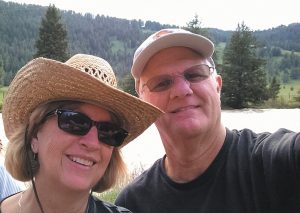
Rick and Jan Nullmeyer enjoy their RV travels.
Since joining FMCA in 2003, my wife, Jan, and I have traveled all over the United States in our motorhome. We’ve been as far north as Lubec, Maine, and as far south as the Florida Keys; to Moton Field in Alabama, where the Tuskegee Airmen of World War II fame learned how to fly; to the crocodile-infested waters of the Florida Everglades; to the home of Abraham Lincoln in Springfield, Illinois; to Sleeping Bear Dunes in Michigan — all from our home base in northern California. We’ve also been to many U.S. national parks, including national battlefields, national seashores, and national historic sites under the stewardship of the National Park Service.
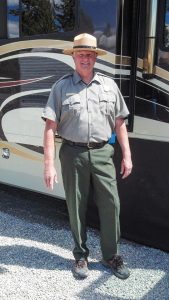
Rick Nullmeyer worked as a Yellowstone National Park ranger from 2013 to 2019.
In fact, for the summer seasons from 2013 through 2019, I served as a National Park Service ranger in Yellowstone National Park. I worked for the U.S. Department of the Interior at the visitors centers in West Yellowstone, Montana, and in the Madison Information Station in Madison, Wyoming. I answered questions about the park, gave evening campfire talks, presented Junior Ranger programs, and helped visitors enjoy as much as they could with the time they had set aside to see the park.
People from all over the world and of all ages visit Yellowstone. They come as individuals, as families, or on guided tours, hoping to experience all the park has to offer. Most visitors have some basic, well-intentioned knowledge about Yellowstone and its many wonders; however, they quickly realize they have no idea how to put that knowledge into action. This can lead to a frustrating and disappointing visit. They soon realize that planning is the key to an enjoyable visit.
Saluting the U.S. flag at the Madison Information Station.
As a park ranger, I learned that visitors don’t plan much before they arrive. They typically walk up to the visitors center desk and say they want to see the entire park; they have set aside two days, don’t want to miss anything, and ask for suggestions.
But seeing all of Yellowstone in only two days is not going to happen. The park is way too big (almost 3,500 square miles) and hosts way too many visitors (millions each summer season) to make that possible. It is home to scores of wild animals (bison, elk, grizzly and black bears, and wolves, to name a few), plus a supervolcano, geysers, hot springs, fumaroles (steam vents), waterfalls (nearly 300), rivers, hiking trails, and a whole array of other natural features, all of which are very spread out. So, visitors haven’t set aside enough time to see what they want to.
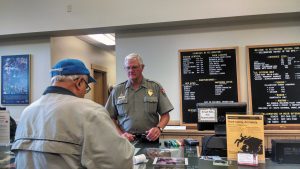
Rick answered questions and offered suggestions to visitors eager to see as much of the park as possible.
To help visitors maximize their experience, I wrote a book — A Ranger’s Pocket Guide To Yellowstone National Park — in which I created “ranger day plans” corresponding to the length of time people set aside to see the park. These plans are based on years of experience that rangers develop from visitors’ questions and what they want to see the most. The more time they have, the more they can see. My hope is that with some guidance, people can plan their visit and set aside enough time to explore the park.
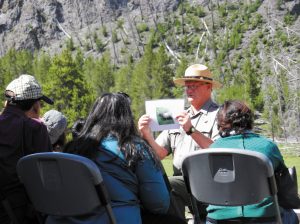
Rick also presented Junior Ranger programs.
Consider accommodations, for example, which are limited in and around Yellowstone. Visitors quickly discover that they have to plan months, if not a year, in advance to reserve a spot. The further ahead they plan, the better their choices. If you want to camp in the park, note that campgrounds are limited; some close seasonally or at various times. Generally, an RV length limit is imposed. And some campground areas accommodate tents only. If visitors wait too long to reserve a site, they often find themselves staying outside the park, about an hour’s drive away. Inside the park, traffic can be congested or stopped completely, which adds even more drive time. (The book discusses ways to minimize this.)
You’ll want to be aware of several other impediments you might experience during your park visit. First, large crowds of people want to visit the same attractions at the same time. That results in lots of traffic, overloaded parking lots, and lines for the bathrooms and restaurants.
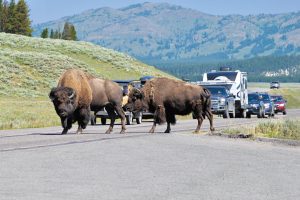
Bison and other wild creatures stroll the park freely, which can result in traffic tie-ups.
Second, everyone wants to take photos of the animals. Remember, they are wild creatures, and at times they get too close to the main roads. Sometimes they get on the roads. That creates huge traffic jams (which rangers call “animal jams”). The animals can back up hundreds of cars and sometimes close off a portion of the park if they block an area of the roadway that has no alternate routes. Occasionally, the roads become gridlocked. There goes all your planning.
Speaking of animals, one season a few years back, park rangers learned that an unusually high number of visitors sustained injuries from getting too close to wild animals. A man walked up to me at the visitors center desk and said, “You should train the wild animals to stay away from the visitors, because trying to get the visitors to stay away from the animals is definitely not working.” Looking back, he was right.
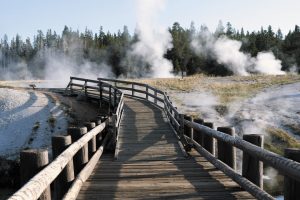
Remain on the boardwalks that have been erected around hot springs and geysers.
A third impediment to keep in mind: Boardwalks are installed around the hot springs and geysers for your safety. Don’t step off a boardwalk for any reason. Hydrothermal and geothermal geyser basins are deadly. Beneath the boardwalks are geyserite mineral deposits and extremely hot water beneath the geyserite. The geyserite may not support your weight.
Fourth, the weather is unpredictable. For example, we’ve had snow in the town of West Yellowstone on the Fourth of July. We also experience a fair amount of thunderstorm activity. Cold weather may hit in April, May, October, and November. That means it may be very difficult to take photos of the hot springs, because all you see is steam.
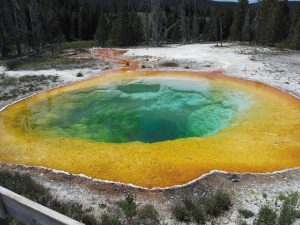
Park wonders include the Morning Glory Pool.
Fifth, cell signals are very limited inside the park. Everyone is used to getting in their vehicle and using GPS to go someplace. That’s not likely to happen in Yellowstone. So, you’ll be forced to use the more antiquated method . . . maps.
If each visitor took the time to invest in their own enjoyment by planning their visit, they’d find out that Yellowstone National Park can be a wonderful, amazing, and awe-inspiring place where so much is going on.
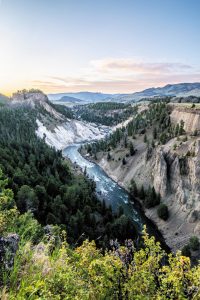
The Yellowstone River, viewed from the Calcite Springs Overlook.
Besides becoming a ranger as I did, you also can volunteer in most national parks, including Yellowstone, through the Volunteers In Parks (VIP) program. To inquire about the program, you can call the main phone number at any of the 423 (and growing) national park units or access information online at www.nps.gov.
Thank you for allowing this one ranger, and fellow FMCA member, to help you.
Yellowstone By The Book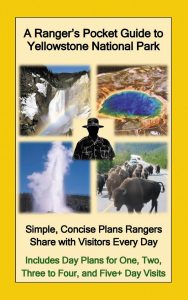
Experience what it’s like to look over the shoulder of a National Park Service ranger and see how they help to plan visitor trips in A Ranger’s Pocket Guide To Yellowstone National Park: Simple, Concise Plans Rangers Share With Visitors Every Day by R.D. (Rick) Nullmeyer ($14.95).
The author addresses the questions visitors ask most often: the park’s features, tips on getting around, locations of particular sites, and more.
The book includes “ranger day plans” for one, two, three to four, and five-plus day visits to Yellowstone, along with driving maps and turn-by-turn instructions. Map references are provided at the start of each plan, which readers can transfer to a Yellowstone Park map and highlight, depending upon which ranger day plan they’re following. (Park maps are available online or in the park visitors centers.) After readers have highlighted areas of interest, they will know how much time is needed to visit based on the time they have.
“The primary purpose of this book (is) to allow a ranger to help you plan a safe and fulfilling visit you’ll remember the rest of your life,” Rick said.
A Ranger’s Pocket Guide To Yellowstone National Park is available from bookstores and Amazon.com.