

When Canadian travelers want to escape the springtime thaw, they often head west — far west, to British Columbia’s provincial capital.
By Jan Lee
April 2022
Perched on the southeastern tip of Vancouver Island and surrounded by miles of parks, trails, and natural attractions, Victoria has become one of British Columbia’s top RV destinations. A warm, sub-Mediterranean climate keeps rain and snow away from Victoria’s coastline much of the year. For families, the island’s beaches and kid-friendly activities are a plus during the spring and summer months. But so is the island’s scenic beauty and the convenience of RV parks both inside the city and within easy commuting distance.
Sailing To Victoria
Getting to Vancouver Island is half the enjoyment of visiting Victoria. Two Victoria-bound ferry lines are equipped to carry RVs. BC Ferries departs from Tsawwassen, British Columbia, and docks at Swartz Bay, near Sidney, at the end of Provincial Highway 17 (27 miles/36 km north of Victoria). The other, Black Ball Ferry, departs from Port Angeles, Washington, and arrives in Victoria. Both ferries take about 90 minutes to reach their destination.
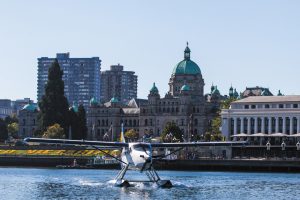
Harbour Air seaplane tours take off from the Inner Harbour, with BC’s Parliament Buildings in the background.
The BC Ferry from Tsawwassen threads its way through the picturesque Georgia Strait, past clusters of small islands, private coves, and marinas, before docking at Swartz Bay. Abundant seating usually is available in the forward observation deck and cafeteria. Pets are not allowed on the upper-level passenger decks, so a pet room is located below on a vehicle-parking level. At this writing, an RV with two adults and two children travels round trip for $145-$250 (Canadian), depending on the size of the RV.
Getting to the privately owned Black Ball Ferry terminal is a scenic excursion of its own. Ferries leave the Olympic Peninsula terminal and dock in Victoria’s Inner Harbour. This route doesn’t provide the same up-close view of BC’s Gulf Islands, but it does include a panoramic vista of the Victoria shoreline. A coffee shop is onboard. Fees are roughly equivalent to BC Ferry’s rates.
Ferry reservations are strongly recommended for RVs over 18 feet. For BC Ferries, arrive 30 to 60 minutes before sailing; for Black Ball, arrive 90 minutes prior. Staff may request proof of COVID-19 vaccination and molecular tests.
Victoria: City Of Gardens And History
Victoria’s famous manicured gardens are part of the city’s springtime attractions. Many residents compete to see who can grow the most spectacular flower gardens. Each May, a flower-counting competition further helps to inspire the burst of local color as temperatures warm. For horticulturalists and other flower lovers, spring is the perfect time to visit the city that made Vancouver Island known for its beauty.
Vancouver Island is home to Butchart Gardens, one of its many famous parks. Butchart is a collection of five main gardens on 55 acres, interwoven by walking paths and stunning flower displays that change frequently. Several restaurants are also located on-site. The park is about a 30-minute drive northwest of Victoria, off Highway 17.
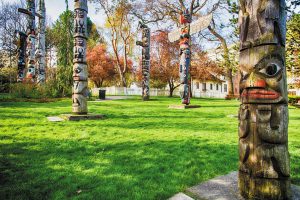
Thunderbird Park, next to the Royal BC Museum, displays First Nations totem poles.
Interested in learning about Northwest history? Victoria’s museums and 19th-century historic landmarks are the place to start. The city sits on the ancestral lands of the Lekwungen people, today known as the Songhees and Esquimalt nations. The Royal BC Museum has several exhibits dedicated to Vancouver Island’s early residents, as well as the European settlers who built Victoria. Be sure to view the First Nations totem poles in Thunderbird Park behind the museum.
The British Columbia Parliament Buildings and the Fairmont Empress Hotel, which opened in 1898 and 1904, respectively, are both a short walk from the museum and rank among the city’s most famous historical landmarks. Another is Craigdarroch Castle — a 39-room mansion owned by 19th-century coal baron Robert Dunsmuir — which illustrates the life of Victoria’s privileged class (and their hard-working staff) before the days of cell phones, washing machines, and smart appliances.
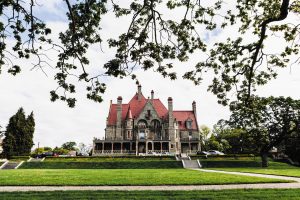
Visitors can tour 19th-century Craigdarroch Castle, built by coal baron Robert Dunsmuir.
Touring Victoria
Victoria is an easy city to navigate if you prefer to sightsee on your own. The Victoria Regional Transit System connects all major points within the Victoria area by bus. Most of the buses offer accessible entrances, but some attractions may be several blocks from bus stops.
The historic Inner Harbour serves as the central port for tour services and is connected to nearby shops, restaurants, and attractions by a waterfront pathway. Nearby, Murchies Tea & Coffee is the quintessential Canadian tea shop, and a perfect setting for a relaxing tea or coffee break. The Victoria Bug Zoo and Miniature World are just two of the city’s kid-friendly attractions, an easy stroll or bus ride from the harbor.
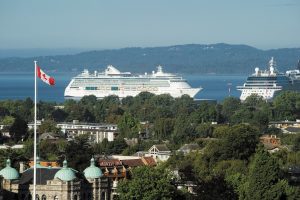
Picturesque views of the Inner Harbour abound in Victoria.
Information about four intriguing self-guided tours of downtown Victoria are available online at bit.ly/3Im6VgV. Tours include Victoria’s famous Chinatown and the city’s many “haunted” residences.
Spring and summer are great times to whale-watch in Victoria. Many a visitor has caught a glimpse of whales while standing on the banks of the Inner Harbour. Humpbacks and orcas regularly pass through the area between May and October.
Guided whale-watching tours attract thousands of visitors each year, but there are other ways to experience Victoria as well. Sample a mouthwatering culinary tour or view Victoria’s scenery from a seaplane. Contact Tourism Victoria for a list of tour operators.
Where To Stay
Victoria has two main RV parks within the city. Both are open year-round, and they usually have room for visitors in the spring.
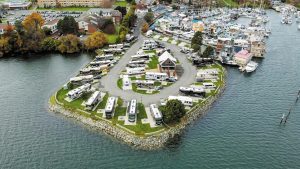
Salish Seaside RV Haven overlooks Victoria Harbour.
Salish Seaside RV Haven, overlooking Victoria Harbour, has 37 sites. It bills itself as “big-rig friendly,” offering easily accessible paved roads. Its redesigned waterfront section accommodates motorhomes; an additional section accommodates motorhomes and towable RVs. Sara Tayler, who works at Salish Seaside RV, said March to May is one of the best and least-crowded periods to visit. “Once springtime hits, things start to open up in Victoria,” she said. The park is 16 minutes from downtown by vehicle. www.salishseasidervhaven.com
Fort Victoria RV Park, 19 minutes from downtown, has a loyal following, and 122 sites open to seasonal visitors. According to the park, it’s advisable to book at least two weeks ahead, as availability “is always changing. Definitely check the ferry schedules and call ahead.” www.fortvictoria.ca
For a country setting, consider one of the parks approximately 30 minutes north of downtown. Oceanside Resort has full-season and per-night bookings and overlooks scenic Haro Strait. It’s 16 minutes south of Swartz Bay on BC 17. “Reservations are always recommended, especially after the Easter long weekend,” notes property manager Samantha Lenz. www.parkbridge.com/en-ca/rv-cottages/oceanside-resort
Malahat Mountain Meadows RV Park, 30 minutes via Highway 1, has a rustic setting near water-falls and the Malahat Skywalk. www.victoriacampgrounds.com
Goldstream Provincial Park, 25 minutes from Victoria, has no hookups, but the forested surroundings of its 100 sites can’t be beat. The park includes numerous waterfalls and nature walks. www.bcparks.ca/explore/parkpgs/goldstream
Whatever park setting you choose, spring is among the best times to visit Victoria. Do some research and planning beforehand to enhance your stay in this vibrant capital city.
Tours And Attractions
Tourism Victoria
Getting To Victoria
BC Ferries — Vancouver (Tsawwassen) Terminal
1 Ferry Causeway
Delta, BC V4M 4G6
(888) 223-3779
Black Ball Ferry — Port Angeles Terminal
101 E. Railroad Ave.
Port Angeles, WA 98362
Port Angeles terminal:
(360) 457-4491
(888) 993-3779
Cross-Border Travel Requirements
The United States and Canada recently updated their requirements for cross-border travel by land. If you are a visitor planning to enter Canada for tourism (not a Canadian resident), make sure to check current COVID-19 requirements at bit.ly/3t78Akc.
The following requirements were in place as of February 28, 2022:
Visitors must be fully vaccinated and be able to show the dates of vaccination.
Proof of a negative antigen test is required for individuals ages 12 and older, taken the day before entry to Canada. (Home testing is not accepted.)
Canada uses an online registration process called ArriveCan for entering the country. The advantage is that it speeds up the entry process at the border and reduces long lines of vehicles. You’ll be asked to input your passport and vaccination information when you register. Please note that if you don’t preregister on ArriveCan, you may be turned back at the border. For more information, visit bit.ly/3t4syMq.
Canada randomly tests travelers entering the country to reduce the spread of COVID-19, but if you are selected, you won’t be required to quarantine while waiting for the test result.
Also at this writing, the province of British Columbia requires masks to be worn in most indoor settings, including events and attractions. It has reduced some requirements. For up-to-date information, visit bit.ly/3LSEVnr.
U.S. Re-Entry
As of January 22, 2022, U.S. residents re-entering the United States are not required to be vaccinated, but they must carry identification. Types of ID include a valid passport, an enhanced driver’s license, or a Tribal card.
Non-U.S. residents must be vaccinated, carry proof of vaccination, and answer questions about their vaccination when requested. Like Canada, the U.S. accepts all WHO-accepted COVID-19 vaccines. For more information, see https://www.usa.gov/americans-abroad.
Be sure to check both Canada’s and the United States’ websites for updates, as border processes may have changed since this was written.