
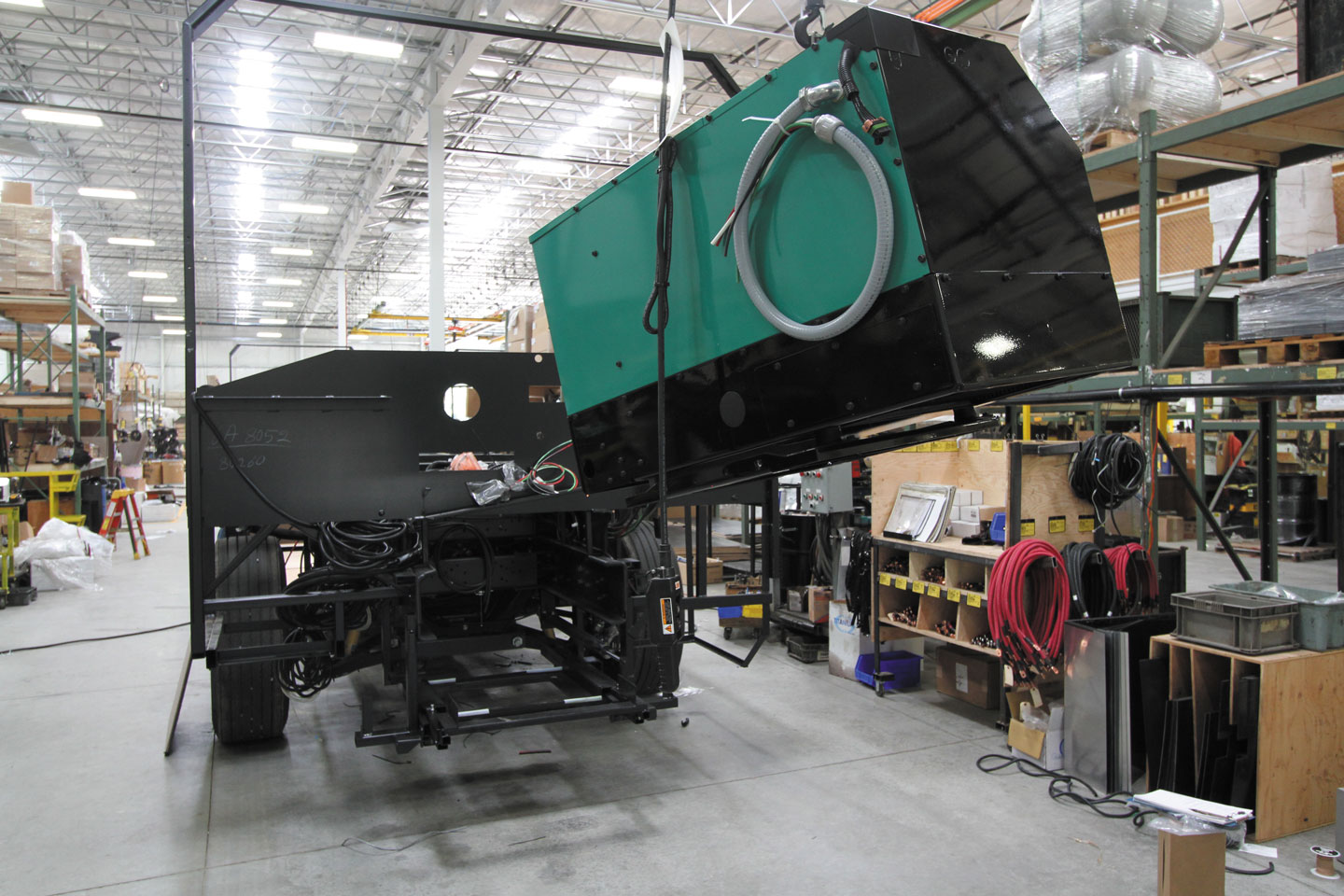
Considerations for choosing an RV generator that will meet your needs.
By Mark Quasius, F333630
August 2022
Today’s RVs are packed with electrical appliances and electronics. Multiple air conditioners, heated tile floors, induction cooktops, and residential refrigerators have become commonplace. That begs the question of how to operate all this equipment when shore power is not available. That’s when the RV owner’s best friend is a generator.
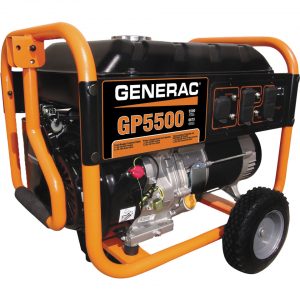
The 5,500-watt Generac GP5500 is portable.
Generators can be portable or permanently mounted in the RV. There are benefits to both, but the best choice depends on your camping style.
Portable generators can multitask; you can use them to power your RV, run power tools at a job site, or even operate critical appliances in your stationary home during a power outage. The drawbacks to portable units are that they require storage space and a separate fuel supply, and their power output is limited. It takes horsepower to produce electrical power, which means larger-sized units can be heavy and difficult to manage.
Permanently mounted generators tend to be physically larger and capable of greater output, but they also don’t need to be lifted or moved around. Many mounted units can tap into an existing fuel source on the RV, eliminating the need to carry any five-gallon cans while also enabling the generator to run for longer periods before refueling. A mounted unit also can utilize larger mufflers and operate at a slower rpm, resulting in quieter operation. Larger RVs, especially motorized units, will benefit from a permanently mounted generator, while smaller, towable recreational vehicles may be best served by a portable unit.
This Martin 20-kw open-frame generator sits inside a soundproof enclosure, with remote cooling, in a Newell motorhome.
Frequency
Generators vary in type and size, but they all create electricity via a rotating magnetic field powered by an engine. Each time the magnet passes over a coil of wire, it induces a burst of electricity into that wire. The number of times this occurs per second is referred to as frequency, which is measured in hertz (Hz). In North America, AC power is generated at 60 Hz.
In order to achieve 60 Hz from an AC generator that has two magnetic poles, the generator must spin at a constant 3,600 rpm. A generator with four poles in its rotor need only turn at 1,800 rpm to produce 60 Hz.
Most small portable generators are two-pole, 3,600-rpm units. The compact size of two-pole rotors allows the generator to be reasonably lightweight. The downside is that it is very loud as a result of its higher rpm. For example, a 3,500-watt generator will require around 8 horsepower to generate that much electrical power. A typical 8-horsepower engine will produce this amount at its peak rpm, which is going to be close to the 3,600 rpm that a two-pole generator will operate at.
A four-pole generator, with a larger rotor, frame, and engine, is heavier, but it is much quieter because of its lower rpm. The 1,800-rpm units generally are stationary and mounted in an RV, where weight and portability aren’t as important as noise levels. A large engine in the 12- to 14-horsepower range will need to be used so that 8 horsepower is still available at the lower 1,800 rpm.
Split-Phase Versus In-Phase
Regardless of whether your generator is a two-pole or four-pole unit, it will contain two field windings that provide power to the receptacles. Each winding can produce 120 volts of AC power at one-half of the rated capacity of the generator. These windings can be connected in series to offer 120 or 240 volts in a split-phase design or in parallel to offer only 120 volts — the latter is referred to as an in-phase design.
For example, a 6,000-watt generator has two field coils with 3,000 watts of available power at 120 volts. Referring to the accompanying “120/240-Volt Split-Phase Wiring Supply” graphic, we can see that there are 6,000 watts of 240-volt power available between L1 and L2. There are 3,000 watts of 120-volt power available between L1 and neutral and another 3,000 watts available between L2 and neutral. Since 3,000 watts at 120 volts is only 25 amps, you can’t draw 30 amps on one circuit, because the two fields are in series.
The split-phase system works fine on larger generators, such as those 10,000 watts and up, but has its limitations on smaller units. Many of the smaller generators used in RVs do not have 240-volt capabilities; this is generally not an issue, however, because 240-volt appliances in RVs are extremely rare, except in very high-end coaches. In this case, the two windings are placed in parallel rather than in a series. This eliminates any 240-volt capability but allows for the full 6,000 watts to be available on any one circuit.
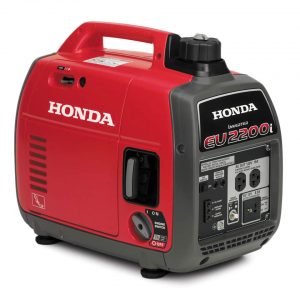
The Honda EU2200i is a 2,200-watt portable inverter generator and has a carbon monoxide detection system.
Inverter Generators
Inverters are quite popular in recreational vehicles. They take 12-volt-DC input power from the batteries and create 120-volt-AC output power through a process called inversion. This allows you to operate residential refrigerators and entertainment systems while driving or camping when shore power is not available, or when you don’t want to run the generator.
Inverter technology has filtered into generators as well. Inverter-based generators include some small portable models, such as the Honda EU2200 series, as well as the Onan Quiet Diesel line in the 7- to 8-kilowatt range. These DC generators send their output through inverter circuitry built into the generator itself. This eliminates the requirement to operate at a steady 1,800 or 3,600 rpm, as they convert the DC power from the generator into 120-volt-AC power, electronically establishing a 60-Hz frequency. A DC generator has no requirement to turn at any given speed. The faster it turns, the more power it makes. This allows the generator to operate at a lower rpm, saving fuel at a reduced noise level under light loads. As the power demand grows, such as when an air conditioner starts up, the generator’s speed will increase to raise the power output level.
Inverter-based generators also output clean power with low levels of noise or total harmonic distortion, which is a benefit when powering sensitive electronic equipment.
Inverter generators are not found in the larger 10-kilowatt sizes; that’s because the inverter boards would be large, expensive, and unnecessary with the stability present in the larger diesel generators. However, they are quite popular in the smaller portable models.
Sizing
When choosing a generator, keep in mind that wattage is the measurement of electrical power. When sizing up a generator, you need to consider how your loads are distributed across the breaker panel. Split-phase generators have only half of the total capacity available on each leg, so you must be sure that your heavy loads are evenly distributed across both legs of the panel. Remember that each leg has a given amount of amperage, and it cannot be shared. If your loads are imbalanced, you’ll need a much larger generator just to feed one leg while the other leg is not being fully utilized.
Another consideration is static versus dynamic loads. Lighting and heating elements are static loads, because they always consume the same number of amps. Dynamic loads are associated with components whose load requirements vary under different conditions.
Motors are considered dynamic loads, because the current draw varies according to how hard they are working; they also have a startup surge, which can be up to three times the running load. Consider the case of an air conditioner. It may have a typical unloaded draw of less than 10 amps, but when it first starts up, it will have a surge of more than 20 amps as the capacitor start motor powers up against the head pressure in the refrigerant. If the unit was resting long enough, it may settle in to around 10 amps immediately after startup, but as the head pressure increases and the unit works hard, it can draw 12 to 14 amps. Consider that you likely won’t be starting all three air conditioners at the same time, so you don’t need to use the peak starting surge for every unit when calculating how large your generator needs to be. Remember that watts equals volts times amps. So, just multiply your amps by 120 to convert it into watts.
Lastly, when sizing your generator, realize that altitude affects the engine’s ability to create power. Different engines react in varying amounts. According to the Cummins Onan RV Generator Handbook, generator power decreases 3.5 percent for each 1,000 feet above an altitude of 500 feet. To illustrate, a 7,500-watt generator running at an altitude of 9,000 feet will only be capable of handling 5,000 watts unless the engine has enough excess horsepower to allow for that.
Diesel engines can manage the fuel injection requirement at higher altitudes, but carbureted gasoline-powered engines will have issues with running rich due to the lack of air. Some generators, like the Onan Marquis Gold series, have a mixture adjustment on their carburetors — you can adjust the fuel flow with a lever to lean the engine out when operating at higher altitudes. But be sure to reset it to the full rich position when you return to the flatlands, or you risk burning valves by running the engine too lean.
Armed with this information, you should be ready to select the best generator for your RV lifestyle.
Typical Electrical Load Requirements
Air Conditioners
1,400-2,000 watts
Compressor Refrigerator
600-1,000 watts
Electric Skillet
1,000-1,500 watts
Stove Element
675-1,000 watts
Water Heater
1,250 watts
Hair Dryer
500-1,500 watts
CRT Television
200-600 watts
LED Television
100-375 watts
Portable Ceramic Heater
750-1,500 watts
Toaster
1,000 watts
Satellite Dish And Receiver
200 watts
Battery Charger/Converter
750-1,400 watts