

When your inverter system starts to fail, it’s hard to be a happy camper. Luckily for one RV couple, help was readily available.
By Steve Froese, F276276
September 2022
It is rare that I get an opportunity to meet FMCA members who have emailed for technical assistance, but I recently had the pleasure of meeting up with Arthur and Nancy Timm. They were having some issues with the inverter in their motorhome, and Arthur had reached out to me for assistance.
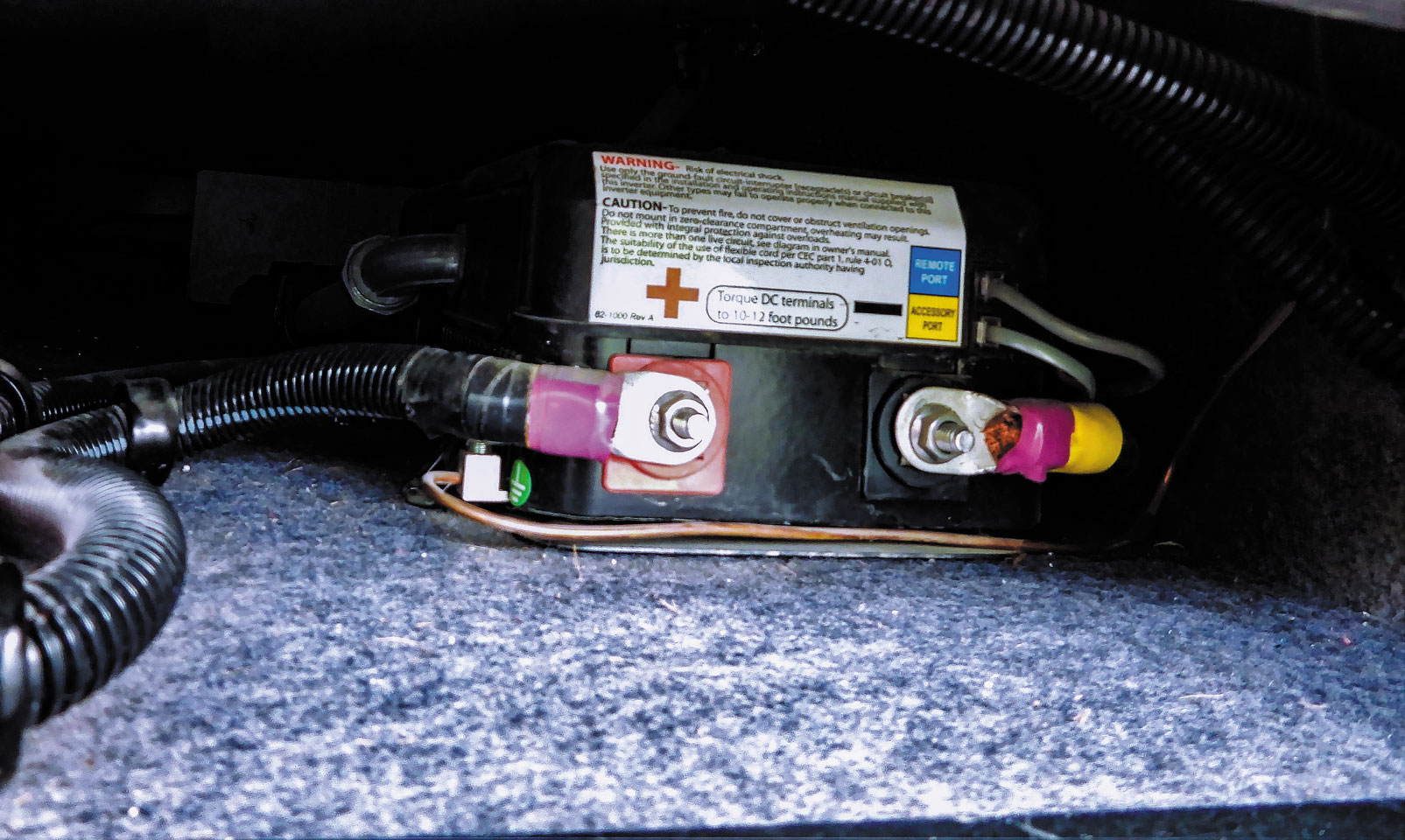
Inverters enable devices and appliances to run safely off different types of power, converting electricity from DC to AC.
The Timms travel in an RV that has a residential refrigerator. Because they do a fair amount of dry camping, it is imperative that the inverter system functions correctly. As a result, they decided back in 2020 to add absorbed glass mat (AGM) batteries and a solar panel.
That is when the issue began to manifest itself: The inverter would go into low-battery mode whenever they turned on the fridge. This meant the fridge would operate only when the Timms were connected to shore power — obviously an unacceptable situation since they enjoy their off-grid camping.
Attempting to find a solution, the Timms took their RV to a dealership. After five days of running the fridge off the inverter, the technicians were unable to replicate the issue. In frustration, Arthur reached out to techtalk@fmca.com for assistance. I asked him several questions that I thought might lead to a root cause and then corrective action.
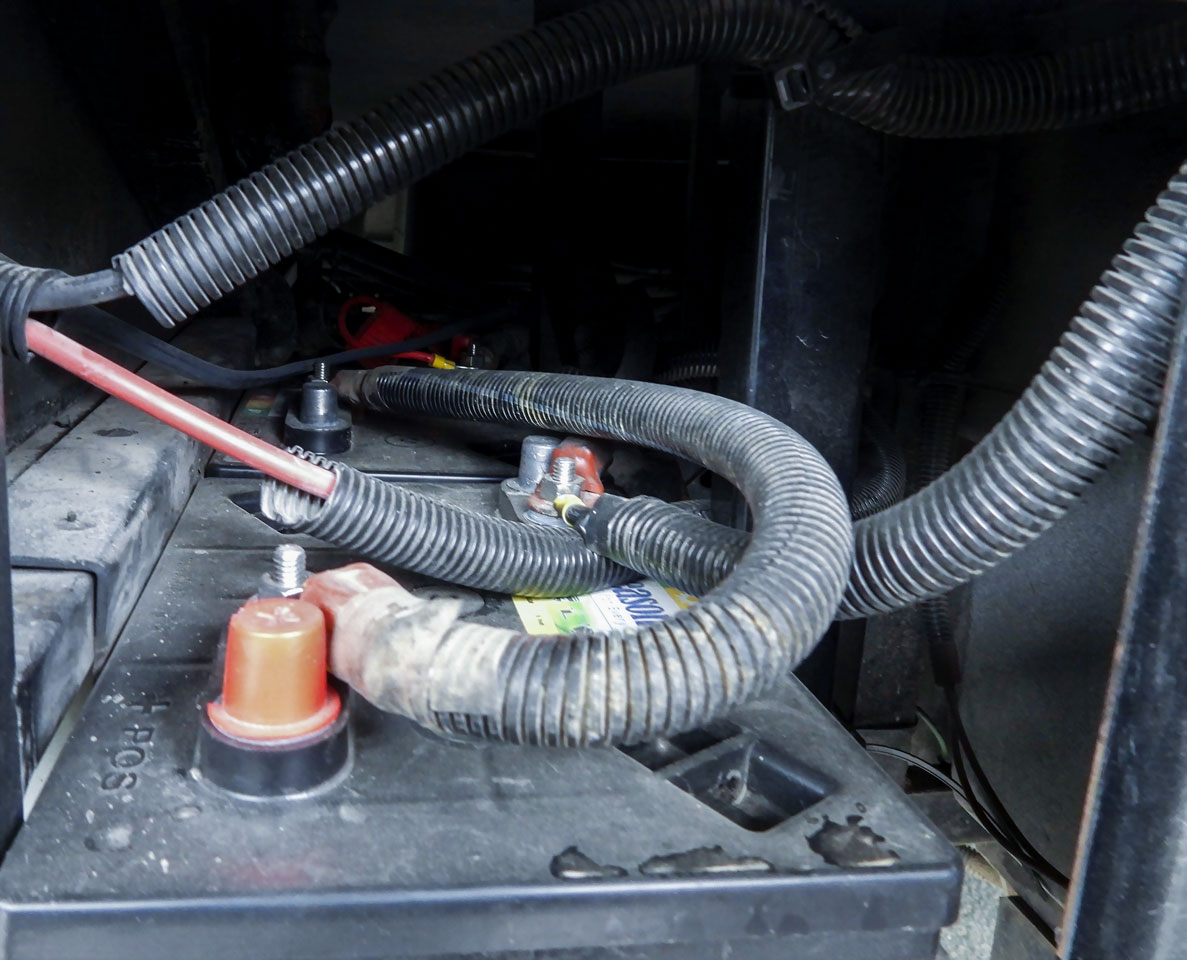
If a battery starts to have issues, it could cause problems with the inverter down the line.
Prior to replacing the batteries, the Timms were able to run the refrigerator all night after charging the RV batteries in the evening. Shortly after they had the new AGM batteries and solar panels installed, the inverter began to go into low-power mode immediately and shut down as soon as the fridge was turned on. Effective troubleshooting in this case would cause one to ask, “What changed?” The answer was obvious: the addition of the solar panels and replacement batteries.
The solar panels are unlikely to be a contributor to this issue. If the solar controller were to fail, it would be possible for the panels to deliver too much current or voltage to the batteries and damage them, but this is highly unlikely, especially for a new system. If incorrect wiring were to blame, the result would be either no power reaching the batteries from the controller, or damage to the controller or panel from a reverse-polarity situation. Therefore, I ruled out the solar system for the time being. Fortunately, the solar controller has a built-in voltage meter, so we were able to get (presumably) accurate real-time readings from both the chassis and house battery systems. During that time, the solar controller was giving fairly normal voltage readings at the house batteries.
These voltage readings were suspicious, or at least they didn’t reveal the entire truth. Battery voltages can appear normal with minimal loads. But once you add a large load, such as an inverter with a nominal draw, the voltage may reveal itself to be much lower. This may indicate a battery issue. As I gleaned more information from Arthur, I learned that several times he could not start his generator in the morning without starting his RV engine first. This was a clear indication that a battery problem existed.
I asked Arthur to take some voltage readings off each of the four batteries, and there seemed to be an inconsistency in two of them, as the voltages measured much lower than the other two. I suspected there was an issue with the batteries, but given their young age, it didn’t make sense to me that 50 percent of his batteries might have failed.
At this point, Arthur determined that we would be in the same neck of the woods in May. They were heading up to Alaska, and I would be in Washington state during an upcoming Canadian holiday. So, he booked a site at the RV park I would be staying at, and I eagerly waited for a rare opportunity to do some hands-on troubleshooting for a member.
After we met and introduced ourselves, I located the inverter and battery boxes on his RV and quickly determined that two of the batteries had low voltage readings. I was able to get accurate voltage readings using a load tester, which is more accurate than the solar controller. Both suspect batteries were showing around four volts (note that the RV had been plugged into shore power throughout the previous evening).
The RV has two separate battery compartments, but they are right next to each other, and the inverter is alongside them as well. I discovered that one of the batteries in each of the series-connection banks was bad. It concerned me how two of the four relatively new AGM batteries could have failed (or possibly been bad from the factory). They are a reputable brand that is not known for having faulty products. Since the low-voltage issue started occurring shortly after the Timms had the batteries installed, it is possible the batteries were faulty from the factory, but it would be extremely rare (although not unheard of) for two batteries to be bad.
I was fairly certain I had identified what was causing the issue, but I wanted to know why. I thought about this while Arthur went to a local dealer and purchased two new batteries. I installed the new batteries in one bank and the older ones in the other bank. Once the new batteries were in place, the inverter and fridge were turned on, and everything worked as normal. Arthur and Nancy were very happy campers.
In terms of possible root causes for the failed batteries, one thing I wanted to check was whether the solar controller and inverter were set to the correct battery type. I discovered that the solar controller was indeed set to AGM for the house batteries and flooded for the chassis batteries. Kudos to the installer, because this step is often overlooked. However, it was not possible to check the battery type setting on the inverter, as the inverter remote was not designed to verify or set this parameter. While the inverter itself has a default type of AGM battery, if a remote is connected, the default is flooded. Since the original house batteries were the flooded type, and since the installed remote is not able to set the battery type, it is probably safe to assume that the battery type for the inverter is still set to flooded.
I recommended that Arthur replace the remote with the upgraded one that allows for more control over the inverter, and then set the battery to the correct type. Because the AGM charging curve is different from that for flooded batteries, it is possible that two of the AGM batteries were damaged by the inverter charging profile. If this is true, I have some theories as to why only two of the batteries were affected, but I won’t go into that here.
I followed up with the Timms a few days later, as I wanted to know if their inverter continued to function properly. Arthur reported that after several days of dry camping, everything was running normally.
I am happy to have had the opportunity to meet Arthur and Nancy Timm, and I am especially glad that I was able to help them resolve an issue that would have adversely affected their RV travel.