
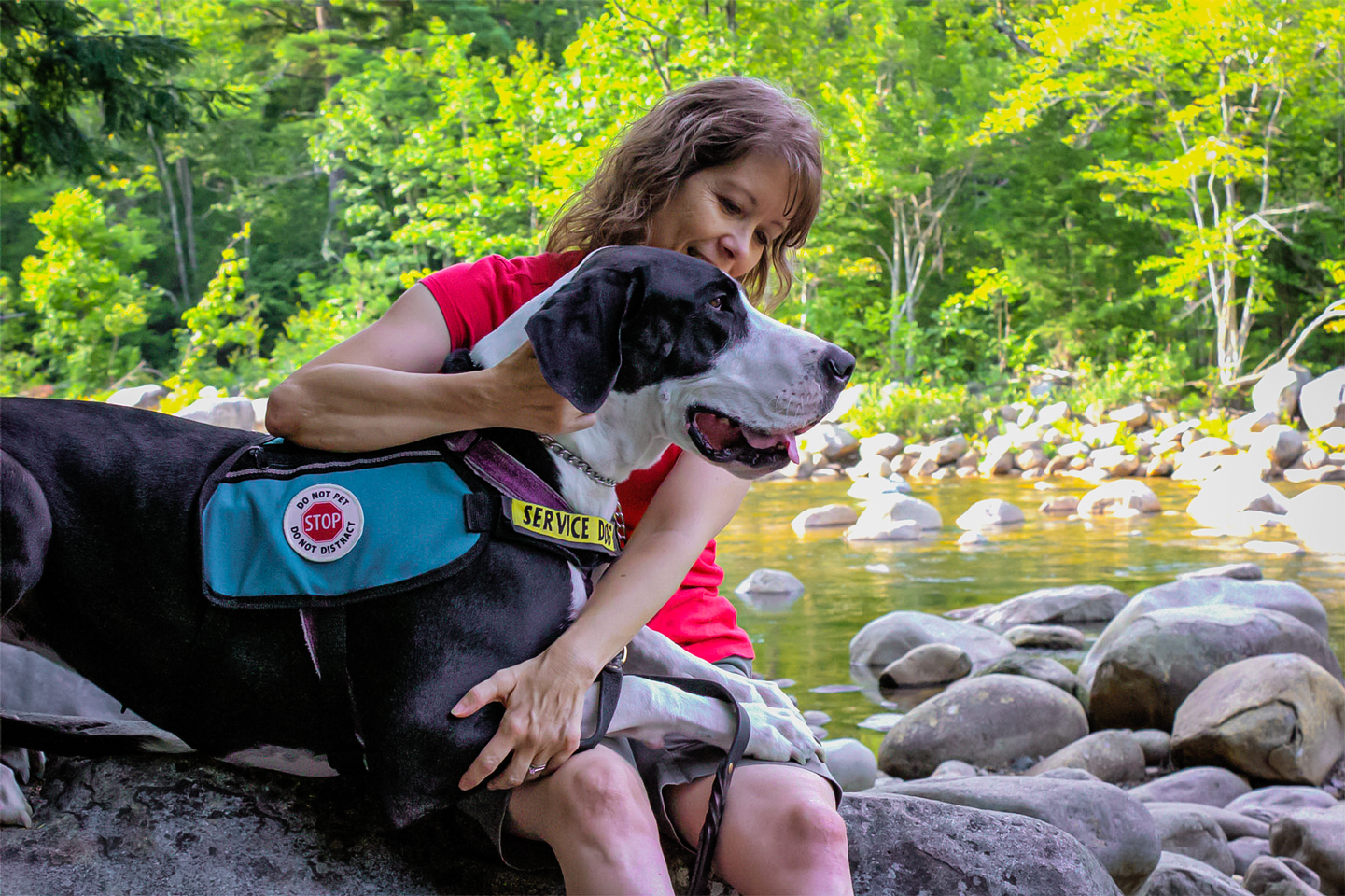
Trained canine companions help their owners enjoy the RV life
By Kate Doherty, F499712
November 2022
Over the years, I’ve met numerous folks with disabilities who enjoy the RV lifestyle. Three years ago, at Flathead Lake, Montana, I crossed paths with Mel. He loved traveling in his diesel pusher motorhome, even with the two full-length leg braces he needed — at the age of 92.
Mel introduced me to his wife and her diabetic alert dog, a golden retriever sitting outside their motorhome. The dog wasn’t wearing its service dog vest, but Mel pointed to the dog and said, “She’ll nudge my wife incessantly when her blood sugar gets out of whack.” His wife added, “She watches me like a hawk.”
Diabetic alert dogs detect glucose level changes via smell, such as in their owner’s breath. They may respond accordingly by licking or nudging their human to ensure he or she is conscious; retrieving glucose tablets or insulin; or even contacting authorities with specialized calling equipment.
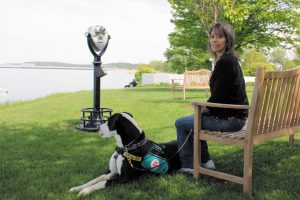
Dolly is always by Brenda’s side when they’re out and about.
Service dogs play a vital role in the lives of people with disabilities, performing specific tasks for them. According to the Americans with Disabilities Act, these include mobility-related help; medical/allergen or epilepsy alerts; calming those with PTSD, anxiety, or depression or reminding them to take their medication; guiding a blind person; or alerting someone who is deaf, to name a few. Service dogs have federally protected public access rights that allow them to go places where pets or emotional support and therapy dogs cannot.
For more than 15 years, my spouse and I have worked with several classes of public service and military working dogs, as well as task-trained canines for hearing, seeing, psychiatric, and medical needs. Guide dogs for the blind and visually impaired help their owners to navigate everyday life. As with Mel’s wife above, medical alert dogs can be trained to detect low or high blood sugar for their diabetic companions.
Recently, I was filled with admiration after getting to know Brenda Swarts, an RVer from upstate New York. What stood out at our first encounter was Brenda’s sidekick, Dolly, her Great Dane service dog. Standing 44 inches tall, Dolly is considered a medium-sized Great Dane, but her stature fits Brenda’s needs perfectly. Brenda inherited Charcot-Marie-Tooth disease, a motor and sensory neuropathy disorder that progressively affects the peripheral nerves of her lower extremities. After a handful of hip operations, she looks to her mobility aid, Dolly.
After being near Brenda and Dolly for a number of months, I developed profound respect for Dolly and wanted to learn more about her intuitive nature and training. Dolly was bred and trained by Service Dog Project (SDP) of Ipswich, Massachusetts. Lynn George, director of SDP, walked me through the levels and intense training that Dolly and other Great Danes go through to become mobility service dogs for their human partners.
Why Great Danes
SDP’s Great Danes are bred, born, raised, and trained on-site. The dogs incorporate European bloodlines, which tend to make them stockier and better able to help stabilize their human counterparts. Dolly is the right height and stature to assist her petite owner. Dolly is also in remarkable shape; her eyes are a mark of intelligence, yet stealthy. No utterances, just patiently watchful. And if my description of her size means little to you, just know that Dolly’s head is larger than my cat.
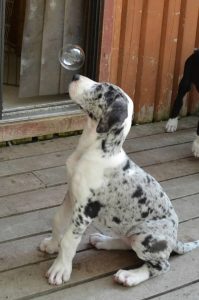
Service Dog Project’s pups are trained from a very young age, but they still have time for fun.
In the five months I worked alongside Brenda and Dolly, I concluded that Dolly is one of the most well-trained service dogs I have encountered. She monitors Brenda’s needs, immediately responding with stability, love, and affection. Yet she is acutely aware of her role as a service dog, and helping Brenda is her only focus. That’s a compliment to Service Dog Project trainers.
At home without her service vest, Dolly is like most family pets. She’s playful, enjoying affection and attention. She doesn’t act like a big dog, but you realize it when she steps on your foot to get close as you’re scratching her head. Dolly’s bed is a repurposing of a firm foundation between the RV’s two front captain’s chairs. While traveling, her place is on the sofa.
Various facets determine the strengths and weaknesses of a pup that is being considered a candidate for service dog training. Qualified facilities like Service Dog Project look at the pup for alertness and cognitive behavior. Can they listen and obey? Lynn George noted that pup training begins at three to four weeks of age, or as soon as their belly is off the floor. The first in a sequence of training steps is to get them to sit by spoon feeding them baby food. They are trained to learn their name and wait for the cue to eat.
Service Dog Etiquette
Dog lovers — both adults and children — may find it difficult to resist approaching service animals when they’re out and about. However, interacting with a service dog without consideration for its owner may distract the dog from its tasks. Consider some of the suggestions set forth by the Guide Dog Foundation:
- *Do not touch, talk, or distract a dog while it is “on duty.”
- *Speak to the handler, not to the dog.
- *Do not offer food to the dog.
- *If you have a pet with you, do not allow it to challenge or intimidate the dog.
Dolly gives Brenda, her best friend and owner, the ability to enjoy RVing without limits. She and service dogs everywhere enable their human companions to enjoy the freedom so many of us take for granted. While Dolly is my husband’s new “girlfriend,” she is Brenda’s hero.
If you want to brighten your day, visit SDP’s website (www.servicedogproject.org) and scroll through the pictures of some soon-to-be-canine heroes.
Learn More
The ADA National Network (www.adata.org) provides information about the Americans With Disabilities Act, including service animals and their role.
ADA.gov answers frequently asked questions here: www.ada.gov/regs2010/service_animal_qa.html
Online searches will yield many individual organizations that train and/or provide service animals. These include:
Assistance Dogs International (www.assistancedogsinternational.org), a coalition of nonprofit organizations that raise, train, and place assistance dogs.
Diabetic Alert Dogs of America (www.diabeticalertdogsofamerica.com), which provides service dogs to individuals affected by diabetes.
Guide Dog Foundation (www.guidedog.org), which assists people who are blind or have low vision or other special needs.