
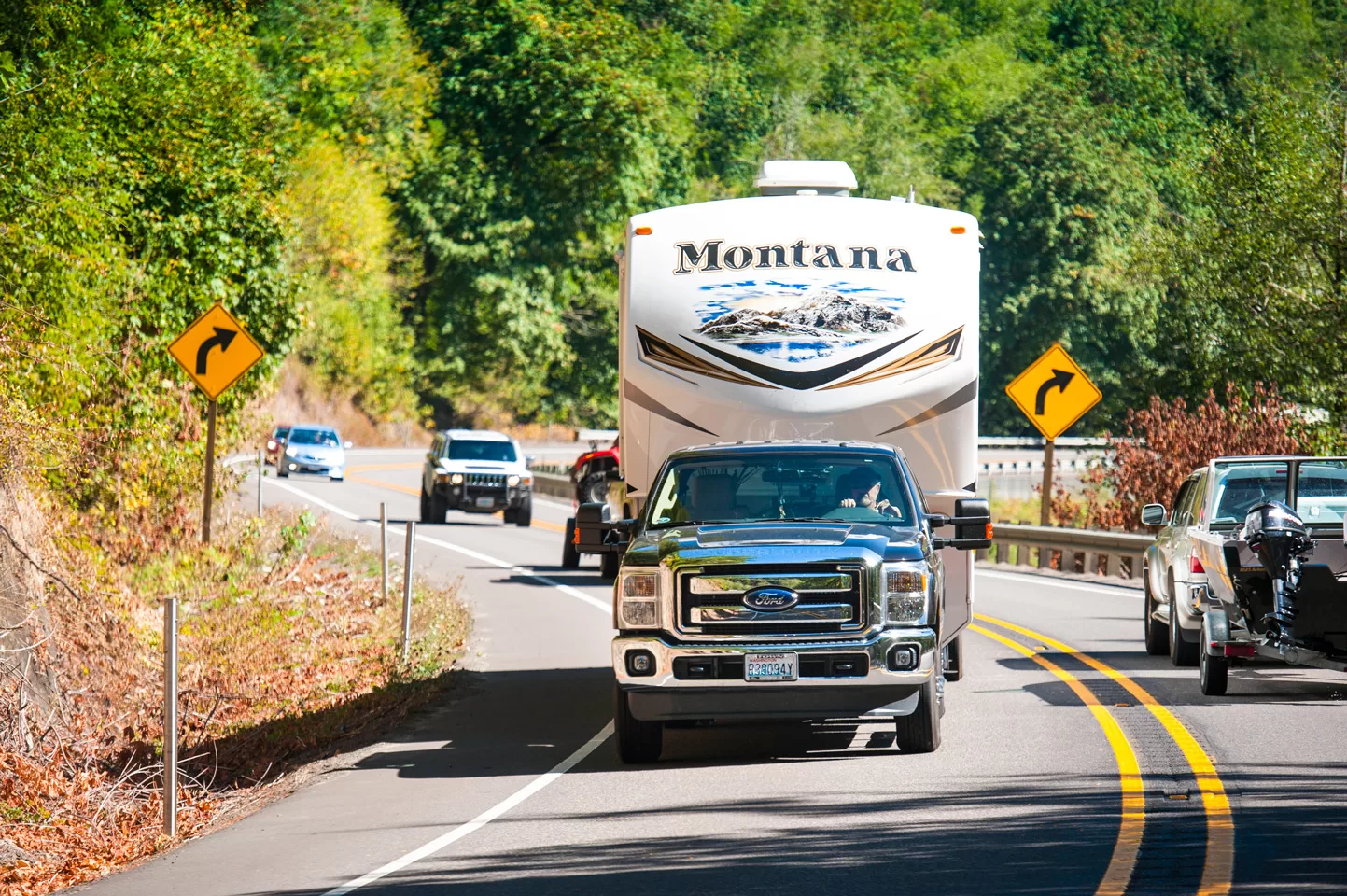
If you’re considering a fifth-wheel RV, familiarize yourself with the types and features of hitches on the market today.
By Bruce W. Smith
January 2023
Changes in personal and family dynamics can lead to changes in the type of RV that best meets one’s needs. So, RVers sometimes find themselves switching from a motorhome to a towable RV – or vice versa. One common move is from a motorhome to a fifth-wheel travel trailer. And if you’ve never owned a fifth-wheel, you’ll find that multiple decisions are involved in making such a change.
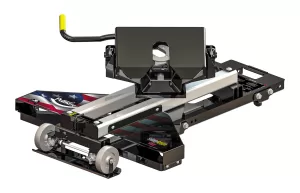
The PullRite 3200 SuperGlide 14K ISR hitch is designed for truck beds shorter than six feet.
It requires a great deal of thought on multiple fronts, in part because of the significant monetary investment involved. Deciding what pickup truck is best suited for the trailer you have in mind — or which trailer is the right one for the pickup you already own or want to buy — necessitates a lot of research and forethought. There are dozens upon dozens of pickups to choose from and many times more choices when it comes to fifth-wheel travel trailers.
The other factor that plays a significant role in this move is deciding what fifth-wheel hitch is going to be used to connect the trailer to the pickup. Choosing the correct hitch for your particular pickup and trailer combo is a very important step.
What Is A Fifth-Wheel Hitch?
The fifth-wheel hitch is not new. In 1914, Otto Neumann and August Fruehauf invented the semi-trailer, which used an innovative hitch coupling device to attach the big trailers to the trucks. In 1916, inventor Hermann Farr received a patent for a hitch in the shape of a wheel that rocked on hinges to make travel on unpaved roads easier. He and his partner, Charles Martin, started marketing these “fifth-wheels” through their Martin Rocking Company in Massachusetts. All of today’s fifth-wheel manufacturers can trace their roots back to the “Martin Rocker.”
The advantage of a fifth-wheel hitch over a receiver hitch, which attaches the trailer to the rear of the towing vehicle, is that the former distributes the load of the trailer more evenly over the towing vehicle and trailer chassis, keeping the truck level without the need for a weight-distribution hitch used with a tow-behind trailer. This provides for safer and smoother towing, improved maneuvering in tight quarters, and easier hookup than a receiver hitch used for towing conventional travel trailers.
Availability Of Hitches
A wide variety of fifth-wheel hitches are offered for sale at RV dealers, hitch installers, big retailers, online, and even through vehicle manufacturers and dealerships that sell new pickup trucks. Prices range from the most basic at around $400 to over $2,800 for a more advanced version.
A basic fifth-wheel hitch consists of a mounting platform and pivoting head attached to the pickup bed. The trailer hitch pin slides into it and locks into place. Some are permanently mounted in the bed, while others have special mounts so the hitch can be easily installed and removed. Some hitches slide fore and aft to move the trailer farther from or closer to the pickup cab. This allows for more dynamic weight distribution and pivot point control. Others have a cushioning system, or even an air-ride feature, to reduce the “clunk and bump” between the truck and the trailer.
Installation costs can vary by vehicle, hitch model, and where you have the work done. But expect to pay for one to two hours labor ($100 to $300) to have a fifth-wheel hitch installed.
“Most fifth-wheel hitches can be installed without professional help as long as you have the tools for the job,” says a post on Curt Manufacturing’s website, www.curtmfg.com. “Typical tools required include a ratchet, socket set, crescent wrench, drill with drill bits, and a torque wrench.”
The newer pickups with original-equipment-manufacturer fifth-wheel hitch mounting systems don’t even require special tools to set the hitch in place, as it simply locks into four pockets in the bed.
Fifth-Wheel Prep Packages
Installation costs can be greatly reduced if you have a pickup truck that already has the fifth-wheel/gooseneck hitch prep package installed from the factory. All the major pickup truck manufacturers offer this option, which typically includes the frame-mounted hitch platform under the bed, the trailer wiring harness, and other features you may not get with an aftermarket-installed kit.
GMC’s Sierra Heavy Duty Gooseneck/Fifth-Wheel Prep Package, for example, is designed to be integrated into the Sierra Heavy Duty pickup. Sierra Heavy Duty’s prep package includes a factory-installed hitch platform that sits tightly against the top of the frame and is welded to the side mounting brackets. Chevrolet offers a similar prep package.
Compared with an aftermarket hitch platform, which may be bolted in place, GM engineers claim that this design provides a stiffer hitch and reduces the probability of trailer shuddering over rough roads and while braking.
What Fifth-Wheel Hitch Mount Is Best?
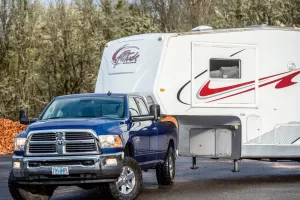
When backing or making a sharp turn, the fifth-wheel hitch must be in a position to keep the front of the trailer from impacting the rear cab of the pickup.
Installation of the actual hitch is the easier part, because all fifth-wheel hitches mount in the pickup bed and are attached to the truck’s frame with special brackets (the platform under the bed) that place the hitch assembly just forward of the rear axle. The decision-making relates to what type of fifth-wheel hitch is best suited for your particular pickup and trailer package.
The biggest concern with the fifth-wheel placement and type relates to keeping the front of the trailer from contacting the rear of the cab when making sharp turns, such as backing into a tight RV space or entering/exiting a parking lot onto a busy street or highway. When the trailer is at a sharp angle (jackknifed) in relation to the towing vehicle, the trailer cap and frontal area can impact the truck cab if the wrong type of fifth-wheel coupling is used, or if it’s not properly positioned in the bed.
Also consider how the hitch mounts in the bed. Many of today’s fifth-wheel hitches can be removed easily from the pickup bed, leaving only the mounting rails behind. If you want the bed of the pickup free to haul other items when the trailer isn’t being used, you may opt for a hitch that does not leave any rails or bracketry behind when it is removed.
Ford, GM, and Ram offer OEM puck-style mounting systems as part of their fifth-wheel prep option just for this purpose, and many aftermarket hitch manufacturers sell a variety of models to fit these mounting systems. There are also aftermarket puck-style mounting kits for use in some older pickups.
What Type Of Fifth-Wheel Hitch Is Best?
The best fifth-wheel hitch for any pickup is one that is rated for the weight of the trailer it will be used to tow. All three manufacturers of heavy-duty pickups offer OEM-installed fifth-wheel prep packages and dealer-installed fixed fifth-wheels for their new pickups, which makes it easy for those entering the world of pulling a fifth-wheel travel trailer to drive away from the showroom ready to tow.
Then it’s a matter of selecting the style of hitch that keeps the front of the trailer from hitting the cab during tight turns. For instance, a good fifth-wheel coupler for a pickup with an eight-foot bed, commonly referred to as a long-bed model, is called a fixed hitch, because the hitch can be mounted far enough from the cab to avoid contact with the trailer’s front cap. Fixed fifth-wheel hitches are the least expensive to buy but not necessarily the easiest to install and remove.
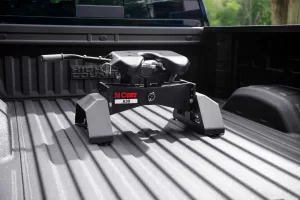
Full-size pickup manufacturers offer factory-installed fifth-wheel-hitch mounting kits, along with dealer-sold/installed hitches, such as this Curt unit in a Chevrolet bed.
Best Fifth-Wheel Hitches For Short-Bed Pickups
RVers towing a fifth-wheel trailer with a six-foot short-bed pickup should have a sliding fifth-wheel hitch installed, because this ensures cab-to-trailer clearances will be adequate for those occasions when a really tight maneuver is required. An even nicer setup is an automatic sliding fifth-wheel hitch that changes the position of the trailer from the cab as the truck makes turns. Demco’s Autoslide is just one example of such a fifth-wheel hitch system.
Another option for RVers using short-bed pickups to tow a fifth-wheel is having the trailer’s pin box upgraded to one that automatically changes its position in relation to the position of the pickup. This can take the place of a sliding fifth-wheel hitch. One such version is the Reese Sidewinder Pin Box. It fits a wide variety of fifth-wheel trailers and has a 20,000-pound capacity with a patented kingpin locking system, among many other features.
Curt also offers a pin box called the Turning Point, which can be installed by RV dealers. It moves the fifth-wheel pivot point 22 inches rearward, creating extra clearance — another solution for half-ton, short-bed pickup trucks.
Regardless of the type of fifth-wheel hitch system you choose — provided it is a suitable fit — towing a fifth-wheel-style trailer or toy hauler should be relatively drama-free compared to pulling a tow-behind model, and you’ll enjoy the extra space a big fifth-wheel travel trailer provides.
Choosing A Pickup For Fifth-Wheel Towing
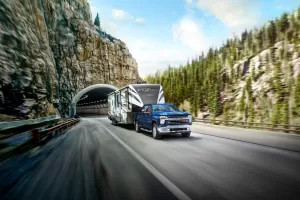
The best pickup for towing a fifth-wheel trailer is one that has 20 percent more towing capacity than the GVWR of the trailer it’s pulling.
What is the best pickup to tow a fifth-wheel trailer or toy hauler? As a general rule of thumb, that would be any model with a maximum towing capacity that’s 20 percent greater than the gross vehicle weight rating (GVWR) of the trailer. The maximum towing capacity of the pickup is based on that particular model’s engine, cab configuration, bed length, and axle ratio.
The specific tow ratings for Ford, GM (Chevrolet/GMC), and Ram usually can be found on those manufacturers’ “Fleet” websites under the “Trailering & Towing Guides” or “Trailering Guides” sections. These manufacturer guides list the specific tow ratings for their vehicles, along with valuable towing-related information specific to their products. For the majority of fifth-wheel travel trailers, a three-quarter-ton pickup is a good choice.
Gas or diesel? Diesels have the best pulling power and fuel economy. But a diesel option usually adds $10,000 to the price of a similar gas model in the heavy-duty line and can add $2,000 to $4,000 more in a half-ton pickup.
As for pickup cab type, it’s up to personal preference. Most RVers like a crew-cab, because it provides the most passenger room.
When considering single-rear-wheel (SRW) or dual-rear-wheel (DRW or dually) on the one-ton pickups, the decision boils down to towing capacity and ride comfort.
A dually will give the best handling when towing a fifth-wheel trailer that’s longer than 36 feet or weighs more than 15,000 pounds. A dually is also a little more stable when towing bigger trailers over roads that have a lot of twists and turns, such as highways that traverse coasts and mountains.
The downside is that a dually pickup’s ride is harsh when unloaded compared to that of an SRW model. So, if you are going to be driving the truck around a lot without a trailer hitched in the bed, a one-ton SRW pickup is the better choice if it has the towing capacity for the trailer you want to pull.
Additional Information
Andersen Hitches
www.andersenhitches.com
(208) 523-6460
B&W
www.bwtrailerhitches.com
(800) 810-4918
Blue Ox
www.blueox.com
(402) 385-3051
Camco
www.camco.net
(800) 334-2004
Curt Manufacturing
www.curtmfg.com
(877) 287-8634
Demco
www.demco-products.com
(800) 543-3626
Draw-Tite
www.draw-tite.com
(800) 632-3290
PullRite
www.pullrite.com
(574) 259-1520
Reese
www.reeseprod.com
(800) 632-3290
Tulga Fifth Wheel
www.tulgafifthwheel.com
(800) 611-2366