
Understanding the basics of RV water systems can come in handy should concerns arise.
By Steve Froese, F276276
January 2023
Many RV systems are “out of sight, out of mind” — they run smoothly with no intervention, such that we, as RV owners, don’t really think about them. Even when we do, we don’t tend to consider exactly what they do or how they work. In this article, I will provide an overview of the fresh-water plumbing system in an RV. Most of us understand the basics of these systems, but let’s proceed to follow the flow (pun intended) of water through the typical RV system.
The water flow starts at either the fresh-water tank or the city-water inlet. Fresh-water tanks vary in capacity, depending on the RV size and the space available. Most fresh-water tanks are made of polyethylene (PE) plastic that is a semitransparent white. The fittings generally consist of a drain, a fill, a vent, and a pump inlet.
The drain usually is a valve connected directly to the bottom edge of the water tank that allows for evacuation of the contents. In some instances, instead of a valve, the tank simply has a water line with a cap on it underneath the RV. In the case of a valve, it could range from a quarter-turn valve directed through a hole in the floor to a more complex plumbing network with the valve located away from the tank. Be sure you know the location of your fresh-water drain valve or cap. As mentioned, it could be next to the water tank, under the RV (common with trailers), or somewhere else.
The fill line is either a gravity fill accessible behind a cover on the sidewall of the RV or facilitated through the city water connection by operating a valve. Some RVs have both. The fill line is connected on top of, or near the top of, the tank.
The pump inlet feeds the fresh water to the pump and is located at the bottom of one of the tank sidewalls.
The vent line is located on top or near the top of the tank and allows air to enter the tank as the water exits. Think of how you must open the small vent cap on a gas can to allow proper flow of the gas out the nozzle. The vent also helps to pre-vent the container from collapsing. In addition, the vent line on an RV water system acts as an overflow as the tank is filled.
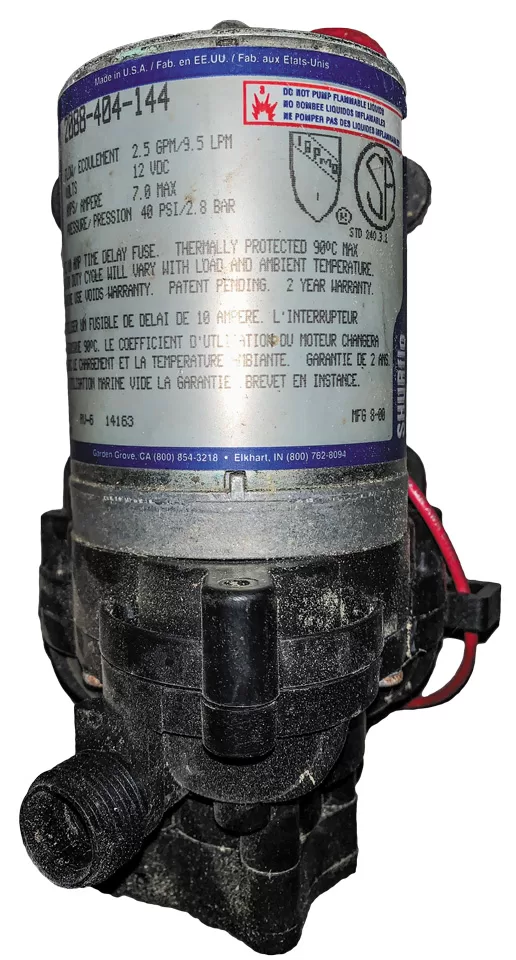
Next in line is the water pump, which takes the low-pressure inlet feed from the water tank and pressurizes it into the pump outlet line. As with the tank drain fitting, it is important to know where your water pump is located in case it ever requires maintenance or servicing. Since the pump may not be near the tank, the best way to locate it might be to turn on the water pump, open a faucet, and listen for the sound of the pump. Because the inlet line to the pump is low pressure, it may utilize flexible tubing and hose clamps. On the outlet side of the pump, more rigid tubing (usually PEX — cross-linked polyethylene) feeds the RV plumbing system. Flexible tubing and hose clamps are not permitted anywhere on the pressure side of the water pump.
The pump outlet line has two primary junctions. The city-water fill line tees directly into it and incorporates a check valve at the city water hose connection, as well as at the water pump outlet. These check valves prevent water from pouring out of the city water fitting when the pump is in use and keep water from backflowing through the pump when city water is used. City water and the water pump both act to pressurize the water system in an RV.
The other main connection on the water pump outlet line is the water heater inlet. The cold-water inlet to the water heater is teed off the pump outlet line to allow cold water to enter the water heater tank for warming. As with the pump and city water, there is a check valve at the water heater inlet to prevent hot water from backing into the pump outlet line.
Other than the city water and water heater junctions, the pump outlet line is routed to all the cold-water faucets, as well as the RV toilet (if applicable). This is done through a series of fittings to direct the water to different areas of the RV. The pump outlet line terminates at the last faucet in the plumbing network.
Similarly, the hot-water line exiting the water heater is plumbed to the hot-water faucets in the RV, terminating at the last one.
The main problems that occur with the RV fresh-water plumbing system are leaks and pump failures. Almost all leaks occur at a fitting, but, unfortunately, there are many fittings in many locations within the plumbing system, and some of them can be hard to find. The best way to identify the existence of a leak that is not visually obvious is to listen for the water pump to cycle when no water fixtures are turned on. It is normal for some cycling to occur, since air could be trapped somewhere in the system, but repeated and regular cycling when no water is being drawn is not normal. Water leaks can lead to serious damage to the RV if left unchecked, so if you suspect a leak, be sure to have your system professionally inspected.
You may find visible evidence of a leak inside your RV, such as pooling water, which could point you to the source of the leak. Bear in mind, however, that water can flow for a long way away from the leak, especially if the RV is not level. To help avoid plumbing leaks, it is important to always use a pressure regulator on your city water line and never set the regulator above 60 psi if it is adjustable.
Water pumps do not have an infinite life, since they consist of moving parts, but they generally can be replaced or repaired easily. Also be aware of the location of the 12-volt fuse for your water pump, as a blown fuse can be a cause of pump failure.
Your RV may have other plumbing features, such as a water filtration system, but the above description applies to the basic fresh-water plumbing system in almost all recreational vehicles. The intent of this article is not to provide troubleshooting tips, but rather to share an overview of the plumbing system in hopes of giving you a better understanding and possibly valuable insight should you have a problem in the future.
Send your troubleshooting questions to Steve Froese at techtalk@fmca.com. The volume of correspondence may preclude personal replies. Not all responses will apply in every instance. Some situations may require a visual inspection and hands-on testing. If you choose to follow any procedures outlined in this column, first satisfy yourself that neither personal nor product safety will be jeopardized. If you feel uncomfortable about a procedure, stop and make an appointment with an RV service facility.
You may also want to consult the FMCA Forums (https://community.fmca.com) to see whether your question has already been addressed or, if not, to post it.