
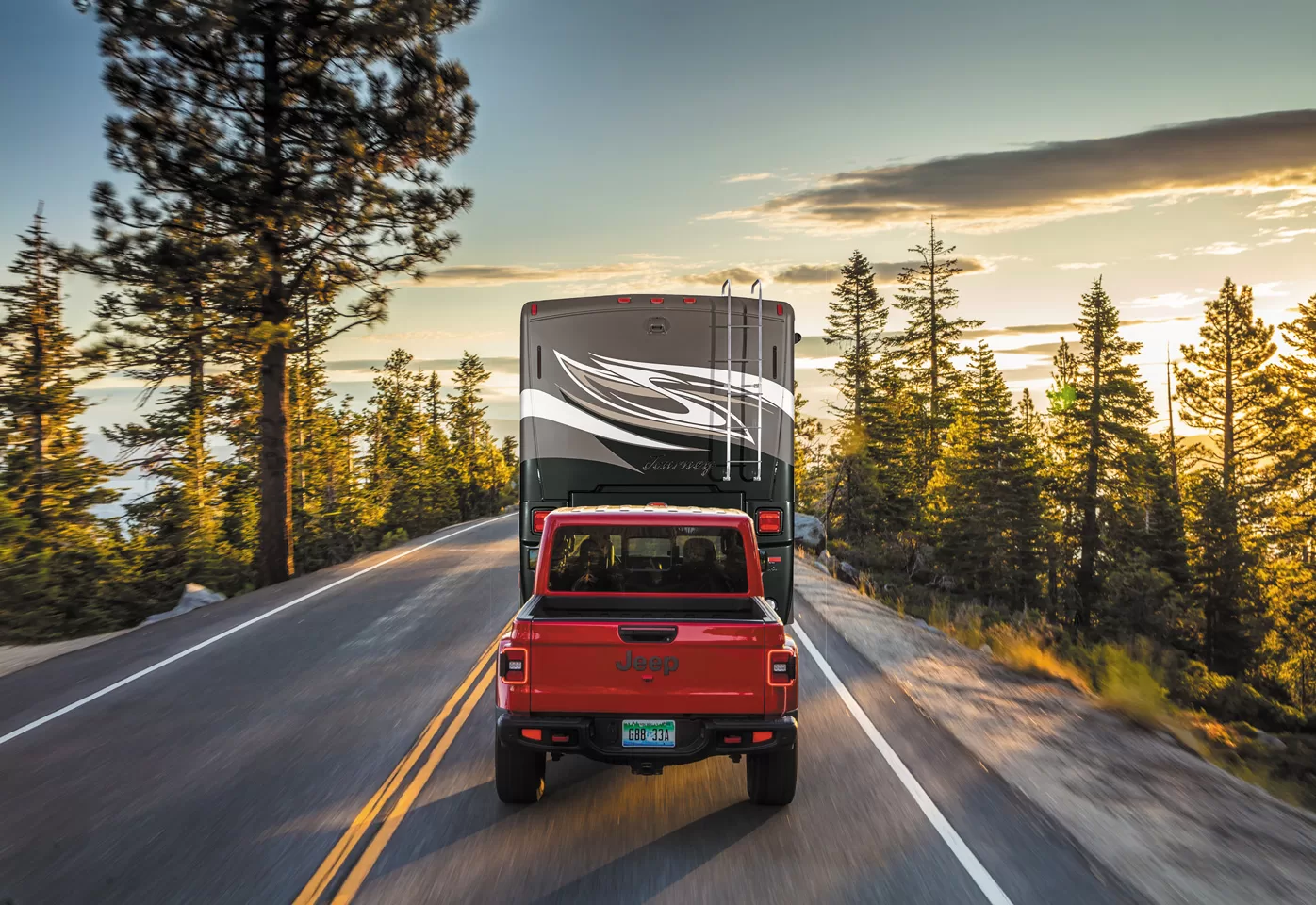
A guide to 2023-model-year vehicles that manufacturers have indicated can be flat towed behind a motorhome without significant modifications.
February 2023
The following information is intended to help motorhome owners select a vehicle that is approved by its manufacturer for flat towing. The information was gathered from automobile manufacturers and vehicle owners manuals and pertains only to 2023-model-year vehicles. The information may or may not be correct for earlier or later models. While every attempt has been made to present accurate information, continued vehicle improvements and production-line changes could alter the information and render it out-of-date. Before purchasing any vehicle, consult its owners manual to determine whether the vehicle can be flat towed behind a motorhome and what procedures must be taken to prepare the vehicle for towing. And check with the dealer to ascertain whether any service bulletins have been issued to update the owners manual information as it pertains to recreational towing. Also check with base plate manufacturers to determine whether that component is available for the vehicle you will be towing.
Towing surveys for prior years are available at www.familyrvingmag.com.
The majority of motorhome owners take along another vehicle that they use for transportation once they set up camp. Having a second vehicle eliminates the need to unhook the motorhome when it comes time to explore the local area, and it also provides flexibility for traveling to or parking in places not accessible to motorhomes.
Since 1999, this magazine has published an annual guide intended to assist members in selecting a vehicle to tow. Each guide is specific to one particular model year and focuses on the most popular method of towing a vehicle behind a motorhome — flat towing, or towing four wheels down (as opposed to using a dolly or trailer).
The list that appears on the following pages represents 2023-model-year cars, trucks, and sport-utility vehicles that manufacturers have indicated can be towed four wheels down behind an RV without significant modifications.
Brand/Model Updates
Some vehicles from last year’s chart have been discontinued, or the 2023 versions are not towable because of design changes. Discontinued models include the Chevrolet Spark.
Vehicles with modifications that render them no longer towable or that are otherwise absent from this year’s list — some because information was not available from the manufacturers yet — include the Chevrolet Colorado and Malibu, Dodge Durango SRT, GMC Canyon, Jeep Cherokee, Kia Soul GT Turbo, and Nissan Versa Sedan.
Vehicles added to the flat towables list for 2023 include the Chevrolet Traverse.
Regarding electric vehicles, most of today’s EVs are not able to be towed four wheels down behind a motorhome. However, one of Ford’s patent applications, 218-0779 Battery Charging By Towed Regenerative Braking (U.S. Patent Application No. 17/133485), describes a way for EVs to charge while being towed behind a vehicle. This would allow the towed vehicle to be charged at all times or while braking or going downhill, potentially paving the way for EVs to charge while being flat towed by motorhomes in the future.
Before You Buy
Towing information may be difficult to obtain directly from the auto manufacturers, and often dealership salespeople don’t understand the concept of recreational towing or they have limited knowledge about which vehicles can be towed four wheels down.
That’s why it’s important to do your homework when it comes to selecting your next towed vehicle. Think of the “2023 Towing Lineup” as the first step in your discovery process. Also, you may want to check the “Technical Forums” at FMCA.com to see whether there have been reports about towing particular vehicles.
Following are some additional guidelines:
- Before purchasing a vehicle, make sure the dealership representative with whom you are speaking understands that you are looking to tow the vehicle and not to use it to tow a trailer.
- Next, and perhaps the most important step, is to request that you be shown a copy of the vehicle’s owners manual. Once you have the manual in hand, find the section that addresses four-wheels-down towing — often under a heading such as “Recreational Towing.” (Do not confuse this with “Emergency Towing,” which may be possible four wheels down on a limited basis for emergency purposes only.) This section addresses specific guidelines regarding towing procedures, necessary modifications, and safety issues pertaining to the vehicle. Many manufacturers post owners manuals online, and sometimes, updated versions of the printed manuals become available. If you have a particular vehicle in mind, visit the manufacturer’s website and click on the “Owners” link to see whether the manual for that vehicle is available to download.
- Once you are confident the vehicle is towable and you are comfortable with the towing setup procedures and guidelines, ask a few more questions before making the purchase. Find out from the dealer, manufacturer, or owners manual how towing will affect the vehicle’s warranty. Manufacturers sometimes issue revised instructions for flat towing, so ask the dealer rep whether any service bulletins have been released that relate to towing the vehicle behind a motorhome.
- If possible, have the vehicle weighed. Your motorhome has been given a gross combination weight rating (GCWR), which is the maximum allowable combined weight of the motorhome and the attached towed vehicle. The accompanying charts include approximate curb weights as supplied by the manufacturers; however, optional equipment and accessories can increase the weight of the vehicle. So, make sure that its weight will not push the combined weight above the GCWR. It’s also a good idea to weigh your motorhome (see “Weighty Matters,” July 2020, page 34, and “Weighing Your RV,” July 2014, page 40). Because of overloading issues, some motorhomes should not tow anything. In fact, certain motorhomes may need to have their loads lightened before being driven solo.
- Check whether a base plate is available for the vehicle you plan to purchase. The base plate, which must be installed on the chassis of the towed vehicle, provides a secure point of attachment for the tow bar. The primary manufacturers of base plates are Demco (www.demco-products.com; 800-543-3626), Blue Ox (www.blueox.com; 800-228-9289), and Roadmaster (www.roadmasterinc.com; 800-669-9690).
Towing Equipment
Once you’ve selected a vehicle for towing and determined that a vehicle-specific base plate is available, the next step is to purchase a tow bar and base plate. Several companies sell tow bars with varying convenience and safety features. The most important factor when selecting a towing package is to make sure it is rated to handle the weight of the towed vehicle. Have the initial installation done by qualified and experienced personnel. Once installed, check the equipment frequently and use it only in the manner for which it was designed. As with any mechanical gear, proper maintenance can increase the life of towing equipment. However, there comes a time when the equipment must be replaced to prevent a dangerous situation. Frequent inspections will alert you to the need.
When hooking up the towed vehicle, do not let yourself be distracted. Also, get in the habit of checking the towing equipment each time you stop for fuel or to take a break. Walk around the towed vehicle to make sure the tires are properly inflated and do not exhibit any unusual wear patterns. Perform these safety inspections each time you’re stopped, and you will decrease the chances of a potential problem while on the road.
Safety is the most important issue for motorhomers when they operate their coaches. That’s why, for safety’s sake, every motorhome owner who tows a vehicle four wheels down should consider using an auxiliary braking system. Many motorhome, chassis, and automobile manufacturers recommend that supplemental brakes be used on any towed vehicle.
A question that is often asked about supplemental brakes involves the legal ramifications of not using them. Not all jurisdictions mandate supplemental brakes on towed vehicles, but when it comes to four-wheels-down towing, safety should be paramount. Your motorhome’s brakes were designed to stop the weight of the coach. Add several thousand pounds of towed vehicle weight to the equation, and the motorhome’s braking system is being asked to do more than it was intended. The extra weight can reduce the effectiveness of the brakes in emergency stopping situations, as well as lead to premature — and potentially costly — wear on the motorhome’s braking system.
A supplemental brake provides stopping assistance to the tandem, allowing the towed vehicle’s brakes to slow the vehicle and reduce the weight inertia that’s pushing forward against the rear of the motorhome. Most of us have never heard anyone say that the brakes on their motorhome stop it too quickly. Nevertheless, many of us have seen what happens when brakes don’t work quickly enough.
Although this guide focuses on vehicles that can be flat towed, there is no single best way to tow. Each vehicle and each method has its advantages and disadvantages. If a vehicle you already own or wish to purchase cannot be flat towed, it may be possible to tow it on a dolly or trailer, or have adaptations made to the vehicle to make it towable.
Reading The Chart
Based on questions we’ve received from readers in past years, here are some clarifications regarding information that appears on the accompanying towing chart. A “Yes” in the column under the type of transmission (auto or manual) means that when equipped with that type of transmission, the vehicle is towable; “No” means it is not towable. If the model is not available with a particular transmission, “N/A” appears in the column. The “Approximate Curb Weight” and “Total Length” figures are for a vehicle’s base model. “TBD” means that as of press time that piece of information was still to be determined. Keep in mind also that although some vehicles are indicated as being towable, not all trim lines, engine configurations, etc. within that model line may be towable; to be sure, always refer to the particular vehicle’s owners manual and check for any technical service bulletins.