

Correction
Life Members
The list of FMCA life members that was published in the January 2023 directory issue was missing two entries. The list should have included the following:
- Karen Kieser, L8827
- Willis & Lucille Gray, L1585S
Carbon Monoxide Alarm Not For RVs
The February 2023 issue of Family RVing included a writeup about the First Alert CO410 Battery-Operated Carbon Monoxide Alarm in the “RV Products” column. I liked it, and I ordered one and received it; however, after reading all the instructions, I noted that in the section titled “Where Alarms Should Not Be Installed,” there is a warning that the device is not suitable for RVs, boats, airplanes, or any other mobile application.
— Rod Beeche, F424521
San Diego, California
Editor’s note: Our sincere apologies for this oversight. We checked with the folks at First Alert and were told that a good option for RV owners would be the CO250RVA, which was specifically designed for RV use in accordance with standards from the RV Industry Association. It features an electrochemical carbon monoxide sensor, an 85-decibel horn, a full-function test switch, and a red LED light that indicates DC power or alarm. It is powered by a 9-volt alkaline battery.
Troubled By Towing Info
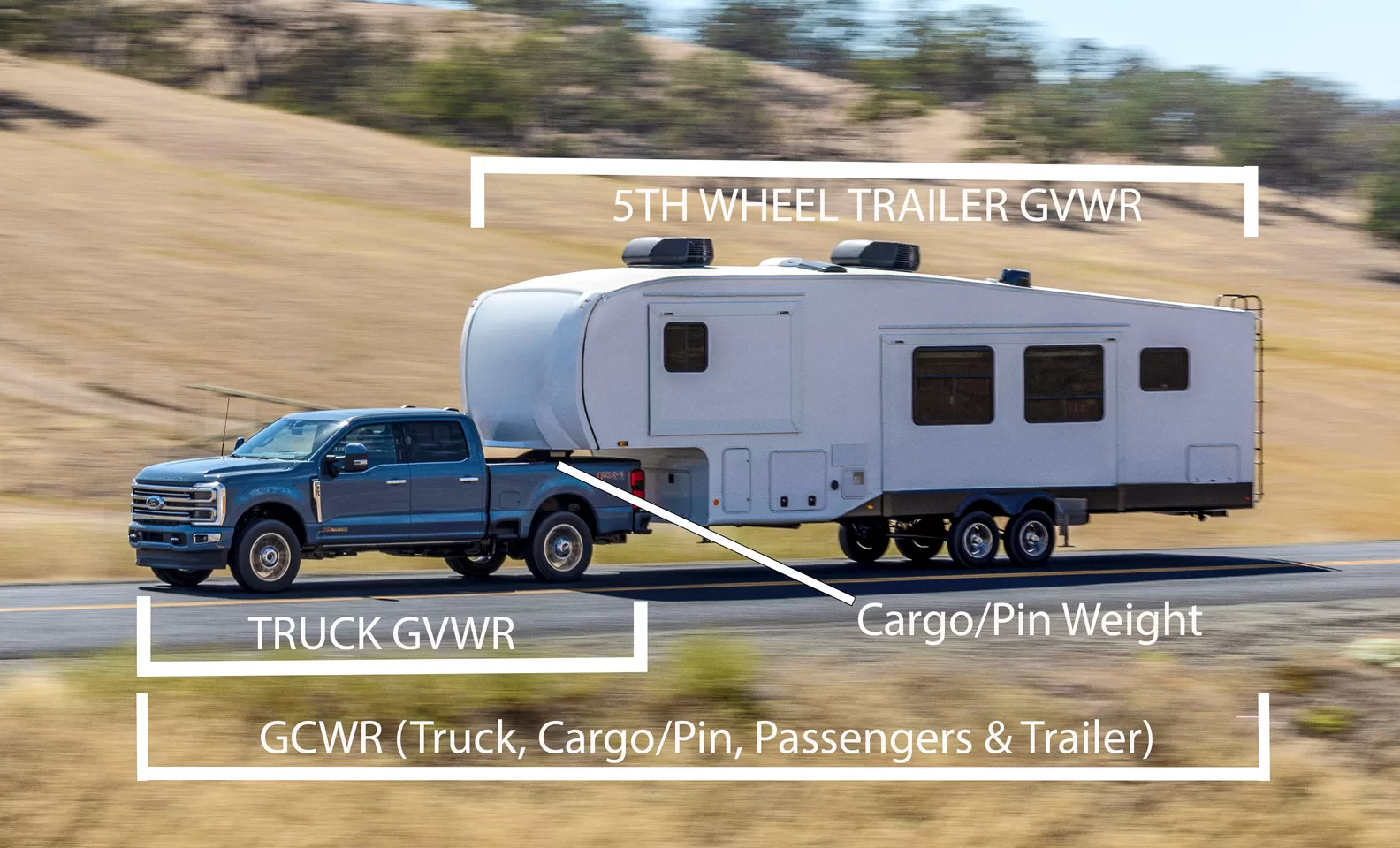
This image visually depicts the relationship between various weights related to towing a fifth-wheel travel trailer.
I was very disappointed in the “A Beginner’s Guide To Fifth-Wheel Hitches” article in the January issue. You totally ignored the one item most important when deciding what size pickup to purchase as a tow vehicle. Your entire weight discussion talked only about the max towing capacity. Any diesel pickup can “tow” virtu-ally any fifth-wheel. What you neglected to mention, and is really more important than the tow capacity, is the weight-carrying capacity of the pickup, as noted on the truck’s tire and loading information sticker on the edge of the driver’s door.
Then the article stated, “For the majority of fifth-wheel travel trailers, a three-quarter-ton pickup is a good choice.” That is totally false and is the problem we have with the new buying public; they think a three-quarter-ton truck is fine, where the truth is it is well over its weight-carrying capacity — but NOT its towing capacity.
This is a very serious omission and, in my opinion, should be included in a future issue to prevent even more new fifth-wheel owners from purchasing a vehicle incapable of carrying the heavy pin weight of a fifth-wheel and remaining within weight limits.
— Bert Adams, F421125
Fort Smith, Arkansas
Editor’s note: Weights related to towing a fifth-wheel or conventional travel trailer could be an article in and of itself. The article in the January issue did refer readers to the truck manufacturers’ websites for specific vehicle ratings, but it could have expounded on the importance of not exceeding the pickup manufacturer’s listed gross vehicle weight rating (GVWR) or gross combination weight rating (GCWR) for a specific model. The GVWR is the maximum allowable weight of the loaded truck. The GCWR is the combined weight of the pickup, its passengers, cargo, and the trailer.
Cargo in this application includes the fifth-wheel’s pin weight. The pin weight is the portion of the fifth-wheel that is carried by the pickup and not by the trailer axles. The pin weight of a fifth-wheel trailer generally will be between 15 to 25 percent of the total weight of the trailer. Since the pin weight is cargo, like any other items loaded onto the pickup, it is important to know the truck’s GVWR and not exceed it.
The pickup manufacturers take all that into consideration when they list the pickup’s “maximum loaded trailer weight” within their “trailering guides,” which those planning to tow a trailer should read.
We want to hear from you! Family RVing welcomes comments about articles published in the magazine or topics of interest to RV owners. Email readerswrite@fmca.com; mail to Readers Write, FMCA, 8291 Clough Pike, Cincinnati, OH 45244. Please include your name, city, and state/province. Letters may be edited for space and clarity.