
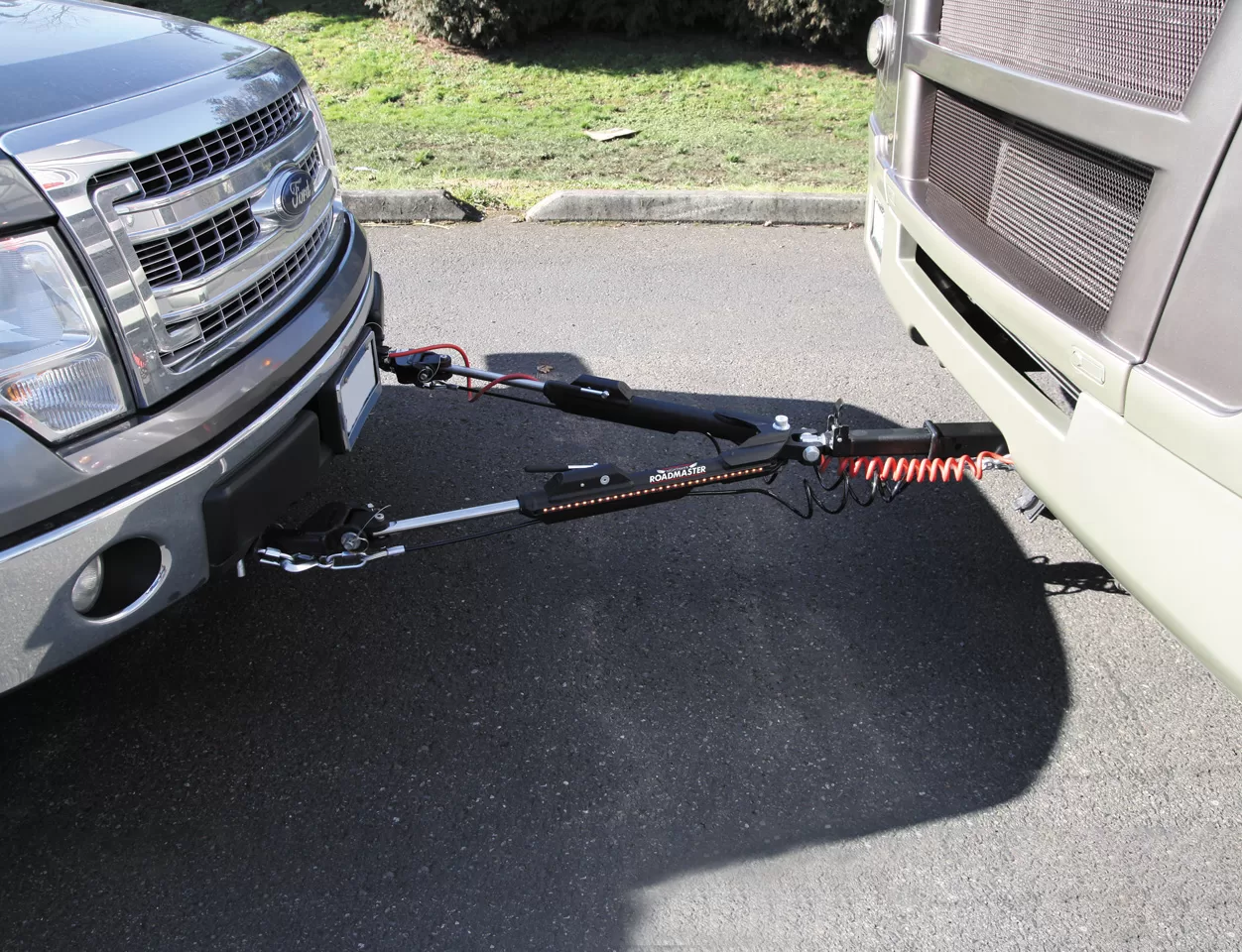
Most motorhome owners take along another vehicle for use once they reach their destination. Before setting up a car, SUV, or truck as a “dinghy,” it pays to do your homework.
By Mark Quasius, F333630
April 2023
Motorhome travel makes it possible to take all the comforts of home with you, no matter where you roam. Once you reach your destination, it helps to have a smaller vehicle for touring the area and running errands. This can be accomplished in several ways.
You can load most vehicles onto a flatbed trailer or into an enclosed trailer. This has advantages, especially if your intended daily driver is a collectible or classic vehicle that you want to protect, or a lifted rock-crawling Jeep that would be impossible to tow otherwise. On the flip side, you’ll have to find a place to park the trailer at your destination and deal with the task of loading and unloading.
A tow dolly is another option for some vehicles that cannot be towed with four wheels on the ground. Not every vehicle can be towed on a dolly, either; so, that method has limitations, too.
The most popular method of towing a vehicle behind a motorhome is to use a tow bar to flat tow it, also known as towing “four down” or “dinghy” towing.
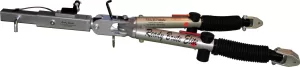
NSA RV Products’ Ready Brute tow bar features a built-in surge brake.
Towability
First, find out whether the vehicle you own or wish to own can be flat towed. FMCA publishes an annual towing guide that lists various vehicle makes and models in a particular model year that can be towed in this manner, as well as limitations or modifications required. For many vehicles, flat towing isn’t possible. Automatic transmissions utilize a pump to circulate transmission fluid through the transmission and torque converter. This pump runs off the input shaft on the front of the transmission. If lubrication does not flow to the transmission when the engine is not running, towing such a vehicle would destroy the transmission. In the past, Remco offered a lube pump that circulated the automatic transmission fluid during towing to circumvent this concern, but, unfortunately, the company discontinued production of its vehicle towing products. A driveshaft disconnect is an option that allows a rear-wheel-drive vehicle to be flat towed.
Many four-wheel-drive vehicles have a manual transfer case to shift between two-wheel-drive and four-wheel-drive modes. They also have a neutral position that disconnects the transmission from the driveline so that the vehicle can be towed freely. Note that this will not work on a lighter-duty transfer case that does not have the capability to shift into neutral.
Not all transfer cases are alike, and there may be a speed restriction and/or a limitation as to how many miles you can tow the vehicle before stopping and running the engine to circulate the fluid in the transfer case. Smaller transfer cases won’t hold enough fluid to keep the gears and bearings from overheating. Check the vehicle owners manual for specific information.
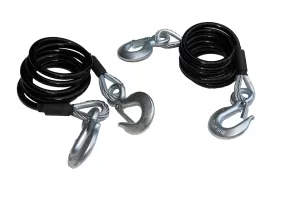
Safety cables are a vital component.
Another consideration is the vehicle that is doing the towing. Just because a motorhome is large doesn’t mean it can tow every vehicle. You will need to check the motorhome’s weight ratings and conform to them. They should be posted on a placard inside the RV.
Among those listed is the gross vehicle weight rating (GVWR), which is the maximum weight for a fully loaded motorhome. The gross combination weight rating (GCWR) represents the maximum weight of the motorhome plus whatever it is towing. For instance, if your coach has a 32,000-pound GVWR and a 42,000-pound GCWR, it is capable of towing a 10,000-pound trailer or towed vehicle. A smaller motorhome may have a GVWR of 18,000 pounds, for example, and a GCWR of 21,500 pounds; this would leave 3,500 pounds for towing, limiting your choice of towed vehicles considerably.
These examples assume that your motorhome is loaded to its maximum GVWR. If you don’t load your coach to the full GVWR, that allows a little more leeway. For example, if the aforementioned motorhome with the GVWR of 18,000 pounds is loaded to only 17,000 pounds, you will have 4,500 pounds available before reaching the 21,500-pound GCWR. A motorhome that weighs more than its GVWR should not be used to tow anything and, in fact, should have weight removed from it before being driven solo.
You will need to put your motorhome on a scale to determine this. The ideal is to have it weighed by individual wheel position. At the very least, though, you’ll want to have it weighed by axle. Do this when the vehicle is fully loaded with fuel, cargo, and people. You might be surprised what your coach weighs.
In addition, consider the rating on the motorhome’s tow hitch. If the hitch is rated at 5,000 pounds, but the truck you want to tow weighs 6,000 pounds, it’s a no-go. You cannot safely exceed the weakest link in your towing capacity.
Selecting A Tow Bar
A wide variety of tow bars for flat towing are available. The most basic is an A-frame unit that mounts to the towed vehicle and has a trailer ball coupler; it folds down to attach to a ball hitch on the tow vehicle. These have become less popular, because they require jockeying to align the coupler precisely to the trailer ball, and they must be removed from the towed vehicle and stored someplace when the vehicle is not being towed.
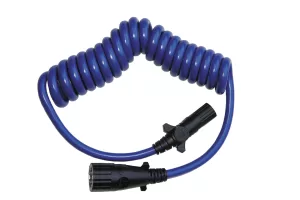
An electrical umbilical cord connects the lights of the motorhome and towed vehicle.
The most common tow bar is a motorhome-mounted unit. These units insert into the motorhome’s hitch receiver and can remain there when not towing. The tow-bar arms are telescopic, so you don’t have to be as precise when positioning the vehicles to hook them up. Just get the vehicles close and connect the arms. Once you back the towed vehicle slightly or drive the motorhome forward, the arms will extend and lock into place. After towing, simply raise the arms and fold them up alongside the rear of the motorhome; you won’t need to remove anything. The coach can be driven with the tow bar in the stored position.
Various manufacturers offer this type of tow bar. Most feature steel construction, but some aluminum models are available. Aluminum has the advantage of weighing less than steel, but that benefit comes at a higher price as compared with a similar steel model, as well as a reduction in towing capacity. In my opinion, the expense isn’t worth the few pounds saved, and because of its weight and density, steel is less likely to bend or break under application of weight, force, or heat. Most aluminum tow bars do use steel mounting lugs for greater strength and to prevent pin holes from elongating because of wear. Tow bars with built-in braking systems also are available.
Tow Bar Mounts
Once you select a tow bar, you’ll need to find a way to attach it to your towed vehicle. The most common method is to use a baseplate. Baseplates are offered by the tow-bar manufacturers and designed for their specific products. However, most offer adapters that make it possible to attach a tow bar from brand A to a baseplate made by brand B. In addition to giving you the opportunity to mix and match if you prefer one brand over another for these components, it also allows you to replace an existing tow bar with one from another manufacturer without having to purchase a new baseplate.
Baseplates mount to the frame rails of the towed vehicle and are engineered to handle the stress of towing. The steel structure has specific attachment points designed for a particular vehicle. The front end will have attachment points to connect the tow bar, as well as places to connect safety cables that run between the motorhome and the towed vehicle. The baseplate also should be equipped with safety cables or chains that connect to the towed vehicle’s frame to prevent the baseplate from separating from the vehicle should the mounting bolts fail.
Many of these tow bars have removable mounting tabs. When the towed vehicle is parked, the tabs can be detached. They stick out from the front of the vehicle a bit, so removing them improves the appearance, and it adds a measure of safety by eliminating the concern of someone hitting their shins on them.
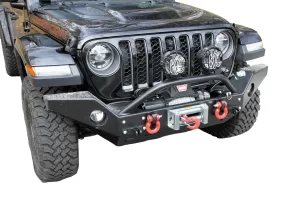
A Rockhard 4×4 steel bumper for Jeeps eliminates the need for a baseplate.
If you tow a Jeep Wrangler or Gladiator, you also can use tow tabs that mount directly to a heavy-duty off-road steel bumper. This eliminates the need for a baseplate, which can sustain damage if the vehicle is driven off-road. I’ve used Rockhard 4×4 bumpers and tow tabs extensively and have had excellent results. The company’s tow tabs mount with bolts that go through the heavy steel bumper and into the Jeep’s frame-rail end brackets.
Lighting
All vehicles need working taillights, turn signals, and brake lights when being towed. These lights must operate in tandem with the motorhome lights. An umbilical cord connects the two vehicles via the coach’s trailer lighting receptacle.
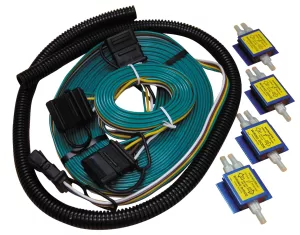
A Roadmaster diode harness kit can be used to wire vehicle lights for towing.
You will need to determine what lighting system will work with your towed vehicle. On older vehicles, the taillight housings were larger, and it was possible to add an extra bulb inside the housing that would be connected to the trailer lighting from the coach. Most vehicles now have smaller light housings, so this method isn’t very popular. However, it is possible to purchase portable lights or a light bar that is magnetic and/or straps to the vehicle and can be plugged directly into the motorhome via a long cord.
Another method is to use the existing lights and add diodes. Most tow bar manufacturers offer various lighting options, and a diode pack is a popular choice. The diode pack is inserted between the towed vehicle’s lights source and the motorhome’s taillights. The wiring from the motor-home connects to the downstream side of the pack, and the diodes prevent back-feeding to the towed vehicle’s lights. This method has worked for years, but some of the newest vehicles may pose issues.
New vehicles often are equipped with a controller area network bus — CAN bus — to manage various features, including lighting. One nice thing about this system is that the controller can detect when a taillight is
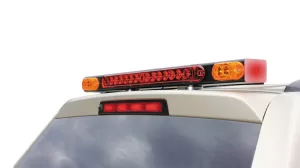
A separate light bar can be added to a towed vehicle; this one incorporates multiple LEDs.
ut and warn you with an error message. A diode package may not work with the system and will throw an error code.
The best way to deal with this is by having two separate lighting systems — one feeding from the vehicle and one from the motorhome — and these two systems must be isolated from each other. Some manufacturers offer a toggle switch to do this. The switch is mounted in the towed vehicle and allows you to alternate between the motorhome and towed vehicle lighting systems manually. This switch requires connections between the motorhome’s rear lights and the towed vehicle lights, so it requires a bit of work to tap into the vehicles’ wiring systems to install it. The other drawback is that you need to manually flip the switch every time you hook up or unhook the towed vehicle. If you forget when you unhook, you won’t have any rear lights when driving the vehicle solo; conversely, if you don’t flip the switch before towing, the towed vehicle will be without lights.
Another method to provide an isolated wiring system is to use relays. If you look around RV parks as you travel, you’ll find a lot of Jeep Wranglers being towed. Mopar makes a complete towed-vehicle lighting system for Wranglers that I’ve personally installed on three vehicles so far. It features a plug-and-play wiring harness that connects directly to the factory receptacle. Instead of a manual switch, it uses solid-state relays to switch between the motorhome and towed vehicle lighting. As soon as you plug in the lighting umbilical cord, the relays sense voltage from the hot terminal on the plug, and the relays switch over to the coach lighting. When you stop towing and unplug the trailer lighting cord, it automatically switches back to the towed vehicle lights. This system eliminates operator error and is truly an “install and forget it” system.
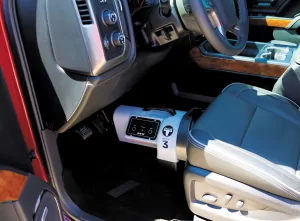
The Blue Ox Patriot 3 is a portable supplemental braking unit.
Auxiliary Braking Systems
Another key component for flat towing is a supplemental braking system for the towed vehicle. As mentioned earlier, the GCWR is the combined weight rating of your motorhome and a towed vehicle and is the prime factor in determining the size vehicle you can tow safely. But GCWR, a term borrowed from the trucking industry, assumes that the vehicle being towed has its own operable braking system. The motorhome’s braking system is not designed to safely stop the coach and towed vehicle in the required distance. A supplemental braking system will make a difference, especially during an emergency stop.
One Roadmaster test showed that a 34-foot Type A motorhome took 132 feet to come to a complete stop from 50 miles per hour. When a medium-size car was connected to the motorhome, the stopping distance increased to 209 feet. When a supplemental braking system was added to the towed vehicle, this distance decreased to 137 feet. Those extra 72 feet can make the difference between safely stopping in time or being involved in an accident should an emergency stop be required.
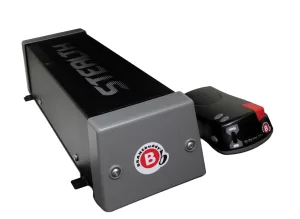
The built-in Brake Buddy Stealth has a dual controller so it can be operated from the motorhome.
Supplemental braking systems can be portable or permanently mounted in the towed vehicle. Portable units have the benefit of being able to be moved easily from vehicle to vehicle. They don’t require a lengthy installation process, but you still must connect a breakaway switch and do some under-hood wiring. These systems rely on a decelerometer to detect when the vehicle is slowing down; they utilize an arm that attaches to the brake pedal to apply the brakes. The unit generally pushes against the seat to avoid moving away from the vehicle’s brake pedal when applying the brakes. At least one of these systems also can incorporate a tire pressure monitoring system (TPMS) that will monitor the tire pressures on the coach and towed vehicle.
Permanent braking systems use a variety of methods. Some are electric and employ decelerometers to sense when to apply the brakes, while others use air pressure from a diesel coach with air brakes to proportionately control the towed vehicle’s brakes at the level that the coach brakes are being applied. The latter eliminates false readings that can occur from decelerometers when coasting down a grade, causing the towed vehicle’s brakes to drag. If you step on the motorhome’s brake pedal, the towed vehicle’s brakes will apply proportionately.
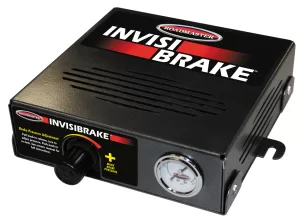
The Roadmaster InvisiBrake supplemental braking system installs out of sight in the towed vehicle and activates only when the motorhome brake lights illuminate.
Yet another method is a surge brake system that is an integral part of the tow bar. It utilizes a steel cable that connects the towed vehicle’s brake pedal to the tow bar’s surge brake controller.
It’s also important to use a breakaway feature with any supplemental braking system. If a tow bar should fail or become disconnected, the towed vehicle could become a runaway missile and cause an accident or seriously injure someone. Even if the safety cables hold, damage could occur to the front of the vehicle and the rear of the motorhome. I can recount one experience where a breakaway feature saved me from an expensive repair bill.
While traveling on a two-lane highway and flat towing our Jeep, we heard a bang and felt a sudden jerk at the back of the coach. I looked at the rearview camera monitor and noted that the Jeep was pretty far back from the motorhome and being dragged along by the safety cables. Because the breakaway switch on our supplemental braking system had applied the Jeep’s brakes, I was able to slow down and pull off the road to correct the problem. Without this supplemental braking system and its breakaway switch, the Jeep would have impacted the rear of the coach once I tried to slow down, causing extensive damage to the coach and the Jeep.
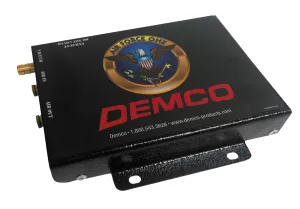
Demco’s Air Force One brake controller utilizes air pressure to apply the towed vehicle’s brakes.
The system you choose will depend largely on your motorhome. If it has air brakes, the pneumatic proportional systems may be the best option. If you have a gasoline-powered coach, you can purchase a compressor unit that mounts in the RV to allow you to use a pneumatic proportional system, but this adds to the cost significantly. The benefit, though, is that your towed vehicle is all set if you upgrade to a diesel-powered motorhome in the future. Otherwise, your choices will be a permanent electrically powered system or a portable braking system.
Safety should be your top priority. Towing equipment is not the place to cut corners. Pick a tow bar that meets your needs; set up a proper lighting system and a supplemental braking system; and travel safely.
Resources
Blue Ox
(800) 228-9289
www.blueox.com
Tow bars, baseplates, braking systems, lighting kits
Brake Buddy
(800) 470-2287
www.brakebuddy.com
Braking systems
Demco
(800) 543-3626
www.demco-products.com
Tow dollies, tow bars, baseplates, braking systems, lighting kits
Hopkins Towing Solutions
(800) 835-0129
www.hopkinstowingsolutions.com
Vehicle wiring and lighting kits
M&G Brake Systems
(903) 675-2812
www.mgbrakes.com
Braking systems
NSA RV Products
(800) 933-3372
www.nsarvproducts.com
Tow bars with integrated braking system, baseplates, lighting kits
Roadmaster
(800) 669-9690
www.roadmasterinc.com
Tow bars, baseplates, braking systems, lighting kits
Rockhard 4X4
(844) 762-5427
www.rockhard4x4.com
Integrated Jeep bumpers with tow tabs
RVi Brake
(800) 815-2159
www.rvibrake.com
Braking systems, tire pressure monitoring systems, towed battery chargers
Superior Driveline
(855) 447-3626
www.remcodsc.com
Driveshaft disconnects
TowMate
(800) 680-4455
www.towmate.com
Lighting kits