

Travel
California Waterfalls
The Golden State is full of natural wonders, among them world-famous Yosemite Falls, the tallest waterfall in North America. It’s a must-see, but the state boasts more than 100 other waterfalls worth visiting.
Waterfall lovers across California finally have something to celebrate. After several years of drought, California has received enough snow to bring most of the state’s waterfalls back to life this spring. While many waterfalls are hidden deep in the mountains and accessible only by hiking trails, quite a few of them are easier to reach. Camp-California.com, a resource for campers and outdoor enthusiasts in California, has compiled a list of several lesser-known waterfalls in the Golden State, along with campgrounds that can be used as base camps when visiting these beautiful destinations. Here are just a few of the possibilities:
Rainbow Falls

This 101-foot waterfall is located on the Middle Fork of the San Joaquin River within Devils Postpile National Monument, in the eastern Sierra near Mammoth Lakes. The waterfall gets its name from the rainbows that shine through the mist, and it’s best to visit around midday when the sun is at its highest point.
Nearby Mammoth Mountain RV Park (www.mammothrv.com) offers RV and overlanding campsites. It is open year-round and has sites with full or partial hookups. Amenities include restrooms with hot showers, an indoor swimming pool and spa, internet hotspots, a laundry room, a dump station, and more.
Alamere Falls
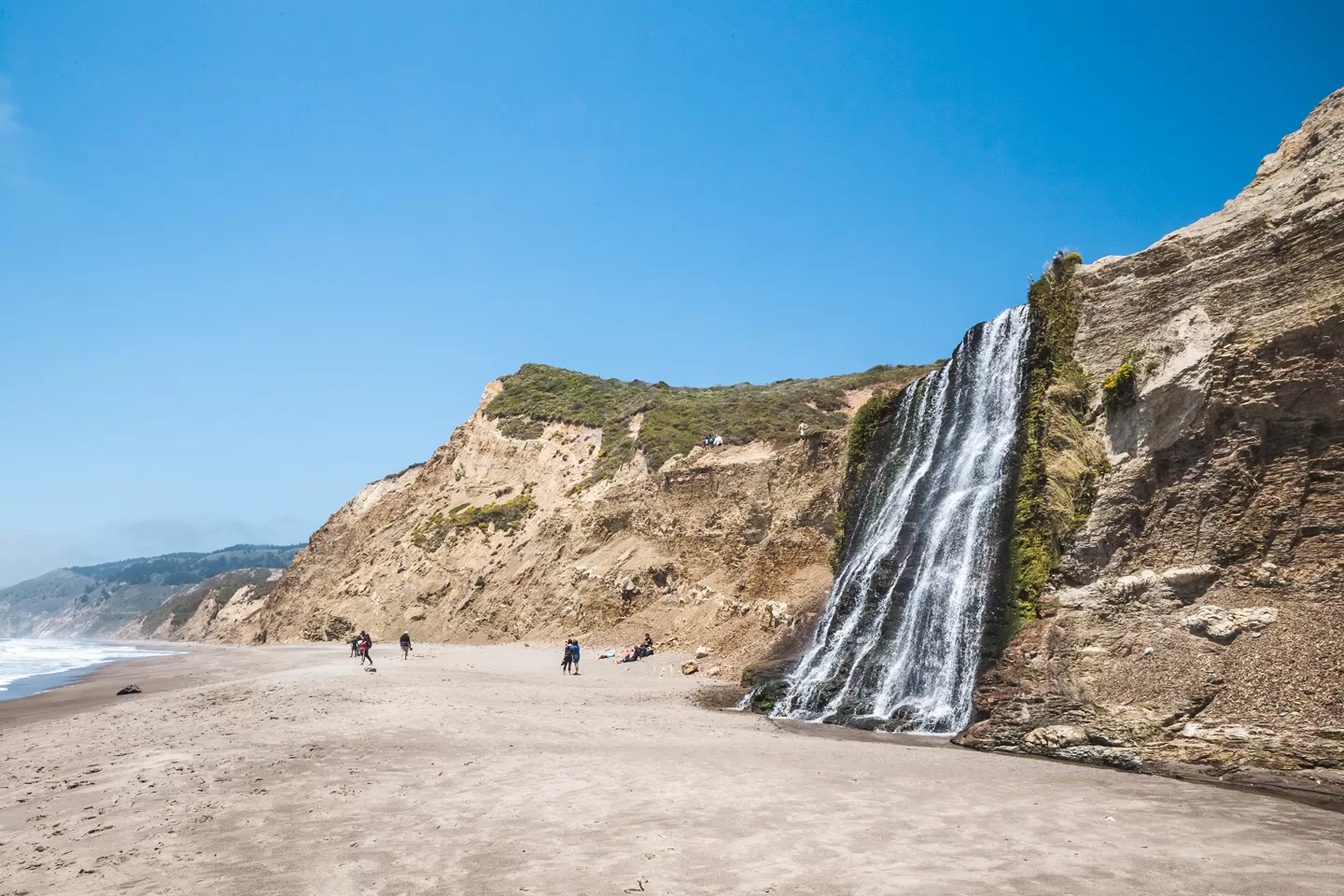 Located in Point Reyes National Seashore and within the Phillip Burton Wilderness, Alamere Falls cascades over a cliff onto a beach and then runs into the ocean. It can be accessed via the Palomarin Trailhead at the southern end of Point Reyes, but note that it’s a strenuous 13-mile round-trip trek.
Olema Campground (www.olemacampground.net) is located nearby and has 80 RV campsites, including 26 with full hookups. Amenities include bathrooms with hot showers, free Wi-Fi, a dump station, a honey wagon, propane, a laundromat, an ATM, and more
Burney Falls
 Burney Falls is a 129-foot spring-fed waterfall considered to be among the most scenic in the state. Located inside McArthur-Burney Falls Memorial State Park, it flows with 100 million gallons of water every day, making for an impressive sight.
Campgrounds and resorts are available not far away. Among them is Hat Creek Resort and RV Park (www.hatcreekresortrv.com) in Old Station. Hat Creek offers full-hookup sites with 30-amp electric and cable TV. It is near Whiskeytown-Shasta-Trinity National Recreation Area and Lassen National Forest. Another option is Lassen RV Park Campground (www.lassenrvparkcampground.com) in McArthur, which offers 42 full-hookup sites and two sites with partial hookups. Set within a 68-acre wilderness area, the campground boasts stunning views of Mount Shasta.
To locate other waterfalls in California, and beyond, visit www.world-of-waterfalls.com.
App File
Birding
Even if you’re an expert birder, having a reference guide is always helpful. But lugging around a book can be cumbersome. Luckily enough, you can download one or more of these apps to help you during your outdoor bird-watching adventures.
 Merlin Bird ID by Cornell Lab: Not sure what bird you saw or heard? Just ask Merlin! This app is powered by eBird, the world’s largest database for bird sightings, sounds, and photos. To identify a bird, you can answer a few simple questions, upload a photo, record audio, or explore what birds are in your region. The app also offers customized lists of birds based on where you live or travel as well. Whenever you identify a new bird, you can build a digital scrapbook of your birding memories by using Save My Bird. Free on iOS and Android. merlin.allaboutbirds.org
 iBird Pro: Great for offline use, iBird’s self-contained database doesn’t require an internet connection. The search engine incorporates a neural-network feature for identifying birds from any photo and turns your phone into a field guide for the birds of North America. By using illustrations, photos, field marks, maps, songs, photo recog-nition, and the Percevia nature-based search engine, novice birders will have ample help identifying birds they come across. A free trial is available on iOS and Android. Monthly and yearly subscription plans are available. www.ibird.com
 Larkwire—Learn Bird ID: If you don’t want to rely on outside sources for identifying birds, sometimes it’s easier to memorize everything yourself! Larkwire is a game-based learning system. Users can play games and follow audio courses to learn how to identify bird sounds. Visual courses help users learn to distinguish plumage. You can customize what bird species you want to learn how to identify. Free on iOS. Additional birdsong packs can be purchased through the app. www.larkwire.com
Hobbies
Calligraphy On The Go
Many artists take their supplies with them on trips, especially if they plan on painting the gorgeous landscapes they come across while traveling. But what if you’re a calligrapher? Fortunately, there are plenty of ways to bring your artful penmanship with you on the road.

Honing your calligraphy skills is a great way to relax after a long day of traveling.
With the right kind of planning, creative RVers can bring their art supplies with them on their journeys. For many artists, including painters, that usually involves a travel kit tailored to their specific needs. The same applies to calligraphers — those who pursue the art of decorative handwriting — you just need to get a bit creative!
Of course, you’ll need writing tools. The principal tools for a calligrapher are the pen and the brush. Calligraphy pens may have interchangeable nibs — the part of the pen that contacts the writing surface to deposit the ink. Packing your nibs is easy, especially if you already own a nib tin. If you don’t, you can always put them in a mint tin or anything similar. Ink can be a bit tricky to travel with, though, since it can stain anything it touches. If you aren’t packing your ink away and plan on keeping it upright, you can leave it in a cupholder. If you’re putting it in a bag or other container, small jars with fitted caps are a great way to make it portable. Small, glass jam jars can be used for this. If you’re worried about spillage, cover the container in plastic wrap or put it in a zip-top bag (or both, as a precaution).
If you don’t want to risk spilling ink everywhere, watercolor calligraphy is always an option. Many different watercolor travel kits are available from art retailers or online stores. Watercolor paint comes in a few different forms. Sometimes it is sold in small toothpaste-like containers, or it may be supplied in small pans. Both have their pros and cons.
If you are thinking about bringing small paintbrushes along, make sure they are properly protected to avoid damage to the bristles. When you buy a small paintbrush, it likely will have a section of plastic tubing covering the bristles to protect them. If you don’t have the plastic cover anymore, purchase inexpensive aquarium airline tubing from a pet store and cut it to size. Plastic straws also may work for this. If you don’t want to create something yourself, you can always buy a portable paintbrush box.
If bringing ink and brushes is too much of a hassle, consider brush pens. They often are less expensive and more portable than traditional brushes, and they have ink fed to them like a marker. Different types of brush tips are available. Some have natural hair, and others use synthetic material. You also can find felt tips. Brush pens are very portable, and you can use a regular pencil case to transport them — no additional ink required.
With minimal supplies needed, calligraphy is an art that lends itself well to travel. It makes a great creative outlet while enjoying the RV lifestyle.
Bookshelf
The Civilian Conservation Corps Cookbook
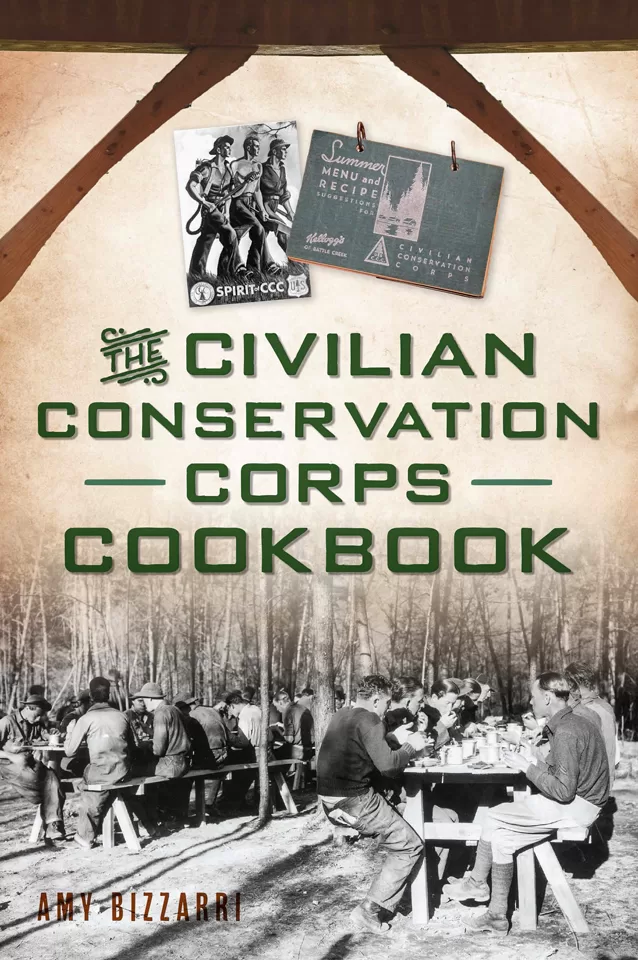 The Civilian Conservation Corps (CCC) was a voluntary government work relief program that ran from 1933 to 1942 in the United States. Over the years, an estimated 3 million men from the ages of 17 to 28 took part in the CCC. These young men were unemployed and unmarried, and they helped restore and conserve public lands, forests, and parks.
The Civilian Conservation Corps Cookbook features recipes that sustained those in the CCC and others during the Great Depression. These recipes are budget friendly and include easily obtainable ingredients, reflecting the “make do” attitude of Depression-era cooking. All of the included recipes originate from CCC camp menus. Most, if not all, of the recipes are simple and straightforward, too. For example, Moonstruck toast is like egg-in-a-hole, but the recipe gives an option of adding maple syrup or fresh fruit jam. Others, like Brunswick stew, include many ingredients but only need to be combined and simmered.
Amy Bizzarri, the author, is a Chicago-based freelance writer and covers food and travel for the Chicago Tribune, BBC Travel, Lonely Planet, Tasting Table, Smithsonian, PBS, and others. She is a certified wine expert, and she has written four books focused on history and food.
The Civilian Conservation Corps Cookbook (Arcadia Publishing, $23.99) is available for purchase at various bookseller websites and stores.
Travel Tip
Hang It Up
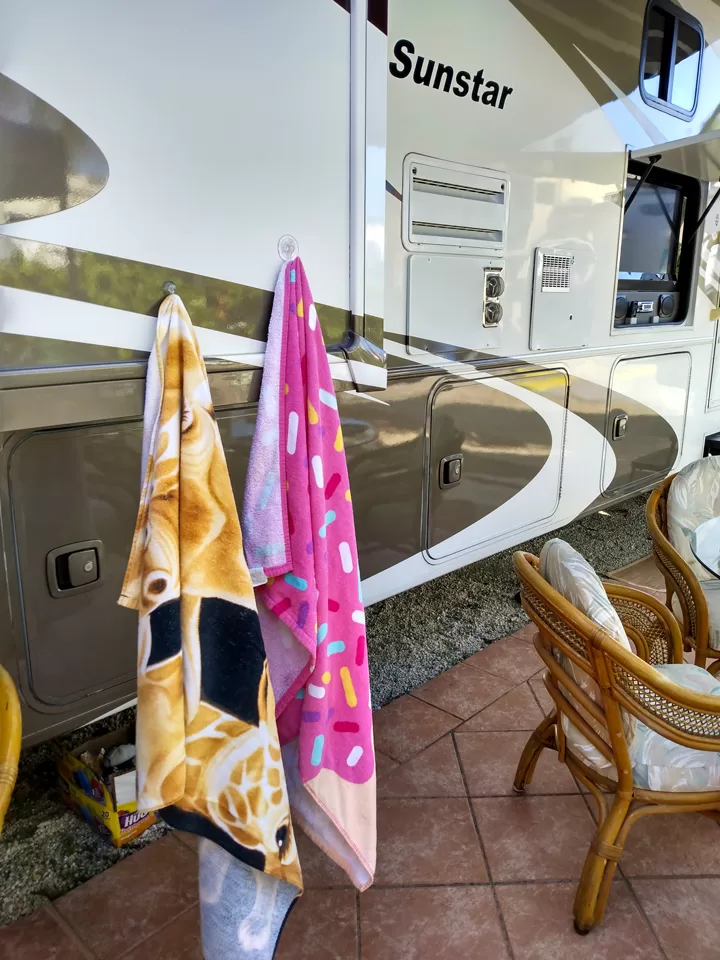 I thought I would share an easy solution to a soggy problem. We have a clothes rack that hangs off the back of our RV when we are stationary. But at the last two campsites we have stayed in, space has been too tight to use it. This created a problem for our soggy pool towels each day.
We had a couple suction cup hooks for the kids’ sun-catcher art in the RV. We decided to move the hooks outside and attach them to the side of our RV to hang our towels on. They worked well for drying the beach towels each day.
Suction cups are a cheap problem solver and take up very little space in the camper.
— Crystal Hammes, F508127
Libertyville, Iowa
Send Us Your Travel Tips!
If you have a suggestion for improving life on the road, we’d love to hear about it. Email it to editor@fmca.com or send to Family RVing, 8291 Clough Pike, Cincinnati, OH 45244. Please include photos or drawings. If your tip is chosen for publication, you’ll receive $35.