
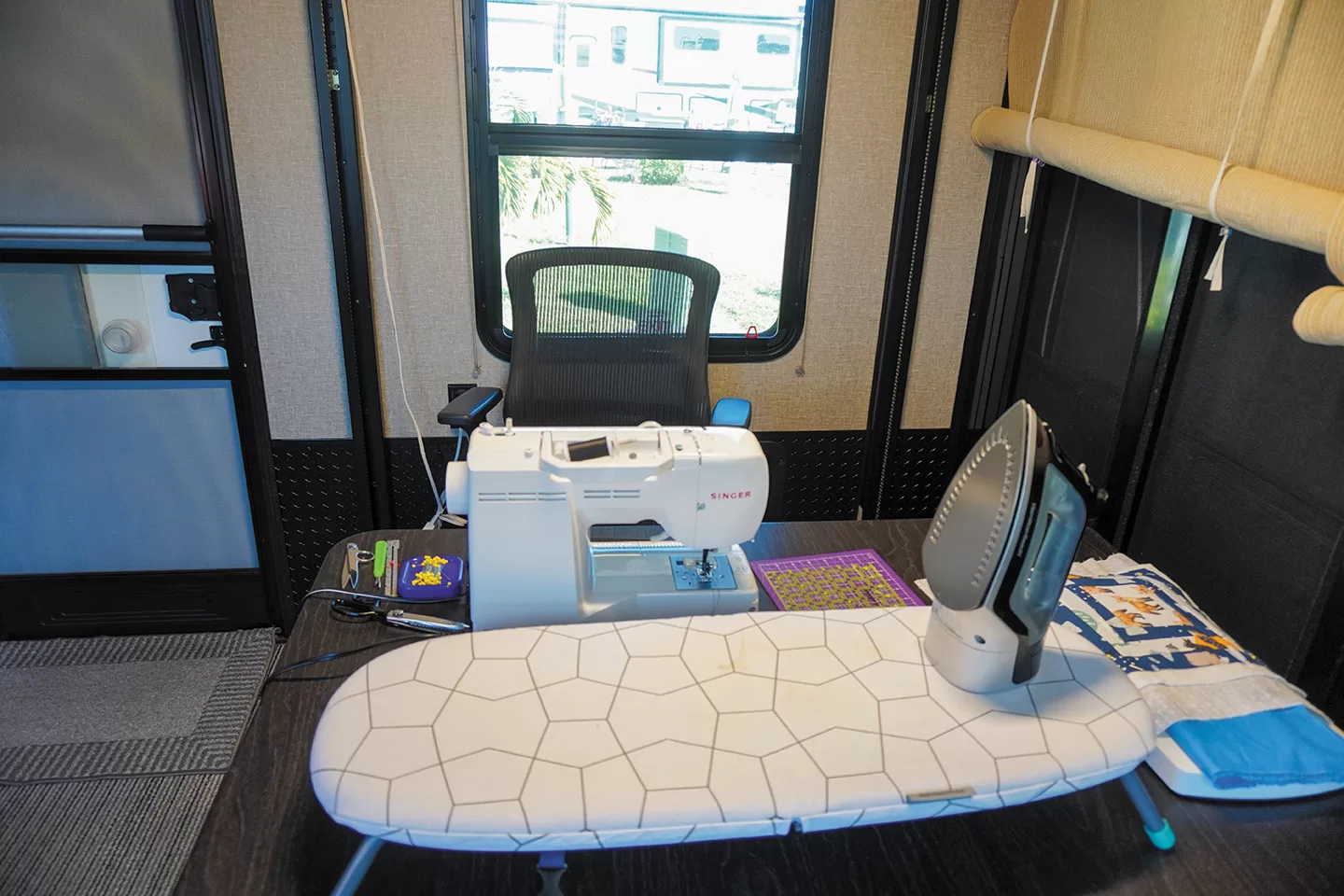
Examples of ways RVers have organized and personalized their mobile craft space.
By Diane L. Murtha, F465708
September 2023
You planned your trip. You have the maps, directions, and campground reservations. You packed your food and other essentials, as well as all your crafting hobby supplies. You arrive at your scenic locale. Now what? What is the best way to set up your RV so that you can enjoy your quilting or crafting? This is a popular question.
The answer: A roving work area can be organized in countless ways, all depending on the space and layout inside each specific RV. One thing we know for sure is that space is limited. Here are four examples of how actual RV quilters set up their sewing nooks.
Cute And Cozy
The first thing I noticed in Donna’s toy hauler were the simple cream-colored roll-up shades the full-time RVer had created to cover the black screen doors that lead to her outside “patio.” Not only did that add a lovely, homey feeling, but it helped brighten the workspace and reflect the natural light coming from two side windows. Her worktable is positioned in the center of the room, with space to move to and from the sewing machine chair or around to the front of the table for ironing and cutting. Under the table she stores project boxes, machine cases, and other items. Directly above her sewing station, an under-cabinet-style plug-in light is mounted to the HappiJac bed lift overhead. The key take-away here is that she has all her essential sewing, cutting, and ironing materials on one table, within arm’s reach. This setup could be used in just about any RV with a table.
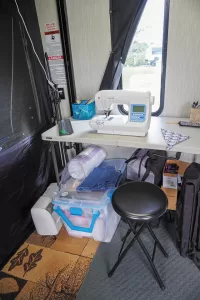
Denise’s setup prioritizes storage and proper lighting.
Doing It All
Denise is an expert in many crafting hobbies and has her toy hauler set up for easy access to them all. Her sewing station is a folding table positioned against one window, with many items stored underneath. On the opposite wall under the window is another small table for her sublimation machine, where she can create T-shirts, mugs, Christmas ornaments, and other cool things. This table also has a spot for cutting and ironing. Underneath it are power tools for her other craft hobbies. One of the key takeaways from Denise’s setup is her lighting, which we all can use more of. An inexpensive magnetic light purchased at a hardware store hangs from the ceiling but can be moved to any metal surface in the room where additional illumination is needed.
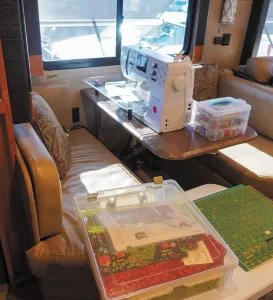
A table extension accommodates Diane’s machine.
No-Dinner-Until-I’m-Done Sewing!
Well, that’s not entirely true. I store my sewing machine and project bags on the top bunk of our Type A motorhome. When I’m ready to quilt, the machine sits on the booth-style dinette table. I use an acrylic table extender designed for my machine to provide extra surface for quilting, and it also creates space below the table for my scissors, pattern instructions, and other little essentials. I position a small adjustable table at the end of the dinetteto extend my surface if my project has a lot of fabric pieces or if I need to do cutting (such as for paper piecing); then I can easily turn to the side to do this. My iron and ironing board are on the kitchen counter. When I’m done for the day, I temporarily store my sewing machine on the floor in front of the pantry cabinets, and the other items go in the lower bunk bed. Just as we get accustomed to setting up and stowing away items for traveling, it doesn’t take much time to set up and store my sewing supplies.
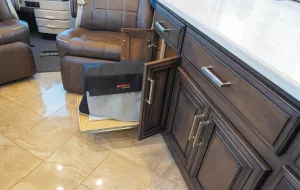
Patti’s RV has a custom-built cabinet to store sewing supplies.
Tricked-Out Workstation
Patti has the ultimate work area! She took out the loveseat in her Type A motorhome and replaced it with a custom-built cabinet. The shelves and drawers were designed specifically to hold her sewing machine, cutting mat, acrylic rulers, and other supplies. When she is ready to sew, her sewing machine sits on the under-cabinet table extension. Her cutting station is to her right, and ironing takes place on the kitchen counter behind her. Patti can leave her quilting items out all day, all night, and she and her husband can still have dinner.
Living in our RVs is all about creatively managing the space we have. These examples may spark additional thoughts and ideas on how you can make your own space more convenient for your quilting and crafting hobbies.
Diane L. Murtha has been quilting for over 30 years. She is also a fiber artist, lecturer, instructor, and author of the book Artful Insights In Fabric. She also leads crafts classes at FMCA international conventions. Learn more at www.dianeLmurtha.com, follow her on Instagram @dianelmurtha, or email dlmurtha2018@gmail.com for more information.