
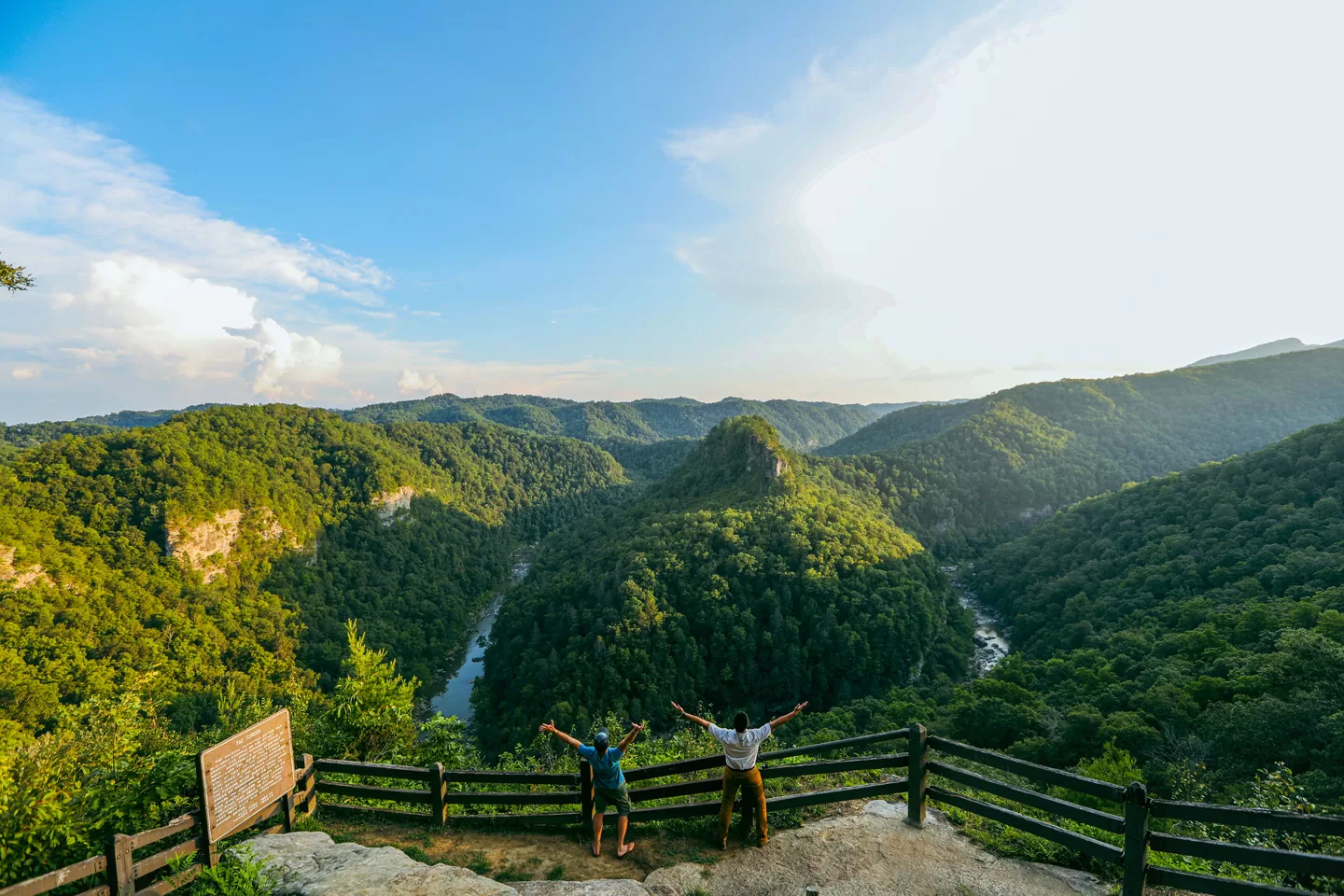
In the southwestern corner of Virginia lies a land that offers rest, relaxation, and outdoor recreation, along with a dose of music and coal-mining history.
By Kathleen Walls, F522187
April 2024
They say, “Virginia is for lovers.” Well, there is a lot to love about the region nestled in the westernmost tip of the state, known as the Heart of Appalachia. The tourism folks also refer to it as “the heart of all things fun.” Activities range from simply soaking in the serene scenery to exploring the area’s history and culture or engaging in exhilarating outdoor adventures.
HIGHS AND LOWS
Want a break from big-city traffic? Consider Breaks Interstate Park, set in the Appalachian Mountains on the Virginia-Kentucky border. One of only two interstate parks in the United States, Breaks boasts 4,500 acres of spectacular scenery and a 5-mile-long gorge. With land in southwestern Virginia and southeastern Kentucky, the bistate park is managed jointly via a compact between the two states.
Park your RV in one of the 138 campsites at Breaks Interstate Park, which range from primitive to full-hookup spots. The campground is open from April through October. The park has so many things to do, you may not want to leave.
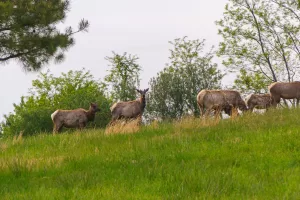
Breaks Interstate Park offers guided elk viewing tours.
There’s something to please every taste. Don’t feel like cooking? Check out the Rhododendron Restaurant at the Chafin Lodge. Its floor-to-ceiling windows give a spectacular view of Breaks Canyon, one of the deepest gorges east of the Mississippi River, which earned it the nickname “Grand Canyon of the South.”
For thrill seekers, the Canyon Rim Zipline transports folks along more than 2,300 feet of lines across the gorge, going from one scenic outlook to another.
You can get a more down-to-earth thrill by whitewater rafting the 16 miles of rapids on Russell Fork River. Currents in some parts of the river can be dangerous, depending on weather conditions and the season, but the lower section of the river is best for beginner and intermediate paddlers. The Breaks Interstate Park website warns that only experienced whitewater paddlers should attempt to navigate the Russell Fork within park boundaries.
If you enjoy heights, consider rock climbing at the Breaks, with more than 300 routes up steep sandstone cliffs.
Those who prefer tamer adventures can rent a pedal boat, canoe, or kayak and cruise Laurel Lake. The park also offers biking options using either a pedal-type or electric bike. Fishing is excellent. Hiking along the 25 miles of trails provides opportunities to watch birds and wildlife. You may see white-tailed deer, black bears, and many smaller animals. If you hike down into the gorge, watch for peregrine falcons, which were released into the park in 2007 and now nest in the cliff sides. Along the river, you might see beavers and mink.
Among the other amenities is a large waterpark with a 4,000-square-foot beach-entry shallow pool, in-pool basketball and volleyball courts, a current channel, four waterslides, a spray ground, and some shaded spots if you want to avoid the sun.
Be sure to visit some of the eight overlooks. Certain ones are accessible via trails, and others can be viewed by driving to them. My favorite is Stateline Overlook. From there, you see Russell Fork Gorge crossing along the Virginia-Kentucky line. Looking down at the Kentucky side, there’s a relatively flat piece of land called Potters Flats, which was home to a family of moonshiners. The park took Potters Flats under eminent domain. Many of the descendants still live nearby. One local story says that when the Potters were selling their moonshine, a buyer could send his money across the gorge in a basket rigged on a cable, which is still hanging on one side. The Potters would then deliver the moonshine via the basket. The park has plans to develop the area and make the flats accessible via a swinging bridge across the river.
In my opinion, the park’s greatest attraction is the Elk Tour. Habitat loss and hunting depleted the once vast herds of eastern elk. The last one was killed by a hunter in Pennsylvania in 1877, and the subspecies was declared extinct. Elk were reintroduced in Virginia near Breaks Interstate Park in 2012 and began with 75 Rocky Mountain elk. Today, there are over 250 in the Virginia herd. The tours take place March through May, and August through October.
The tour bus transports you up rugged mountain roads to wildlife conservation land. Much of this property once contained coal strip mines. Conservationists restored it to provide food and habitat for the newly introduced elk. When the bus approaches elk herds grazing on slopes, the driver stops and lets
passengers out to take pictures.
At the top of a mountain stands a small shelter and picnic tables. This land, now owned by the Nature Conservancy, is where the elk were originally reintroduced. Part of the tour is a picnic meal while you wait for elk to appear. They stay in the trees to avoid the sun and then come out at dusk. Elk shed their antlers annually, and if you find a shed, you can keep it.
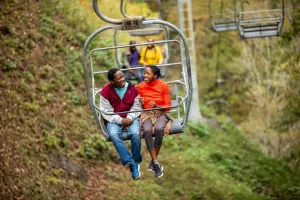
At Natural Tunnel State Park, a chairlift takes visitors down into the gorge.
CHAIRLIFT RIDE
Another good spot for RVers is Natural Tunnel State Park, a little farther south. This park offers 34 campsites in two designated campgrounds — Cove View and Lover’s Leap — all with electricity and water, as well as bathhouses and a dump station.
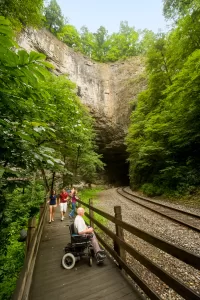
The limestone tunnel in Natural Tunnel State Park is more than 850 feet long and 10 stories high.
The centerpiece here is Natural Tunnel, measuring over 850 feet long and 10 stories high — big enough to accommodate a railway and a stream, the latter carved by nature into solid rock at the bottom of the gorge. You can ride a chairlift 530 feet down to the bottom, where you can see what is believed to be the oldest house in Scott County, the Carter Cabin.
Back at the upper level of the park, visitors can check out a re-creation of The Blockhouse, which was a starting point for settlers traveling the Wilderness Trail carved out by American frontiersman Daniel Boone.
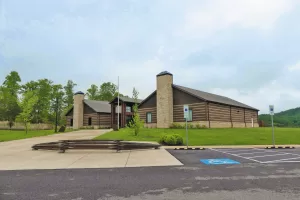
The Daniel Boone Wilderness Trail Interpretive Center.
About six miles from the park, follow Daniel Boone’s adventures at Daniel Boone Wilderness Trail Interpretive Center, a satellite facility of Natural Tunnel State Park. The interactive museum tells how Boone led a band of approximately 30 ax men to chop out a path through the wilderness, beginning the country’s westward expansion.
THE CROOKED ROAD
Visitors to the Heart of Appalachia also can explore musical history. Music is celebrated along The Crooked Road: Virginia’s Heritage Music Trail. The Carter Family, who lived in this area, had a major impact on the beginnings of country music. A.P. Carter traveled the Appalachians collecting old-time ballads brought mostly from Scotland and Ireland by settlers. A.P.; his wife, Sara; and Maybelle Carter, Sara’s cousin and A.P.’s brother’s wife, began recording their music in Bristol, Tennessee, in 1927. They went on to record more than 300 songs in the next eight years. On his deathbed, A.P. asked his daughter, Janette, to keep the family’s music alive. Janette founded the nonprofit Carter Family Memorial Music Center and the Carter Family Fold music venue in 1974 on land that was part of the original Carter Family homestead at the base of Clinch Mountain in Hiltons, Virginia.
The rustic frame building that’s home to the Carter Family Fold today was constructed in 1976 and expanded over the years. It’s not fancy, but it carries on the Carter Family’s music style. Normally, you’ll find acoustic bands playing the Fold; electric instruments are a rare exception. During the first weekend of August, the Fold hosts a festival complete with craft vendors, good country cooking, and — naturally — music.
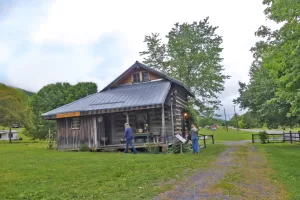
A.P. Carter’s birthplace cabin in Hiltons.
A.P. Carter’s birthplace cabin was moved to this location from Little Valley, the next valley over from where the Fold is. The cabin is a simple two-room log building with a tin roof and stone chimney that dates back to the mid-1800s. The furnishings reflect the way it looked when A.P. was a child, with old family photos, clothing, cooking utensils, Mason jars, and early 20th-century furniture.
A.P.’s old general store now holds the museum that tells the story of the Carter Family. It was where the first concerts took place prior to the concert hall being built. A.P. opened the store in the mid-1940s and ran it almost to the time of his death in 1960. It’s a white frame building with twin-peaked tin roofs. Displays incorporate memorabilia from the Carter Family’s career, including dresses Sara and Maybelle wore at a 59th anniversary performance, an old gramophone, and more.
Another place music lovers will want to visit is the Ralph Stanley Museum, located in a century-old four-story home in Clintwood, Virginia. Ralph Stanley’s music helped to create the bluegrass genre, although he never used the term, preferring to call it “mountain music.” The museum offers an interactive journey through the career of Dr. Ralph Stanley and mountain music. Ralph and his brother Carter formed the Clinch Mountain Boys band in Norton, Virginia. Lincoln Memorial University in Harrogate, Tennessee, awarded Ralph an honorary doctorate of music for his contributions to the music of America. He was the first artist given the Traditional American Music Award by the National Endowment for the Humanities. He received a National Medal of Arts from the National Endowment for the Arts and a Living Legend Award from the Library of Congress.
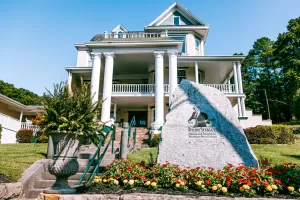
The Ralph Stanley Museum in Clintwood.
Pick up a headset at the front desk to listen to stories and songs throughout the museum. The major instruments used in mountain music are on display — mandolins, banjos, guitars, and fiddles. The museum tells how this music originated in primitive churches and later merged into country and even pop genres.
COAL HERITAGE ZONE
Along with music, coal mining was, and still is, embedded in southwest Virginia. For an understanding of coal mining, visit the Pocahontas Exhibition Mine, a National Historic Landmark in the town of Pocahontas. Go underground into a real mine and learn things not taught in history class. This includes stories of how immigrants were lured to work in the mines when they arrived at Ellis Island by promises of a job and a house — every immigrant’s dream. However, working in the coal mines was hard, dangerous work. Owners paid miners less than a dollar a ton for the coal brought out of the mine. If a rock accidentally got into the carload, the miner wasn’t paid. The prep work was unpaid, so miners brought their young sons to do this work.
When a fire erupted in the Pocahontas Consolidated Coal Company Mine on March 13, 1884, 114 miners died, including children. The rescue parties couldn’t get the miners out and the owners flooded the mine. A nearby cemetery contains the bodies of those miners. One rule the owners had was that if a miner was killed, his wife had one week to marry another miner, or they would give her train fare to leave.
Our guide, Michele, was wonderful and told the miners’ story well. If you have a choice, ask for her as your guide. The mine is open daily from mid-May through the end of October.
The Coal Heritage Museum, next to the mine in the original powerhouse, has exhibits explaining the coal history of this area, recognized as Virginia’s Official Coal Heritage Zone.
OFF-ROAD ADVENTURES
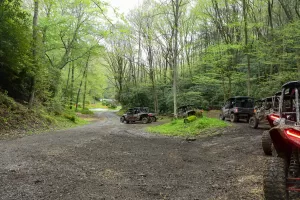
The Spearhead Trails Original Pocahontas trail section attracts ATV riders.
All-terrain vehicle riding is popular in this area. Trailhead ATV Resort, off the Spearhead Trails Original Pocahontas trail section, is a good place to rent or ride an ATV. They also have RV sites with full hookups. The trail between the resort and the mine is beautiful but challenging. It’s part of over 600 miles of the mountainous off-road Spearhead Trail System.
Southern Gap Outdoor Adventure in Grundy, at the trailhead of the Spearhead Trails Coal Canyon section, also offers ATVing. If you don’t have your own ATV, they can arrange a rental. Bluegrass musicians often can be found playing in the visitor center, which also contains interesting wildlife displays and an observation deck. This facility has a campground with 19 full-hookup pull-through RV sites.
SIPS AND SOUNDS
For some adult fun, there are several wineries, breweries, and distilleries in the Heart of Appalachia. Axe Handle Distilling in Pennington Gap, Virginia, holds bluegrass picking sessions on Fridays from spring to fall. Anyone can bring an instrument and join in. They also host events featuring local musicians. The distillery’s name comes from the original family business, building Appalachian-style log homes all over the country. Big Cedar Creek Distillers and Vincent’s Vineyard in Lebanon combine to provide either cocktails or wine.
All this, plus amazing small-town main streets with shops, art galleries, murals, and restaurants, makes the Heart of Appalachia the perfect place for your RV vacation.
FURTHER INFO
Heart Of Appalachia Tourism Authority
3028 Fourth Ave.
St. Paul, VA 24283
heartofappalachia.com
(276) 762-0011
Breaks Interstate Park
627 Commission Circle
Breaks, VA 24607
breakspark.com
(276) 865-4413, ext. 3201 or 3202
Natural Tunnel State Park
1420 Natural Tunnel Parkway
Duffield, VA 24244
dcr.virginia.gov/state-parks/natural-tunnel
(276) 940-2674
Carter Family Memorial Music Center
3449 A.P. Carter Highway
Hiltons, VA 24258
carterfamilyfold.org
(276) 594-0676
Ralph Stanley Museum And Traditional Mountain Music Center
249 Main St.
Clintwood, VA 24228
ralphstanleymuseum.com
(276) 926-8550
Pocahontas Exhibition Mine
215 Shop Hollow Road
Pocahontas, VA 24635
facebook.com/exhibition
mineofpocahontas
(276) 945-9522
Trailhead ATV Resort
465 Miners Park Lane
Bluefield, VA 25605
trailheadatvresort.com
(276) 945-3089
Southern Gap Outdoor Adventure
1124 Chipping Sparrow Road
Grundy, VA 24614
sgadventures.com
(276) 244-1111