

These devices record your travels and allow you to revisit them later, but they also can be helpful in the event of an accident or other traffic situation.
By Mark Quasius, F333630
September/October 2024
Have you ever been driving down the road and wished you had a picture or video of something you saw? It may have been wildlife crossing the road or some scenery you wanted to capture. Or perhaps you witnessed a traffic incident or were involved in an accident it would have been helpful to chronicle. For any of these scenarios, installing a dash camera can be beneficial.
Dash cams have come a long way since they were first introduced. Early versions with fuzzy video recordings and short memories have been replaced by high-tech cameras offering up to 4K HD video resolution, audio, and a plethora of features. On top of that, many of today’s cameras are affordable.
If you’re concerned about being the victim of an accident, a dash cam may be a good investment. Recorded video footage can document the events that led to you becoming involved in the incident and could be invaluable to the police or your insurance company when it comes to proving who was at fault. Dash cams first became popular in Russia, where insurance fraud is a major problem, but their use has extended to the United States. This may be especially applicable to anyone driving a nice, expensive-looking motorhome that appears to be a lucrative target for a scammer looking to collect on an insurance claim. Dash cams allow you to record the actions of other drivers to prove what they did to harm you or your vehicle.
But dash cams have other uses as well. They continually record as you drive, and the resulting video is saved to a removable memory chip. This chip can be taken out of the dash cam and transferred to a personal computer so that the video footage can be viewed or saved there. This lets you relive a certain portion of your day’s drive. I particularly found that feature enjoyable when we drove the Million Dollar Highway from Durango to Ouray, Colorado, as well as other scenic roads.
DASH CAM FEATURES
Dash cams differ from regular video cameras, such as GoPro action cameras. The latter require a bit of manual operation and will stop recording when the memory card is full. Dash cams are more automated and turn on when power is applied, such as from a 12-volt-DC receptacle activated by the ignition, and generally go off when power is no longer available. The dash cam also will overwrite the oldest recorded video with the most recent footage, ensuring that you never run out of memory and that you continue to have a record of recent events. If desired, you can either remove the memory card for safekeeping or mark footage as “saved” to avoid overwriting it.
Most dash cams have built-in G-sensors, also known as accelerometers. They detect sudden changes in speed or direction and automatically save recent footage to prevent it from inadvertently being overwritten. Most also can retrieve still images that can then be emailed to an insurance adjuster.
Dash cams typically are capable of recording in multiple modes, which can be selected in the camera’s setup menu. If you want simple standard-definition video, you can opt for that mode and record many hours of video without having to overwrite. High-resolution settings — even up to 4K Ultra HD — are available if you want to record some high-definition footage of your drive. Note that recording at higher resolutions requires more megabytes of storage space, resulting in previously recorded footage being overwritten much sooner. Dash cams sometimes come with a small 2GB micro-SD memory card. By purchasing larger-capacity memory cards, you can extend that time considerably.
Most dash cams also feature the ability to record audio from the interior of the vehicle. However, recording audio does require additional memory space, so your memory card will fill up faster.
Another popular feature in many dash cams is a GPS link. It will display the GPS coordinates on the recorded footage as well as a date and time stamp. This is useful in documenting exactly where and when the footage was taken. Some models have both front and rear cameras, and some use Wi-Fi to allow you to view and download dash cam video to a cellphone.
CHOOSING A DASH CAM
Plenty of options are available in the dash cam marketplace. In addition to popular name brands such as Garmin, Rear View Safety, and Rexing, there are a ton of cameras available from offshore manufacturers that are very affordable and have surprisingly good reviews. A typical search via Amazon or other vendors will bring up enough brands and models to give anyone a wide selection.
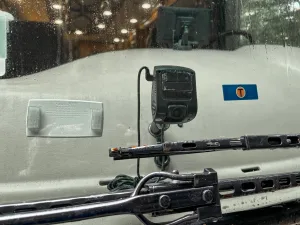
The author’s camera, as viewed from outside, is mounted low on the coach windshield.
There are several features to consider when purchasing a dash cam. Some cameras incorporate a 2.3-inch LED screen on the back. Obviously, this isn’t something you’ll want to monitor when driving, and if the unit is mounted up high in the windshield, the screen may be distracting, especially when traveling at night. In my case, the unit is mounted down low on the windshield where I can’t really see the screen, so it’s not an issue. On some models, the screen can be turned off when the camera is in use. I find that the rear screen is handy when mounting the camera, as it allows you to aim it for the best view.
My personal camera does have audio capability, but I choose not to use it. For one, the recording takes up valuable space on the memory card, reducing the amount of video that can be captured before overwriting previous footage. Also, do I really need to capture all the oohs and aahs of some fantastic scenery, or the screaming that might occur during an accident? Probably not.
In addition to offering the option to stamp the footage with date, time, and GPS coordinates, most dash cams record your current speed and direction of travel. The speed feature might even be useful if you receive a speeding ticket or red-light ticket in error via an automatic traffic camera, as it could serve as good evidence in court.
Cameras that have incident detection likely have sensitivity levels that can be adjusted by the user. In the event of a collision or even hard braking, depending on the adjustment level, the device will automatically save the last few minutes of recorded video and prevent it from being overwritten.
The most important element of a dash cam tends to be the field of view. A camera with a 170-degree field of vision will ensure that you capture adequate coverage of the front corners of a Class A motorhome in the event of an accident. If you have a narrower angle of view, you’ll lose that coverage as well as the up-front view of the nose of the coach. A narrow view reaches farther out, but you don’t need or want that, and it’s preferable to concentrate on what’s right in front of you.
My Rexing V1 dash cam has a 170-degree field of view, as many models do, and I find it perfect for up-close sights as well as what’s coming in the distance. I’ve recorded some nice travel videos of scenic roads I’ve driven on, plus videos that show all the buildings when driving through small towns. It’s also a 1080p camera. It’s available in a 4K model, but because of the higher resolution, that seriously reduces the amount of footage that can be stored on the memory card. Fortunately, most 4K cameras can be set to record at lower resolutions if more storage space is desired.
INSTALLATION CONSIDERATIONS
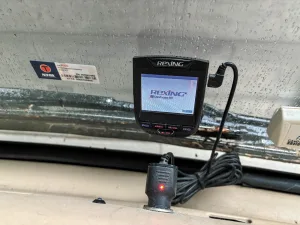
The author’s dash cam plugs into a 12-volt receptacle inside on the dash.
Dash cams typically come with a suction cup mount that attaches to the windshield. That’s okay if you plan on moving it from one vehicle to another, but eventually suction cups just don’t want to stick any more. Most cameras also will come with a permanent mount or one will be offered as an option. These can be attached to the windshield using a good adhesive or mounted on the dash itself. The permanent mount usually incorporates a plate that secures the camera yet enables it to be removed easily when desired. Also, the purchase of a second mounting plate will allow easy transfer to another vehicle.
Note that it is illegal in some states to attach things to the windshield. Some states allow a dash cam to be installed in certain spots on the windshield but may restrict the size of the device.
A dash cam also needs power, generally from an adapter that plugs into a 12-volt power receptacle or via a cable from a USB port. This can lead to a messy power cable dangling over your dash. I solved that problem by adding a 12-volt power socket up by the defroster ducts in our Entegra Coach motorhome and connecting it to an ignition-hot power source. This resulted in a clean installation that is hands-free and automatic in operation.
FINAL THOUGHTS
Dash cams can be a big help if you ever need to document something, but they also serve as a source of entertainment by capturing your travels and allowing you to revisit them. You can purchase a 4K model with all the bells and whistles or settle for a less-expensive model that is more than capable. This technology tends to be affordable, and you can choose from a huge selection of brands and models.
RESOURCES
Garmin
(800) 800-1020
garmin.com
Rear View Safety
(800) 764-1028
rearviewsafety.com
Rexing USA
(877) 740-8004
rexingusa.com