
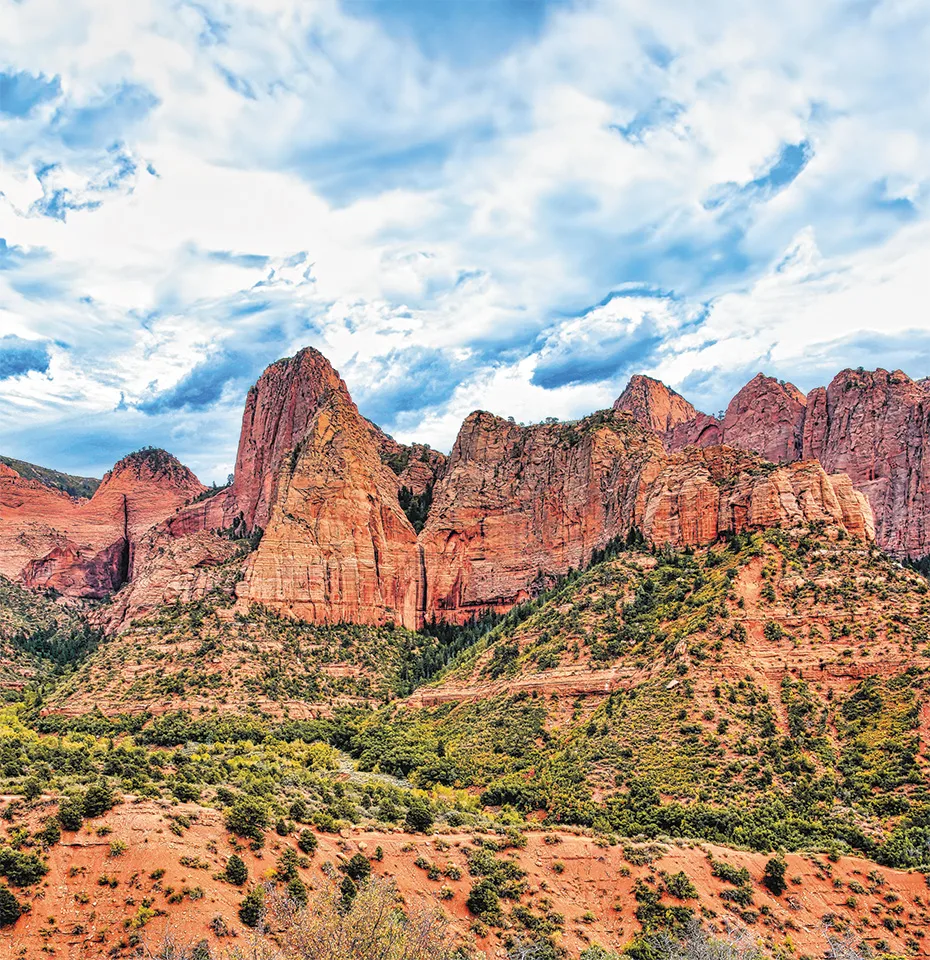
Fall is a special season to explore the Beehive State’s natural wonders, from the most popular sites to its smaller, less-visited treasures.
By George Moore, A460576
September/October 2024
A few years ago, my wife, Sherrian, and I met up with some friends at an RV park located on U.S. Highway 89 in Utah between Bryce Canyon and Zion national parks. This was the starting point for our extended trip through the state. In addition to the major parks and tourist attractions, we had a list of nine smaller “off the beaten path” parks we wanted to visit. Several campground choices are available in each of the areas where we established camp.
Our trip took place during September, which resulted in greatly reduced crowds at the major parks and no crowds at the smaller parks. Further enhancing our trip was the beautiful chamber of commerce fall weather. For the most part, we enjoyed clear skies and mild temperatures. Because it was after the summer tourist season, making reservations generally wasn’t a challenge. The exception was in Moab, which is a popular 4×4 destination.
Starting our trip in southern Utah made it convenient to visit four of the smaller destinations on our list. Our first “small park” visit was to the Kolob Canyons section of Zion National Park. Kolob Canyons boasts the park’s highest peak, 8,726-foot Horse Ranch Mountain, as well as Kolob Arch, once considered the world’s longest free-standing natural span (many experts now rank it second). The arch can be reached by a strenuous eight-hour round-trip wilderness hike. Kolob Canyons also has a visitor center and a scenic paved auto route with numbered stops. In addition, an easy scenic trail provides visitors with beautiful views of the canyon. (nps.gov/zion; 435-772-3256)
South of Mt. Carmel Junction lies 3,730-acre Coral Pink Sand Dunes State Park. In addition to a large portion of the park that’s open to off-highway vehicles such as dirt bikes and dune buggies, the park includes a 265-acre conservation area. This is the only location in the world that is home to the coral pink tiger beetle. Easy marked trails and signs provide information about the dunes, flora, and fauna. The coral pink dunes, with their very fine sand, are best photographed shortly before sundown, when the colors stand out. (stateparks.utah.gov/parks/coral-pink; 435-648-2800)
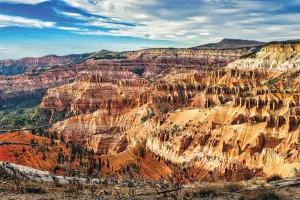
Cedar Breaks National Monument affords views of a half-mile-deep natural amphitheater.
Not far from Coral Pink Sand Dunes is Pipe Spring National Monument in Kaibab, Arizona. Here, you can explore the history and traditions of the Kaibab Paiute tribe and the Mormon settlers. Visitors can check out a museum, a historic fort, cabins, a garden, and hiking trails. Guided tours are provided in the fort, known as Winsor Castle. (nps.gov/pisp; 928-643-7105)
Our last “off the beaten path” visit in southern Utah was to Cedar Breaks National Monument in the Dixie National Forest. Cedar Breaks was established as a national monument by President Franklin D. Roosevelt in 1933 to preserve the “multicolored geologic spectacle of the amphitheater” and scenic overlook. The amphitheater is over 2,000 feet deep and stretches across three miles. With its multicolored spires and columns, Cedar Breaks resembles a miniature Bryce Canyon. Native Americans referred to it as the “circle of painted cliffs.” The monument is located approximately 23 miles east of Cedar City. At an elevation of 10,350 feet, expect cooler temperatures when visiting the monument. An added blessing to our September trip were the patches of gold as the aspen trees in Dixie National Forest displayed their fall colors. (nps.gov/cedarbreaks; 435-986-7120)
The next leg of our trip took us to Salt Lake City. In addition to sightseeing in the city itself, we explored a couple out-of-town sites. As an amateur wildlife photographer, I wanted to visit the Bear River Migratory Bird Refuge, at exit 363 off Interstate 15. The 74,000-acre refuge lies at the northeast arm of the Great Salt Lake, where the Bear River enters the lake. The refuge protects the marshes found at the mouth of the river. These marshes form the largest freshwater component of the Great Salt Lake ecosystem.
Located along the eastern edge of the Pacific Flyway and the western edge of the Central Flyway, the refuge is an oasis for migrating waterfowl and other birds. More than 250 bird species have been identified at the refuge, including 67 nesting species. Among nesting birds are the white-faced ibis, American avocet, and black-necked stilt. Migrating tundra swans can number in the tens of thousands.
The refuge can be accessed by car on 12 miles of well-maintained roads that provide easy viewing of marshes and wildlife. It has been designated a Western Hemisphere Shoreline Reserve Network Site and a National Audubon Society Important Bird Area. (fws.gov/bearriver; 435-723-5887)
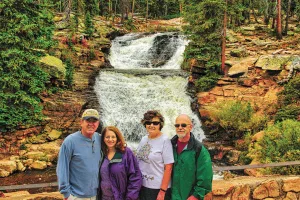
George and Sherrian Moore, right, and friends at Provo River Falls, a popular stop along Mirror Lake Scenic Byway.
The following day we packed a picnic lunch and enjoyed a drive along Mirror Lake Scenic Byway. Starting at Evanston, Wyoming, Route 150 winds through the Uinta-Wasatch-Cache National Forest and the Uinta Mountain Range for 78 miles to Kamas, Utah. The scenic drive provides beautiful mountain views, reaching an elevation of 10,682 feet at Bald Mountain Pass. The byway provides photo ops of mountains, alpine meadows, waterfalls, and tranquil Mirror Lake. This is a seasonal route, so check ahead of time to see whether it will be open when you plan to visit. (utah.com/things-to-do/scenic-drives/mirror-lake-highway)
From Salt Lake City, we headed southeast to Moab, Utah, and nearby Dead Horse Point State Park, not far from Canyonlands National Park. This scenic state park is situated 2,000 feet above a horseshoe bend of the Colorado River. In the late 1800s, packs of wild mustangs roamed the mesa here. According to legend, cowboys fenced the narrow neck of land leading to the promontory overlooking the river, making a natural corral in which to herd the mustangs. This is just one of the many breathtaking overlooks in the 5,200-acre state park that are easily accessible by trail. (stateparks.utah.gov/parks/dead-horse; 435-259-2614)
Our last base camp was a short drive south of Moab in Blanding, Utah. This provided a convenient location from which to visit Natural Bridges National Monument. Natural Bridges lies approximately 30 miles west of Blanding on State Route 275. Here, you will find three large sandstone bridges formed by erosion from the streams that flowed through the switchback bends of a canyon. A well-maintained, nine-mile road leads to easy trail access to the bridges. More adventurous visitors can try a hike, such as the six miles of trails on the canyon floor connecting the bridges (watch out for flash floods). The monument is also a designated International Dark Sky Park. (nps.gov/nabr; 435-692-1234, ext. 616)
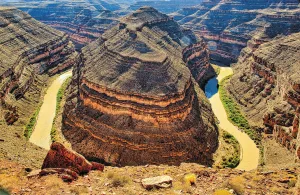
Goosenecks State Park encompasses the meandering San Juan River and the canyons it created.
After leaving Natural Bridges, we drove south on State Route 261 on our way to Goosenecks State Park. This is a well-maintained paved road that has a section of extremely tight switchbacks as it winds down off the mesa. Even though the Utah Department of Transportation doesn’t have any RV restrictions on this road, and a trucker’s atlas shows it is suitable for trucks, the San Juan County sheriff strongly advises not driving this section of State Route 261 with anything larger than a standard passenger vehicle or pickup. In his words, “It is a driving test that everybody fails.” I concur. A scenic overlook is situated just before the descent.
Just north of Mexican Hat, turn off State Route 261 onto State Route 316 to arrive at Goosenecks State Park. This 10-acre park provides dramatic views of the beautiful, rugged landscape. From the park’s mesa, you can see four “gooseneck” bends of the San Juan River 1,000 feet below. Erosion from the meandering river has cut deep into the valley floor, exposing layers of sandstone, shale, and limestone dating back more than 300 million years. (stateparks.utah.gov/parks/goosenecks; 435-678-2238)
If you are planning your first trip to Utah, definitely consider visiting major attractions such as Bryce Canyon, Zion, and Arches national parks, plus the sights in Salt Lake City. But whether this is your first or 21st trip, include some of the smaller and much less crowded off-the-beaten-path sights as well. If your schedule permits, make the trip in September when the crowds are smaller and the temperatures are milder. Regardless of when you go, have a safe and blessed trip in wild and beautiful Utah.
MORE INFO
Visit Utah
visitutah.com
(801) 538-1900