
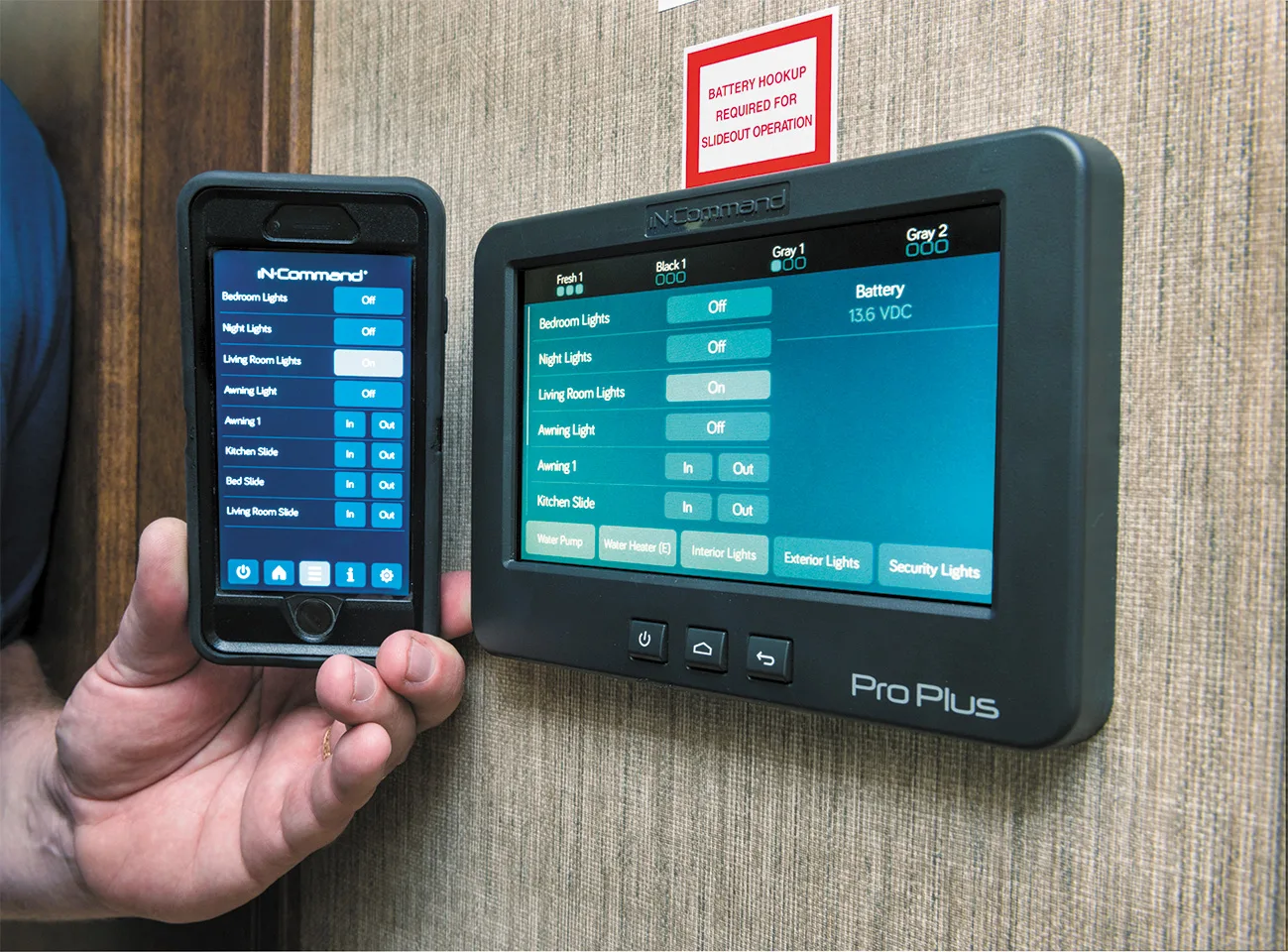
CAN bus, multiplexing, RV-C: How modern technology is being used to control RV systems and what it means for owners.
By Chris Dougherty, F263059
September/October 2024
Many RVs and other vehicles today incorporate a computerized communication network called a “CAN bus,” which adds convenience and also may reduce the number of wiring components and cables required in a build, thereby offsetting cost and weight. But exactly what is “CAN bus” and the related term “multiplexing,” and how do they work?
CAN stands for “controller area network” — a dedicated set of conductors that carry digital or voltage signals to various components tied in parallel along the “bus” — the physical cables used. Multiplexing is the process of sending multiple signals along a single communication channel.
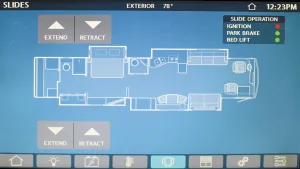
The Spyder Controls system, shown here in a 2019 Tiffin Allegro Bus, is custom designed for each floor plan.
CAN bus technology is used in many industries, and several different protocols exist. At the beginning of the century, CAN bus was being developed and deployed in various places in our lives. We started to see home automation systems and vehicles integrating multiple modules and sensors that could communicate with a central computer.
From an automotive standpoint, CAN bus has progressed dramatically. Now, automotive diagnostics almost always require a computer. Practically all vehicle systems and controls, including steering and acceleration, are electronic in new vehicles. All these system modules communicate via a CAN bus.
When the RV industry started considering CAN bus in the early 2000s, several concerns were raised about possible roadblocks to RV automation. RVs weren’t houses, cars, or computers. All the factors of RV equipment and construction were considered, which led to the creation of the RV-C standard.
The idea was to have a standard to communicate between appliances, sensors (tanks, etc.), lighting, generators, inverters, and chassis through one system. The system had to communicate along a much larger bus (some RVs are 45 feet long), and the components had to work and fit in an RV environment. There is no central computer/router/hub requirement with CAN bus, so the failure of a single component (aside from the bus itself) won’t cause the entire system to go down. Individual modules will continue to communicate with each other. A UI, or user interface module — usually a tablet computer — translates the data for a user to read.
This early integration of advanced technology also came with a high price tag, leading RV manufacturers and vendors to delay the standard implementation. It took 15 years or so for the cost of the technology to drop enough for the price-conscious industry to begin adapting it. This implementation was partly forced by new generations of iPhone and Android users entering the lifestyle with expectations of integrating their favorite smart devices with RVs.
BENEFITS OF MULTIPLEXING
So why would you want an RV with a multiplexing system?
Most users see convenience as a significant benefit. In many installations, a smart device app allows complete control and monitoring of the RV, including lighting, heating and air conditioning, tank monitors, power systems, slideouts, awnings, and more.
A multiplexing system eliminates most mechanical switches. Instead, lighting is controlled through the multiplex, and depending on the system, the lighting can even be dimmed. Eliminating that much copper wire can result in weight and cost savings.
More and more appliances and equipment are including RV-C communications protocols in their circuitry. As this progresses, it is easy to see how these devices could notify the owner of malfunctions and even be connected to a service team for remote diagnostics. OBD2 connectors in cars and trucks are available for diagnostic connections, so computers and smart devices can diagnose problems and make computer changes on the fly. RV multiplexing systems hold the same promise.
Global connectivity allows RV owners to check in and control their RV from basically anywhere with an internet connection. This can be useful for weekenders who store their RV away from home and for full-timers when they are away from the vehicle.
Further, the continued development of the Matter interconnectivity standard, designed to increase compatibility, will bring together a world of smart devices already working their way into the RV world. For instance, if an RV multiplex system were to have a Matter-compatible hub, then software and apps such as Apple HomeKit, Z-Wave, Google Assistant, Amazon Alexa, and Samsung SmartThings modules would all be able to communicate. RVers have been installing Ring alarms and camera systems in their vehicles for some time, which allows some interoperability. In sticks-and-bricks homes, the system can control a Nest thermostat, which, on its own, can be aware of local weather details and more. In RV land, the MicroAir EasyTouch RV thermostat has many of the equivalent features, and RV multiplex systems may integrate some of the same in their interface.
MULTIPLEX SYSTEMS
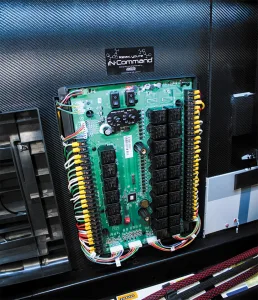
The iN-Command Pro Plus control board contains most of the operational modules in the central unit.
Several multiplex systems are available in the RV space. The features vary depending on the manufacturer and cost. Some systems are RV brand specific, and the touch-screen software is almost always model and floor plan specific, especially for those with a graphical interface. Common multiplex systems include the ASA Electronics iN-Command, BMPRO, Dometic Interact Solution, Firefly Vegatouch, Intellitec, Lippert OneControl, Precision Circuits P-Plex, SilverLeaf Electronics, and Spyder Controls.
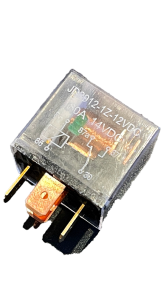
The iN-Command system uses automotive relays to serve as switches.
ASA Electronics’ popular iN-Command offers a different take on RV multiplexing; instead of individual control modules connected by an RV-C bus, all the RV circuits are run back to the main iN-Command unit. With iN-Command, all the powered circuits operate via automotive relays on the main board. The system still has a main LED touch panel and a smart-device app, which can be connected to the internet for “global” access. The iN-Command unit uses off-the-shelf plug-in relays, which reduces cost and may simplify field service if a relay fails, compared to an integrated relay on a circuit board. However, an RV-C bus is also used to connect RV air conditioner gateways and the touch panel to the main unit. Also, unlike other systems, iN-Command doesn’t have touch-pad-style switches mounted throughout the RV. Control of individual lights, awnings, slideouts, etc., can be done only through one of the interfaces or the main board’s manual controls. If you have iN-Command, be sure to become familiar with the main control board’s manual controls and have an extra relay or two in your RV tool kit, just in case. Relays are available at any auto parts store or online.
TROUBLESHOOTING
If your system is having a hiccup, the best first step is to shut down the RV entirely and reboot the system. This means unplugging the shore power and turning off 12-volt-DC inputs (batteries and solar) to make sure there is no power, AC or DC, in the RV. Wait a minute, reconnect the batteries (and solar eventually), and allow the system to boot up. Note that the system may not function properly with low DC voltage. If this happens, you must charge the batteries by plugging into shore power, operating a generator, etc.
Each manufacturer of multiplex systems has its own troubleshooting steps, which owners should have access to. In many cases, their troubleshooting engineers are available via phone or chat to assist with a malfunction.
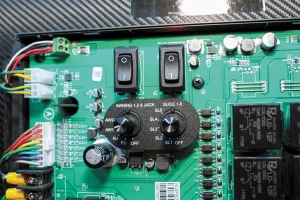
If a logic failure occurs on its central tablet, the iN-Command system can be controlled from the main board by selecting the circuit and operating the switches.
An RV-C bus installation has to be precise. It must be made with the right size and type of twisted-pair cable and have a terminator/resistor at each end of the bus. Often, these terminators become dislodged or are tampered with, causing a loss of communication. In rare cases, the wiring gets damaged somewhere in the RV, which can be more of a challenge to find. A failure of any one module or component on the system should result in a specific error code, which can then be traced to the offending system.
A multimeter and the system’s service manual are the best tools for troubleshooting a multiplex system. Every RV owner should carry a multimeter, and every tech should have a good-quality one in their toolbox. With CAN bus, you primarily test voltage, continuity, and resistance.
As with all systems, the work can’t be done if the “fuel” supplying the “worker” is insufficient. So, often the first thing to do in the case of a recurring issue is to verify the condition of the 12-volt-DC power system. A fully charged battery bank should read 12.6 to 12.8 volts at rest. The charging system, when active, should show 13.2 volts DC or higher depending on the charging mode.
The only way to test the battery bank is to remove all charging sources and test when fully charged, both at rest and under a load. A common occurrence is having your multimeter show 13.6 volts DC on the system, which drops or disappears when a load is turned on. The reason could be the solar system. The batteries can be turned off or disconnected, but it can be confusing if the solar controller is still energized.
UPDATING OR MODIFYING THE SYSTEM
Updates are vital to any computer system, and your multiplex system is no exception. A firmware update may be required if your system is experiencing logic issues. It is rare that an addition would be made to the system’s functionality as initially designed. Once the floor plan is set in the system and tested, it should be good. However, the update process will help to keep this and any coding and internet security issues at bay. If you want to know whether updates are or will be available for your multiplex system, contact the RV manufacturer or the maker of the system.
Sometimes, owners add or change components in an RV that can be incorporated into the multiplex. In this case, the system manufacturer can assist the owner with an appropriate update file delivered electronically or via a USB drive. If, for instance, the central LED touch-screen on an iN-Command fails and has to be replaced, the replacement is programmed at the factory before it is sent out.
While it may be possible to add modules to the RV-C multiplex system (window shades, for example), access to the bus is required and that may be challenging.
AFTERMARKET MULTIPLEX INSTALLATION
I have often been asked this question: Can a multiplex system be installed in the aftermarket? While the answer is yes, at least in theory, it comes down to cost versus benefit. It is certainly doable if you are gutting an RV and redesigning it. But without rewiring the unit, there’s not much that can be done.
Some RV industry vendors offer wireless apps and internet connectivity system by system. For instance, the BMPro ProSmart system adds tire pressure monitoring, propane,
and temperature sensors to a web-connected module. Even if your RV doesn’t have an actual multiplex system, you can still get some of the app benefits. The sensors utilize Bluetooth and Wi-Fi for communication instead of a bus.
In addition, the companies that make these systems must design the matrix with the floor plan in mind, and they may not be willing to do a one-off. So, while making your RV a technological wonder is tempting, it would likely be prohibitively expensive.
WHAT IS GLOBAL OR ANYWHERE CONNECTIVITY?
Most multiplex systems currently in use have built-in internet connectivity, or the internet is available via an added module. The benefit is that some of your RV’s functions will be available to your smart device anywhere you have an internet connection. For example, if you are on a Caribbean cruise with internet access, you can check your tanks and control the HVAC in your RV parked in California. The only things you can’t usually control are motorized modules such as awnings, slideouts, and jacks. Most everything else is possible.
Of course, the RV must have active internet access to connect the multiplex system. That is a whole other article, but, generally, a local area network must be established in the RV, such as a Winegard Air 360+ 5G with a Winegard Gateway 5G.
WHAT OTHER FEATURES CAN BE IN THE SYSTEM?
Some of the systems are complex. For instance, the SilverLeaf RV-C system in Newmar motorhomes integrates complete electrical load monitoring, automatic generator start, and Magnum inverters. Cummins Onan gensets can be operated, and error codes can be reported through the systems. Victron inverter systems are RV-C compatible. When paired with GMC trucks, Keystone RVs with iN-Command can have a control interface for the RV to appear on the radio head in the truck. So, if owners want to check tanks and start the genset and A/C before arriving at the campsite, they can do that. The list goes on . . .
If a vendor wants to design that kind of interoperability into their products, the sky is the limit as to what can be connected.
While this level of technological connectivity is geekily alluring and undoubtedly convenient, RV controls usually are no more than 35 feet away when you’re camping. Further, every electronic device, including the RV-C control modules, consumes amps when active. While most RVers prefer campsites with hookups, those who like to boondock for more prolonged periods should consider the multiplex system’s power usage. Some modules use more than others and consume power even when the loads are off.
RV multiplexing systems are here to stay, and as technology continues to advance, we can expect these systems to become even better, to integrate more with other technologies, and to help more RVers enjoy their travels.
RESOURCES
ASA Electronics iN-Command
in-command.net
BMPRO
teambmpro.com
Dometic Interact
dometic.com/en-us/outdoor/mobile-power/system-controls
Firefly Vegatouch
fireflyint.com
Intellitec
intellitec.com
Lippert OneControl
lippert.com/brands/onecontrol/rv
Precision Circuits P-Plex
precisioncircuitsinc.com/multiplex-system/
SilverLeaf Electronics
silverleafelectronics.com
Spyder Controls
spydercontrols.com