
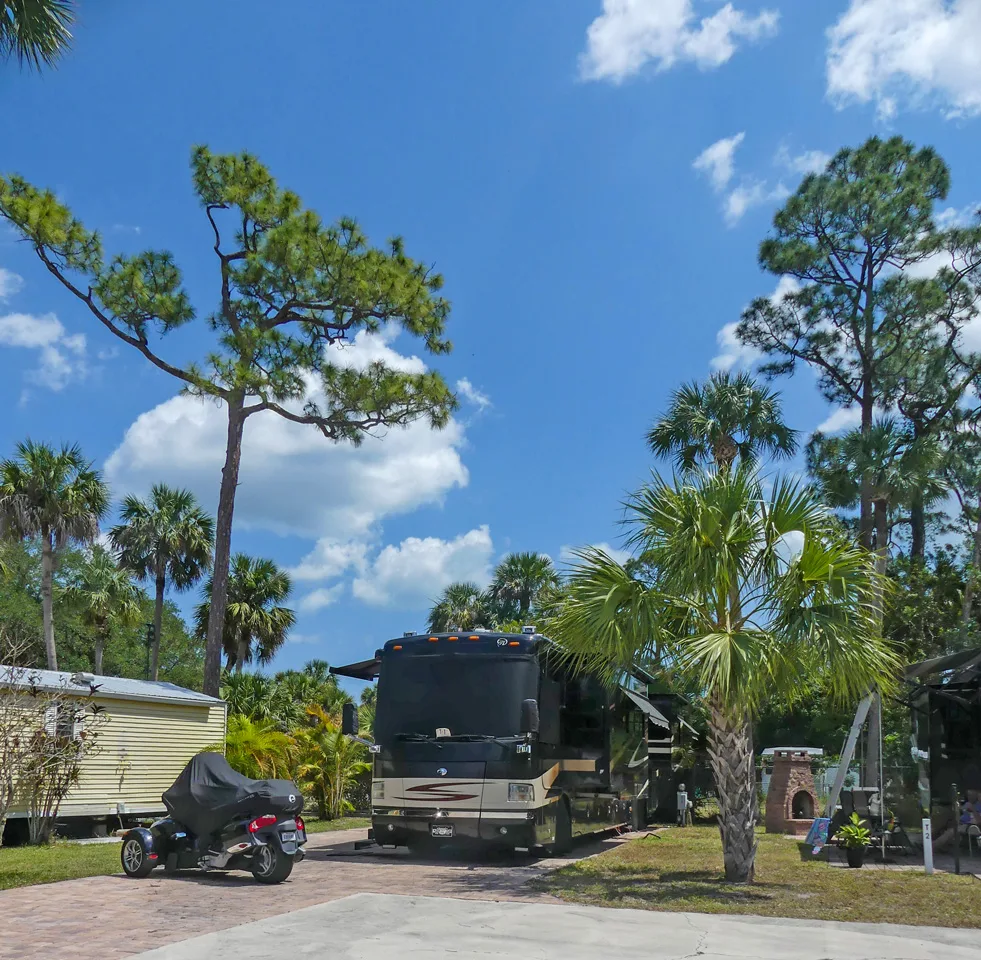
Southeastern Florida flaunts beautiful weather and attractions galore, including this oasis for nature lovers along the Atlantic Coast.
By Kathleen Walls
November/December 2024
T he “Treasure Coast” has been referred to as one of Florida’s best-kept secrets. Three counties make up this mecca of uncrowded destinations 120 miles south of Orlando. Among them, St. Lucie County shines with its outstanding natural attractions.
St. Lucie County boasts a watery location near the Atlantic Ocean, St. Lucie River, Indian River, Indian River Lagoon, and numerous lakes. The Indian River Lagoon is one of the most diverse estuarine environments in North America, providing a home to more than 4,000 plant and animal species. You can enjoy the county’s 21 miles of beaches for swimming, fishing, or paddling. All are free except for those in the state parks. All create a wonderful place for nature lovers.
RVers have many choices of places to stay while they explore this natural wonderland. Here are several suggestions.
One low-cost spot to use as a hub is the U.S. Army Corps of Engineers, Jacksonville District, St. Lucie South Campground (recreation.gov). This small facility is adjacent to the St. Lucie Canal portion of the Okeechobee Waterway, a perfect escape spot for boaters.
Another choice is Road Runner Travel Resort (roadrunnertravelresort.com), minutes away from Hutchinson Island Beach, Indian River, and the historic downtown section of Fort Pierce. It’s an award-winning 38-acre RV resort with 452 full-hookup sites, including some pull-throughs. It costs a bit more than some other options but has lots of amenities, including a heated outdoor pool, a clubhouse, laundry facilities, a store, lakeside fishing, a golf course, and a fantastic restaurant.
Charlene’s Coyote Grille at Roadrunner Resort is popular even for folks not staying at the resort. The owner, Charlene James, makes sure everything is fresh and, if possible, local. Indoor and outdoor dining is available; outside, guests sit on a large, covered porch with a lake view.
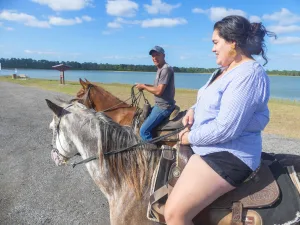
Horseback riding is an excellent way to explore the Florida pinelands at McCarty Ranch Preserve.
If you’re up for primitive camping on a waterfront with ample privacy, consider McCarty Ranch Preserve. Even if you’re not camping there, you can go horseback riding at McCarty Ranch around three lakes set on 3,100 acres of Florida pinelands. We rode around Lake John, but there are several riding trails as well. Alligators, snakes, panthers, bobcats, feral hogs, and other wildlife make the preserve their home, along with egrets and other bird species.
Once you settle in at your chosen base, start exploring the area’s natural attractions. They include a couple of not-to-miss botanical gardens.
Heathcote Botanical Gardens (heathcotebotanicalgardens.org) boasts a collection of specialty gardens: Japanese Garden, Reflection Garden, Herb Garden, Rainforest Display, Pioneer Field featuring native plants, Children’s Garden, Community Garden, Palm and Cycad Walk, and several more. It’s also home to the largest tropical bonsai garden in the United States. At the Butterfly Garden, look closely for the tiny black, blue, and red Atala butterfly, once thought to be extinct. The Children’s Garden features a small playhouse and a replica of a Seminole chickee hut, built with open sides and a thatched roof. For tree huggers, there is a labeled Hugging Tree.
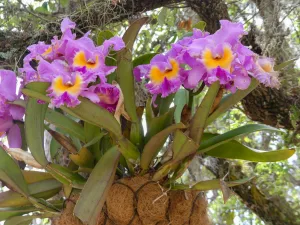
Orchids are among the featured blooms at the Port St. Lucie Botanical Gardens.
Besides its many species of plants, some of them rare, Heathcote’s gardens feature some one-of-a-kind art as well. During my visit I viewed “Mosaic Gorilla,” created by local artist Anita Prentice, and “Potman,” made entirely of red terra cotta pots with a bandana, hat, and gloves. There was also a set of colorful butterfly wings — a great backdrop for taking a selfie.
Port St. Lucie Botanical Gardens (pslbg.org) offers 18 or so sections filled with unique flowers and plants. It’s completely run by volunteers.
The Butterfly Garden is a great place to view butterflies up close and learn about their life cycle. Giant milkweed plants host beautiful monarchs. The Orchid Room is home to about 100 beautiful, fragrant flowering plants from around the world and is maintained by the Port St. Lucie Orchid Society.
St. Lucie County’s wildlife and ecosystems can be explored in-depth at two fantastic hiking areas. One is the Oxbow Eco-Center (stlucieco.gov), part of a 225-acre preserve along the North Fork of the St. Lucie River. Take a guided hike along 3½ miles of trails and see pine flatwoods, hydric hammocks, and depression marshes. There is a good chance of spotting wildlife as you walk to the river; interpretive signs along the trails provide information about what you may see.
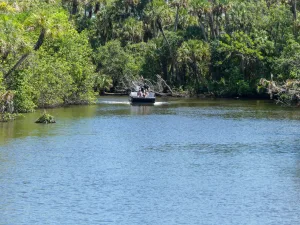
The St. Lucie River is visible when hiking nature trails at the Oxbow Eco-Center.
Another hiking spot is at the county-run D.J. Wilcox Nature Preserve (stlucieco.gov), which borders the Indian River Lagoon. A 1-mile self-guided trail passes through pine flatwoods, a mangrove swamp, a hammock, and an evergreen-forested wetland known as a baygall. Two observation shelters provide views of Alligator Lake and are easily accessible from a wooden boardwalk. During our walk, we saw several wild birds, including a little green heron and a beautiful white ibis.
Many other places offer insight into St. Lucie’s water life. They include the St. Lucie County Aquarium (stlucieco.gov), featuring the Marine Ecosystems Exhibit from the Smithsonian Institution’s National Museum of Natural History in Washington, D.C. The aquarium displays living modelsof six different Florida marine and estuarine ecosystems and interprets the habitats in the Indian River Lagoon. In addition, the largest display is a 3,000-gallon exhibit of a Caribbean coral reef ecosystem. At the touch tank, you can handle hermit crabs, horseshoe crabs, and other small sea life.
The Manatee Observation and Education Center introduces visitors to Florida’s favorite water mammal (manateecenter.com). A manatee skeleton hangs above the entryway between two exhibit rooms. In one room, an 800-gallon saltwater tank is filled with native and non-native species. The other room contains a tide pool touch tank. It’s also the home of Diego, a red rat snake that makes her home at the center. Often a volunteer will have her out so folks can pet her.
Outside is the Observation Walkway on which to stroll and look for manatees. They visit most frequently between November and March.
Take a deeper look at the ocean’s secrets at the Harbor Branch Ocean Discovery Visitors Center. It’s the public area for Florida Atlantic University’s Harbor Branch Oceanographic Institute (fau.edu/hboi). There, scientists use cutting-edge technology to learn ways to protect marine environments. You’ll see models of the machines that have helped them to discover new reefs and explore the deepest parts of the ocean. The many varied exhibits delve deeper into the scientific aspects than those found at most aquariums.
Take a tour of the Indian River Lagoon with Captain Barry “Chop” Legé on his boat, Emilie, with Indian River Lagoon and Swampland Boat Tours (bit.ly/IndianRivertours). During the 90-minute tour, he will seek out dolphins, manatees, and hundreds of species of fish and birds that inhabit the lagoon. We cruised past one island where roosting birds filled the treetops, and scores of pelicans flew overhead and floated in the water. On another island, the captain pointed out an eagle’s nest.
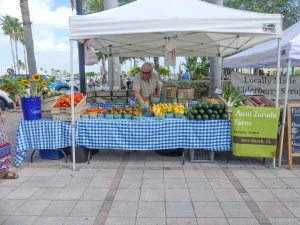
Downtown Fort Pierce has hosted a Saturday farmers market since 1997.
For an even more immersive excursion, explore the wetlands by kayak. We took a guided trip with Lisa’s Kayaks (lisaskayaks.com; temporarily closed). Our guide took us through some open waters and then into the thick mangroves, where we would have gotten lost if we had explored them on our own. In some of the narrow tunnel-like openings, I had to hold my paddle inside the kayak and pull myself through using the mangrove roots. Naturally, we saw a lot of birds, including an osprey. Other tour operators include Rivers To Ocean Kayaking (riverstooceankayaking.com) and Get Up And Go Kayaking (bit.ly/GetUpandGoKayaking).
For in-town exploring, visit the Downtown Fort Pierce Farmers Market, open Saturdays from 8:00 to noon for local produce, some prepared foods, and arts and crafts (fortpiercefarmersmarket.com). Enjoy live music from local entertainers, too. The market is located along the beautiful Indian River in historic downtown Fort Pierce by Marina Square.
If you are a nature lover, you will appreciate St. Lucie County.
On the Menu
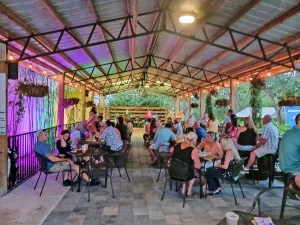
Hop Life Brewing Company in Port St. Lucie offers artisan craft beers and live entertainment.
St. Lucie County offers a full plate of dining choices. Here are a few I found worth visiting:
- Berry Fresh Café for breakfast, brunch, or lunch. All the food is fresh and locally sourced (Port St. Lucie).
- On the Edge Bar & Grill is a waterfront spot with fantastic seafood, views, and live music (Fort Pierce).
- Little Jim Bait & Tackle is another waterfront eatery, located in what was once a World War II training base for Navy SEALs (Fort Pierce).
- Enjoy West End Grill for lunch and dinner (Port St. Lucie).
- Taco Dive offers unusual taco choices (Fort Pierce, Port St. Lucie).
- If you are in the mood for some fantastic candy, visit Bruno Chocolate Creations (Fort Pierce).
- Hop Life Brewing Company offers adult beverages and food; brewery tours are available Tuesday through Friday from 10:00 a.m. to 4:00 p.m. (Port St. Lucie).
MORE INFO
Visit St. Lucie
visitstlucie.com
(800) 344-8443