
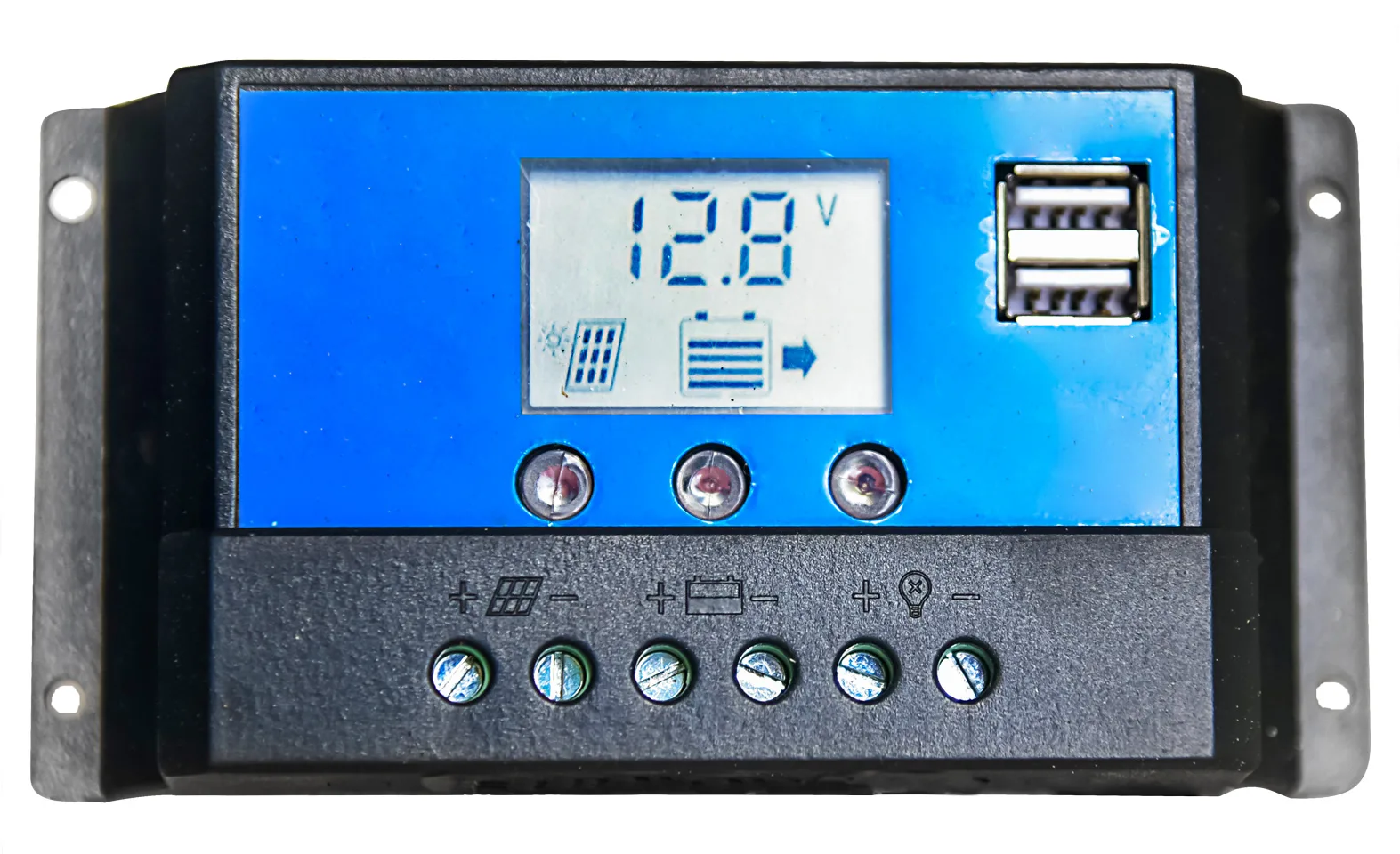
Exploring the workings and the pros and cons of PWM and MPPT solar controllers.
By Steve Froese, F276276
May-June 2025
In the March/April issue, I discussed RV solar panel installation. Now, I’d like to explain the differences between pulse-width modulated (PWM) and maximum power point tracking (MPPT) solar controllers.
Solar panels are devices that convert photons from the sun into electrons through photovoltaics. Therefore, they produce voltage that is used to charge RV batteries and to power 12-volt systems.
Although batteries only store electricity, while solar panels produce it, you can think of them both as sources of DC voltage in your RV. If you are familiar with basic series/parallel circuits, you will recognize the different ways your RV batteries may be connected if you have more than one. If you have multiple 12-volt batteries in your RV, they will be connected to each other in parallel. This connection type keeps the voltage the same while increasing the current capacity. For instance, two 200-amp-hour (Ah) 12-volt batteries connected in parallel provide 400Ah of current capacity at 12 volts.
 If you have a pair of 6-volt batteries in your unit, they are connected in series. Two 200Ah 6-volt batteries connected in series provide a total of 12 volts at 200Ah.
Finally, if you have more than one pair of 6-volt batteries in your RV, they will be set up in a series/parallel arrangement. That means each pair of 6-volt batteries will be connected in series to create 12-volt pairs, while each pair will be connected in parallel, to provide pairs of 12-volt groupings.
The same series and parallel principle applies to solar panels. A single solar panel will require a less expensive pulse-width modulated (PWM) solar controller. However, once you have more than one solar panel installed (multiple solar panels are referred to as an array), the decision on whether to use PWM or maximum power point tracking (MPPT) comes into play, as will the decision regarding how to connect the panels together into the array.
Let’s examine the PWM controller first. As noted in the previous issue, this is a much less expensive alternative to the MPPT controller. A PWM generally is used when only one panel is involved, or in systems where only low-output trickle charging is required. They also tend to be included in lower-priced solar systems.
 A PWM controller is very simple in its operation. It takes the output of the panel or array and switches it on and off to control the total voltage output. It adjusts the duration of these cycles to control the amount of power output. For example, to reduce the power to 20 percent, the controller will remain off four times as long as it is on. To increase the amount of power to 80 percent, it will be on four times longer than it is off. To create a charging cycle for the battery, a PWM controller simply adjusts its output as the current requirements change. However, for a PWM controller, the battery voltage must match the solar array voltage. This means if you have a solar array and a PWM controller, your 12-volt panels must be connected in parallel.
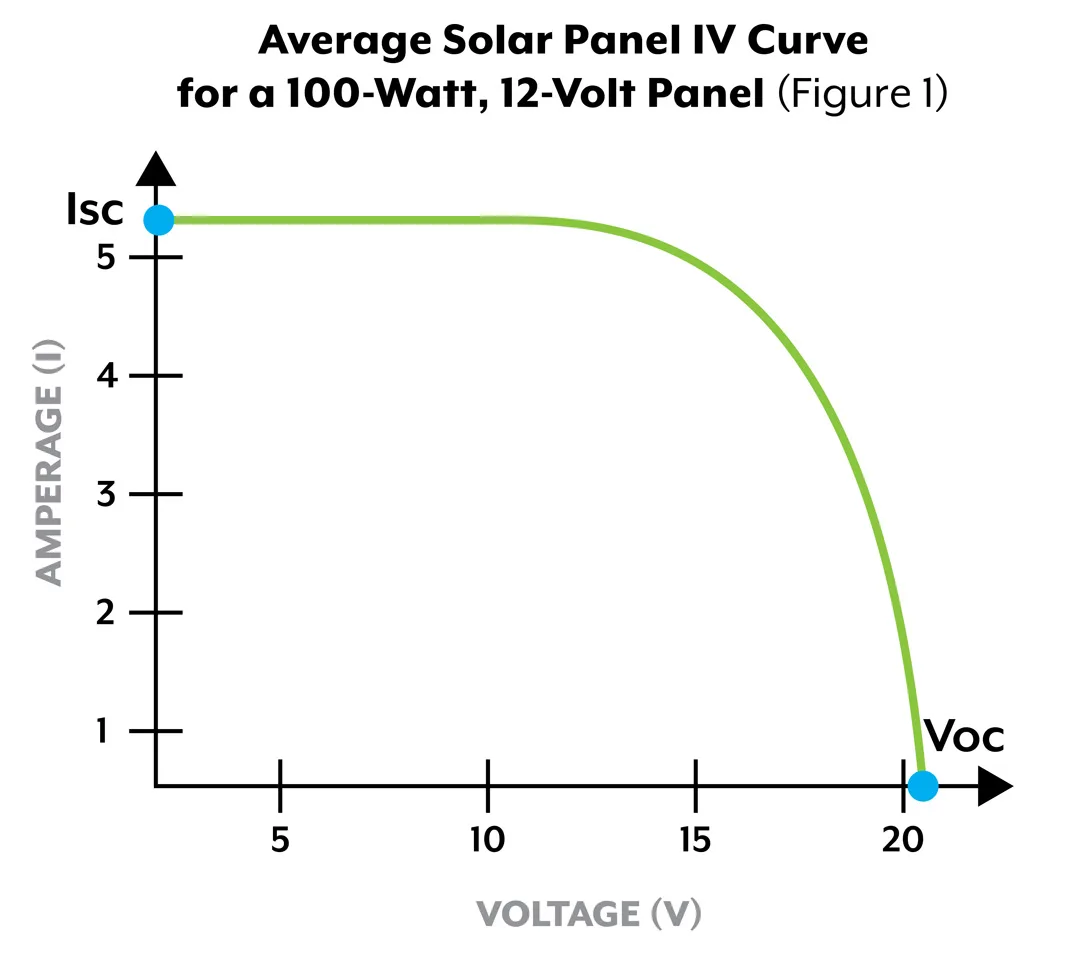
The output of any solar panel can be graphically represented by what is known as the IV curve, or current-voltage curve, shown on a graph with voltage (V) and current (I) axes. Figure 1 shows a typical Isc–Voc relationship, or IV curve. The intersection point on the voltage axis is Voc, or open-circuit voltage (no load). The current axis intersection point is Isc, or short-circuit current. The curve in Figure 1 is based on the output of a 100-watt, 12-volt solar panel.
A solar cell power output is expressed in watts (W) and is a function of the IV curve. The solar panel maximum power calculation is power (P) = voltage (V) x amperage (A). From the graph above, the calculation would be P = 22.5 V x 5.29 A, or P = 119 watts maximum power.
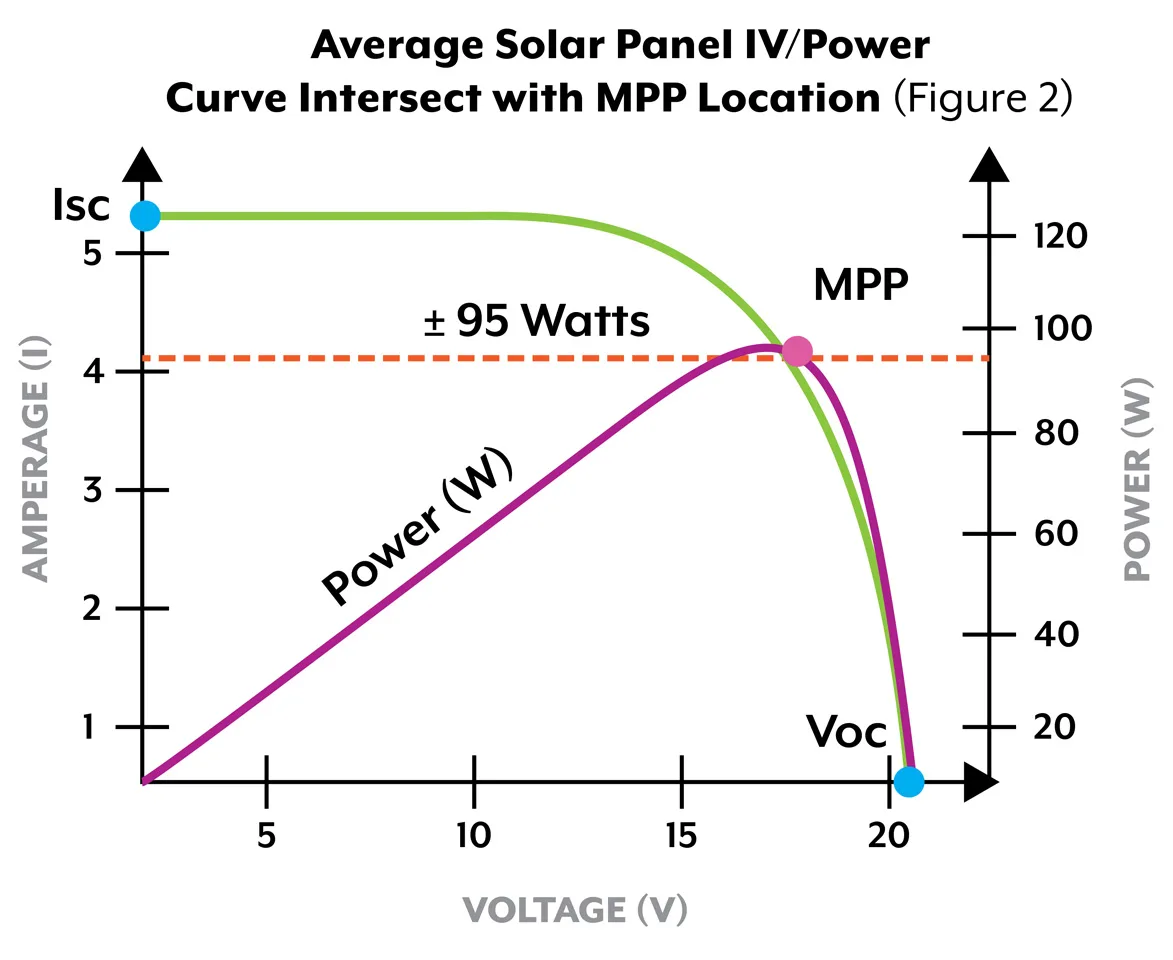
The maximum power voltage curve is usually depicted along with the IV curve on an expanded, three-axis graph, as shown in Figure 2.
The point where the power and IV curves meet is known as the maximum power point, or MPP. This is where the panel produces its maximum output voltage and power figures for those specific circumstances. It is generally slightly lower than the rated power because of internal inefficiencies.
The curves in the chart represent solar panel outputs under optimal conditions. As the sun travels across the panel location or shading occurs, the curves will change across the graph, and the maximum power voltage point will follow suit.
Solar panel outputs constantly change throughout the day, and that’s where the maximum power point tracking charge controller excels. MPPT controllers monitor output power changes and track the MPP while constantly adjust-ing their operation accordingly. This ensures the solar charge controller will always utilize the maximum possible power under all conditions throughout the day.
To summarize, let’s list the pros and cons of each system:
PWM Pros
- Effective and reliable.
- Operate efficiently in hotter environments.
- Lower cost than an MPPT controller (anywhere between 20 to 50 percent less).
- Smaller and lighter than an MPPT controller.
PWM Cons
- Not as efficient as MPPT controllers (typically 25 percent less).
- The solar array voltage must match the battery voltage (parallel connection).
- Noisy and generates a lot of radio frequency (RF) interference.
- Seldom features battery temperature compensation functions.
- Initial cost savings can be lost to additional wiring expenses due to the higher currents involved (remember, parallel connections add the currents of all panels).
MPPT Pros
- Highly efficient (typical efficiency ratings of greater than 90 percent).
- Increased efficiency versus PWM.
- Very flexible regarding solar array sizes.
- Equally flexible with solar panel sizes (can accommodate 60- and 72-cell panels).
- Can accommodate all common battery voltage parameters.
- Works well in colder climates and heavily shaded locations.
- Almost exclusively includes battery temperature compensation.
- Very quiet.
MPPT Cons
- High initial cost (potentially up to double the cost of a PWM solar controller).
- Shorter service life.
- Larger and heavier than PWM solar controller modules.
The hope is that this article has provided some insight for those considering solar array configurations for their RV.
Send Your Troubleshooting Questions to Steve Froese at techtalk@frva.com. The volume of correspondence may preclude personal replies. Not all responses will apply in every instance. Some situations may require a visual inspection and hands-on testing. If you choose to follow any procedures outlined in this column, first satisfy yourself that neither personal nor product safety will be jeopardized. If you feel uncomfortable about a procedure, stop and make an appointment with an RV service facility.
You may also want to consult the Family RV Association Forums (https://community.fmca.com) to see whether your question has already been addressed or, if not, to post it.
Recalls
Looking for the latest RV-related recall information? Visit FRVA.com for a list of the most recent recalls issued by RV and component manufacturers. Or, to search for recalls, investigations, and complaints by vehicle year, make, model, and VIN, visit nhtsa.gov/recalls. NHTSA’s Vehicle Safety Hotline is (888) 327-4236.