
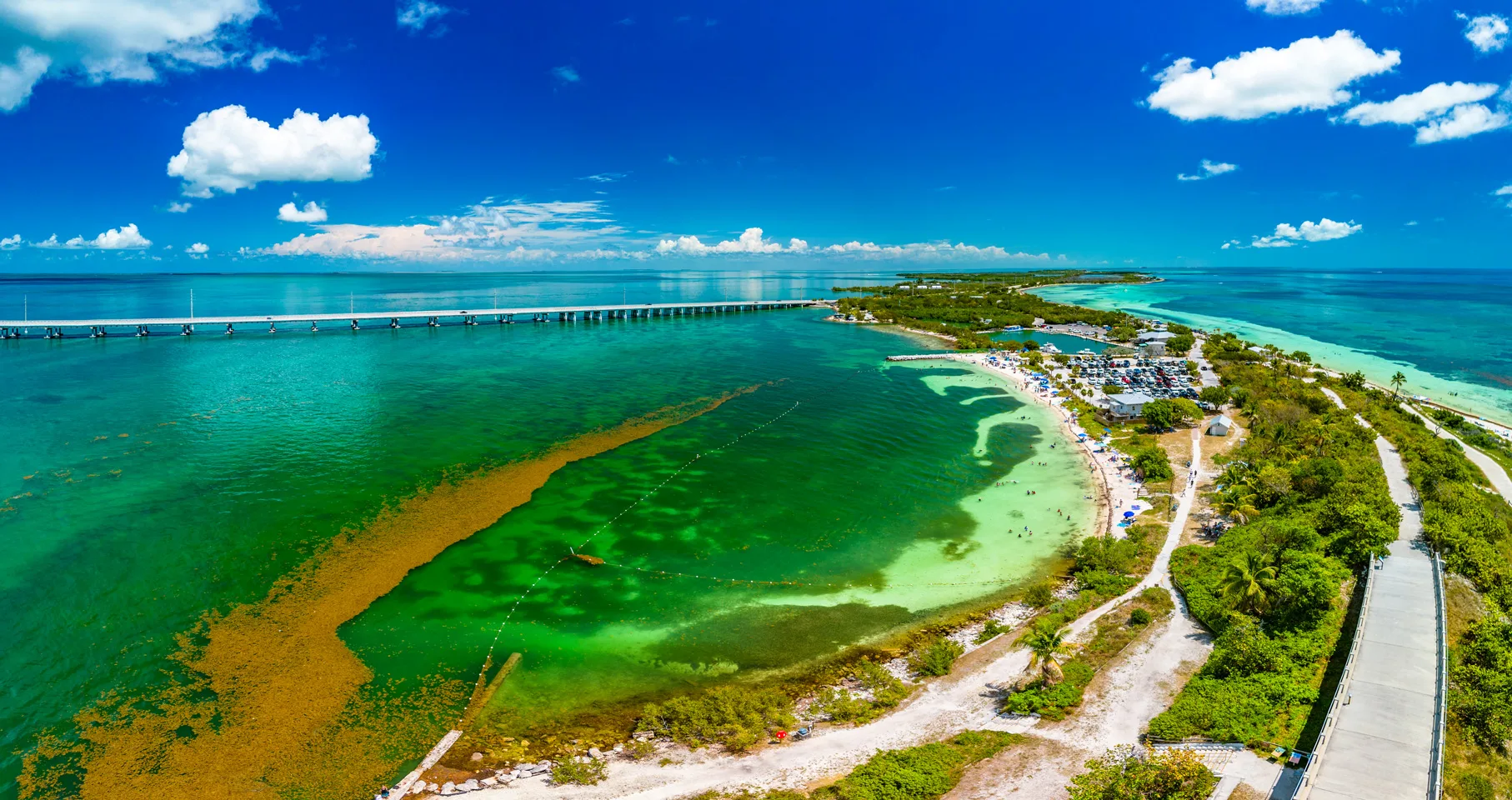
A trip to Key West along the Overseas Highway offers breathtaking ocean views and a chance to experience the natural beauty and laid-back attitudes found in the Florida tropics.
By Kathleen Walls
March-April 2026
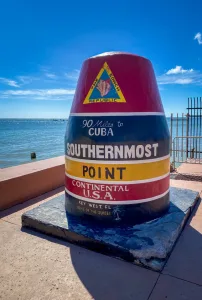
The Southernmost Point Buoy.
The Florida Keys are a popular destination for winter and spring RVing. For many travelers, the 113-mile drive “across” the open seas is a bucket-list adventure like none other. Hundreds of small islands — keys — connected by 42 bridges take motorists from Key Largo to Key West, the southern terminus of U.S. Route 1. Along this journey, you are guaranteed to find great seafood; intriguing wildlife and nature areas; and all sorts of fun, sometimes quirky, attractions and activities.
The route, known as the Overseas Highway, follows the same path as the Over-Sea Railroad that began service in 1912. The rail line opened travel and trade opportunities between Key West, the southernmost deep-water port in the United States, and mainland Florida. A 1935 hurricane destroyed portions of the rail system, and the route to Key West was rebuilt as a road. The Overseas Highway officially opened in 1938 and has served as the passage to paradise for millions of travelers ever since.
BAHIA HONDA
While in the Keys, Bahia Honda State Park (floridastateparks.org/BahiaHonda) makes a great base for your adventures. It’s roughly 37 miles north of Key West and 65 miles south of Key Largo, so you can spend time in all the Keys. Warning, though: It’s tough to get a campsite here. If you’re a Florida resident, you can apply 11 months ahead. Non-residents may reserve a site up to 10 months in advance.
The park encompasses nearly the entire Bahia Honda Key. Buttonwood Campground has 48 sites that can handle large RVs. Sandspur Campground offers 23 sites for RVs up to 23 feet long. Both have gravel parking with electricity, water, picnic tables, and grills.
Bayside Campground contains eight primitive sites with picnic tables, grills, and water. To access this campground, vehicles pass under the Bahia Honda Bridge, which has a height restriction of 6 feet 8 inches.
The park has three beaches: Loggerhead and Sandspur face the Atlantic Ocean, while Calusa Beach faces the Florida Bay. Concession services include a gift shop, snack bar, kayak and snorkeling rentals, and daily snorkeling tours to the Looe Key National Marine Sanctuary. The Old Bahia Honda Railroad Bridge is a short walk away. A section has been renovated as a fishing and pedestrian bridge. You’re sure to see wildlife at Bahia Honda, including Atlantic bottlenose dolphins, sea turtles, wading and shorebirds, and ghost crabs.
HISTORY OF KEY WEST
The city has a rich and remarkable history. Its earliest residents were of Bahamian and Cuban descent, owing to the close proximity of these island countries. In the mid-1800s, Europeans began to settle the southern part of Florida. By then, Key West’s economy was booming thanks to shipwreck and salvage operations, fishing, turtle hunting, sponging, and salt manufacturing. Cigar production flourished, making it the largest and wealthiest city in Florida throughout the late 1800s.
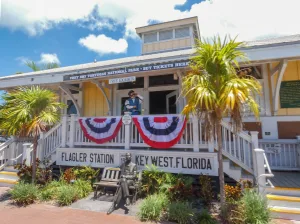
Key West sights include Flagler Station, home of the Sails to Rails Museum.
During the 1900s, Miami, West Palm Beach, Fort Lauderdale, Tampa, St. Petersburg, and other cities began to grow as Americans realized the opportunities available to them in the southern part of the Sunshine State. As their growth continued throughout the 20th century, Key West, which is just 4.2 square miles in size, changed its image and attitude to become a tourist destination promising stunning sunsets, clear blue waters, a laid-back vibe, and quirky charm to those who visit. And it does not disappoint.
An example of Key West’s less-than-serious attitude is the Conch Republic Festival (conchrepublic.com) held each April, which commemorates the city’s “secession” from the Union. And last year, I was lucky to visit during this celebration.
It all started in March 1982 when the United States Border Control set up a roadblock in Florida City — the last stop along U.S. 1 before entering or exiting the Keys from the mainland — to catch drug smugglers and illegal aliens. News of this roadblock and others, some that stretched for 17 miles, severely impacted the Keys’ economy.
Key West mayor Dennis Wardlow, who later became the movement’s “prime minister,” sought legal recourse, arguing that only nations at war can blockade another country. When this approach was unsuccessful, he declared, “We secede; we’re not going to take it anymore. If you’re going to treat us as a foreign country, we’ll become a foreign country. We’re going to raise our flag and declare war.”
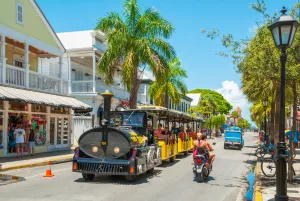
The Conch Tour Train stops at many famous Key West attractions.
On April 23, 1982, the Conch Republic flag was raised over Key West’s city hall. That afternoon the Conch Republic’s Western Union schooner “attacked” the U.S. Coast Guard Diligence with water balloons, conch fritters, and stale Cuban bread. The Diligence defended itself with a volley of water from fire hoses. Wardlow immediately surrendered, and the war was over.
Each year, the 10-day festival features parades, Old Town tours, cruises, and a mock battle to commemorate the secession. During last year’s celebration, Wardlow, now “prime minister emeritus,” recounted the story at several festival events. On land, Commander “Scarlett Jai” Somers, the Supreme Commander, General, and First Piratess of the Conch Republic Military Forces, struck a U.S. naval officer across the head with a loaf of stale Cuban bread. Land-based cannons were mounted in Mallory Square, pointing at the harbor, and fired multiple times.
Ultimately, the Coast Guard surrendered and participants proceeded to Schooner Wharf Bar for the surrender ceremony. Wardlow noted that while they never received the U.S. aid package, the barricade in Florida City was removed the next day. Hence their motto, “We seceded where others failed.”
VISITING KEY WEST
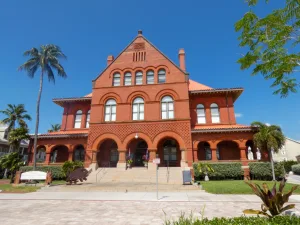
The Custom House, Key West, site of the Key West Museum of Art and History.
Parking in Old Town, where most of the attractions, bars, and restaurants are located, is limited and expensive unless you have a Florida disabled parking permit or license, which makes it free in any city-owned metered space. The best way to tour Old Town is to buy a ticket for the Old Town Trolley (trolleytours.com/key-west) or Conch Tour Train (conchtourtrain.com). The Conch Train offers a nonstop tour, while the Old Town Trolley lets you hop on and off near most attractions. Both tours start at Mallory Square and take riders past hot spots such as Sloppy Joe’s, The Green Parrot, and Key West Legal Rum.
While you’re in Mallory Square, visit the Key West Historic Memorial Sculpture Garden (keywestsculpturegarden.org), featuring bronze busts of notable figures in local history. Don’t miss the daily Sunset Celebration at the square for entertainment, food, and stunning sunsets.
Nearby is the Key West Shipwreck Treasure Museum (keywestshipwreck.com). Exhibits recount how “wreckers” made Key West one of the richest cities in the United States during the 1830s by salvaging ships from the reefs just offshore.
The Key West Aquarium (keywestaquarium.com), the island’s first tourist attraction, opened in 1935. You’ll observe sea life that inhabit the waters off the Keys at this state-of-the-art marine life showcase.
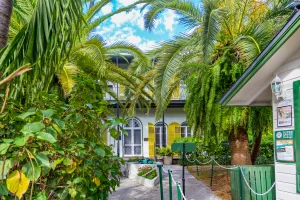
The Ernest Hemingway Home and Museum, Key West.
The Key West Museum of Art and History at the Custom House, one of four facilities operated by the Key West Art and Historical Society (kwahs.org), tells the city’s history with art and artifacts.
Just a few blocks from Mallory Square, the Mel Fisher Maritime Museum (melfisher.org) showcases the artifacts found by one of America’s best-known treasure hunters.
At the Ernest Hemingway Home and Museum (hemingwayhome.com), I met descendants of Hemingway’s six-toed cat, Snow White. She was a gift from Captain Stanley Dexter, a local shipwreck and salvage captain.
A tour through the Harry S. Truman Little White House (trumanlittlewhitehouse.org) takes visitors on a trip through one of America’s most historic times.
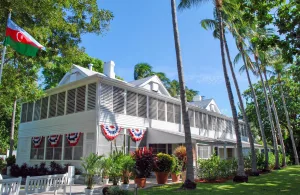
The Harry S. Truman Little White House, Key West, where Truman spent 175 days during his presidency.
I enjoyed the Sails to Rails Museum (trolleytours.com/key-west/sails-to-rails-museum) in Flagler Station, which tells the history of the ships that once sailed throughout the Caribbean, as well as Flagler’s railroad.
Two nature-related museums are located on the island. The Key West Tropical Forest and Botanical Garden (keywest.garden) showcases native plants and species and is a migratory stopping point for many birds from as far away as South America. The Key West Butterfly and Nature Conservancy (keywestbutterfly.com) is filled with more than 50 species of these flying jewels from around the world.
The Fort East Martello Museum, also part of the Key West Art and Historical Society, is housed in a Civil Warera fort with displays and exhibits that tell the story of Key West and Robert the Doll, the city’s most haunted artifact. To get an in-depth look at this creepy figure, take the “Robert the Doll After Dark Tour” at the museum.
Other fascinating museums are not as well-known but worth a visit. The Alex Vega Key West Firehouse Museum (keywestfire.com), housed in a 1907 fire station, spotlights antique fire trucks and other historic artifacts.
The U.S. Coast Guard Cutter Ingham Memorial Museum (uscgcingham.org) is docked at Truman Waterfront Park and one of the most decorated cutters in Coach Guard history, having seen action in World War II, Korea, and Vietnam. It’s a real ship, so the steep stairs are descended like a ladder. If you visit the museum on Thursday, check out the Key West Farmer’s Market held at the park.
If you want a selfie at the Southernmost Point Buoy, expect a long wait. The rest of the world is in line there, too. This anchored concrete buoy marks the southernmost point in the continental United States. At this writing, it is temporarily located at 1499 Duval St.
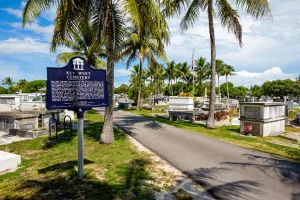
Historic Key West City Cemetery marks the passing of colorful characters.
People may not consider a cemetery a tourist attraction, but the Historic Key West City Cemetery draws a crowd. Many tombs are engraved with humorous sayings, such as those on two sisters’ graves in the same family plot. One was considered the town’s hypochondriac, B.P. Roberts. Her tombstone says, “I told you I was sick.” Her sister’s reads, “I’m just resting my eyes.” One of the most unusual tombstones is a conch shell that marks the grave of Sir Peter Anderson, secretary general of the Conch Republic, who passed away in 2014.
Sometimes pets are buried there also. The grave of Elfina the deer is in the Otto family burial ground along with three dogs and Robert Eugene Otto, owner of Robert the Doll.
After getting my fill of land-based attractions, I took a sunset cruise aboard the Hindu (hinducharters.com), a 50-foot wooden schooner built in 1925. It was fascinating to watch the crew raise and lower the sails. We cruised into a terrific sunset while enjoying snacks and wine.
BIG PINE KEY
Heading north on U.S. 1 just before you reach Bahia Honda Key, look for Key deer on Big Pine Key. The National Key Deer Refuge (fws.gov/refuge/national-key-deer) protects these tiny, endangered deer that are unique to the lower Florida Keys, predominantly on Big Pine Key and No Name Key. The refuge has a nature center on U.S. 1.
MARATHON
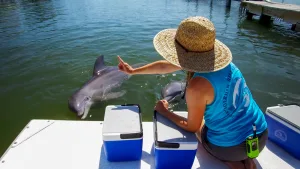
The Dolphin Research Center, Marathon.
Driving north from Bahia Honda across the 7 Mile Bridge to Marathon, look to the left to see the remains of Henry Flagler’s overseas railway bridge and you’ll spot Fred the Tree growing out of the bridge between mile markers 41 and 42.
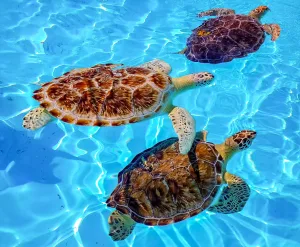
Turtle Hospital, Marathon.
Once you get into town, check out the Turtle Hospital (turtlehospital.org), which opened in 1986 to rescue, rehab, and release endangered sea turtles. During our 90-minute tour, we were led through the tanks and introduced to the turtles. We learned about the most common injuries they sustain, such as ingesting synthetic materials and fishing hooks, or becoming tangled in fishing lines. Sadly, some turtles can never be returned to the wild. If you’re a boater or fishing enthusiast, this facility will make you aware of factors that harm these sea creatures.
Crane Point Hammock Museum and Nature Center (cranepoint.net) was once the site of a Bahamian village. The tram tour took us through forested paths to the Adderley House, one of the oldest homes in the Keys outside of Key West. The Wild Bird Center is behind the Crane Point Museum. In front of the museum is a railcar that was once used on Flagler’s railway.
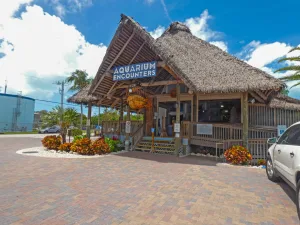
Florida Keys Aquarium Encounters, Marathon.
Florida Keys Aquarium Encounters (floridakeysaquariumencounters.com) lets you get close to aquatic life. I watched a trio of snorkelers explore a coral reef environment and a couple have a stingray encounter while sitting in the water.
The Dolphin Research Center (dolphins.org) just north of Marathon in Grassy Key is an education and research facility. During our visit we met dolphins, sea lions, tortoises, and parrots. Jax, one rescued dolphin missing half of its dorsal fin from a shark bite, came from an area near Jacksonville. Two relocated sea lions were being taught to adapt to a new house built for them here. The animals cannot be released back into their natural habitat, so the center is their loving forever home.
Fun fact: The movie Flipper was filmed here. Mitzi, the dolphin that mainly played Flipper, is buried under the statue of a life-sized dolphin near the entrance.
ISLAMORADA
Continuing our northbound journey, the next stop is Islamorada. Even if you’re not a diver, you’ll love the History of Diving Museum (divingmuseum.org), where you’ll find a variety of interactive opportunities. Get a picture wearing a diving helmet while seated next to a fully suited diver, or see how long you can hold your breath. The museum provides a chronology, from primitive divers to modern treasure hunters.
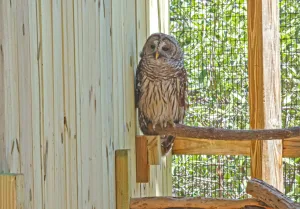
Laura Quinn Wild Bird Sanctuary, Key Largo.
The Florda Keys History & Discovery Center (keysdiscovery.com) tells the story of the Keys through hundreds of artifacts and photographs. If you see just one thing here, make it the documentary about Flagler’s Florida East Coast Railway.
The Laura Quinn Wild Bird Sanctuary, part of the Florida Keys Wild Bird Center (keepthemflying.org), is home to more than 40 rescued, non-releasable birds representing nearly 30 species.
KEY LARGO
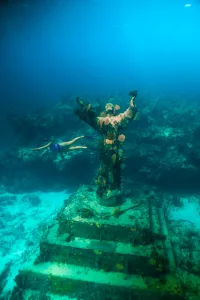
Christ of the Abyss statue at John Pennekamp Coral Reef State Park, Key Largo.
The northernmost island on the Overseas Highway, Key Largo has earned the title of “Dive Capital of the World” thanks to its proximity to John Pennekamp Coral Reef State Park (floridastateparks.org/parks-and-trails/john-pennekamp-coral-reef-state-park), the country’s first undersea park. Visitors can view the marine life and coral reefs during boat tours or get a closer look on snorkeling or diving excursions. If you wish to explore the mangroves and reef area at a more leisurely pace, you can rent a canoe or kayak.
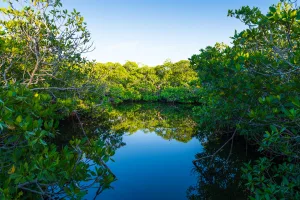
John Pennekamp Coral Reef State Park, Key Largo.
While in Key Largo, be sure to book a cruise aboard the real African Queen (calypsosailing.com/The-African-Queen), the boat that Humphrey Bogart and Katherine Hepburn fell in love on in the movie of the same name. The steamboat was built in England in 1912 as a work vessel for the British East African Railway. John Huston leased it in 1951 for the movie and changed its name to African Queen to fit the script. After the movie, the boat was returned to the railway and then went through several owners before being left to deteriorate in a Florida cow pasture.
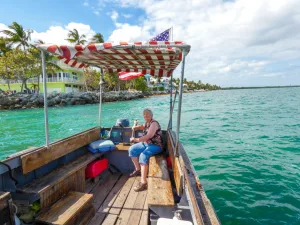
The author cruised aboard the African Queen in Key Largo.
The boat was saved by Bogart movie buff Jim Hendricks, who fixed it up and began giving visitors rides from the Key Largo Holiday Inn. Today, Lance and Suzanne Holmquist have a long-term lease to keep it in top shape and offer cruises. Your captain will navigate the boat past the gorgeous homes along the canals and out into the Atlantic Ocean. Our captain let us take turns steering it and reenacting some scenes from the movie. Make sure this is on your to-do list when you get to Key Largo.
Believe it or not, there is so much more to do on a trip through the Florida Keys than what’s included in this story. Do your research, find your favorites, and enjoy this amazing voyage to paradise.