
By Gary Bunzer, Technical Editor
September 2019
Moisture Intrusion
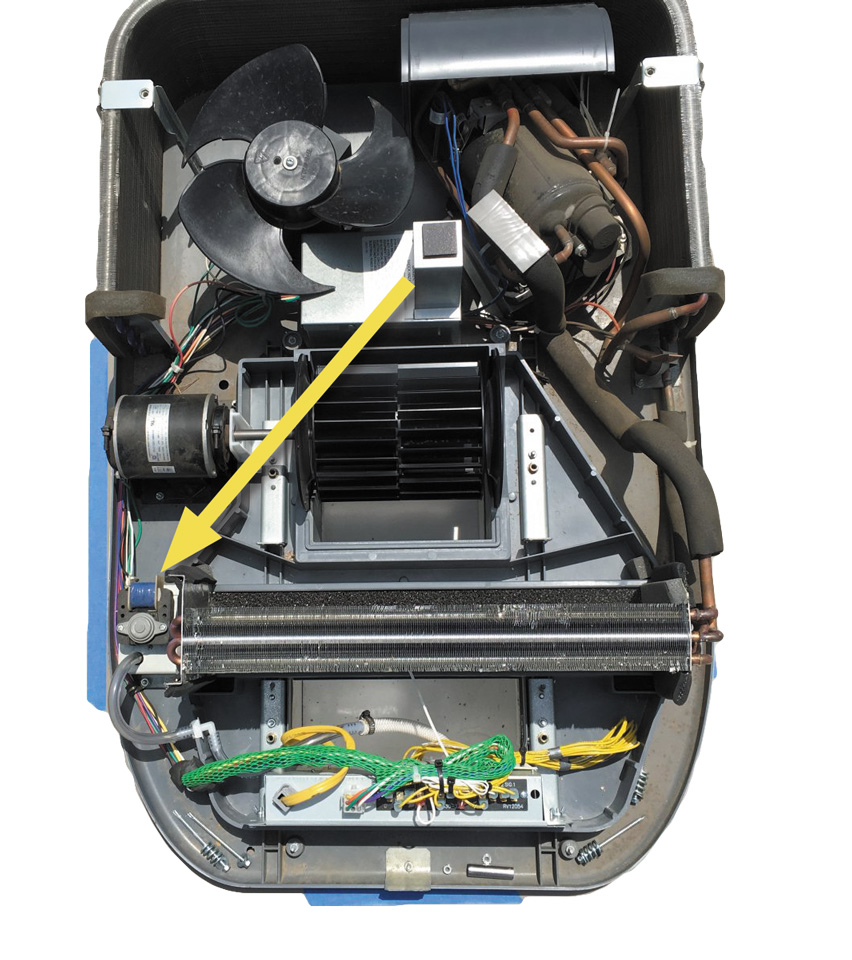
The arrow indicates the location of the condensate pump in the roof A/C unit.
I have a Monaco motorhome equipped with two Coleman Mach air conditioners that have an evaporation condensation pump. When it rains, water drips from the nonfilter side of the inside grille. The back air conditioner apparently is okay, since it doesn’t leak when it is off and when it rains. The condensate pump is working; water runs out of the outside hose. Two dealers worked on this, but they couldn’t find the problem, so they blamed it on condensation. Because I do not have the same problem with the back air conditioner, I find it difficult to accept their answer. I would appreciate your input.
Jim McQuillan, F150944, Summerfield, Florida
You have an interesting problem with that front air conditioner. Typically, if it leaks only while it’s raining, the problem can be associated with a faulty seal between the air conditioner and the roof, or perhaps blocked drain holes in the pan. Be sure the drain holes are free from blockages.
Regarding the seal, the rubber gasket may not be compressed enough, or it may have been tightened too much. You can check by removing the ceiling assembly and looking at the perimeter of the 14-inch-square hole in the roof that the air conditioner sits on. The gasket should be compressed to approximately 1/2 inch, about half its original thickness. If it’s too tight, it may not seal properly. The rubber gasket is available at any well-stocked RV accessory store.
If the condensate pump is definitely working, it might be wise also to check where the hose attaches to the pump. You can reach the pump from up on the roof. It will be necessary to remove the shroud first. The red arrow in the accompanying photo indicates the location of the condensate pump. I’m thinking it might be leaking a little there, even with the majority of the moisture going down the internal drain piping.
Also, shine a light up inside the roof unit and see whether there is any blockage (dirt, dust, grime) on the evaporator coils. And while you’re up on the roof, check the condenser coils for blockage. Dirty coils can cause an abundance of condensate, and perhaps the pump simply can’t keep up with it.
I’ve heard of rare occurrences of a faulty seal at the motor/fan assembly, but that is likely the last thing to check. Since the pump operates only when the compressor is running, I have a feeling it’s more related to a faulty 14-inch rubber gasket, or plugged drain holes. Let me know what you find.
Kings Highway Electricity
I am trying to figure out an electrical issue in an old Kings Highway motorhome. The AC electricity was working fine, and then it was overloaded. We replaced the 20-amp ground-fault circuit interrupter, because the reset was stuck. We are not currently using the DC electricity at all. I believe the motorhome, which is plugged into an outside power source, may have had the wrong converter. I believe it is currently 30-amp from 50-amp but should be a 15-amp. Could you please give me an idea of all possible things to look for?
Shanice Braun, Via email
If I remember correctly, your Kings Highway came equipped with a 30-amp shore power connection. The fact that you may be connected to 50-amp service should have no bearing; it is totally permissible. If the “converter” you speak of is the electrical reducing adapter, it should indeed be a 50-amp-male-to-30-amp-female adapter if you are plugging into a 50-amp outlet. I would not recommend plugging your motorhome into a 15-amp power source.
Before you plug the coach into that 50-amp receptacle, measure the voltage and check the polarity. It must be 120 volts AC, plus or minus 5 percent on each leg. You should measure 240 volts from one hot terminal to the other hot terminal. Once you plug in, check all the circuit breakers on the main panel board inside the RV. You should have power at all the receptacles and appliances that run on 120 volts AC (air conditioners, refrigerator, microwave, etc.).
However, all the lights, the water pump, exhaust fans, etc., run on 12-volt-DC electricity through a 120-volt-AC-to-12-volt-DC converter somewhere in the motorhome. That converter also is protected by a 120-volt-AC circuit breaker inside the panel board. Once plugged in, check all the receptacles for power. Have you run the generator to see if you have power from it? Try that first and then let me know if you still do not have AC electric.
Kings Highway Follow-Up
Thank you! My friend is staying in a motorhome and knows absolutely nothing about it. I know enough to get myself into and possibly out of trouble. Do I understand you correctly that whether or not the RV is plugged into 120-volt-AC power, the 12 volts must be converted? We have checked everything but the 12-volt electricity. My friend has a 30-amp adapter plugged into a 120-volt outlet on the wall outside a garage. We have flipped every breaker, including the one in the garage. I thought that the battery might have drained, because he hasn’t started the motorhome since last year. Does the motorhome use both AC and DC at the same time regardless of being plugged into a 120-volt outlet? Since last fall, my friend has used only the outlets that power the TV, microwave, lights, and two space heaters. I told him that we need to check the 12-volt system, too, but he insisted he does not need to, because he isn’t using it.
— Shanice Braun, Via email
Let me see if I can help a bit further. The 12 volts DC is not converted; only the 120-volt-AC system needs to be converted to 12 volts DC. Most everything is powered by or controlled by DC voltage, typically through the battery bank. When 120 volts AC is available, you plug in the RV and then the AC-to-DC converter kicks in and powers those 12-volt devices, such as the lamps, the water pump, etc. At the same time, the AC-to-DC converter should be charging the battery bank (if all is operating properly). When the coach is being driven, the alternator on the motorhome engine also charges the battery bank.
Whenever possible, plug into either a 30-amp or a 50-amp 120-volt-AC receptacle instead of a 15-amp or 20-amp receptacle. When AC is not available, all the power for the low-voltage lamps, fans, and pumps comes directly from the battery bank only. Distinct appliances are AC only, including the air conditioners, the microwave, and all the receptacles (and whatever you plug into them). They work only when plugged into 120 volts AC (or by running the generator). But most everything inside the coach is configured to run on low voltage (12 volts DC).
So, your friend is using the 12-volt system, by virtue of the AC-to-DC converter, for all the lamps and the water pump and some controls on the appliances. Check the electrolyte in the batteries (they may be ruined already); as I noted, the converter should be charging the batteries when the coach is plugged into shore power.
Running two space heaters can overload the AC circuits, so care must be taken. Most AC receptacles inside the motorhome are rated for only 15 amps. But that’s cumulative. As many as four or five receptacles may be on the same 15-amp circuit. I would recommend a complete systems checkout (AC and DC systems) by a professional certified technician. A coach that old is bound to have some issues that may need addressing. The propane system should be checked out as well. After an inspection, your friend can use the furnace for heat (as designed) and eliminate the danger of running space heaters. Until then, crack a window open at one end of the coach and a roof vent at the other end. That will help the convection process of moving the air. Safety is paramount!