

Two small towns, one on either side of the British Columbia-Alaska border, share many common bonds and attractions.
By Claudia Abbott, F323453
April 2020
The 40-mile drive on British Columbia Highway 37A, also called the Stewart Highway, from Meziadin Junction to Stewart is spectacular. You travel past towering, snowcapped mountains to Bear Pass, where you can pull alongside the beautiful Bear Glacier. A very large snowpack remains in this part of the province year-round.
Once in Stewart, we set up our motorhome at Rainey Creek Campground, a shady place with huge trees and a creek running through it. Since Stewart is in British Columbia, we used our towed vehicle to tour Hyder, Alaska, and avoid having to take the RV through customs again. Because Hyder is in the United States, you have to cross back over the Canadian border.
Stewart and Hyder, only two miles apart, once boomed with mine money. Silver, copper, gold, and other valuables have been taken out of the earth in this region.
During the 2010 U.S. census, Hyder’s population was listed at 87. It is 100 now, according to The Milepost, the most authoritative guide to these parts. Stewart is a metropolis compared to Hyder, with approximately 400 residents. Little Hyder relies on Stewart for town services such as law enforcement. It’s been reported that residents usually set their watches to Stewart’s Pacific Standard Time, not Alaska Standard Time. The former is an hour ahead of the latter.
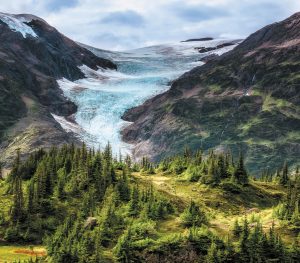
The scenery around Stewart and Hyder, such as this meadow and glacier, sometimes resembles works of art.
Stewart is Canada’s most northerly ice-free deep-sea port. This area is close to the ocean, so the climate retains strong maritime influences. Winters are much milder than locations farther inland. Averaging 985 hours of sunshine in an entire year, Stewart is one of the cloudiest places in the world. The same can likely be said for Hyder.
Stewart’s major business still is mining; next is lumber, and third, the movie industry. Those gray weather days make it a popular place for filming. Several car commercials have originated here, as have several movies, including Leaving Normal (1992), The Thing (1982), Bear Island (1979), Insomnia (2002), and Eight Below (2006).
Props and other objects related to some of these movies are displayed at the Stewart Historical Museum, a collection that highlights Hyder’s history, too. A walking tour of town includes buildings that date back to 1910.
The Portland Canal, one of the longest fjords in the world, sits at Hyder’s doorstep. I love taking photos of the misty harbor. When I returned to the RV and viewed them on my computer, I saw that each high spot had an eagle sitting on it, looking for prey.
As you cruise from Stewart into Hyder, you barely notice that you are driving out of Canada and into the United States — there is no U.S. border inspection at this crossing — and that the time zone changes.
Hyder’s main road was paved a scant few years ago. A small plane from Ketchikan brings mail to residents, weather permitting, on Mondays and Thursdays. A hand-painted banner that hangs above the road proclaims, “Friendliest Ghost Town in Alaska.”
It feels as though you’ve entered a time warp in Hyder, for it has nothing that reminds you of life as you know it. There is no cell phone service, and no GPS.
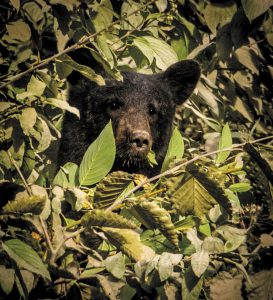
If you don’t see bears at the usual spots, you’ll probably find them elsewhere!
This was our third visit to Hyder, and I think two attractions draw people back. One is the fabulous $1 million bear-viewing platform and elevated boardwalk along Fish Creek. The Fish Creek Bear Viewing Area is one of only two official bear-viewing locations in Alaska accessible by road, and the easiest to visit. You can wait for hours for a chance to see grizzlies dive off the banks to catch salmon that are stacked up in the creek. The fish and the bears are most numerous from late July to mid-August. But whenever we go, the bears always seem to have just left the area. However, we did see many bruins on our last trip.
The best reason to go to Hyder, for us, is Salmon Glacier Road. Just past the bear-viewing platform, the pavement ends, and you are on what I consider the third worst road in Alaska. Even though it is heavily potholed and is in absolutely terrible condition, it is not as bad as others in the state. (The 199 miles of haul road we took to the Arctic Circle and the 70-mile McCarthy Road to Kennecott Mines were worse.)
Salmon Glacier Road has very little traffic, which gives you plenty of space and time to drive around the potholes. And makes it safer. We were in our Jeep Wrangler, and we saw several SUVs and pickup trucks using it, too. But if your towed vehicle is a cute little sports car, don’t even think about it.
Salmon Glacier is just 16 miles up the road, and the views around it are stunning. Alpine valleys lie between it and other glaciers, and wildflowers grow among rocks and ice.
Most people are glad to survive the 16 miles and turn around once they reach Salmon Glacier, but 10 more miles of road take you past more glaciers than you can keep track of, and you can see the tunnels from the old gold mines. We thought Berendon Glacier made the last 10 miles worth doing.
We saw enough of the old mine buildings to make us wonder about their history. We learned about them at the little museum in Stewart, and more specifically, saw artifacts and photos related to the 1965 avalanche that occurred there, when 28 men lost their lives.
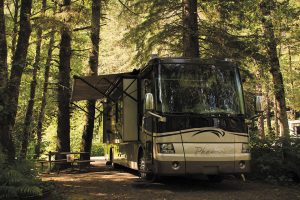
The author and her husband parked their RV at Rainey Creek Campground in Stewart and used their towed vehicle to see area sights.
The foundation of the Granduc Mine mill still stands, and a mountain railway to the workings dominates this scene. It’s hard to imagine that 500 people once worked at this site, which cost $115 million to develop. We drove all around the area trying to figure out what happened.
In 1964 a camp of the Granduc Mine was located near the Leduc Glacier, and so called Leduc Camp. Its four bunkhouses, dining hall, recreation hall, auditorium, offices, and powerhouse provided 140 workers with fairly comfortable accommodations in the harshest of conditions. A large runway was constructed right on the glacier for supply planes.
On the steep mountainsides above the camp, millions of tons of snow let loose at 10:16 on the morning of February 18, 1965. Virtually the entire camp was wiped out by the avalanche. Some people survived because the slide misssed them when it split into two forks, and others were able to dig themselves out. When the cookhouse was blown apart, a 20-year-old cook used the knife he was holding to cut himself free, which took three hours. A carpenter was buried for 79 hours while huge rescue helicopters landed on the snow directly above him; he finally was uncovered by a bulldozer and spent months recovering at a Ketchikan hospital.
Leduc Camp was abandoned, but the company continued copper mining operations in the area until 1984. What’s clear is that Granduc will never be forgotten. Although visitors new to Stewart may not know why so many homes and apartments are empty, any of the locals can tell the story. And if you drive to Salmon Glacier, you’ll get an up-close look at the conditions faced by the people who constructed the mine and the mining camp buildings. You can read more about the story and many other aspects of this area at http://explorenorth.com/alaska/hyder.html and http://explorenorth.com/bc/stewart.html.
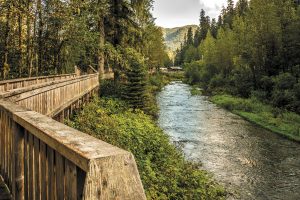
A long boardwalk lines salmon-friendly waters at the Fish Creek Bear Viewing Area.
During our visits to Hyder and Stewart in August and in September, the weather has been pleasant but chilly. The area RV parks are open from May through October, but we try to be across the border by late September, when campgrounds and businesses start closing along the road south.
We always stop at Hyder on the way home from Alaska, but if you’re ever in Washington state and want a thumbnail view of the Last Frontier without driving thousands of miles, you can be in Hyder in a couple of days.
Further Info
Stewart and Hyder are accessed via British Columbia Highway 37A, a spur off the Cassiar Highway (BC Highway 37). The Milepost offers details about this and other roads, plus information about larger border crossings, sights along the way, and much more:
(800) 726-4707
www.themilepost.com
Travel & Tourism Info
District of Stewart, British Columbia
(250) 636-9224
http://districtofstewart.com/discover-stewart/tourist-information/
Area Campgrounds
Bear River RV Park
2200 Davis St.
Stewart, BC V0T 1W0
(250) 636-9205
www.bearriverrvpark.com
Camp Run-A-Muck
990 Hyder Ave.
Hyder, AK 99923
(888) 393-1199
(250) 636-9006
www.sealaskainn.com
Rainey Creek Municipal Campground
Eighth Avenue
Stewart, BC V0T 1W0
(403) 998-8546
www.raineycreekcampground.com