

Keep your budget in mind as you decide on necessities and wish list items.
By Gary Bunzer, Technical Editor
Buying an RV requires thoughtful decision-making. That’s as true for people who have a fair amount of RVing experience as for those making a first foray into the lifestyle.
What type of RV best suits your family? How much can you afford to pay, not only for the initial purchase, but for ongoing maintenance? What degree of difficulty is involved in accessing components that require periodic inspection and service? I covered those topics and more in the article “Motorhome Buying Tips” (August 2017, page 48). Although it was aimed at people considering the purchase of a motorized RV, much of the material is applicable to towables.
Even if you already have decided on the type of RV, and perhaps the floor plan, it makes sense to contact more experienced RVer friends or relatives and quiz them about what they looked for — or should have looked for — when they purchased an RV the first time.
In this article, I’m urging potential buyers of motorhomes or towable RVs to adopt this phrase: Necessities first, wish list second. Keep that in mind when considering an RV’s furnishings, equipment, style, technical features, amenities, and comfort level. The key is that every necessity or desire must fit seamlessly within the established budget. The more items on the wish list, the more likely the cost of the RV will rise. So, prioritize with necessities first and the wish list second, and make sure the budget is the governing principle.
The Necessities

An RV’s galley is an important consideration for people who enjoy cooking.
Obviously, certain features are must-haves, such as enough sleeping berths for all who will use the RV. Foodies should focus on the galley, and consider whether the countertop space, the number of 120-volt-AC receptacles (in the right places), and pantry storage, etc., are sufficient. For people who work while on the road, space for a computer, printer, file storage, etc. might be a necessity.
Storage is always crucial. Pay special attention to the outside storage areas. Many RVs have exterior access doors or compartment bays for stowing camping gear and other cargo. Most RVs also have slideouts, which often extend above the access point of those storage areas. Be sure you can easily retrieve or stow items in the storage compartments with the slideouts extended, especially if you require frequent access.
It’s one thing to have plenty of room; it’s another when you put too much stuff into an RV and exceed the gross vehicle weight rating (GVWR), which is the maximum allowable weight of a fully loaded vehicle, including passengers, cargo, liquids, and tongue weight of a towed vehicle. I once reviewed a motorhome that had as a selling point the extremely spacious storage areas throughout. It seemed too good to be true, and it was. The weight allotted for cargo was 700 pounds. That may sound like a lot, but the weight of the occupants, food, tools, clothes, personal effects, etc. adds up quickly. When filled with typical camping gear, that coach quite likely would exceed many of its safety ratings for tires, axles, and gross weight.
If you are considering buying a conventional travel trailer or a fifth-wheel, pay close attention to the cargo carrying capacity (CCC). Likewise, motorhome purchasers should be familiar with the occupant and cargo carrying capacity (OCCC). The same formula applies when calculating both CCC and OCCC: GVWR minus unloaded vehicle weight (UVW) and full propane weight. UVW is the weight of the vehicle when built at the factory and filled with fuel, oil, and coolants, but not cargo, fresh water, propane, occupants, or dealer-installed accessories.
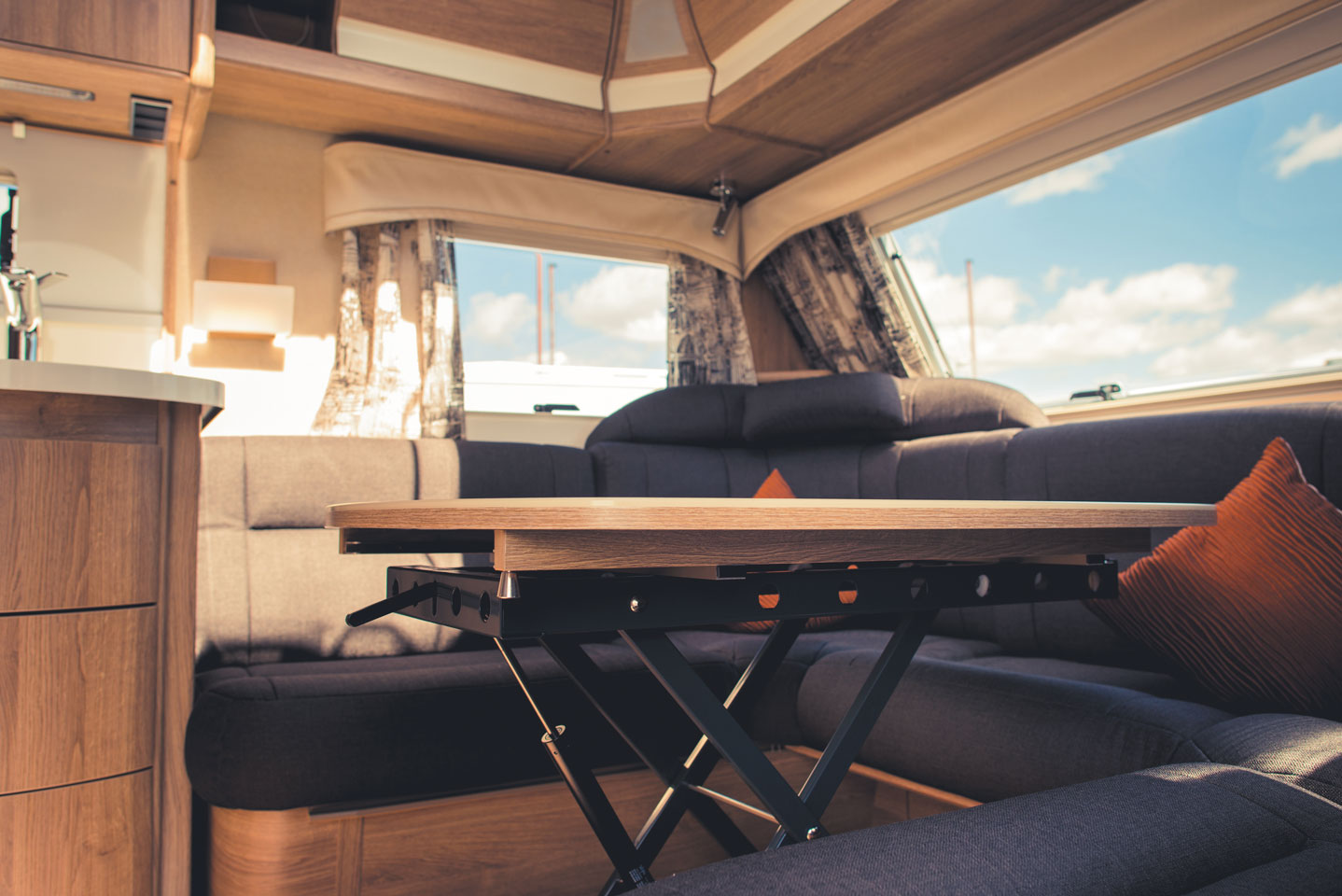
Ensure that an RV has adequate space for sleeping and eating before you contemplate wish list amenities.
Some RV makers also may publish a net carrying capacity (NCC), which is the maximum weight of all personal belongings, food, fresh water, propane, tools, dealer-installed accessories, etc. that can be carried by the RV.
A more comprehensive glossary of terms and safety ratings pertaining to RV weights is on the RV Safety & Education Foundation website: www.rvsafety.com/tools/glossary. Again, the point is that even though space may be plentiful, it’s important to know how much weight an RV can carry.
When RVing in cold weather, a few specialty items might be considered necessities, such as dual-pane window glass; a heated and insulated plumbing wet bay, including the holding tanks; and thicker walls, floors, and ceiling stuffed with heavier insulation.
People who like to camp off the grid need a robust battery bank and perhaps a sophisticated inverter and a solar array. Extended camping when not connected to campground utilities requires a personal commitment to conservation and discipline regarding the RV’s electrical and plumbing systems.
Also, be sure to secure a suitable storage site before purchasing an RV. Unless the plan is full-time RVing, there will be extended periods when the vehicle is not used. If you have plenty of space at your residential dwelling, it’s not usually a problem. But if you live in a neighborhood with RV restrictions (many homeowner associations have them), investigate storage facilities before you sign on the dotted line. Some storage lots may restrict the overall length of the RV.
One final necessity: Always establish a relationship with your selling dealer, especially with the service manager and perhaps the parts manager. RVs are subject to on-the-road emergencies that demand immediate attention. At such times, you want to be able to direct technical questions to someone you can trust. Perhaps they can lead you to an authorized repair facility or provide help over the phone. If they want your return business, they won’t lead you astray. So, use them as a lifeline should you run into a technical bind while traveling.
The Wish List
Possible wish list amenities are endless and subjective, depending on what a buyer desires. Some people want satellite reception or onboard Wi-Fi connectivity. It’s not uncommon for some larger RVs to be equipped with three digital televisions and a sophisticated entertainment system. Other RVers may hope for a nice, relaxing fireplace or more comfortable, upgraded seats.
The wish list might include options offered by the RV manufacturer that do not qualify as necessities. Extras can be considered, but it’s not wise to be coerced into buying items that bust your budget. It’s easy to become overwhelmed by the cool features available directly from the factory or offered by the selling dealership.
Solar battery charging may be a wish list item, but it is quickly becoming standard fare at the manufacturing level. “Solar ready” is a popular feature now offered by most RV makers.
And while most RVers can get by with a single bathroom, wouldn’t it be nice to have a half bath also? Come to think of it, an extra lava-tory might be on some people’s list of necessities!
These are but a few examples of wish list items. If you’re in the market for an RV (or perhaps a newer RV), I encourage you to compile a list of necessities and a list of extras you’d appreciate having, making sure the latter stays within your budget. As for RVing couples, I highly recommend that both of you agree on essential items and wish list items. Work out those details first.
Because of the vast aftermarket, just about anything on an RV can be modified or upgraded. Don’t be dismayed if you settle on an RV only to find it lacking something you forgot to consider fully. Professional RV service technicians can swap out appliances, add more batteries to that battery bank, slap a satellite dish on the roof, or install that new electronic whatchamacallit. Interior modifications also can be accomplished.
Many brands and types of RVs are available, at varying price points, suitable for every family with discretionary funds. By taking your time, making lists of necessities and wish list items, and staying within budget, buyer’s remorse can be avoided.
And remember, RVing is more than a hobby; it’s a lifestyle! Enjoy it by making smart buying decisions.