
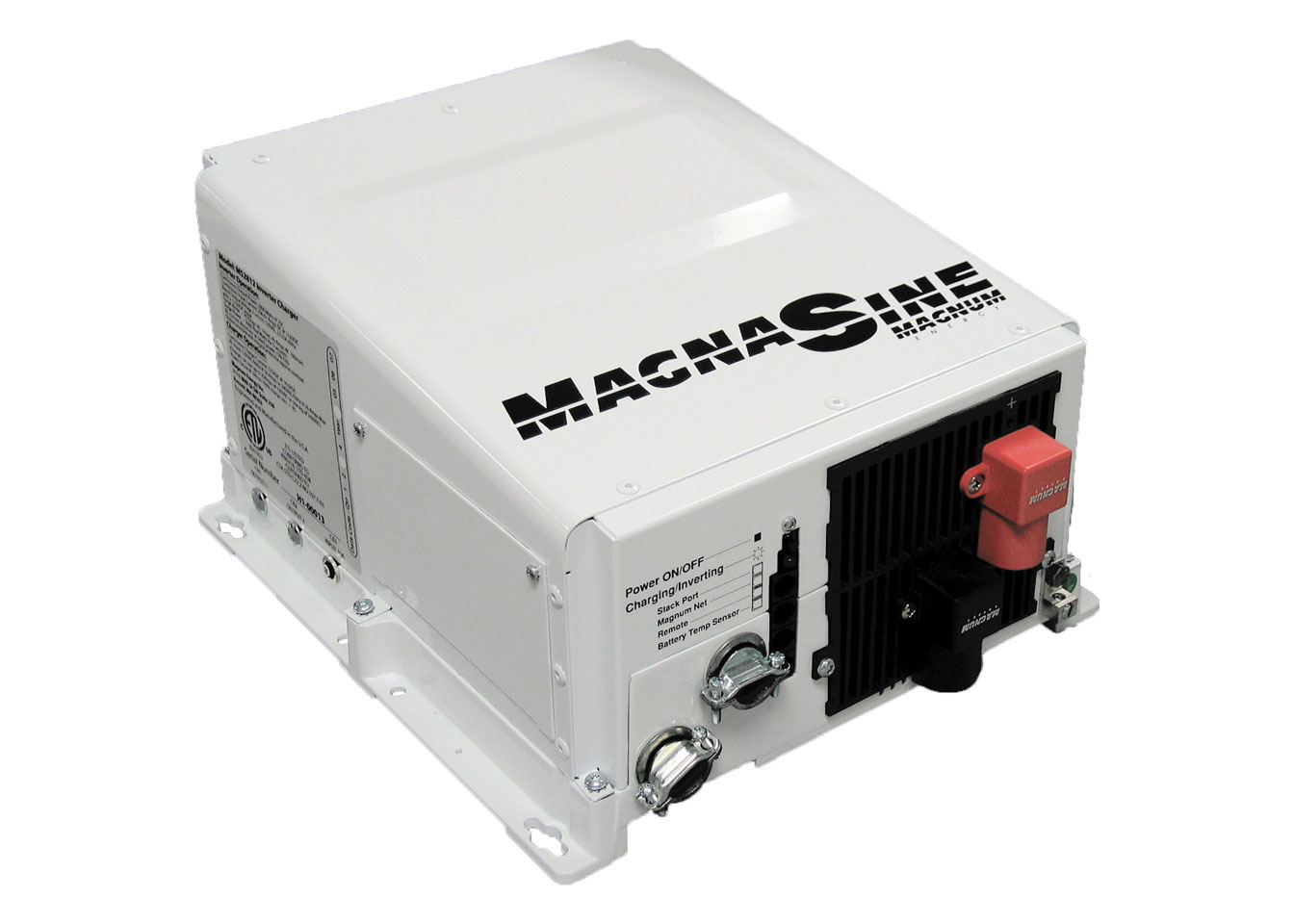
Adding this electronic accessory to an RV will satisfy certain AC power needs.
By Mark Quasius, F333630
August 2020
The electrical needs of RVs have evolved substantially over the years. In order to power today’s high-tech entertainment systems and sophisticated components such as galley appliances, heated tile floors, and multiple air conditioners, 50-amp shore power has become a must in large RVs. When shore power is not available, electrical needs can be met by a generator. But firing it up just to watch television, keep a residential refrigerator cold, or make a quick pot of coffee often isn’t practical. In such cases, the better choice is an inverter, which makes it possible to operate certain 120-volt electrical accessories without running a generator or connecting to shore power.
Inverter Overview
An inverter changes 12-volt-DC battery power into 120-volt-AC power. In that regard, it’s the opposite of a converter or battery charger, which converts 120-volt-AC power to 12-volt-DC power in order to charge batteries and to operate the RV’s 12-volt accessories, such as lights, water pumps, and fans. An inverter’s work happens electronically, so there is no exhaust or noise, which is great for quiet time at campgrounds. And using an inverter saves the fuel that would be consumed by a generator.
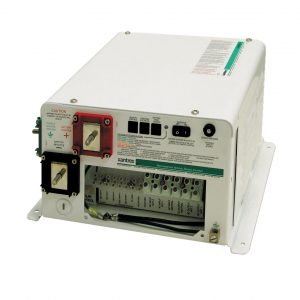
Most large inverters, such as the Xantrex RV3012 modified sine wave, have hardwired electrical connections.
Inverters do have their limits, however. Because battery power is needed to create the AC output, inverters do not work well for high-current loads, such as air conditioners, water heaters, or anything with a sizable electric heating element. The drain on the batteries would be severe, quickly depleting the charge level. That’s why inverters typically are used for short-term heavy loads, such as a microwave oven, or for smaller loads that may run for a longer duration, such as entertainment systems. Generally, larger battery banks are installed in inverter-equipped RVs to provide plenty of inverter runtime. Eventually the battery bank must be recharged, but that can happen by running the generator for a few hours at a convenient time or, in the case of a motorhome, by driving the coach.
Inverters are connected to the RV’s house battery bank with wires that are sized to handle the electrical draw. For small inverters that are used just to operate a TV, 10-gauge wire may be sufficient. A heavier wire gauge is needed as the wattage rating of the inverter increases, and also as the distance between the inverter and the battery bank increases. Correct inverter cable sizing can be found in the manufacturer’s instructions. The power output from small inverters can be hardwired to a remote electrical receptacle in the RV, or a receptacle may be mounted in the inverter itself.
Much heavier battery cables are required in larger inverters that power a number of components. Many larger units are considered inverter/chargers, and they perform two functions. They supply 120-volt-AC power from the batteries as needed, but they also serve as a converter to recharge the batteries and to supply power to 12-volt accessories when shore power is present or the generator is running. If an inverter/charger is present, a converter is no longer needed.
A small inverter such as the Xantrex PROwatt SW 600 can be used to power small entertainment systems.
The output from an inverter/charger generally is fed into a breaker subpanel to power multiple branch circuits. An inverter/charger also has an input connection for 120-volt-AC power. When AC power is present at that input, power passes through the inverter’s internal transfer switch to the output circuits. At the same time, some of the incoming AC power recharges the batteries. When the incoming AC power is no longer present, the inverter draws power from the batteries, changes it to 120-volt-AC power, and sends it to the inverter’s output circuits. Many inverter/chargers also can equalize wet-cell batteries to remove sulfation from the battery plates and restore them to full capacity.
Waveforms
All electrical components operate from a sine wave power source. Sine waves are created by the rotating fields within a generator. But an inverter has no moving parts, so it creates that output electronically. The power from RV inverters generally is in one of two forms: modified sine wave or true (pure) sine wave.
At one time, modified sine wave inverters were the popular option. Their affordability was a plus, and they worked well when powering loads such as toasters, lights, and heating elements when such electrical components were fairly simple. But today, high-tech electronics are incorporated into everything from refrigerators to entertainment systems, which may not function properly or could be damaged by modified sine waves. True sine wave inverters use more sophisticated technology that works well with sensitive electronics, and such inverters are available at reasonable prices. As a result, many inverter/chargers in today’s RVs are true sine wave.
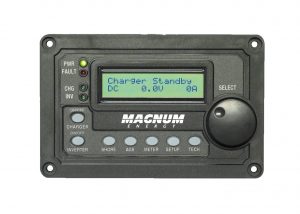
The status of the inverter/charger is shown on the Magnum Energy ME-RC50 remote display panel, which also controls various functions.
Battery Requirements
An inverter can’t create energy, but as we’ve noted, it transforms 12-volt-DC power from batteries into 120-volt-AC power. In order to operate more accessories, or to run them longer, a fairly large house battery bank is needed.
To draw 10 amps of 120-volt power from a battery bank for one hour requires 1,200 watt-hours of power, which is equivalent to 100 amp-hours at 12 volts from the batteries. But inverters are not 100 percent efficient, so check the efficiency rating on the inverter to verify its true output. For example, if an inverter has a 90 percent efficiency rating, approximately 110 amp-hours will be needed from the batteries. To avoid drastically shortening the lifespan of lead-acid battery banks, they should never be drawn down below 50 percent. Therefore, a 220 amp-hour battery bank would be needed to power that load for one hour; that’s about the rating for one pair of 6-volt batteries. After running that load for one hour, the battery bank will be depleted and must be recharged.
RV manufacturers generally supply inverter-equipped RVs with four to eight batteries. A typical bank of four 6-volt golf-cart-style batteries provides 440 amp-hours at 12 volts. Using the 50 percent rule, this means you have 220 amp-hours to work with. Adding more batteries will increase the potential runtime and will result in higher battery voltage readings when they’re in use. A 3,000-watt inverter that needs to pull 3,000 watts for a few minutes will put less strain on the batteries than a 2,000-watt inverter running at half capacity for an hour.
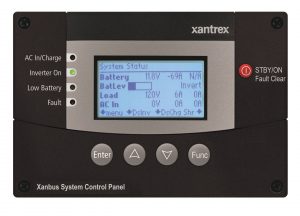
The Xanbus System Control Panel provides diagnostic information and offers comprehensive control of Xantrex Freedom SW inverter/chargers.
An example of a low-power, long-duration load is the power needed for an evening of television or DVD viewing on an entertainment system. An example of a high current, short-duration load is a microwave oven operating for a few minutes. Either of these loads is perfect for inverter use. Residential refrigerators in RVs are growing in popularity, but they are widely misunderstood in that their power draw is not as large as one would think. Such refrigerators consume medium power, and thanks to their high efficiency, actual runtime is minimal. This all assumes that the battery bank is properly sized.
Installation And Upgrades
First, a reminder: If the following procedures are outside your comfort zone, or if you do not possess the appropriate skills, have a qualified RV service technician or electrician do the work.
An existing modified sine wave inverter can be replaced with a similar-sized true sine wave inverter or one with a larger output capacity. A larger inverter requires more battery current to achieve higher output levels, so it might be necessary to replace the inverter battery cables with a heavier gauge. Consult the inverter’s owners manual for the specified size. If you keep the same size of inverter, the existing cables should be fine, but verify that by checking the manual.
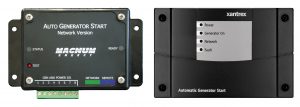
Automatic generator start (AGS) modules that automatically activate a generator are offered by Magnum Energy (left) and Xantrex (right).
Also check the size of fuse that should be installed in the battery cable to protect the inverter and DC cables in the event of a short circuit or overcurrent loads. The AC circuits should be able to remain the same unless a fairly small inverter is replaced with one that has a much larger output. In that case, it’s best to treat it as a new installation.
Upgrading an inverter generally means replacing the inverter’s remote display panel with a new one. You may be able to use the existing communications cable from the inverter to the control panel, but in some cases a new network communications cable may be needed. Again, get that information by consulting the manual or contacting the manufacturer.
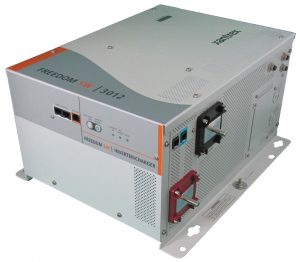
The Xantrex Freedom SW series of true sine wave inverter/chargers includes 2,000-watt and 3,000-watt models.
To add an inverter to an RV that doesn’t have one, you’ll need to do some research. First, consider where to mount the inverter. An inverter generates heat, so it should be installed in a large basement area or in a smaller, vented compartment that is dry. Placing the inverter close to the batteries helps to reduce the voltage drop that occurs when attempting to pass large amounts of current through the battery cables. However, never place the inverter in the same compartment as the batteries, as heat from the inverter could ignite explosive battery gases. If the inverter must be placed far from the batteries, you may need to increase the gauge of the battery cable.
Once the inverter mounting location and cable requirements are established, plan how to connect AC devices to the inverter. A small inverter may be used to power a TV and a few entertainment system accessories, such as a DVD player and a satellite receiver. If a receptacle is built into the inverter, simply locate the inverter close to the entertainment system, making certain to run adequate DC wiring to the batteries. A 450-watt inverter may require only #8 or #6 wiring, depending on the length of the cable run. If the inverter has a fused hardwired output, you should place it in a basement area closer to the batteries to minimize the voltage drop, and then run longer AC wiring to a receptacle near the entertainment system. Some inverters do not have pass-through AC power, so you must unplug devices from their normal outlet and then plug them into the inverter. Inverters that do have pass-through power, such as the Magnum Energy MM612 or the Xantrex Freedom X, can be located anywhere in the AC line and controlled via a remote display panel.
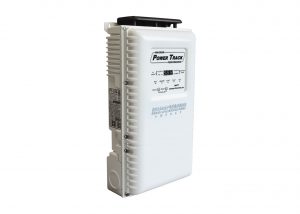
The Magnum Energy PT-100 charge controller harvests energy from solar panels and delivers it to the batteries.
Large inverter/chargers can provide power to many circuits. Generally, the main breaker panel feeds such inverter/chargers with 120-volt power, which is used as bypass power and to charge the batteries when generator or shore power is present. The inverter/charger’s output goes to a subpanel; circuits fed by the inverter (such as a microwave oven, various receptacles, and a residential refrigerator) are connected to the subpanel. If you plan to install an inverter in an RV that doesn’t have one, you’ll probably need to add a subpanel. However, in some cases it’s possible to replace the main breaker panel with a combination breaker panel/subpanel in one box.
An inverter can perform only as long as it has adequate battery power. Unless you are simply adding a small inverter to power an entertainment system, additional battery capacity most likely will be needed. The size of the battery bank depends on the expected load and how long it will run. After determining the number of batteries you need, make sure there is enough space to install them. Wet-cell batteries release hydrogen, so they must be located in a vented area. AGM batteries are more expensive but do not release significant amounts of hydrogen. Many inverters can handle lithium batteries, but check with manufacturers regarding compatibility.
Inverter Options
The most common option is a remote display panel, which controls an inverter’s functions and setup parameters. The panel connects to the inverter via a communications data cable, most likely a four-conductor, twisted-pair cable or a category 6 (cat 6) cable similar to that used in a computer network. Often, other accessories can be controlled from the panel. Magnum Energy’s Battery Monitor Kit displays exact state-of-charge information for the battery bank.
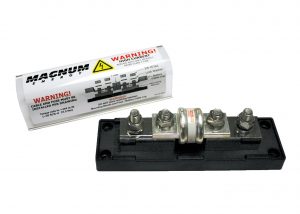
Large-capacity fuses should be placed in an inverter’s battery cable feed to provide overcurrent protection.
Automatic generator start (AGS) modules can be used to monitor the battery voltage so that when voltage drops below a set level, the generator automatically starts. AGS also can be used to start the generator should shore power fail while the air conditioner thermostat is calling for cooling, which is an invaluable feature for people who leave their pets unattended in the RV. Some remote display panels now are equipped with Bluetooth wireless networking, which allows users to view system information on a smartphone or tablet.
A result of the recent trend toward multiplex communications systems in RVs is that numerous accessories — including lighting, HVAC systems, water systems, and power window shades — are controlled by a whole-coach display panel. The generator and inverter also can be operated via the panel.
Most inverter/chargers contain an internal transfer switch to toggle between incoming generator or shore power and the power from the inverter and battery bank. It’s an either/or situation, switching back and forth between the two sources.
One exception is Magnum Energy’s MSH series of hybrid inverter/chargers. The inverters in these devices can supply an extra power boost. For example, with the inverter/charger supplying an added 2,000 watts, if needed, an 8,000-watt generator can provide the power of a 10,000-watt generator. The operation is controlled by a Precision Circuits energy management system. For RVers, the advantage is in using a generator that weighs less and consumes less fuel.
Summary
Many RVers turn to inverters to meet their electrical needs when other forms of power are not available. An inverter also can be invaluable when it’s not practical to run a generator. An inverter provides a quiet, emission-free power supply for light loads over a long duration, or for heavy loads for a brief time. In short, inverters help keep RVing enjoyable.
More Info
Magnum Energy
(800) 553-6418
www.magnum-dimensions.com
Xantrex
(800) 670-0707
www.xantrex.com