
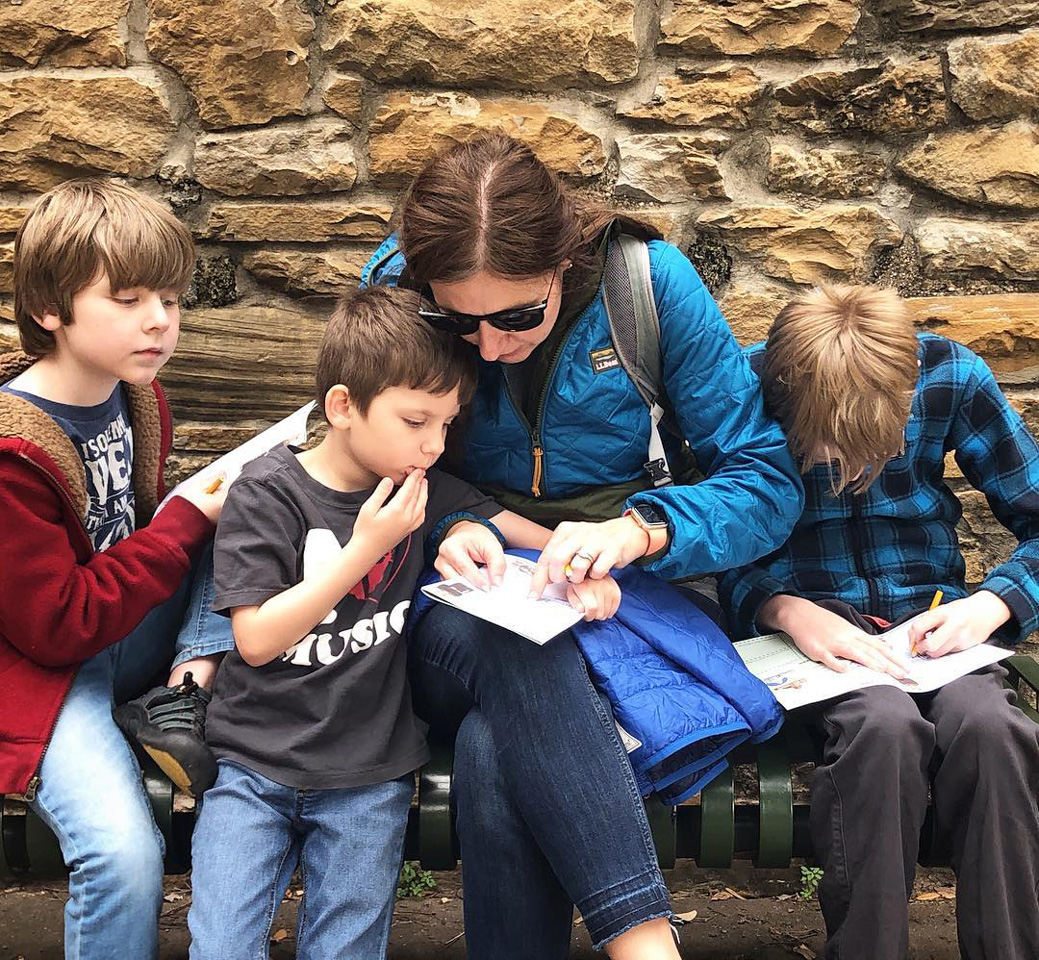
For roadschooling families, the world is their classroom.
By John Johnston, Associate Editor
September 2020
Keith Sims’ three young boys were thrilled this year when he suggested taking an RV trip to a Florida hot-air balloon festival, with one condition: “If we’re going to do it,” he told them, “then we need to study ballooning — the history of it and the science of how it works.”
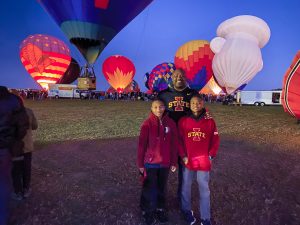
Keith Sims and sons Jayson and Keith Jr.
That was fine with the Sims kids — Keith Jr., 11; Jayson, 10; and Justin, 8. Considering that Justin was 5 and Jayson was 7 when they memorized all the chemical elements in the periodic table, studying ballooning was a breeze. “They loved it. They couldn’t wait to get down there,” Keith said. “We love RVing. And then to tie that into the balloon festival, and for the first time ever to go up in a (tethered) balloon, which we just studied in science, was phenomenal.”
Keith and his wife, Tia, F452083, are staunch proponents of roadschooling, which essentially is homeschooling on the road. It’s unclear how many children are being educated this way today, but it’s certainly plausible the numbers will rise in the wake of the coronavirus pandemic as RV sales surge and more families become accustomed to working and learning remotely.
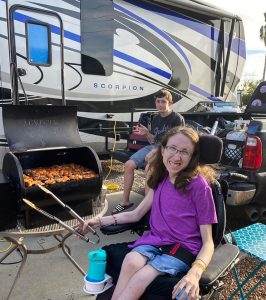
Emily and Daniel Benson cook at a rally.
“We try to plan our trips based on what we’re studying,” Keith said. And sometimes it’s the other way around. What the kids study may depend — at least in part — on where the Georgia-based family plans to travel in their Newmar Dutch Star motorhome. Although not full-time RVers, the Sims family travels extensively.
Roadschooling families can tap a vast teaching laboratory. It ranges from urban to rural settings, and it includes parks, historic sites, science centers, libraries, museums, and nature preserves. It exposes children to diversity in cultures, landforms, and climates.
Family RVing interviewed three roadschooling families. Each agreed there’s no one-size-fits-all formula for roadschooling; everyone develops a style that fits their situation.
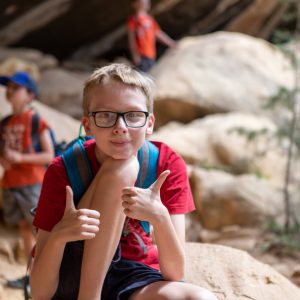
A thumbs-up from Jack Epperson.
Abby and Jason Epperson, F488212, have been roadschooling their children — Jack, 13; Ethan, 10; and Henry, 7 — since becoming full-time RVers four years ago. They home-schooled for two years before that. These days, they travel in a Heartland Pioneer QB300 travel trailer.
Embarking on roadschooling or homeschooling is a major lifestyle shift that can be overwhelming, Abby said. When her family started homeschooling, she followed a recommendation to “de-school,” and is glad she did. For eight weeks, the Eppersons put aside “formal” education; instead, Abby and her children played games, visited parks, created art, and the like.
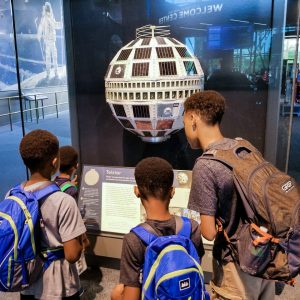
Jayson, Justin, and Keith Jr. Sims at a space exhibit.
“You need to give yourself weeks, maybe even a couple of months, and just be. Don’t jump right into, ‘Oh, I’ve got to have this schedule; we’ve got to do this schoolwork; we have to get our education going.’ You and your children are going through a wonderful time of transition, and you need to use that time to get to know your kids and the kind of learners they are, and the kind of learner you are,” Abby noted.
Eric and Triann Benson, F470701, homeschooled their 18-year-old daughter, Emily, and 14-year-old son, Daniel, before becoming full-time RVers and roadschoolers four years ago. They travel in a Winnebago Scorpion toy hauler.
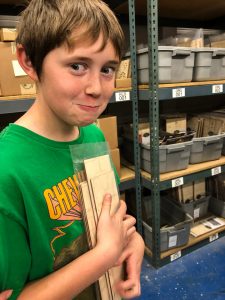
Daniel Benson on a factory tour.
They were initially drawn to home-schooling because Emily, who was born with spina bifida and uses a wheelchair, missed a great deal of traditional school due to surgeries. At first, the Bensons tried to replicate the schedule of a traditional school system. But they soon found that their children could achieve more in less time compared to a classroom setting with 25 or more children, because there are far fewer disruptions.
“I can speak to (my son) in a way that he needs to hear,” Eric said, “and I can speak to (my daughter) in a way she needs to hear. So then in a fraction of the time (of a traditional classroom), we accomplish the same thing and move on to something else that gets them excited.”
Keeping kids engaged is key. At first, Triann said, her mindset was: “I paid for this math curriculum and we are doing it to the end. But if everybody’s in tears every night, it’s just not worth it. So, you have to let it go and find something different. There is so much (curriculum) available, no one should be suffering through that.”
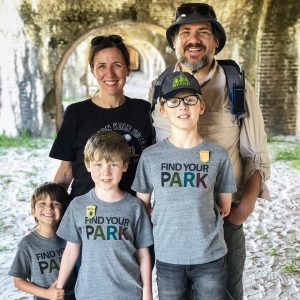
Abby and Jason Epperson, and from left, Henry, Ethan, and Jack.
Roadschoolers often rely on other families for advice about what works. “Our mantra with anything RV-related is that the community is everything,” Eric said. “You learn from friends and peers and families when you’re sitting around a campfire and sharing frustrations.” As a result of such conversations, the Bensons have switched or swapped curriculums a number of times.
With roadschooling, a certain amount of trial and error is inevitable, Jason Epperson said. “We’ve had lots of failures. But what we’ve learned from a lot of other full-time families is that if we can instill excitement about learning in the kids, they can find things they want to learn about. The end goal is to prepare them for a lifetime of learning.”
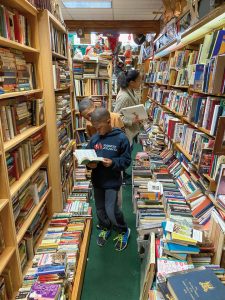
Tia, Justin, and Jayson Sims peruse titles at a bookstore.
One way roadschooling instills excitement is by bringing history alive. A couple of years ago, the Eppersons followed the Lewis & Clark National Historic Trail through Nebraska and into South Dakota. “Ethan, who had just turned 7, really became enamored with the Corps of Discovery,” Abby said. In Nebraska, a campground neighbor brought them the Ken Burns “Lewis & Clark” film documentary. “Our children, particularly our 7-year-old, sat there enthralled by the documentary, because they were experiencing on the road the places that were being talked about.”
Roadschooling also provides parents the option of focusing on subject matter that traditional schools devote little or no time to. The Sims family, for instance, has incorporated numerous African-American museums into their travels. “It’s important for us as minorities,” Keith said. “We study our history as African-Americans, and native American history as well.”
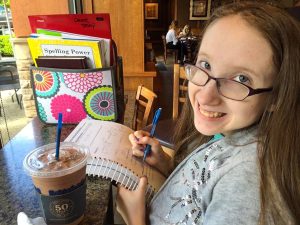
Emily Benson studies in a coffee shop.
A few years ago, the family experienced a particularly powerful lesson. In Selma, Alabama, they spent several days diving deeply into civil rights history. On the day commemorating the 52nd anniversary of “Bloody Sunday,” the Sims family joined thousands of others in walking across the Edmund Pettus Bridge, where police brutally attacked civil rights demonstrators in 1965.
“My wife and I were almost in tears,” said Keith, who had never been to the bridge. “One of the greatest things about roadschooling is we get to experience things, sometimes for the first time, with our children.”
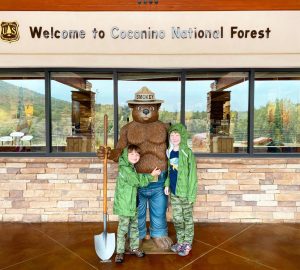
Henry and Ethan Epperson learned about fire safety at Coconino National Forest.
Teaching those civil rights lessons was important, Keith said, even though he acknowledges that at the time his children were too young to fully grasp the significance. He and his wife also know that historic sites that tell the story of slavery in America can weigh heavily on youngsters. “If we go to one of those, we make sure the same day there’s something just pure fun for them to do.”
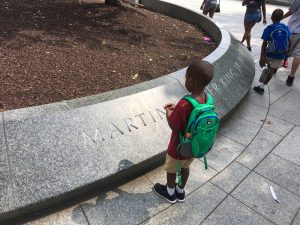
Justin Sims at a Martin Luther King Jr. memorial.
The Bensons, too, recognize the educational value of hands-on learning. Children can read about the Grand Canyon and view photos in a book or online. “But until you actually see that thing, spend a day listening to (park) rangers, and look at displays, there’s no impact,” Eric said. “Until you stand by it and look down, there’s no connection. That’s a life-changing moment.” Such experiences have sparked questions from their kids and become catalysts for additional study.
A good deal of learning also takes place within the daily routine of life on the road, families say.
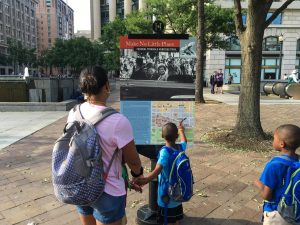
Tia and Justin Sims at the Federal Triangle Heritage Trail in Washington, D.C.
For the Bensons, that can mean putting a child in charge of meal planning for a day with the goal of staying within a budget; or calculating fuel mileage and average price per gallon; or planning trips by reading maps. What’s more, news of the coronavirus pandemic has spurred discussions about economics and money.
In fact, roadschooling lends itself to a variety of educational approaches. Some parents use packaged curriculums and expect children to devote certain hours each day to learning. Other parents shun such structure, believing that learning should be entirely experiential, an approach dubbed “unschool.”
“We’re somewhere in between,” Eric Benson said.
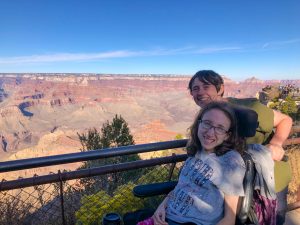
Emily and Daniel Benson at Grand Canyon National Park.
His wife, Triann, said, “Our kids have to know math, and they have to know how to write. So, we have curriculums for math and language arts. I love history, so we have a history curriculum.” But when the opportunity arises to visit a museum or science center, and they can delve into a particular educational theme for a week or two, the curriculums can be set aside temporarily. “There’s flexibility,” she said.
Such flexibility allows children to spend more time on what interests them.
“Our kids love science centers,” Keith Sims said, which typically feature interactive, hands-on activities. “They have been in science centers from Florida to Maine. Everywhere we go, there’s a science center.”
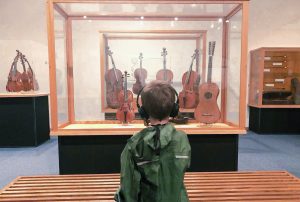
Henry Epperson learns about a Stradivari violin via an audio tour at the National Music Museum in Vermillion, South Dakota.
But roadschoolers generally must do without some of the activities offered by traditional schools, such as organized team sports.
“You do have to weigh that,” Abby Epperson said. Her children haven’t shown an interest in sports. But finding ways for them to socialize with others their age has never been a problem, she said. The Eppersons are members of Fulltime Families, an RV club that offers an online book club for kids, a scouting program called Explorers Club, and opportunities to gather at rallies. “If you put the effort into it, you can find your village for you and your kids,” Abby said.
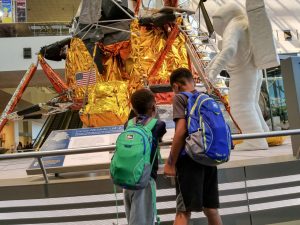
The Sims family’s stops in Washington, D.C., included the National Air and Space Museum.
Triann Benson said she knows a few roadschooling families who return to their home base for their children’s sports season, but that’s rare. It’s much more common for roadschoolers to make friends in other ways, ranging from RV clubs to virtual campfires via Zoom.
Keith Sims is a former NFL player. His son Keith Jr. wants to play football. So far, his parents have allowed him to play only flag football. “When he gets to be 13,” Keith said, “we may have to decide what to do, and maybe consider backing off travel in the fall so he can be part of a team.”
In the meantime, the entire Sims family has taken up karate. Keith Jr. has earned his black belt. In the past year and a half, the family has traveled by RV throughout the Southeast to his tournaments. “We roadschool when we’re doing our athletic endeavors,” Keith said.
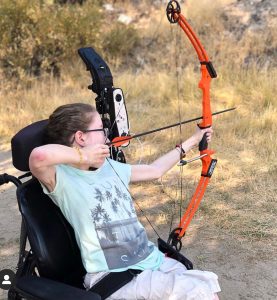
Emily Benson gets an archery lesson.
The roadschooling parents interviewed by Family RVing don’t take lightly their responsibility to educate their children.
“There’s definitely a little bit of a burden and pressure,” Jason Epperson said, “but there’s also the freedom and excitement of knowing you’re in control of (their education), and they’re learning what you want them to learn, the values you want them to learn.”
Eric Benson acknowledged that while growing up, he experienced struggles at school. Roadschooling allows him and Triann to tailor their children’s education to fit their needs. “I have no question they’re going to come out of this with a strong education,” Eric said.

The Sims family viewed the 2017 solar eclipse in South Carolina.
The time and effort roadschooling parents expend for their children is worth it, Keith Sims said, not only for educational reasons, but also because it strengthens relationships.
“I want my kids to have these memories with their dad and their mom, and to think back on all the places we went and say, ‘I didn’t hate being around my parents. I loved it.’
“We only get so many summers, so many weekends, so many opportunities to pour into our children, whether it be spiritually, educationally, or emotionally,” he said. “We’re out here trying to raise good, strong, well-rounded young men, and that’s not easy in this world.”

The Benson family saw the 2017 eclipse in Idaho.
He sees the rewards that roadschooling offers. “I believe in what it is doing for our kids.”
Roadschooling Resources
The laws and regulations for roadschooling/homeschooling vary by state and province. Applicable regulations are determined by a family’s legal residence. Some states and provinces require reporting of test results to ensure that standards are being met, but others have no such requirements.
For more information, visit:
Coalition for Responsible Home Education
https://responsiblehomeschooling.org/
ProPublica
https://projects.propublica.org/graphics/homeschool
Homeschool Canada
https://homeschoolcanada.ca/homeschooling-by-province/