
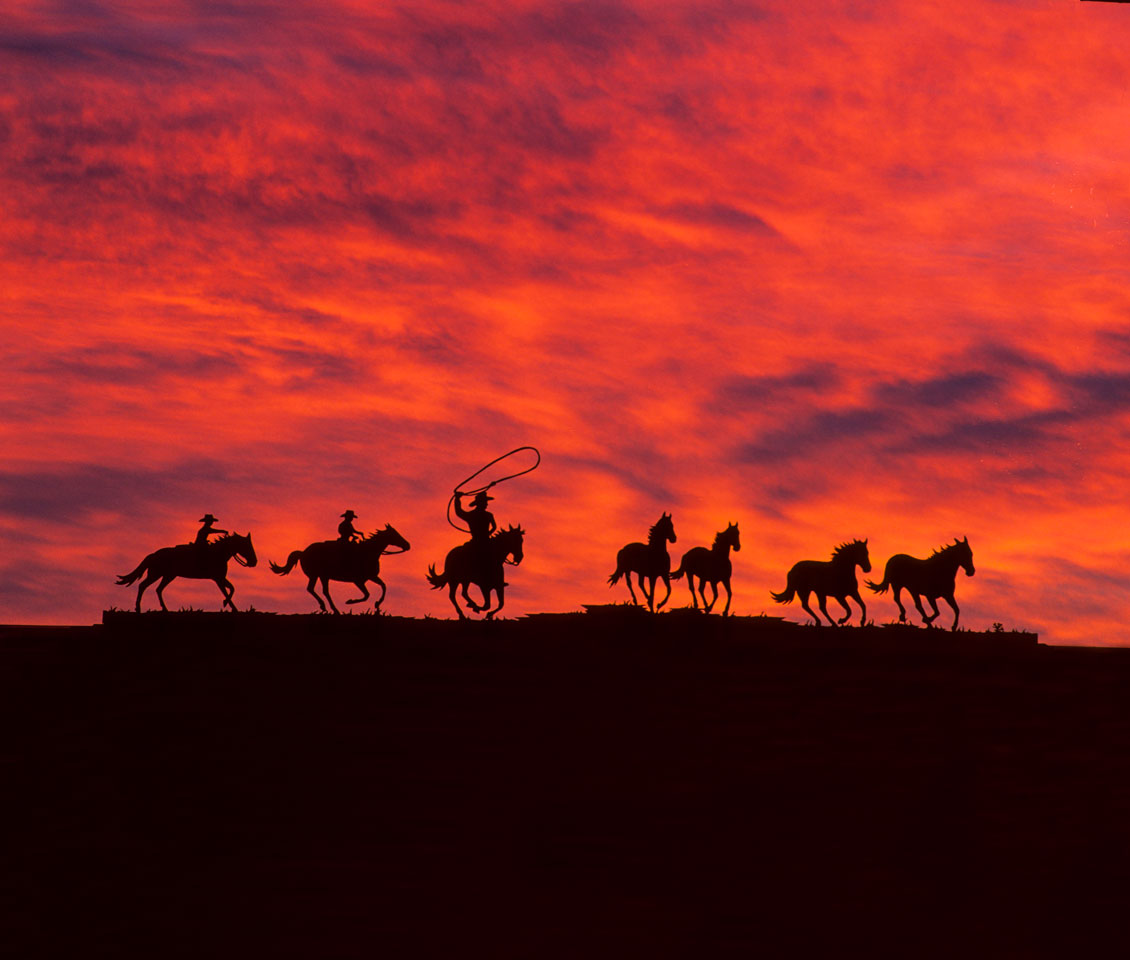
Oregon’s leathery side treats RV travelers to a darn tootin’ good time.
By Rhonda Ostertag
October 2020
Since the 1870s, Oregon’s high desert, eastern river valleys, and mountain prairies have paired easily with lowing cattle, hay, and dusty boots. Motorists enjoy a windshield cinema of sagebrush seas, wind-plaited grasses, cattle, horses, tractors, barns, corrals, windmills, rustic fences, deserted homesteads, and deer and antelope.
Several authentic Western towns, where cowboys reach for Stetsons out of habit, promise intriguing experiences for those who explore.
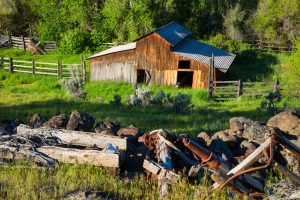
Ranching heritage is preserved at Riddle Brothers Ranch National Historic District.
Travel note: Attractions described in this article may be temporarily closed because of COVID-19 restrictions. Please call ahead or consult the state travel bureau (www.traveloregon.com; 800-547-7842) before you visit.
Burns
The cowboy mystique runs strong in Burns, situated off U.S. 20/U.S. 395. High-desert sagebrush, shallow lakes, and waterfowl fashion the countryside. Also noteworthy is 50-mile-long, 9,700-foot-high Steens Mountain — the highest drive-to point in Oregon (requires a high-clearance vehicle, but worth it).
In these parts, cattle outnumber people 14 to 1. Early ranching followed the Mexican model, which was brought north from California. Cattle barons emerged from the start, such as Bill Hanley, a political progressive and wildlife conservationist whose property now makes up Malheur National Wildlife Refuge. Others included John Devine, Henry Miller, and the controversial Peter French. Their workers were known as “buckaroos.”
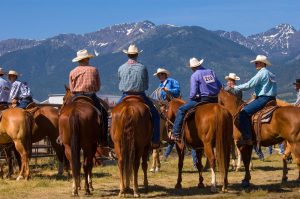
Cowboys and their steeds gather at the Haines Stampede rodeo.
Cowboy lore tells of land squabbles and a shooting sure to sit young boys on their heels. In 1897, an irate homesteader shot French in the head, in front of French’s men. The homesteader went to trial but was acquitted by a jury. A modern-day standoff by those occupying the land at Malheur National Wildlife Refuge adds another colorful chapter to the tale.
The Harney County Historical Society Museum, and the byways and highways that part the region, roll out imagery of the working West. Byways include The High Desert Discovery Scenic Byway (State Route 205), the East Steens Tour Route, and the Diamond and Steens Mountain loops.
At the western outskirts of the towns of Burns and Hines, the BLM Wild Horse Corral Facility houses the Western emblems rounded up for auction. Kiger wild horses from Steens Mountain can be traced to Spain and may show characteristic markings: stocky build, tailbone stripe, dark manes, and barred hocks. Surplus removal is necessary to maintain a sustainable herd for healthy land and animals.
In Harney County, a dramatic sunset bathes the sky.
Peter French Round Barn, a State Heritage Site on Diamond Craters Road, off State Route 78, traces to the approximately 200,000-acre cattle empire of Peter French and Hugh Glen. The barn, with circular tracks and an inverted-umbrella central brace, was designed for exercising horses during the brutal high-desert winters. Local ranchers initiated the barn’s placement on the National Register of Historic Places.
On the south side of Steens, near primitive South Steens BLM Campground, visitors can hike an old ranch road to an untouched archive of cattle and horse ranching at Riddle Brothers Ranch, a National Historic District. Here, a trio of bachelor brothers maintained separate residences and broke wild horses to sell to the U.S. Cavalry during World War I. One brother financed the local school. Another had cats, 40 of them, that consumed 3 gallons of milk morning and night.
Byways lead past two operating historic cowboy waysides: the two-story Hotel Diamond (on Diamond Loop) and the eight-room Frenchglen Hotel State Heritage Site (on State Route 205). Both serve family-style dinners; reservations are required. Frenchglen also offers home-style breakfasts and lunch.
Lakeview
In the great emptiness of southeast Oregon, Lakeview, on U.S. 395, represents the “urban” heart. Cattle and sheep ranching suited the climate and terrain here in the northwestern extent of the Great Basin, a mosaic of alkaline lakes and marshes, high-desert scrub, and pine-juniper forests.
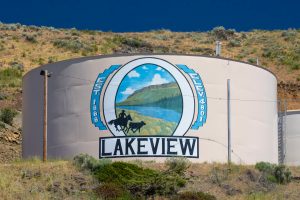
A mural adorns a water tank along the Oregon Outback Scenic Byway.
The first ranchers came seeking room to spread. A new breed of ranchers arrived from California, bankrolled by investors in Sacramento and San Francisco. The Homestead Act brought families trying to make it by practicing dry farming. But hard work, hard times, and heartache ensued, dotting the landscape with ghostly structures and the state map with names of long-gone places.
Lakeview, elevation 4,800 feet, bills itself as “Oregon’s Tallest Town.” Bigger-than-life cowboy cutouts greet arrivals to town and to the fairgrounds, where the excitement of the Lake County Round-Up rodeo takes place on Labor Day weekend. No-frills RV sites with hookups are available. During the Round-Up, the on-site Frontier Village is open for viewing old ranch equipment and structures.
In town, the Lake County Museum houses collections of pioneer memorabilia, both permanent and rotating. Western murals decorate the water tower and the walls of businesses. And, in northern Lakeview, the Old Perpetual geyser shoots steam and spray skyward, announcing Hunter’s Hot Springs.
In springtime, drives around the area will reveal purple fields of camas and balsamroot-decorated sage. Cattle, some free-ranging, fix inquisitive stares on motorists. Antelope shelter in hayfields or churn dust in effortless races across the desert. Across the sky, sandhill cranes lend striking voice and silhouette.
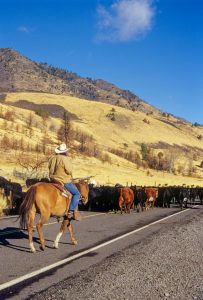
A cattle drive trundles along the Oregon Outback Scenic Byway.
Lakeview, together with Goose Lake to its south, shapes the southern access to Oregon Outback Scenic Byway. Lakeview to Steens Mountain Back Country Byway, stringing northeast from Lakeview and State Route 140, leads to the serial shallow lakes of Warner Wetlands, Hart Mountain National Antelope Refuge, and Camp Hart Mountain (a one-time Civilian Conservation Corps camp). Primitive camping is available at the base of Hart Mountain. Cliffs above the camp are home to bighorn sheep.
The wetlands’ lakes live on a 10-year drought-fill cycle and offer great canoeing during the fill cycle, plus birding anytime.
Pendleton
Despite the wheat fields and wind turbines that prevail around Pendleton, a century ago the cattle trade ruled. The town’s signature event — the Pendleton Round-Up, which occurs the second full week in September — honors that origin. The century-old event combines rodeo prowess with Wild West Show pageantry and local flavor — wild cow milking, stagecoach racing, and more.
From its beginning, the rodeo spotlighted American Indian performances and athletic skills, dance, art, and storytelling. During Round-Up week, Indian artisans gather at Roy Raley Park to sell their quill, bead, woven, metal, and clay crafts.
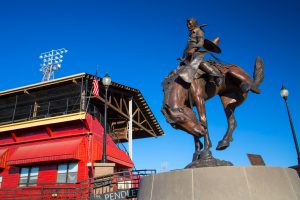
Let ’er Buck, a statue beside Pendleton Round-Up Arena.
The rodeo’s red stadium rivals the charm of the old-time baseball stadiums in the East. Across from it sits the Round-Up and Happy Canyon Hall of Fame, which celebrates the event, its memorabilia, and cowboy and American Indian history. More history unfolds at the Heritage Station Museum near the railroad tracks.
A life-size statue of Sheriff Tillman “Til” Taylor, who was killed in the line of duty, stands in his namesake park. He was an iconic Round-Up founder. In 1911, when judges unfairly passed over Black contestant George Fletcher for Saddle Bronc Champ and the silver saddle prize, Sheriff Taylor snatched Fletcher’s hat, cut it into pieces, and sold the pieces to the crowd. He then presented the $700 prize to Fletcher, the “people’s champion.”
On a traffic island near Til Taylor Park, a statue honors Esther Motanic, the Round-Up’s first American Indian queen. A bronze statue on Main Street depicts Fletcher and the chopped hat. Other rodeo figures also adorn the street.
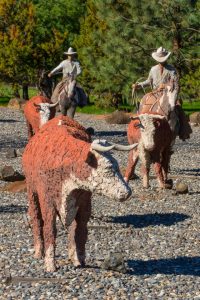
Sculptures in Pendleton give a nod to Oregon’s cowboy culture.
The tradition of Pendleton Woolen Mills continues, with quality blankets of distinctive design. Wildhorse Resort & Casino, southeast of town off Interstate 84, offers an RV park, gaming, and powwows. Exhibits at the Tamástslikt Cultural Institute, which interprets Confederated Tribes’ cultures, provide an awakening, and an educational look at historical events from a different perspective.
Restaurants serving up hearty cowboy breakfasts, and town shops offering boots, saddles, and cowboy hats stir the “Howdy” buried in everyone.
Baker City/Haines
While the discovery of gold populated Baker County, ranching to supply the miners put Baker City on the map. In the late 1860s, the first settlers began grazing herds in the natural pasture bottoms along rivers and creeks.
Baker City’s museums celebrate the many roots of the county, while a trio of byways travels the mountain-valley wealth of the region: Journey Through Time, Blue Mountain, and Elkhorn. The National Historic Oregon Trail Interpretive Center honors the great migration west and the pioneer spirit, while the restored Geiser Grand Hotel relives its yesteryear shimmer.
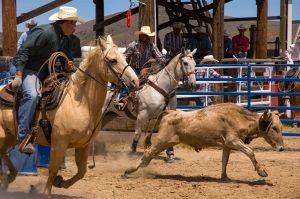
Haines hosts the Haines Stampede rodeo, which takes place each year on July 3 and 4.
Haines, north of Baker City, en route to Anthony Lake and the chiseled Elkhorn Mountains, welcomes a stop at the Eastern Oregon Museum. The Stampede rodeo takes place in the town July 3 and 4 each year. A parade, games, music, a pit barbecue, and fireworks complement the bucking high time. The museum’s collection of historical equipment overflows into town. Log buildings from bygone days adorn 1800s Park.
East of Baker City, in late June, mini competitors strut their stuff at the Hells Canyon Junior Rodeo in Halfway, located on State Route 86 (also called Hells Canyon Scenic Byway). The competitors may be tiny, but their swagger is as big as the outdoors.
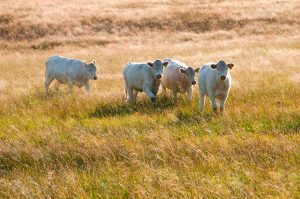
Cattle roam near Blue Mountain Scenic Byway.
If savoring dramatic scenery and exploring authentic Western locales sound appealing, these Oregon sites will provide an enjoyable RV journey.
Further Info
Travel Oregon
(800) 547-7842
www.traveloregon.com
Oregon State Parks
Information: (800) 551-6949
Reservations: (800) 452-5687
www.oregonstateparks.org
RV Camping
Baker City/Haines
Mountain View RV
(541) 523-4824
www.mtviewrv.com
Burns
Burns RV Park
(800) 573-7640
www.burnsrvpark.com
Hines
Page Springs BLM Campground
Steens Mountain Loop Road (near Frenchglen)
(541) 573-4400
www.blm.gov/visit/page-springs-campground
Lakeview
Junipers Reservoir RV Resort
(541) 947-2050
www.junipersrv.com
Pendleton
Pendleton KOA
(541) 276-1041
www.koa.com/campgrounds/pendleton
Wildhorse Resort & Casino RV Park
(800) 654-9453
www.wildhorseresort.com