
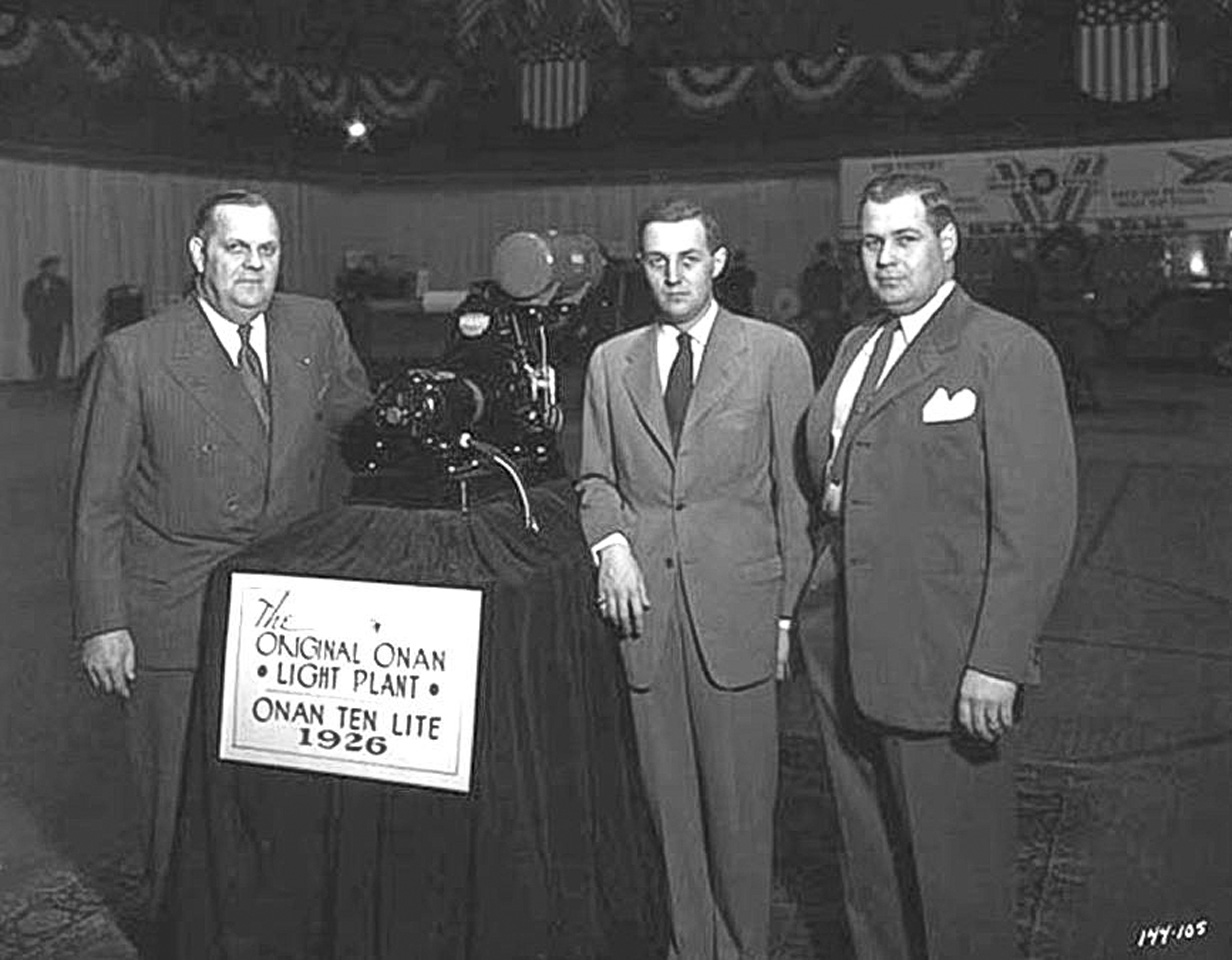
By Steve Froese, F276276
November 2020
What brand of permanently mounted RV generator comes to mind first? I predict most RV owners would say Onan, which is made by Cummins. While several generator brands are in use by the RV industry, Cummins is at the forefront.
This year marks the 100th anniversary of Cummins Power Generation, and in this month’s column, I pay tribute to this iconic brand.
The predecessor of the modern generator was the electrostatic generator, which was in use before the relationship between electricity and magnetism was discovered. The electrostatic generator involved moving electrically charged belts, plates, and discs to a high-potential electrode. Such generators created very high voltage but low current. Their only practical applications were for early X-ray tubes, and later, some atomic particle accelerators.
The concept of today’s electro-magnetic generators was discovered in 1831–1832 by Michael Faraday. The principle, later called Faraday’s law, is that an electromotive force is generated in an electrical conductor surrounding a changing magnetic flux.
He also built the first electromagnetic generator, called the Faraday disc, by rotating a copper disc between the poles of a horseshoe magnet. But this early device was inefficient and had a low-output voltage due to the single-current path through the magnetic flux. Later experimentation found that using multiple turns of wire in a coil could produce higher, more useful voltages. Since the output voltage is proportional to the number of turns, generators easily could be designed to produce any desired voltage by varying the number of turns. Wire windings became a basic feature of all subsequent generator designs.
Further iterations of electrical generation were developed, leading to the invention of the AC generator. The first public demonstration of an AC generator was in 1886 by William Stanley Jr., an employee of Westinghouse.
That’s the same year D.W. Onan was born. His railroad-worker father died when D.W. was 14, so he dropped out of school and went to work at a power plant to support his family. He had subsequent jobs in the mechanical trade, and eventually shared with his employers his vision of starting a business focused on repairing broken parts of automobiles. Within 10 years, D.W. was supervising 50 mechanics and completing 100 to 125 repairs a day. He personally trained each of the mechanics working for him, and he designed and built many of the tools he needed.
In 1920 D.W. borrowed $100 to start his own business with one other employee. They manufactured and sold auto repair shop tools and equipment out of D.W.’s basement. Thus, the Onan Corporation was established. Shortly thereafter, D.W. moved his growing business into a larger building and continued to increase his portfolio of tools.
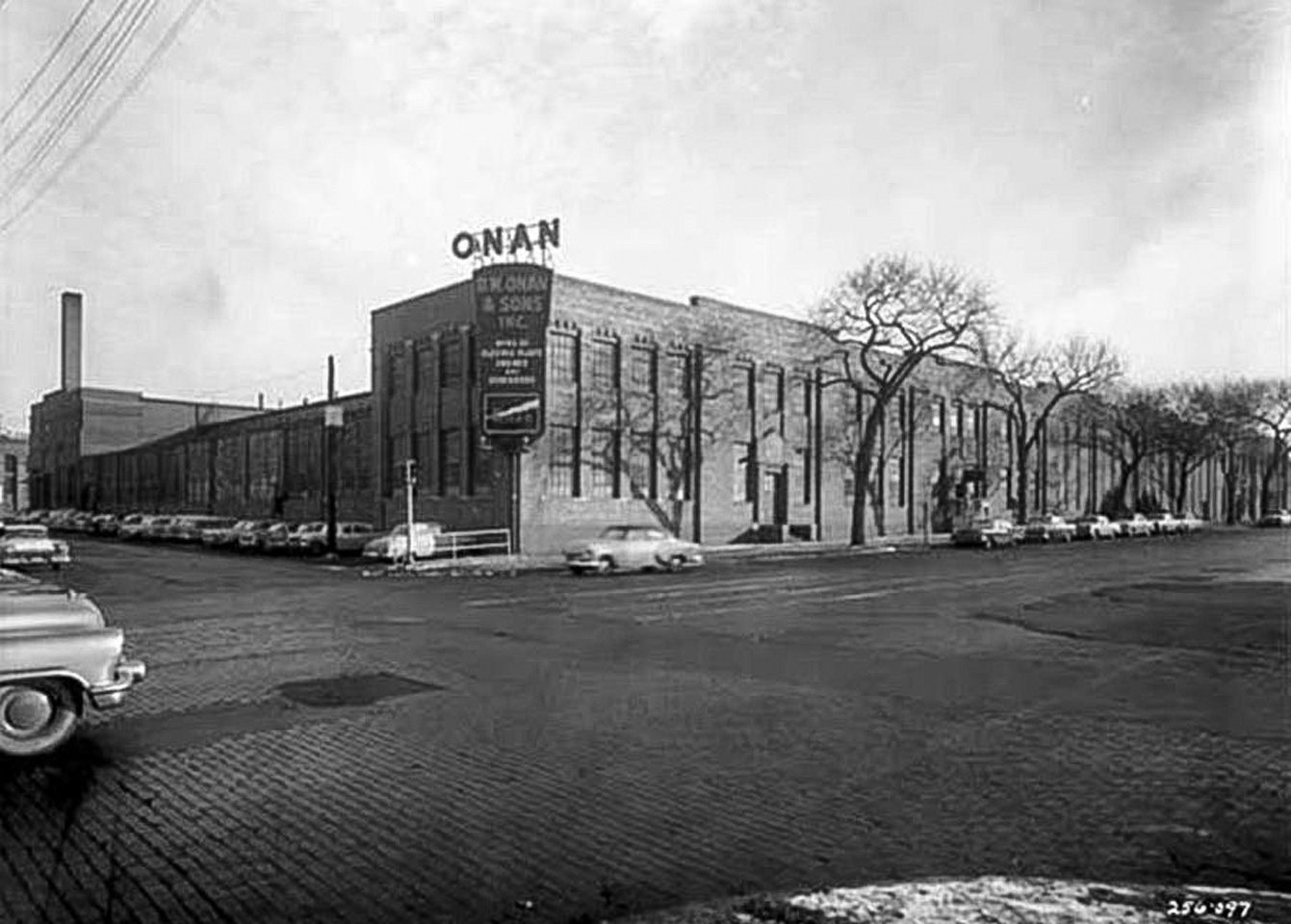
The Onan plant in Minneapolis, Minnesota, was replaced in the late 1960s.
In 1923, D.W. realized his employees were spending too much time building shipping crates for his tools, so he invented the “Safty Saw.” It was very similar to a table saw, except the blade moved instead of the wood; think of an upside-down radial-arm saw.
The Onan generator legacy began in the summer of 1926, when one of D.W.’s fishing buddies, George VanWagenen, asked him to design a generator with a gasoline engine that he could use when he was at his fishing lodge, and then “forget about it” when he wasn’t there. Intrigued with the idea, D.W., along with his 16-year-old son, Bud, worked for several months designing and building a 300-watt, 115-volt direct-current generator set. After a few more tweaks, the Onans increased the power to 350 watts. They called the machine the “Onan Ten-Lite Generator,” since it had enough power to illuminate 10 light bulbs, each 30 watts. They sold the generator for $99 plus $12 for the 30-watt light bulbs and wiring. Thus, the first Onan generator was born.
In 1927, the Cummins company, founded by Clessie Cummins, also was getting involved in power generation. As part of a diesel electrification program, Cummins was contracted by the U.S. Lighthouse Service to supply several 50-horsepower Model F generators.
Before 1930, D.W. used third-party engines. But that year, he realized that his company could solve many of its technical issues by designing its own power plant for its generators.
That also was when rural electrification was gaining popularity across North America. As a result, Onan eventually expanded its product line to include generators up to 20 kilowatts. The company also began to ship generators overseas.
In 1939, in support of the war effort, Onan was the first company to design and produce a line of aluminum opposed twin-cylinder gasoline engines with pressure lubrication, cast-iron sleeves, and replaceable bearings. It manufactured more than 10,000 per year during the war. More than half of all generators used by Allied forces were produced by the Onan Corporation.
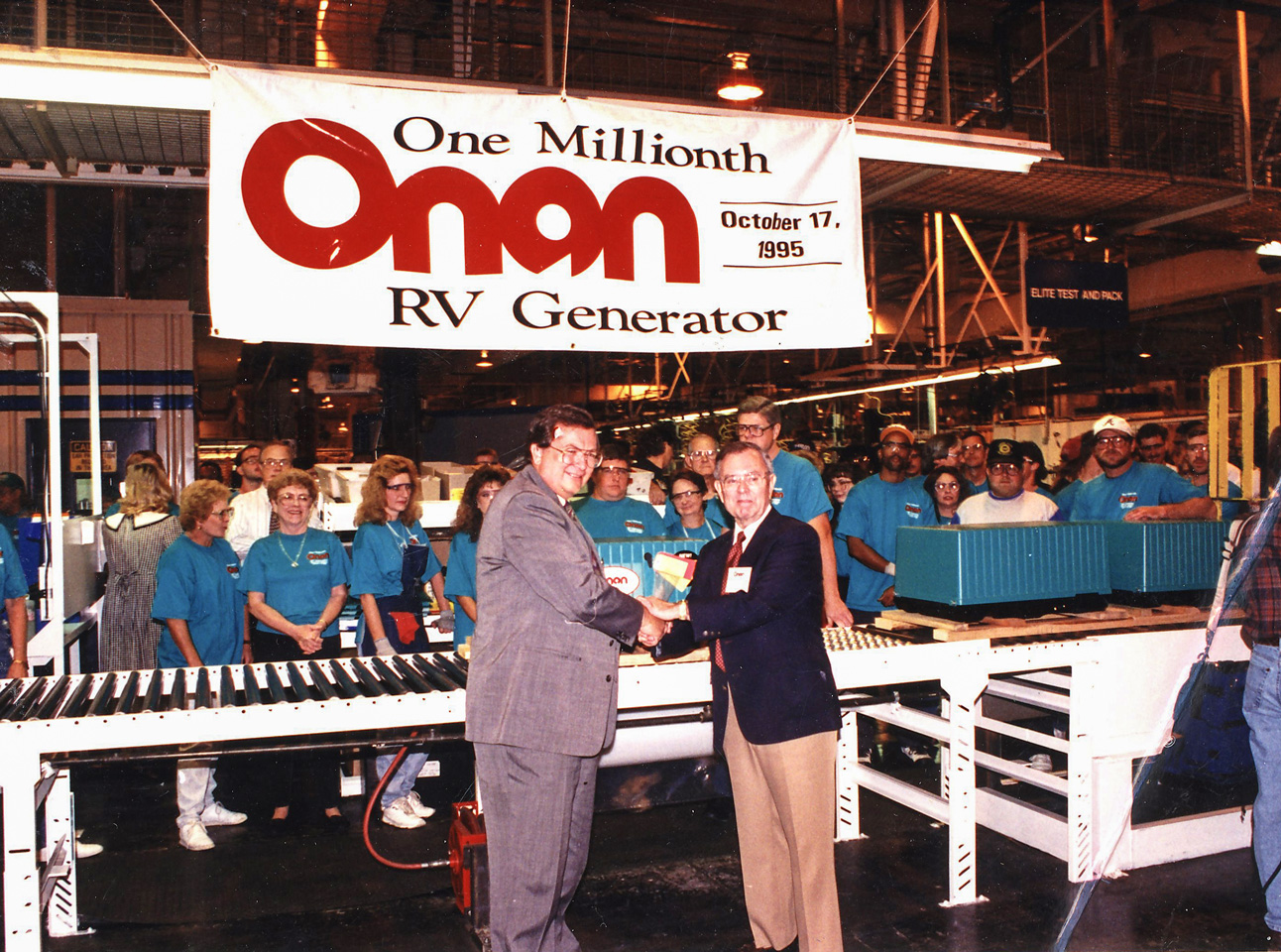
Generator production flourished at the Onan plant in Fridley, Minnesota.
Many RV owners are familiar with transfer switches, as they are a popular electrical device in RVs. In 1943, Onan introduced the first transfer switch, the Onan Power Transfer Control.
Demand for generators dropped dramatically after the war. During that time, Onan developed its first diesel engine. In 1946, Onan began selling stand-alone gasoline engines not attached to generator units.
In 1958, D.W. Onan passed away, and his son Bud took control of the company.
In 1967, the first RV generator was produced by Onan. It took several iterations, but the end result was a generator that exhibited limited noise and vibration. It revolutionized the RV industry, because owners could enjoy 120-volt power while off the grid. By 1985, RV generators represented more than half of Onan’s generator business.
Cummins and Onan began a formal relationship in 1986, when Cummins acquired majority ownership of Onan. In 1992, Cummins purchased Onan. The Onan brand continues to be used for the company’s power generation products, most notably in the RV and marine generator sectors. Outside of those sectors, Cummins combined its heavy-duty engine and generator business in 2016 into a single business unit, now called Cummins Power Systems.
In the years since, Cummins Power Systems has opened plants in Sao Paolo, Brazil; Daventry, United Kingdom; Phaltan, India; and Wuhan, China. It has expanded its product offerings and business models to include generator rentals; paralleling generators; switchgear boards; and large-scale backup power, including large liquid-cooled units. Its generator sets range in size from 2.8-kilowatt RV units to the largest, a 3,750-kilovolt-ampere powerhouse with the highest kilowatt-per-square-foot ratio in its class. Cummins provides generators powered by diesel, gasoline, propane, and natural gas, and it recently acquired a company specializing in hydrogen and fuel cells.
In 2010, Cummins celebrated a true milestone — the manufacture of its two millionth RV generator out of the Fridley, Minnesota, plant. The RV generator industry remains a key sector for Cummins.
For the RV owner, Cummins provides a full line of generators across all RV types and classes. They range from 2.8 kilowatts to 12.5 kilowatts, which is a broad enough offering to provide power for the smallest pop-up or truck camper to the largest Type A or fifth-wheel.
Cummins includes four technical centers; six manufacturing plants and 5,000 employees; and 8,000 distributors and dealers across 190 countries and territories. It is no wonder many RVers think of Cummins when it comes to generators.
D.W. Onan would be very proud of what his company has accomplished.
For more information, visit www.cummins.com. Details about the 100th anniversary are at www.cummins.com/100-years-power-generation.
Send your troubleshooting questions to Steve Froese at techtalk@fmca.com. The volume of correspondence may preclude personal replies. Not all responses will apply in every instance. Some situations may require a visual inspection and hands-on testing. If you choose to follow any procedures outlined in this column, first satisfy yourself that neither personal nor product safety will be jeopardized. If you feel uncomfortable about a procedure, stop and make an appointment with an RV service facility.